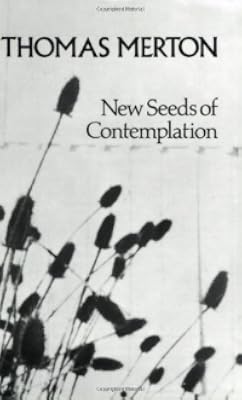
New Seeds of Contemplation
by Thomas Merton
On This Page
Description
New Seeds of Contemplation is one of Thomas Merton's most widely read and best-loved books. Christians and non-Christians alike have joined in praising it as a notable successor in the meditative tradition of St. John of the Cross, The Cloud of Unknowing, and the medieval mystics, while others have compared Merton's reflections with those of Thoreau. New Seeds of Contemplation seeks to awaken the dormant inner depths of the spirit so long neglected by Western culture, to nurture a deeply show more contemplative and mystical dimension in our lives. For Merton, Every moment and every event of every man's life on earth plants something in his soul. Just as the wind carries thousands of winged seeds, so each moment brings with it germs of spiritual vitality that come to rest imperceptibly in the minds and wills of men. Most of these unnumbered seeds perish and are lost, because men are not prepared to receive them: for such seeds as these cannot spring up anywhere except in the soil of freedom, spontaneity, and love. show lessTags
Recommendations














Member Reviews
Serendipity: "the occurrence and development of events by chance in a happy or beneficial way."
—Google Dictionary
I was listening to the Homebrewed Christianity Podcast while running, just after finishing up Merton's book. The Podcast was a question-and-answer time with the influential German theologian of the cross, Jürgen Moltmann. Moltmann's theology emphasizes the pathos of God. While the Greek philosophers envisioned a dispassionate Deity, Moltmann (in line with the Old Testament) speaks of a passionate God who is angered, loves, suffers, and even repents!
It was during this discussion that I realized what bothered me about Merton.
...
Before I get there, let me start with praise. Thomas Merton was a Trappist monk, a man dedicated show more to cloistered contemplation. This book is a collection of advice about contemplation. What does contemplation mean? Do you need to be isolated to be a contemplative? What sort of obstacles do contemplatives face? What is the role of spiritual experience in contemplation?
Each of the 39 chapters are full of insight into the human condition—insight only grasped by someone who has spent his life in the contemplation of God. The more I grow in the Christian life, the more Merton's observations resonate with my own experience. He is a wise spiritual director.
...
Now back to the problem. For Merton, the ideal contemplative is not a person who is passionate but one who lets feelings, even religious feelings, flow across the surface of her mind without being moved. These consolations are mere distractions:
"Many contemplatives never become great saints, never enter into close friendship with God, never find a deep participation in His immense joys, because they cling to the miserable little consolations that are given to beginners in the contemplative way" (206).
I wholeheartedly agree that experience-chasing is devastating to true Christianity. That said, if our God is passionately engaged with his creation, if he created us with passions and emotions, how could ignoring that part of our being honour God? Could this emphasis of Merton be the result of his interfaith dialogue with Buddhism adjusting his anthropological insight?
In the end, I value and will continue to read Merton. Much of this work was pure gold. However, I fear that his dispassionate view of humanity suggests a deity more like the Greeks envisioned than the Hebrew writers of scripture! show less
—Google Dictionary
I was listening to the Homebrewed Christianity Podcast while running, just after finishing up Merton's book. The Podcast was a question-and-answer time with the influential German theologian of the cross, Jürgen Moltmann. Moltmann's theology emphasizes the pathos of God. While the Greek philosophers envisioned a dispassionate Deity, Moltmann (in line with the Old Testament) speaks of a passionate God who is angered, loves, suffers, and even repents!
It was during this discussion that I realized what bothered me about Merton.
...
Before I get there, let me start with praise. Thomas Merton was a Trappist monk, a man dedicated show more to cloistered contemplation. This book is a collection of advice about contemplation. What does contemplation mean? Do you need to be isolated to be a contemplative? What sort of obstacles do contemplatives face? What is the role of spiritual experience in contemplation?
Each of the 39 chapters are full of insight into the human condition—insight only grasped by someone who has spent his life in the contemplation of God. The more I grow in the Christian life, the more Merton's observations resonate with my own experience. He is a wise spiritual director.
...
Now back to the problem. For Merton, the ideal contemplative is not a person who is passionate but one who lets feelings, even religious feelings, flow across the surface of her mind without being moved. These consolations are mere distractions:
"Many contemplatives never become great saints, never enter into close friendship with God, never find a deep participation in His immense joys, because they cling to the miserable little consolations that are given to beginners in the contemplative way" (206).
I wholeheartedly agree that experience-chasing is devastating to true Christianity. That said, if our God is passionately engaged with his creation, if he created us with passions and emotions, how could ignoring that part of our being honour God? Could this emphasis of Merton be the result of his interfaith dialogue with Buddhism adjusting his anthropological insight?
In the end, I value and will continue to read Merton. Much of this work was pure gold. However, I fear that his dispassionate view of humanity suggests a deity more like the Greeks envisioned than the Hebrew writers of scripture! show less
I picked this up in September after seeing Pope Francis's speech before Congress. As a Catholic I had some passing knowledge of Merton, but I had not read anything he had written. Seeds is a powerful book. It is not something one reads start to finish. Instead, one reads it slowly a paragraph at a time. I have spent weeks contemplating a single paragraph in this remarkable book.
If you read nothing else by Merton, read this. Personal, direct, and lucid, it contains some of his most challenging insights into the struggle to find an honest relationship with God and one's fellow humans. The book takes a compelling yet thoughtful look at a wide variety of spiritual themes, but is -- like most of Merton's writings -- devoid of theorizing. A must for anyone who is ready to seriously reassess the reality and direction of his or her life. But beware: you will not emerge untouched. Reprinted over twenty times and translated into more than twelve languages.
"It can become almost a magic word," Thomas Merton says of contemplation; "or if not magic, then inspirational, which is almost as bad." With these words, Merton takes us through the reality of contemplation, which is, the author says, "life itself, fully awake, fully active, fully aware that it is alive. It is spiritual wonder." Above all, contemplation is "awareness of the reality" of the Source, "with a certitude that goes beyond reason and beyond simple faith." As these definitions should suggest, in this 20th-century classic on the contemplative life, as in the best of Merton's work, this Trappist monk wonderfully combines a disciplined and deeply learned intellect with the lyrical passion of the poet. It is this rare combination show more that makes this book not only informative but also moving. Covering a diverse range of subjects ("Faith," "The Night of the Senses," "Renunciation"), it moves the reader through certain traditional "phases" of contemplation, and gives an idea of what to expect in this spiritual process (including despair and darkness). The book describes, but it also enacts. In its own prose it invites the reader to "cast our awful solemnity to the winds and join in the general dance." --Doug Thorpe
The best place to begin reading TM show less
The best place to begin reading TM show less
New Seeds of Contemplation seeks to awaken the dormant inner depths of the spirit so long neglected by Western man, to nurture a deeply contemplative and mystical dimension in our lives. For Merton, "Every moment and every event of every man's life on earth plants something in his soul.
I'm not sure I agree with everything Merton writes, but I found his invitation to a deeper relationship with God thought-provoking.
Religious writing, that satisfied me at the time of reading. Merton wrote well, no matter what subject he took on.
Members
- Recently Added By
Lists

The Essential Western Mystics
66 works; 4 members
Author Information

397+ Works 38,167 Members
Born in France, Thomas Merton was the son of an American artist and poet and her New Zealander husband, a painter. Merton lost both parents before he had finished high school, and his younger brother was killed in World War II. Something of the ephemeral character of human endeavor marked all his works, deepening the pathos of his writings and show more drawing him close to Eastern, especially Buddhist, forms of monasticism. After an initial education in the United States, France, and England, he completed his undergraduate degree at Columbia University. His parents, nominally friends, had given him little religious guidance, and in 1938, he converted to Roman Catholicism. The following year he received an M.A. from Columbia University and in 1941, he entered Gethsemani Abbey in Kentucky, where he remained until a short time before his death. His working life was spent as a Trappist monk. At Gethsemani, he wrote his famous autobiography, "The Seven Storey Mountain" (1948); there he labored and prayed through the days and years of a constant regimen that began with daily prayer at 2:00 a.m. As his contemplative life developed, he still maintained contact with the outside world, his many books and articles increasing steadily as the years went by. Reading them, it is hard to think of him as only a "guilty bystander," to use the title of one of his many collections of essays. He was vehement in his opposition to the Vietnam War, to the nuclear arms race, to racial oppression. Having received permission to leave his monastery, he went on a journey to confer with mystics of the Hindu and Buddhist traditions. He was accidentally electrocuted in a hotel in Bangkok, Thailand, on December 10, 1968. (Bowker Author Biography) show less
Some Editions
Awards and Honors
Series
Belongs to Publisher Series
New Directions Paperbook (337)
Common Knowledge
- Canonical title
- New Seeds of Contemplation
- Original title
- Seeds of Contemplation; New seeds of contemplation
- Original publication date
- 1961
- Epigraph
- Tu Qui Sedes in Tenebris Spe Tua Gaude: Orta Stella Matutina Sol Non Tradabit.
- First words
- What is Contemplation? Contemplation is the highest expression of man's intellectual and spiritual life. It is that life itself, fully awake, fully active, fully aware that it is alive. If is spiritual wonder. It is spon... (show all)taneous awe at the sacredness of life, of being.
- Quotations
- The silence of the spheres is the music of a wedding feast. The more we persist in misunderstanding the phenomena of life, the more we analyze them out into strange finalities and complex purposes of our own, the more we inv... (show all)olve ourselves in sadness, absurdity and despair. But it does not matter much, because no despair of ours can alter the reality of things, or stain the joy of the cosmic dance which is always there. Indeed, we are in the midst of it, and it is in the midst of us, for it beats in our very blood, whether we want to to or not.
Omnia in omnibus deus.
Vivo, iam non ego, vivit vero in me Christus.
Bonum est praestolari cum silentio salutare Dei.
Lux in tenebris lucet et tenebrae eam non comprehenderunt. - Blurbers
- Gray, Francine du Plessix
- Disambiguation notice
- New Seeds of Contemplation is a revised and expanded version of Merton's earlier book Seeds of Contemplation.
Classifications
- Genres
- Religion & Spirituality, Nonfiction, General Nonfiction
- DDC/MDS
- 248.34 — Religion Christian practice & observance Christian experience, practice, life Prayer and private worship Contemplation and Meditation
- LCC
- BX2350.2 .M46 — Philosophy, Psychology and Religion Christian Denominations Christian Denominations Catholic Church Practical religion. Christian life
- BISAC
Statistics
- Members
- 2,571
- Popularity
- 7,411
- Reviews
- 18
- Rating
- (4.22)
- Languages
- 5 — Czech, English, German, Hungarian, Spanish
- Media
- Paper, Audiobook, Ebook
- ISBNs
- 14
- ASINs
- 21