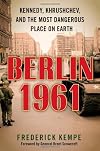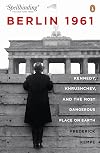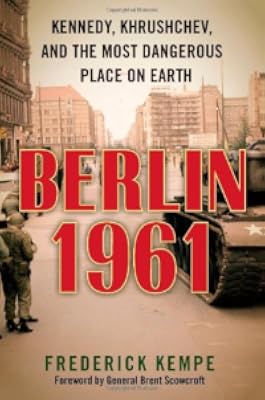
Berlin 1961: Kennedy, Khrushchev, and the Most Dangerous Place on Earth
by Frederick Kempe
On This Page
Description
Based on a new documents and interviews, this work is a look at the Berlin Crisis of 1961, with powerful applications for the present. In June 1961, Nikita Khrushchev called it "the most dangerous place on earth." He knew what he was talking about. Much has been written about the Cuban Missile Crisis a year later, but the Berlin Crisis of 1961 was more decisive in shaping the Cold War, and more perilous. For the first time in history, American and Soviet fighting men and tanks stood show more arrayed against each other, only yards apart. One mistake, one overzealous commander, and the trip wire would be sprung for a war that would go nuclear in a heartbeat. On one side was a young, untested U.S. president still reeling from the Bay of Pigs disaster. On the other, a Soviet premier hemmed in by the Chinese, the East Germans, and hard liners in his own government. Neither really understood the other, both tried cynically to manipulate events. And so, week by week, the dangers grew. show lessTags
Recommendations











Member Recommendations
Member Reviews
I'd heard of the Checkpoint Charlie standoff in October 1961, with US and Soviet tanks (and contingents of soldiers) loading live ammunition and facing each other across the East Berlin / West Berlin boundary, but realise now I'd conflated it with the Berlin Airlift of 1948. Kempe's account of the lead-up to the tense confrontation of 1961, the first and last time the Cold War antagonists would face each other directly with arms rather than via proxy, helps set matters straight, and ties the confrontation to the larger political context.
Kempe's main contribution is putting together a continuous narrative leading to the emergence of the Berlin Wall, detailing both the structural pressures (the brain drain from the Eastern Bloc through show more Berlin to the West, the logic of a nuclear deterrent) and political pressures (individual interests of Khruschev, Kennedy, Adenauer, Ulbricht -- and those arrayed with them in various configurations) converging on "the testicles of the West", as Kempe quotes Khruschev in characterizing Berlin. [4]
As popular history, there's always the question as to how complete are the facts and circumstances used to shape the narrative, and whether Kempe pursues an agenda which may account as much for his conclusions as those facts and circumstances. The blurbs claim much of the material accessible to Kempe are new, and his account is a departure from accepted history. Kempe does not identify where his conclusions might differ from others. I could not assess his account on those merits, and would be interested to find others who are able to put this argument in perspective.
There are two key insights for me in reading Kempe's account:
First, that the tensions arising from Berlin convinced Kennedy to explore options for tactical nuclear warfare and put in place both an overall strategy and specific rules of engagement involving the use of nuclear weapons. As another LT reviewer emphasised, prior to this the only options were MAD (primarily a political gambit), and on the field of operations the stark choice of all-or-nothing nuclear strikes.
Second, the changes leading to the Wall raise the question of whether the US doctrine of flexible response effectively avoided a nuclear war, or whether conversely it enabled the Eastern Bloc in efforts to seal its borders and literally cement the Cold War dynamic forming since the end game of World War II. Evidence that a war was avoided arise from Kempe's recounting of discussions between Khruschev and Ulbricht, arguing that a design to seal East Berlin was well established, Khruschev's approval was almost inevitable, and absent a flexible response these developments would have led to full military conflict between NATO and the East Bloc. On the other hand, Kempe also addresses evidence that while US commanders had no real way of knowing for certain, there is now reason to think a firm resistance to the closing of East Berlin would have put a stop to this effort, the Wall would not have been built, and generations would have been spared all that the Cold War would bring. I'm inclined to think war was avoided, and am curious to know both whether there is any consensus on this point, and whether that consensus was any different prior to the "new" archives available to Kempe.
A very readable history, presented in a journalistic style with as much attention to personalities (and there are a great many interesting people involved) as to political strategies and realpolitik. At the very least, it frames key questions in the Cold War and suggests issues for further reading: Cuban Missile Crisis; the interesting relationship between the DDR and CCCP; Khruschev's challenges within the Communist world.
My ARC is an "uncorrected proof" missing black-and-white photo inserts and endpapers, presumably among which would be an orienting map or two. The cover also promises "an Amplified eBook including historical video footage and other extras" which piques my curiosity. show less
Kempe's main contribution is putting together a continuous narrative leading to the emergence of the Berlin Wall, detailing both the structural pressures (the brain drain from the Eastern Bloc through show more Berlin to the West, the logic of a nuclear deterrent) and political pressures (individual interests of Khruschev, Kennedy, Adenauer, Ulbricht -- and those arrayed with them in various configurations) converging on "the testicles of the West", as Kempe quotes Khruschev in characterizing Berlin. [4]
As popular history, there's always the question as to how complete are the facts and circumstances used to shape the narrative, and whether Kempe pursues an agenda which may account as much for his conclusions as those facts and circumstances. The blurbs claim much of the material accessible to Kempe are new, and his account is a departure from accepted history. Kempe does not identify where his conclusions might differ from others. I could not assess his account on those merits, and would be interested to find others who are able to put this argument in perspective.
There are two key insights for me in reading Kempe's account:
First, that the tensions arising from Berlin convinced Kennedy to explore options for tactical nuclear warfare and put in place both an overall strategy and specific rules of engagement involving the use of nuclear weapons. As another LT reviewer emphasised, prior to this the only options were MAD (primarily a political gambit), and on the field of operations the stark choice of all-or-nothing nuclear strikes.
Second, the changes leading to the Wall raise the question of whether the US doctrine of flexible response effectively avoided a nuclear war, or whether conversely it enabled the Eastern Bloc in efforts to seal its borders and literally cement the Cold War dynamic forming since the end game of World War II. Evidence that a war was avoided arise from Kempe's recounting of discussions between Khruschev and Ulbricht, arguing that a design to seal East Berlin was well established, Khruschev's approval was almost inevitable, and absent a flexible response these developments would have led to full military conflict between NATO and the East Bloc. On the other hand, Kempe also addresses evidence that while US commanders had no real way of knowing for certain, there is now reason to think a firm resistance to the closing of East Berlin would have put a stop to this effort, the Wall would not have been built, and generations would have been spared all that the Cold War would bring. I'm inclined to think war was avoided, and am curious to know both whether there is any consensus on this point, and whether that consensus was any different prior to the "new" archives available to Kempe.
A very readable history, presented in a journalistic style with as much attention to personalities (and there are a great many interesting people involved) as to political strategies and realpolitik. At the very least, it frames key questions in the Cold War and suggests issues for further reading: Cuban Missile Crisis; the interesting relationship between the DDR and CCCP; Khruschev's challenges within the Communist world.
My ARC is an "uncorrected proof" missing black-and-white photo inserts and endpapers, presumably among which would be an orienting map or two. The cover also promises "an Amplified eBook including historical video footage and other extras" which piques my curiosity. show less
 This review was written for LibraryThing Early Reviewers.
"A wall is a hell of a lot better than a war"
That was John F. Kennedy's verdict on the prolonged foreign policy crisis of 1961 surrounding the status of Berlin, still in limbo 15 years after the end of the Second World War, which had left both the city and Germany itself split into rival factions that gave dramatic shape to the Cold War confrontation between the Soviet Union and the United States. At the beginning of 1961, the year that Fred Kempe chronicles so painstakingly in this excellent diplomatic, political and social history, it was fairly straightforward for residents of Soviet-occupied East Berlin to cross into West Berlin, made up of the British, French and American sectors. So straightforward, in fact, that thousands of show more refugees -- including the young and able-bodied that East Germany's new Communist leaders needed to stay put -- were using Berlin as a way to simply walk across the border and take refuge in the West. East Germans may not have had free elections, but they were exercising their right to vote with their feet and fleeing at an ever-faster rate.
As this book opens, Ullbricht, the East German leader, is determined to halt this flow and enlists Khruschev, himself fed up with the need to subsidize the ailing German economy. On the other side of any negotiations about Berlin's status was Kennedy, just elected, who seemingly has never encountered a figure of importance whom he couldn't charm or a problem that was truly intractable. He saw Berlin as a sideshow at the time of his inauguration; for Khruschev, it was clear that the city was the most dangerous place in the world.
Kempe's chronicle of the events of 1961, which culminated in the building of a wall that would divide the city for nearly three decades, is a delicate balancing act. Just when the risk that the reader might bog down in too much diplomatic to-ing and fro-ing reached perilous levels, he injects a short three- or four-page tale focusing on a particular character whose life was affected by the division of the country and the city. These examples of how real lives were brutally affected by the great power talks were well chosen and force the reader to stop and remember the thousands of individual tragedies that preceded and followed the wall's construction. This isn't just a diplomatic history -- although it's that par excellence -- it's the story of real-world confrontation, misunderstandings, mistakes and missteps. Many of these were on the part of Kennedy, Kempe points out: while Khruschev may have looked like a buffoon to Americans when he slammed his shoe on the rostrum at the UN to win attention, he was a wily street fighter whom Kennedy was ill-prepared to confront. For his part, Kennedy may have been smart as a whip, but as Dean Acheson wryly remarked (and Kempe pointedly quotes), "brains are no substitute for judgment." The Bay of Pigs debacle, followed by a disastrous performance at the Vienna summit, put Kennedy at a diplomatic disadvantage that Kempe points out the Soviet leader ruthlessly exploited in 1961 in Berlin.
This probably won't be a book for all readers. It's a hefty tome, with 502 pages of text that require close scrutiny. On the other hand, it's been a long time since I've read a book about the Cold War years that engaged me as much as this one did. I grew up in a world where the Berlin Wall was simply a fact of life (I was born months after its construction; educated at schools in a rigidly divided Europe and honestly had little hope of seeing anything different) and it was fascinating to realize that while we may now see this as a simpler era -- one easily identifiable enemy, taking the shape of a nation state -- at the time policymakers were grappling with the unknowns of their situation in the same way they do today. It's also a sharp reminder that the process of making policy isn't simply a matter of what seems logical or wise, but what is politically expedient or what is dictated by the personalities and biases of the policymakers and the information they have at their disposal. (After all, Kennedy himself, lounging in a bathtub in Paris, commented that bickering over the state of Berlin when Germany would never be reunified anyway, was a bit of a foolish pastime.)
Before the postmortem reputation of Kennedy the statesman took hold and was fostered energetically by his circle, there was this Kennedy -- the man out of his depth in the aggressive games of power politics being played on a global stage. Read this book to understand how that shaped the world that many of us lived in in the decades that followed. Highly recommended to anyone interested in the personalities, the era, the issues or diplomatic history in general.
Full disclosure: While the author and I worked for the same publication in Europe for a few years in the late 90s, neither he or his publishers contacted me with respect to this book, or provided a copy for review. show less
That was John F. Kennedy's verdict on the prolonged foreign policy crisis of 1961 surrounding the status of Berlin, still in limbo 15 years after the end of the Second World War, which had left both the city and Germany itself split into rival factions that gave dramatic shape to the Cold War confrontation between the Soviet Union and the United States. At the beginning of 1961, the year that Fred Kempe chronicles so painstakingly in this excellent diplomatic, political and social history, it was fairly straightforward for residents of Soviet-occupied East Berlin to cross into West Berlin, made up of the British, French and American sectors. So straightforward, in fact, that thousands of show more refugees -- including the young and able-bodied that East Germany's new Communist leaders needed to stay put -- were using Berlin as a way to simply walk across the border and take refuge in the West. East Germans may not have had free elections, but they were exercising their right to vote with their feet and fleeing at an ever-faster rate.
As this book opens, Ullbricht, the East German leader, is determined to halt this flow and enlists Khruschev, himself fed up with the need to subsidize the ailing German economy. On the other side of any negotiations about Berlin's status was Kennedy, just elected, who seemingly has never encountered a figure of importance whom he couldn't charm or a problem that was truly intractable. He saw Berlin as a sideshow at the time of his inauguration; for Khruschev, it was clear that the city was the most dangerous place in the world.
Kempe's chronicle of the events of 1961, which culminated in the building of a wall that would divide the city for nearly three decades, is a delicate balancing act. Just when the risk that the reader might bog down in too much diplomatic to-ing and fro-ing reached perilous levels, he injects a short three- or four-page tale focusing on a particular character whose life was affected by the division of the country and the city. These examples of how real lives were brutally affected by the great power talks were well chosen and force the reader to stop and remember the thousands of individual tragedies that preceded and followed the wall's construction. This isn't just a diplomatic history -- although it's that par excellence -- it's the story of real-world confrontation, misunderstandings, mistakes and missteps. Many of these were on the part of Kennedy, Kempe points out: while Khruschev may have looked like a buffoon to Americans when he slammed his shoe on the rostrum at the UN to win attention, he was a wily street fighter whom Kennedy was ill-prepared to confront. For his part, Kennedy may have been smart as a whip, but as Dean Acheson wryly remarked (and Kempe pointedly quotes), "brains are no substitute for judgment." The Bay of Pigs debacle, followed by a disastrous performance at the Vienna summit, put Kennedy at a diplomatic disadvantage that Kempe points out the Soviet leader ruthlessly exploited in 1961 in Berlin.
This probably won't be a book for all readers. It's a hefty tome, with 502 pages of text that require close scrutiny. On the other hand, it's been a long time since I've read a book about the Cold War years that engaged me as much as this one did. I grew up in a world where the Berlin Wall was simply a fact of life (I was born months after its construction; educated at schools in a rigidly divided Europe and honestly had little hope of seeing anything different) and it was fascinating to realize that while we may now see this as a simpler era -- one easily identifiable enemy, taking the shape of a nation state -- at the time policymakers were grappling with the unknowns of their situation in the same way they do today. It's also a sharp reminder that the process of making policy isn't simply a matter of what seems logical or wise, but what is politically expedient or what is dictated by the personalities and biases of the policymakers and the information they have at their disposal. (After all, Kennedy himself, lounging in a bathtub in Paris, commented that bickering over the state of Berlin when Germany would never be reunified anyway, was a bit of a foolish pastime.)
Before the postmortem reputation of Kennedy the statesman took hold and was fostered energetically by his circle, there was this Kennedy -- the man out of his depth in the aggressive games of power politics being played on a global stage. Read this book to understand how that shaped the world that many of us lived in in the decades that followed. Highly recommended to anyone interested in the personalities, the era, the issues or diplomatic history in general.
Full disclosure: While the author and I worked for the same publication in Europe for a few years in the late 90s, neither he or his publishers contacted me with respect to this book, or provided a copy for review. show less
Berlin, 1961 is a dramatic and fascinating account of the international crisis that threatened nuclear confrontation at the height of the Cold War, and culminated in erection of the Berlin Wall. In October 1961, US and Soviet tanks faced off across the east- west boundary, and while military conflict was averted, the outcome affected the nature of Berlin, Germany, and Europe for the next 3 decades. Further, the 1962 Cuban Missile Crisis – when the world came very close to nuclear conflagration -- was foreshadowed and (arguably) shaped by the confrontation over Berlin.
Author Frederick Kempe is a highly- regarded journalist and European editor of the Wall Street Journal. In researching this book, he drew upon archival and declassified show more material from German, Soviet, and American sources. Kempe’s account is meticulously documented, and provides a wealth of original information and insight. What’s more, his reconstruction of the historic events is truly gripping. Although this book is history and international politics, it is as engaging and exciting as a novel.
Four protagonists dominate Kempe’s account: the newly elected young US president, John F. Kennedy; the 67 year old Soviet Premier Nikita Khrushchev; Konrad Adenauer (the aging chancellor of West Germany) and Walter Ulbricht (the east German head of state). US readers may be interested to learn that through Khrushchev’s perspective, Kennedy appears as a weak and indecisive individual unlikely to stand up to the USSR in any confrontation. But they may be equally surprised to realize that Khrushchev had his own problems. Having survived Stalin's purges and an attempted coup against himself, he was vulnerable to opposition from militarists in his own government, as well as to criticism from China’s Mao for being unworthy to head the international communist movement.
The book is populated by a host of supportive characters, and periodic vignettes personalize the crisis in vivid ways. One such vignette involves the first man to die under the East Germany’s new “shoot to kill” order; he was shot to death while swimming across a canal to the west. Another was the east German refugee Marlene Schmidt who was awarded the Miss Universe title; she had escaped just one month before the Ulbricht closed access to the west, and constituted a major embarassment to the his regime. Yet another was the East German soldier who managed to leap over the barbed wire in his escape to the west, while tossing aside his weapon -- making for an iconic photograph of the era able to be found on the internet.
How did crisis originate? By the fall of 1961, Berlin had become an epicenter of the Cold War. While western Germany was flourishing, the economy of east Germany was foundering under enforced Soviet- style collectivism (per capita income being half that of the west). Nowhere was the contrast between the two political systems more evident than Berlin. Not only were >50,000 residents of east Berlin commuting to work in west Berlin on a daily basis, but the eastern sector was losing population to the west at the rate of up to 2000/ day. The situation not only exposed the illegitimacy of the east German regime, but it also threatened political survival of Nikita Khrushchev, who was fighting a rear-guard action against militarists in his own government. Khrushchev’s one alternative was pre-emptively to sign a treaty with eastern Germany – a move that would have turned over control of western access to Berlin to that government (with attendant risks of military conflict with the west). His other alternative was to acquiesce to Ulbricht's proposal to cut off contact between the western and eastern sectors. This of course is what transpired. Meticulous, secret planning went into the effort, and the US and west Berlin were taken entirely by surprise, being forced to watch helplessly as a barrier of barbed wire and soldiers was introduced and rapidly replaced by concrete.
Kempe sheds new light on at least three aspects of the crisis. First is the way in which domestic political pressures limited freedom of action by Nikita Khrushchev, as mentioned above. Second is how Khrushchev’s maneuvers were affected by his view of JF Kennedy as inexperienced and indecisive (based in turn on the abortive US invasion of Cuba, and Kennedy’s miserably weak performance in debate with Khruschev at the 1961 Vienna summit). Third was Kennedy’s public and private signals to Khrushchev that as long as access to west Berlin was not impeded, that the US would accept isolation of the eastern part of the city. (Kennedy noted that a wall was better than a war, and saw that it offered the USSR a way to avoid military confrontation). To these we might add the role of Kennedy’s health problems, since (as we now know), he was being administered a mixture of amphetamines and steroids by his own private “Dr Feelgood,” a concoction that caused mood swings, nervousness, and anxiety. Kempe speculates that the drugs may have affected Kennedy's performance at the Vienna summit, but is not able to cite specific supportive evidence.
In Kempe’s account, the Berlin crisis reached a major climax in late October 1961 when US and Soviet tanks faced off across the barrier between east and west at Checkpoint Charlie. Despite his dramatic (if not hyperbolic) characterization, the situation actually had elements of a farce. The Soviet tanks were unmarked and US military personnel walked and drove across to see if they could establish their identity. (In fact, a US soldier crawled down inside one of the unoccupied tanks to investigate, and emerged waving a Russian newspaper). On the western side, US tanks began revving their engines as a threat display. When informed, Khrushchev ordered the Soviet tanks to do the same, and to electronically amplify the sound! Further, during the standoff, an 80 year old woman blithely walked across from east to west, "escaping" as everyone watched – and the East German soldiers dared not shoot. The immediate confrontation ended when the Soviet tanks withdrew, and the American ones soon followed suit.
Kempe speculates that the Berlin crisis could have been avoided by more decisive action by Kennedy. This perspective arguably is the weakest part of the author's account. It is not at all clear what the US could have done once the wall construction was initiated, since military action would certainly have precipitated a military response. After all, Kennedy was up against a Soviet regime that had not hesitated to use force to consolidate its power previously in eastern Germany as well as in Hungary (and a few years later, in Czechoslavakia). In this light, Kennedy's reluctance to take military action appears eminently judicious. Kempe also argues that the crisis might not have developed if Kennedy had signaled that the US would not tolerate any change in Berlin’s status. This too is questionable. Khrushchev’s own political survival was at stake. It is hard to imagine that a verbal statement from Kennedy would have led Khrushchev to risk political suicide by letting east Berlin to hemorrhage population indefinitely.
Kempe is on somewhat stronger ground in suggesting that Kennedy missed an opportunity in early 1961 to establish better ties with the USSR, and did so through miscalculation and misunderstanding. I find it significant that in his introduction, Gen. Brent Scowcroft focuses on this missed opportunity (rather than on the "get-tough" option) as the most plausible counterfactual possibility. But even this suggestion ignores the political realities of Kennedy's position vis a vis his domestic political opposition and his political advisors (Dean Acheson, among them). Hindsight is of course easy, from the safer vantage point of 2011. Kennedy did not have the benefits of our knowledge, and to blame him for a lack of omniscience while excusing Khrushchev is to introduce a double standard that ill- serves our attempt at understanding. But by Kempe's own admission, all the counterfactuals are arguable, and we have no way to know how things might have turned out differently. This ought to serve as a cautionary perspective to those inclined to draw hasty historical lessons from the situation, particuarly those armchair militarists who think the answer to every crisis is to threaten military force.
Whatever its value to the political scientist and the professional tactician, Kempe’s Berlin, 1961 is an exciting and thought- provoking account of political and historical events that shaped our world in the last half of the 20th century. I learned a great deal from reading it and strongly recommend it. show less
Author Frederick Kempe is a highly- regarded journalist and European editor of the Wall Street Journal. In researching this book, he drew upon archival and declassified show more material from German, Soviet, and American sources. Kempe’s account is meticulously documented, and provides a wealth of original information and insight. What’s more, his reconstruction of the historic events is truly gripping. Although this book is history and international politics, it is as engaging and exciting as a novel.
Four protagonists dominate Kempe’s account: the newly elected young US president, John F. Kennedy; the 67 year old Soviet Premier Nikita Khrushchev; Konrad Adenauer (the aging chancellor of West Germany) and Walter Ulbricht (the east German head of state). US readers may be interested to learn that through Khrushchev’s perspective, Kennedy appears as a weak and indecisive individual unlikely to stand up to the USSR in any confrontation. But they may be equally surprised to realize that Khrushchev had his own problems. Having survived Stalin's purges and an attempted coup against himself, he was vulnerable to opposition from militarists in his own government, as well as to criticism from China’s Mao for being unworthy to head the international communist movement.
The book is populated by a host of supportive characters, and periodic vignettes personalize the crisis in vivid ways. One such vignette involves the first man to die under the East Germany’s new “shoot to kill” order; he was shot to death while swimming across a canal to the west. Another was the east German refugee Marlene Schmidt who was awarded the Miss Universe title; she had escaped just one month before the Ulbricht closed access to the west, and constituted a major embarassment to the his regime. Yet another was the East German soldier who managed to leap over the barbed wire in his escape to the west, while tossing aside his weapon -- making for an iconic photograph of the era able to be found on the internet.
How did crisis originate? By the fall of 1961, Berlin had become an epicenter of the Cold War. While western Germany was flourishing, the economy of east Germany was foundering under enforced Soviet- style collectivism (per capita income being half that of the west). Nowhere was the contrast between the two political systems more evident than Berlin. Not only were >50,000 residents of east Berlin commuting to work in west Berlin on a daily basis, but the eastern sector was losing population to the west at the rate of up to 2000/ day. The situation not only exposed the illegitimacy of the east German regime, but it also threatened political survival of Nikita Khrushchev, who was fighting a rear-guard action against militarists in his own government. Khrushchev’s one alternative was pre-emptively to sign a treaty with eastern Germany – a move that would have turned over control of western access to Berlin to that government (with attendant risks of military conflict with the west). His other alternative was to acquiesce to Ulbricht's proposal to cut off contact between the western and eastern sectors. This of course is what transpired. Meticulous, secret planning went into the effort, and the US and west Berlin were taken entirely by surprise, being forced to watch helplessly as a barrier of barbed wire and soldiers was introduced and rapidly replaced by concrete.
Kempe sheds new light on at least three aspects of the crisis. First is the way in which domestic political pressures limited freedom of action by Nikita Khrushchev, as mentioned above. Second is how Khrushchev’s maneuvers were affected by his view of JF Kennedy as inexperienced and indecisive (based in turn on the abortive US invasion of Cuba, and Kennedy’s miserably weak performance in debate with Khruschev at the 1961 Vienna summit). Third was Kennedy’s public and private signals to Khrushchev that as long as access to west Berlin was not impeded, that the US would accept isolation of the eastern part of the city. (Kennedy noted that a wall was better than a war, and saw that it offered the USSR a way to avoid military confrontation). To these we might add the role of Kennedy’s health problems, since (as we now know), he was being administered a mixture of amphetamines and steroids by his own private “Dr Feelgood,” a concoction that caused mood swings, nervousness, and anxiety. Kempe speculates that the drugs may have affected Kennedy's performance at the Vienna summit, but is not able to cite specific supportive evidence.
In Kempe’s account, the Berlin crisis reached a major climax in late October 1961 when US and Soviet tanks faced off across the barrier between east and west at Checkpoint Charlie. Despite his dramatic (if not hyperbolic) characterization, the situation actually had elements of a farce. The Soviet tanks were unmarked and US military personnel walked and drove across to see if they could establish their identity. (In fact, a US soldier crawled down inside one of the unoccupied tanks to investigate, and emerged waving a Russian newspaper). On the western side, US tanks began revving their engines as a threat display. When informed, Khrushchev ordered the Soviet tanks to do the same, and to electronically amplify the sound! Further, during the standoff, an 80 year old woman blithely walked across from east to west, "escaping" as everyone watched – and the East German soldiers dared not shoot. The immediate confrontation ended when the Soviet tanks withdrew, and the American ones soon followed suit.
Kempe speculates that the Berlin crisis could have been avoided by more decisive action by Kennedy. This perspective arguably is the weakest part of the author's account. It is not at all clear what the US could have done once the wall construction was initiated, since military action would certainly have precipitated a military response. After all, Kennedy was up against a Soviet regime that had not hesitated to use force to consolidate its power previously in eastern Germany as well as in Hungary (and a few years later, in Czechoslavakia). In this light, Kennedy's reluctance to take military action appears eminently judicious. Kempe also argues that the crisis might not have developed if Kennedy had signaled that the US would not tolerate any change in Berlin’s status. This too is questionable. Khrushchev’s own political survival was at stake. It is hard to imagine that a verbal statement from Kennedy would have led Khrushchev to risk political suicide by letting east Berlin to hemorrhage population indefinitely.
Kempe is on somewhat stronger ground in suggesting that Kennedy missed an opportunity in early 1961 to establish better ties with the USSR, and did so through miscalculation and misunderstanding. I find it significant that in his introduction, Gen. Brent Scowcroft focuses on this missed opportunity (rather than on the "get-tough" option) as the most plausible counterfactual possibility. But even this suggestion ignores the political realities of Kennedy's position vis a vis his domestic political opposition and his political advisors (Dean Acheson, among them). Hindsight is of course easy, from the safer vantage point of 2011. Kennedy did not have the benefits of our knowledge, and to blame him for a lack of omniscience while excusing Khrushchev is to introduce a double standard that ill- serves our attempt at understanding. But by Kempe's own admission, all the counterfactuals are arguable, and we have no way to know how things might have turned out differently. This ought to serve as a cautionary perspective to those inclined to draw hasty historical lessons from the situation, particuarly those armchair militarists who think the answer to every crisis is to threaten military force.
Whatever its value to the political scientist and the professional tactician, Kempe’s Berlin, 1961 is an exciting and thought- provoking account of political and historical events that shaped our world in the last half of the 20th century. I learned a great deal from reading it and strongly recommend it. show less
This review was written for LibraryThing Early Reviewers.“Why would anyone write a book about an administration that has nothing to show for itself but a string of disasters?” - President John F. Kennedy, September 22, 1961.
That is how this book starts and that is how it continues from the very first page. The book is a long one (a tome actually), that covers only one year in President John F. Kennedy’s life - the year he was inaugurated-1961. A young, untried President was at the helm of the nation that was and still is the leader of the free world. He was up against a very formidable opponent. This opponent was battle-hardened, a consummate chess player and one who was the head of the Communist world - Nikita Khrushchev. The battle ground is the divided Berlin after the end of World show more War II. Khrushchev, fully aware of the danger and the powder keg that was Berlin, said over and over, “Berlin is the most dangerous place on earth.” Let me tell you, Kempe spares no punches as he writes in extreme detail about all the happenings in 1961, right from Kennedy’s disastrous Bay of Pigs offensive, through to the Berlin upheaval and the building of the wall and to the Cuban Missile crisis. We get an insider’s look at Kennedy’s and Khrushchev’s political maneuverings, back room dealings. Intelligence reports and an unflinching look at the world’s reaction to all the things that went on in that year. This book is very well-researched and very complex. It’s not for someone who is looking for escapist reading, but it immersed me totally right from the very beginning to the explosive ending. I am sure that I am not the only person in the world who didn’t realize how close we came to a nuclear war in this very alarming and unstable part of world history.The book is a tour-de-force in my opinion, in that it uncovers more than we have ever previously known about the young President Kennedy and his ongoing combative and unstable relationship with Mr. Nikita Khrushchev. At the very end of this book Kennedy makes a long-overdue visit to West Berlin, and on the western side of the wall he made his most memorable speech that he ever made on foreign soil. I will leave you with that.
“There are many people in the world who really don’t understand, or say they don’t understand, what is the great issue between the free world and the Communist world. Let them come to Berlin. There are some who say that Communism is the wave of the future. Let them come to Berlin. And there are some who say in Europe and elsewhere we can work with the Communists. Let them come to Berlin. All free men, wherever they may live, are citizens of Berlin. And therefore, as a free man, I take pride in the words. — “Ich bin fin, Berliner.” - President John F. Kennedy - West Berlin - June 26, 1963. (Just 3 short months before an assassin’s bullet killed him in Dallas.) show less
That is how this book starts and that is how it continues from the very first page. The book is a long one (a tome actually), that covers only one year in President John F. Kennedy’s life - the year he was inaugurated-1961. A young, untried President was at the helm of the nation that was and still is the leader of the free world. He was up against a very formidable opponent. This opponent was battle-hardened, a consummate chess player and one who was the head of the Communist world - Nikita Khrushchev. The battle ground is the divided Berlin after the end of World show more War II. Khrushchev, fully aware of the danger and the powder keg that was Berlin, said over and over, “Berlin is the most dangerous place on earth.” Let me tell you, Kempe spares no punches as he writes in extreme detail about all the happenings in 1961, right from Kennedy’s disastrous Bay of Pigs offensive, through to the Berlin upheaval and the building of the wall and to the Cuban Missile crisis. We get an insider’s look at Kennedy’s and Khrushchev’s political maneuverings, back room dealings. Intelligence reports and an unflinching look at the world’s reaction to all the things that went on in that year. This book is very well-researched and very complex. It’s not for someone who is looking for escapist reading, but it immersed me totally right from the very beginning to the explosive ending. I am sure that I am not the only person in the world who didn’t realize how close we came to a nuclear war in this very alarming and unstable part of world history.The book is a tour-de-force in my opinion, in that it uncovers more than we have ever previously known about the young President Kennedy and his ongoing combative and unstable relationship with Mr. Nikita Khrushchev. At the very end of this book Kennedy makes a long-overdue visit to West Berlin, and on the western side of the wall he made his most memorable speech that he ever made on foreign soil. I will leave you with that.
“There are many people in the world who really don’t understand, or say they don’t understand, what is the great issue between the free world and the Communist world. Let them come to Berlin. There are some who say that Communism is the wave of the future. Let them come to Berlin. And there are some who say in Europe and elsewhere we can work with the Communists. Let them come to Berlin. All free men, wherever they may live, are citizens of Berlin. And therefore, as a free man, I take pride in the words. — “Ich bin fin, Berliner.” - President John F. Kennedy - West Berlin - June 26, 1963. (Just 3 short months before an assassin’s bullet killed him in Dallas.) show less
Wow. A fantastic telling of an event that has been all but forgotten and yet changed the course of history. One of the things I most appreciated about this telling was how the author focuses on the rough start the Kennedy Administration had viz foreign policy. After the Bay of Pigs, this President struggled with how to meet the aggressive challenges of Kruschev in many different places but especially Berlin. The difficulty of calibrating a military response in the nuclear age is something that any history buff should know more about. Is the ability to destroy the world a deterrent? Well, certainly to massive military action. But as for salami tactics - where the foe challenges policy little by little, slice by slice, that deterrent show more complicated things as much as it preserved the peace. Even if you aren't a regular reader of History, get this book. The storytelling is fantastic and the drama so rich. show less
As the Cold War recedes further into the past, it becomes easy to forget some its most contentious battlefields; that is where good history books like BERLIN 1961 by Frederick Kempe comes in, for they remind us how close the conflict came to turning hot. Kempe’s book gives us an invaluable timeline for one of the worst crisis’s of the early 60’s and allows for a chance to become reacquainted with some almost forgotten figures who once played a very important part on the world’s stage. We also get some interesting behind the scenes look at some of the titans of 20th history, namely John F. Kennedy and Nikita Khrushchev.
Kempe’s book does a good job recreating the very tense early days of Kennedy’s administration, a time when show more relations between America and the Soviet Union were at an all time low following the collapse of the Paris Summit in the wake of the U2 incident the previous year. Berlin had been a sore point for the Soviets ever since the end of World War II left it as a piece of Western territory in the middle of what became Communist East Germany. Repeated attempts to settle the issue in their favor, either by threats or by force, by the Russians, had proved futile. Making the situation worse was the free access between East and West that existed in Berlin, an open door through which thousands of German refugees fled Communist oppression, a trickle that had become a torrent by early 1961. This flow of refugees had become so severe that it threatened to cause the implosion of East Germany and possibly unravel Soviet rule over all its Eastern European satellites.
This was the crisis that the untested Kennedy had to deal with in the first year of his administration, when he was warily feeling his way and daily confronted by what he believed was an aggressive Soviet bear, personified by Khrushchev, bent upon humiliating and defeating the West, whenever and wherever possible. The President felt he could not appear weak and invite Soviet aggression, while not overplaying his hand and causing a war by mistake.
BERLIN 1961 gives us a first hand account of the deliberations in Washington and Moscow as both sides circled each other and tried to guess what was happening behind closed doors in each city. The book also takes in account the smaller players in East and West Germany who had ambitions and agendas that differed from their super power partners.
It is Kempe’s contention that the inexperienced JFK bungled an opportunity when did not force the issue when the East Germans, with Soviet backing, erected the Berlin wall in August of 1961 to staunch the flow of refugees. His contention is that Kennedy was so determined to find a way to defuse the tensions over Berlin he was willing to let the Communists build the Wall and imprison the East as long as they did not contest the presence of NATO troops in West Berlin and accept its existence inside their territory. Kempe lays out the case that Kennedy and American diplomats in the early months of the Administration quietly let it be known to the Soviets that they would accept a forcible closing of the Berlin gate if it would preserve the status quo. Kempe contends that if Kennedy had insisted from the get go that the flow of people across the border in Berlin remain open, the Communists would have taken no action and history would have been.
Many would point out the faults in this reasoning. Khrushchev was no Gorbachev, he was a veteran of World War II and had seen the horrors of Hitler’s invasion up close, and like all Soviet leaders of the time, he was not about to undo Stalin’s legacy, a legacy that insured that if there was another great war in Europe in the 20th Century, it would begin hundreds and hundreds of miles further west than it began in 1941. Nor was the hard line Stalinist government in East Berlin about to just throw in the towel and reunite with West Germany, a prospect that was anathema to Moscow. What was possible in 1989 was not possible in 1961 and JFK’s decision to decrease nuclear tensions at the expense of East Germans, whose freedom he had no legal or treaty obligation to defend, made a lot sense at the time.
It’s a point reasonable people can argue over and history is full of interesting possibilities. It is true Kennedy made many mistakes in his first year; chief among them was holding a summit with Khrushchev in Vienna not six weeks after the debacle at the Bay of Pigs. The new American President’s poor performance there gave his Soviet counterpart the impression he could pursue a much tougher course in dealing with the United States, a course that led to the Berlin Wall, and ultimately, putting missiles in Cuba. To his credit, Kennedy knew he had screwed up, later referring to his first year in office as a “disaster.” It says something about the man that nobody can imagine many of successors being that honest and self-critical.
BERLIN 1961 brings back into the historical spotlight a number of characters who have faded into the mists of history, starting with Walter Ulbricht, the hard line Stalinist German Communist, a man determined to make his rump state of East Germany a success no matter what it takes, even if it means turning the whole country into a prison camp. There is Konrad Adenauer, the very elderly Chancellor of West Germany, his country’s first democratically elected leader; a man who has never given up on reuniting his divided nation. A man who finds himself uncomfortably estranged from the young American President whose support is vital for West Germany’s survival. We get portraits of Dean Acheson and General Lucius Clay, old hands from the Truman years, recruited by Kennedy to assist in this new crisis, only to discover that the new President is no Truman. British Prime Minister Harold MacMillan constantly urges negotiation over confrontation; Vice President Lyndon Johnson has a raucous and potentially embarrassing trip to West Berlin at the height of the crisis. Attorney General Robert Kennedy attempts to open a back channel to the Soviet leadership, something the President and his brother loved to do, all to the consternation of the professional diplomats. Most of all, there is the long-suffering citizens of Berlin, both East and West, who really just wanted to be left alone to chart their own destiny, a fate denied them by history and geography.
BERLIN 1961 is a must read for history buffs, especially those interested in the Cold War. The writing is crisp and to the point, putting the reader right on the front lines when American units and the tanks of the Red Army come face to face at Checkpoint Charlie. A good history book must read with the ease of great novel; in this, Frederick Kempe’s BERLIN 1961 is a complete success. show less
Kempe’s book does a good job recreating the very tense early days of Kennedy’s administration, a time when show more relations between America and the Soviet Union were at an all time low following the collapse of the Paris Summit in the wake of the U2 incident the previous year. Berlin had been a sore point for the Soviets ever since the end of World War II left it as a piece of Western territory in the middle of what became Communist East Germany. Repeated attempts to settle the issue in their favor, either by threats or by force, by the Russians, had proved futile. Making the situation worse was the free access between East and West that existed in Berlin, an open door through which thousands of German refugees fled Communist oppression, a trickle that had become a torrent by early 1961. This flow of refugees had become so severe that it threatened to cause the implosion of East Germany and possibly unravel Soviet rule over all its Eastern European satellites.
This was the crisis that the untested Kennedy had to deal with in the first year of his administration, when he was warily feeling his way and daily confronted by what he believed was an aggressive Soviet bear, personified by Khrushchev, bent upon humiliating and defeating the West, whenever and wherever possible. The President felt he could not appear weak and invite Soviet aggression, while not overplaying his hand and causing a war by mistake.
BERLIN 1961 gives us a first hand account of the deliberations in Washington and Moscow as both sides circled each other and tried to guess what was happening behind closed doors in each city. The book also takes in account the smaller players in East and West Germany who had ambitions and agendas that differed from their super power partners.
It is Kempe’s contention that the inexperienced JFK bungled an opportunity when did not force the issue when the East Germans, with Soviet backing, erected the Berlin wall in August of 1961 to staunch the flow of refugees. His contention is that Kennedy was so determined to find a way to defuse the tensions over Berlin he was willing to let the Communists build the Wall and imprison the East as long as they did not contest the presence of NATO troops in West Berlin and accept its existence inside their territory. Kempe lays out the case that Kennedy and American diplomats in the early months of the Administration quietly let it be known to the Soviets that they would accept a forcible closing of the Berlin gate if it would preserve the status quo. Kempe contends that if Kennedy had insisted from the get go that the flow of people across the border in Berlin remain open, the Communists would have taken no action and history would have been.
Many would point out the faults in this reasoning. Khrushchev was no Gorbachev, he was a veteran of World War II and had seen the horrors of Hitler’s invasion up close, and like all Soviet leaders of the time, he was not about to undo Stalin’s legacy, a legacy that insured that if there was another great war in Europe in the 20th Century, it would begin hundreds and hundreds of miles further west than it began in 1941. Nor was the hard line Stalinist government in East Berlin about to just throw in the towel and reunite with West Germany, a prospect that was anathema to Moscow. What was possible in 1989 was not possible in 1961 and JFK’s decision to decrease nuclear tensions at the expense of East Germans, whose freedom he had no legal or treaty obligation to defend, made a lot sense at the time.
It’s a point reasonable people can argue over and history is full of interesting possibilities. It is true Kennedy made many mistakes in his first year; chief among them was holding a summit with Khrushchev in Vienna not six weeks after the debacle at the Bay of Pigs. The new American President’s poor performance there gave his Soviet counterpart the impression he could pursue a much tougher course in dealing with the United States, a course that led to the Berlin Wall, and ultimately, putting missiles in Cuba. To his credit, Kennedy knew he had screwed up, later referring to his first year in office as a “disaster.” It says something about the man that nobody can imagine many of successors being that honest and self-critical.
BERLIN 1961 brings back into the historical spotlight a number of characters who have faded into the mists of history, starting with Walter Ulbricht, the hard line Stalinist German Communist, a man determined to make his rump state of East Germany a success no matter what it takes, even if it means turning the whole country into a prison camp. There is Konrad Adenauer, the very elderly Chancellor of West Germany, his country’s first democratically elected leader; a man who has never given up on reuniting his divided nation. A man who finds himself uncomfortably estranged from the young American President whose support is vital for West Germany’s survival. We get portraits of Dean Acheson and General Lucius Clay, old hands from the Truman years, recruited by Kennedy to assist in this new crisis, only to discover that the new President is no Truman. British Prime Minister Harold MacMillan constantly urges negotiation over confrontation; Vice President Lyndon Johnson has a raucous and potentially embarrassing trip to West Berlin at the height of the crisis. Attorney General Robert Kennedy attempts to open a back channel to the Soviet leadership, something the President and his brother loved to do, all to the consternation of the professional diplomats. Most of all, there is the long-suffering citizens of Berlin, both East and West, who really just wanted to be left alone to chart their own destiny, a fate denied them by history and geography.
BERLIN 1961 is a must read for history buffs, especially those interested in the Cold War. The writing is crisp and to the point, putting the reader right on the front lines when American units and the tanks of the Red Army come face to face at Checkpoint Charlie. A good history book must read with the ease of great novel; in this, Frederick Kempe’s BERLIN 1961 is a complete success. show less
A lot of history writing can be excruciatingly boring, but Berlin 1961, by Frederick Kempe, is not among them. Berlin 1961 is a detailed, yet not tedious, look at one of the most dangerous showdowns between the United States and the Soviet Union during the entire Cold War. The chronological format allows the reader to easily keep track of the sub-events that were happening at various locations around the world. As this book shows, Kennedy's handling of his Berlin crisis was just one more knot on a string of foreign policy failures. If one could read only five books about the Cold War, Berlin 1961 by Frederick Kempe should be on the list.
This review was written for LibraryThing Early Reviewers.Members
- Recently Added By
Author Information

Awards and Honors
Awards
Distinctions
Notable Lists
Common Knowledge
- Canonical title
- Berlin 1961: Kennedy, Khrushchev, and the Most Dangerous Place on Earth
- Original publication date
- 2011
- People/Characters
- John F. Kennedy; Nikita Khrushchev
- Important places
- Berlin, Germany; Berlin Wall, Berlin, Germany
- Important events
- Cold War; Berlin Crisis of 1961
- Quotations
- He [Adenauer] considered Germany, like ancient Gaul, to be a country of three parts defined by its chosen alcoholic beverage. He called Prussia the Germany of schnapps drinkers, Bavaria the land of beer drinkers, and his Rhin... (show all)eland a place of wine drinkers. [106]
Years later, amateur linguists would argue that Kennedy had misspoken and by using the article ein in front of Berliner, which was the name of a German pastry, he had actually told the crowd, "I am a jelly dough... (show all)nut". Yet the president had debated just that point with his two tutors, who had rightly concluded that by leaving out the article he would be suggesting he was born in Berlin and perhaps confuse the crowd, and thus lose the emphasis of his symbolic point. In any case, no one in the delirious crowd had any doubt about Kennedy's meaning. [500] - Blurbers
- Brzezinski, Zbigniew; Kissinger, Henry; Scowcroft, Brent
Classifications
- Genres
- History, Nonfiction, General Nonfiction, Politics and Government
- DDC/MDS
- 943.1550875 — History & geography History of Europe Central Europe: Germany, Austria, Switzerland, Czech, Poland, Hungary Northeastern Germany Brandenburg and Berlin Berlin Historical periods 1866- 1945-1990 : Period of East Germany
- LCC
- E841 .K34 — History of the United States United States Later twentieth century, 1961-2000 Kennedy's administration, 1961-November 22, 1963
- BISAC
Statistics
- Members
- 505
- Popularity
- 59,886
- Reviews
- 29
- Rating
- (3.95)
- Languages
- 6 — Danish, English, German, Portuguese, Russian, Spanish
- Media
- Paper, Audiobook, Ebook
- ISBNs
- 18
- ASINs
- 6