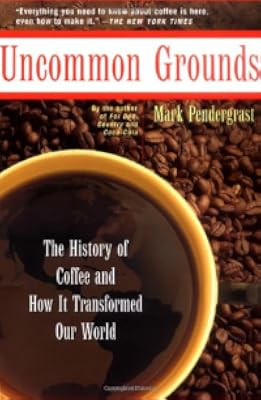
Uncommon Grounds: The History of Coffee and How It Transformed Our World
by Mark Pendergrast
On This Page
Description
Uncommon Grounds tells the story of coffee from its discovery on a hill in ancient Abyssinia to the advent of Starbucks. In this updated edition of the classic work, Mark Pendergrast reviews the dramatic changes in coffee culture over the past decade, from the disastrous "Coffee Crisis" that caused global prices to plummet to the rise of the Fair Trade movement and the "third-wave" of quality-obsessed coffee connoisseurs. As the scope of coffee culture continues to expand, Uncommon Grounds show more remains more than ever a brilliantly entertaining guide to the currents of one of the world's favorite beverages. show lessTags
Recommendations















Member Reviews
I bought this book sometime in 2013 and have read it in fits and starts since then, but only in earnest since last year. Thus is the fate of books in my Kindle app, sometimes. But it is to the book's credit that I bought it for a specific reason--some context on the Coffee Cantata by J.S. Bach for a documentary project I was involved in--but I wound up reading the entire book because it was so exhaustive and fascinating. Indeed, from the Ottoman Empire to Starbucks, Pendergrast traces the commodification and history of the beverage itself, the drinkers, the farmers, the roasters, the purveyors, and some folks in between. If you need a fairly deep dive into the intimate relationship between coffee and world politics, this is a good show more one.
From myths of goatherds, to 18th-c feminist fights for coffee via Abigail Adams, onward to the U.S.'s dangerous dancing with Brazil, as well as domestic coffee wars, there are few stones left unturned here. At times the information felt a bit overwhelming, with some zooming in on economic minutiae that some readers might appreciate, but might disrupt the energy of the narrative for others. It is the kind of book, however, that makes you glad you learned more than you had set out to, and while it lays bare a lot of the unsavory practices and issues surrounding coffee, Prendergrast ultimately reminds us that it is part of a "matrix" and says:
"Compared with many other products developed countries demand in cheap quantity, however, coffee is relatively benign. Laboring on banana, sugar, or cotton plantations or sweating in gold and diamond mines and oil refineries is far worse." (374)
Whether that dose of relativism brings one solace or not is an individual experience, but regardless, Uncommon Grounds is an informative and multifaceted report that may make you take that morning cup of joe a bit less for granted. show less
From myths of goatherds, to 18th-c feminist fights for coffee via Abigail Adams, onward to the U.S.'s dangerous dancing with Brazil, as well as domestic coffee wars, there are few stones left unturned here. At times the information felt a bit overwhelming, with some zooming in on economic minutiae that some readers might appreciate, but might disrupt the energy of the narrative for others. It is the kind of book, however, that makes you glad you learned more than you had set out to, and while it lays bare a lot of the unsavory practices and issues surrounding coffee, Prendergrast ultimately reminds us that it is part of a "matrix" and says:
"Compared with many other products developed countries demand in cheap quantity, however, coffee is relatively benign. Laboring on banana, sugar, or cotton plantations or sweating in gold and diamond mines and oil refineries is far worse." (374)
Whether that dose of relativism brings one solace or not is an individual experience, but regardless, Uncommon Grounds is an informative and multifaceted report that may make you take that morning cup of joe a bit less for granted. show less
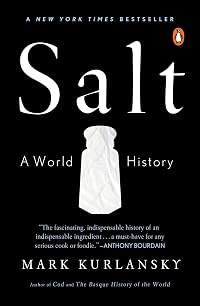
Uncommon Grounds is exactly what I was looking for. I had finished a similar commodity book (Salt: A World History by Mark Kurlansky) and was blown away. I was hoping for the same experience and am happy to say that I found something similar. The author goes into quite a lot of detail about the origin, trade, branding and questionable medicinal qualities of coffee in a relatively entertaining fashion. It gets a little bogged down at times but overall, Pendergrast succinctly digests coffee's history in a way that is not, for the most part, overwhelmingly dragged down by minutia.
It's not an amazing book, but for coffee drinkers who are curious about the history and trade of coffee, it is most certainly enlightening. I would have show more preferred the final chapter to have been the first chapter, and to have more said on the science behind the substances in coffee, but otherwise, it's a good read. A example of the author's start-to-finish style of writing might help to entice possible readers:
"At the Smithsonian conference, I heard a grower ask, “We are shocked and confused that specialty roasters sell our coffee for $8 or $10, when we only receive a little over a dollar a pound. How is that just?” While their U.S. colleagues made sympathetic noises, no one really answered the question.
Later, a specialty coffee professional gave me an answer. Let us say he pays $2 a pound for Colombian Supremo green beans (and remember that this price can fluctuate). Add 11 cents for freight-in, storage, and handling, 46 cents for the 18 percent weight loss during roasting, 19 cents a pound for roasting, 35 cents to hand-pack in five-pound valve bags for wholesale shipments, and 40 cents for shipping costs. That totals $3.51. Add $2.05 to cover overhead for the roaster/distributor (everything from mortgages and machinery loans to sales commissions, repairs, and rubbish removal) and profit, and it costs $5.56 to deliver roasted coffee to a specialty retailer. Depending on the retailer’s size, rent, and other overhead costs, he or she must then charge between $9.50 and $11.50 a pound to make a reasonable profit.
If the roasted beans go to a coffeehouse outlet, the proprietor converts the $5.56 per pound beans into a twelve-ounce regular coffee at $1.75 or cappuccino or latte for $2.50 or more. If the proprietor gets twenty-four servings to the pound, that translates to a whopping $70 a pound for regular filter coffee, and $82.50 a pound for thirty-three lattes, minus the cost of the milk, stirrer, sweetener, and stale discarded coffee. On the other hand, coffeehouse owners have to pay astronomical rents, shell out $18,000 for a top-of-the line espresso machine, and allow customers to linger for long, philosophical conversations or solitary reading over their single cup of coffee." show less
It's not an amazing book, but for coffee drinkers who are curious about the history and trade of coffee, it is most certainly enlightening. I would have show more preferred the final chapter to have been the first chapter, and to have more said on the science behind the substances in coffee, but otherwise, it's a good read. A example of the author's start-to-finish style of writing might help to entice possible readers:
"At the Smithsonian conference, I heard a grower ask, “We are shocked and confused that specialty roasters sell our coffee for $8 or $10, when we only receive a little over a dollar a pound. How is that just?” While their U.S. colleagues made sympathetic noises, no one really answered the question.
Later, a specialty coffee professional gave me an answer. Let us say he pays $2 a pound for Colombian Supremo green beans (and remember that this price can fluctuate). Add 11 cents for freight-in, storage, and handling, 46 cents for the 18 percent weight loss during roasting, 19 cents a pound for roasting, 35 cents to hand-pack in five-pound valve bags for wholesale shipments, and 40 cents for shipping costs. That totals $3.51. Add $2.05 to cover overhead for the roaster/distributor (everything from mortgages and machinery loans to sales commissions, repairs, and rubbish removal) and profit, and it costs $5.56 to deliver roasted coffee to a specialty retailer. Depending on the retailer’s size, rent, and other overhead costs, he or she must then charge between $9.50 and $11.50 a pound to make a reasonable profit.
If the roasted beans go to a coffeehouse outlet, the proprietor converts the $5.56 per pound beans into a twelve-ounce regular coffee at $1.75 or cappuccino or latte for $2.50 or more. If the proprietor gets twenty-four servings to the pound, that translates to a whopping $70 a pound for regular filter coffee, and $82.50 a pound for thirty-three lattes, minus the cost of the milk, stirrer, sweetener, and stale discarded coffee. On the other hand, coffeehouse owners have to pay astronomical rents, shell out $18,000 for a top-of-the line espresso machine, and allow customers to linger for long, philosophical conversations or solitary reading over their single cup of coffee." show less
Pendergrast’s succinct yet extensive text offers a comprehensive look at coffee’s birth and progression to a beverage with global significance. Covering centuries of coffee production and consumption, Uncommon Grounds leads the reader through the turbulent history of a product rife with bloodshed, economic strife, and cutthroat politics. At times heavy on the economic side of the coffee industry, this text still offers an unintimidating glimpse into the complexities of the coffee world.
The start of this book was really interesting, and as I got into it, it became simple light reading I could pick up from time to time. At some point I realized I was only halfway through the book, though, and couldn't keep going with the intricacies of detail about various US marketing and roasting firms.
A very long non-fiction book, but frankly it's hard to see what should be cut. His other books, portions of Salt excepting, don't live up to this book. If you've every protested or boycotted Starbucks or been pressured to buy Free Trade coffee and resisted, you need to read this book. Or if you just like knowing that Dunkin' Donuts was the easiest-to-find high quality coffee in America for years.
This book is the culmination of a thousand years of oral tradition, and I believe the first time these secrets have appeared in print.
Enjoying coffee is a global phenomenon with its popularity exploding throughout the world. This book will appeal both to those who make their living from coffee and those who simply can't live without it. It's written for anyone who loves coffee. The book is quite nice, with lots of details.
The book has an extensive bibliography and illustrations and serves as a road map of the history of coffee and its development into one of the most traded commodities in the world. It's an excellent resource for anyone wishing to deepen their knowledge of coffee and coffee production.
Enjoying coffee is a global phenomenon with its popularity exploding throughout the world. This book will appeal both to those who make their living from coffee and those who simply can't live without it. It's written for anyone who loves coffee. The book is quite nice, with lots of details.
The book has an extensive bibliography and illustrations and serves as a road map of the history of coffee and its development into one of the most traded commodities in the world. It's an excellent resource for anyone wishing to deepen their knowledge of coffee and coffee production.
A fair history. I would have liked a bit more detail of the early history of coffee. The last chapter in this updated version could have been better organized and even broken down into a few chapters. Otherwise, a good read.
Members
- Recently Added By
Lists

r/History Recommended Reading List
603 works; 12 members

In Our Time books
4,934 works; 2 members
Author Information

15+ Works 1,794 Members
Mark Pendergrast is an independent scholar who brews a fantastic cup of coffee. He is the author of many books, including For God, Country, and Coca-Cola. He lives in Vermont.
Common Knowledge
- Original publication date
- 1999
Classifications
- Genres
- History, Nonfiction, General Nonfiction, Food & Cooking
- DDC/MDS
- 641.3373 — Applied science & technology Home economics & family management Food, Cooking & Recipes / Meals, Picnics Food Field and plantation crops Alkaloidal crops Coffee
- LCC
- TX415 .P45 — Technology Home economics Home economics Nutrition. Foods and food supply
- BISAC
Statistics
- Members
- 970
- Popularity
- 27,316
- Reviews
- 10
- Rating
- (3.67)
- Languages
- Chinese, English, German, Spanish
- Media
- Paper, Audiobook, Ebook
- ISBNs
- 15
- ASINs
- 7