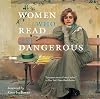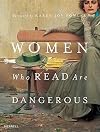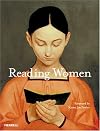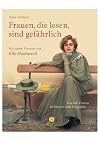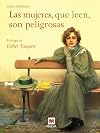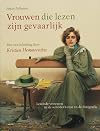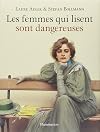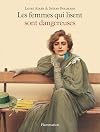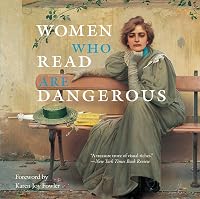
Women Who Read Are Dangerous
by Stefan Bollmann
On This Page
Description
"A compendium of more than 70 iconic works of art featuring women who read, from the Virgin Mary to Marilyn Monroe"--Tags
Recommendations















Member Reviews
I read this book because I am a woman reader, and I like the idea that I'm dangerous. In truth, this book proposed some intriguing arguments about how reading for a woman is subversive from the pose to the text itself. The paintings presented in this book challenged the notions of female beauty, propriety, and intelligence, thoroughly engaging me with every page.
Sometimes I disagreed with the interpretations made by Bollmann, but rather than detract from the book's message, I argue with it. It's rare that what a book lacks can be just as engaging as what it contains. It's easy to wax philosophical with this book because it forces the reader to examine her own reading habits and compare them to the readers presented in the paintings.
The show more reason I gave this book four stars instead of five is for a more egregious error. This book is not very large, and there are hundreds of paintings and photographs of women reading. Obviously, not all of them could be listed here. However, I was frustrated with the lack of some key artists. For example, Mary Cassatt is a famous American painter (more famous than some of the other Bohemians included) who was not added to this collection. Furthermore, the collection didn't include any art from East Asia, and I know there are tons of Japanese prints of women reading, which would've been fascinating to analyze. Since this book didn't market itself as a European or Western art book, I was taken aback by the total lack of art from other cultures.
Again, that lack challenges the reader to think of what's missing and why, but this serves as a detriment instead of as a selling point. show less
Sometimes I disagreed with the interpretations made by Bollmann, but rather than detract from the book's message, I argue with it. It's rare that what a book lacks can be just as engaging as what it contains. It's easy to wax philosophical with this book because it forces the reader to examine her own reading habits and compare them to the readers presented in the paintings.
The show more reason I gave this book four stars instead of five is for a more egregious error. This book is not very large, and there are hundreds of paintings and photographs of women reading. Obviously, not all of them could be listed here. However, I was frustrated with the lack of some key artists. For example, Mary Cassatt is a famous American painter (more famous than some of the other Bohemians included) who was not added to this collection. Furthermore, the collection didn't include any art from East Asia, and I know there are tons of Japanese prints of women reading, which would've been fascinating to analyze. Since this book didn't market itself as a European or Western art book, I was taken aback by the total lack of art from other cultures.
Again, that lack challenges the reader to think of what's missing and why, but this serves as a detriment instead of as a selling point. show less
I found this book very interesting. In fact, I imagine I may have studied art history had it been taught this way -- thematically about a subject (in this case, women reading as subversive) that intrigued me. I loved examining and thinking about the lovely art works displayed in the book. I wish the book had included Asian or African works as well as Western ones. Would we find parallels or major differences?
Having no background in art or art history, I don't know to what extent the descriptions in the book are generally accepted as accurate or seen as marginal. In either case, they are thought-provoking and I think good art (including books) is art that makes you think.
Having no background in art or art history, I don't know to what extent the descriptions in the book are generally accepted as accurate or seen as marginal. In either case, they are thought-provoking and I think good art (including books) is art that makes you think.
This is a beautifully made book; one that feels lovely in the hands and it's a pleasure to leaf through the pages and admire the art.
I just shouldn't have read it.
Full disclosure:
1. I was expecting a different premise based on the synopsis I read. I had the impression that this would be a collection of art anecdotally tied to the strides women have made throughout history as it relates to the time period each piece was created. That misconception is on me.
2. The sum total of my knowledge about art is limited to recognising the work of a 'top 10' master when I see it. I'm not sure it goes much further than that. That too, is on me.
With those two points in mind, I was disappointed by this book; I was hoping to learn something about show more the artists, about what was going on with women when these pieces were created, or what effect books and spreading literacy was having on society in general. Instead, I learned - or was reminded, really - what a pretentious prat sounds like.
I almost didn't include that last line in this review, because it feels fundamentally unfair: I don't know this writer, I don't know that he's a pretentious prat. Perhaps he's regurgitating what is considered canon in the the art world. Maybe he has primary source material that backs up the assertions he makes about the paintings he includes. It might even be a bad translation - it was originally written in German.
All I have to go by is what I'm reading on the page and my interpretation is totally and completely subjective.
BUT - so is art. it's possible it's the most subjective of all mediums, and Bollman delivers his opinions as though they were objective fact. On page after page he tells the reader what they're seeing: from the emotions on the faces of the subjects to the meaning of trivial objects in the backgrounds. He offers no explanation for his interpretations, almost no background information about the painters themselves and nothing about the society they were written in. Any of these things would have made his narrative more palatable, more educational, and given the reader more to consider while studying the pieces. Instead, he just tells us what we're meant to think.
So, I figure, if he can look at a painting and tell me what it means, I can read his words and tell him he sounds like a pretentious prat, and we'll call it even. show less
I just shouldn't have read it.
Full disclosure:
1. I was expecting a different premise based on the synopsis I read. I had the impression that this would be a collection of art anecdotally tied to the strides women have made throughout history as it relates to the time period each piece was created. That misconception is on me.
2. The sum total of my knowledge about art is limited to recognising the work of a 'top 10' master when I see it. I'm not sure it goes much further than that. That too, is on me.
With those two points in mind, I was disappointed by this book; I was hoping to learn something about show more the artists, about what was going on with women when these pieces were created, or what effect books and spreading literacy was having on society in general. Instead, I learned - or was reminded, really - what a pretentious prat sounds like.
I almost didn't include that last line in this review, because it feels fundamentally unfair: I don't know this writer, I don't know that he's a pretentious prat. Perhaps he's regurgitating what is considered canon in the the art world. Maybe he has primary source material that backs up the assertions he makes about the paintings he includes. It might even be a bad translation - it was originally written in German.
All I have to go by is what I'm reading on the page and my interpretation is totally and completely subjective.
BUT - so is art. it's possible it's the most subjective of all mediums, and Bollman delivers his opinions as though they were objective fact. On page after page he tells the reader what they're seeing: from the emotions on the faces of the subjects to the meaning of trivial objects in the backgrounds. He offers no explanation for his interpretations, almost no background information about the painters themselves and nothing about the society they were written in. Any of these things would have made his narrative more palatable, more educational, and given the reader more to consider while studying the pieces. Instead, he just tells us what we're meant to think.
So, I figure, if he can look at a painting and tell me what it means, I can read his words and tell him he sounds like a pretentious prat, and we'll call it even. show less
The title is arresting, but not really born out by the text and images. This is a coffee table book for those whose coffee tables are small. It's nicely printed and bound. The author, Stefon Bollmann, seems knowledgeable and interesting. Most spreads present a full-color image of a woman reading something—a letter, a magazine, a book. Opposite is a squib about the image, or the subject, or the artist.
For example, paired with a photo of Marilyn Monroe by Eve Arnold is this passage:
For example, paired with a photo of Marilyn Monroe by Eve Arnold is this passage:
show more
The question "Did she or didn't she?" is almost unavoidable. Did Marilyn Monroe, the blonde sex symbol of the twentieth century, read James Joyce's Ulysses, a twentieth-century icon of highbrow culture and the book many consider to be the greatest modern
novel—or was she only pretending? For, as other images from the same photographic session make clear, Ulysses is the book that Marilyn is seen reading here.show less
A professor of literature, Richard Brown, wanted to find out. Thirty years after the photo session, he wrote to the photographer, who ought to know the answer. Eve Arnold replied that Marilyn was already reading Ulysses when they met. Marilyn had said that she liked the style of the book; she would read it aloud in order to understand it better, but it was hard work. Before the photo shoot, Marilyn was reading Ulysses while Arnold loaded her film. And this was how she was photographed. We need not pursue Professor Brown's fantasy that Marilyn continued her reading of Ulysses, registered at a college, and abandoned her life as a movie star so as to further her research into Joyce, and that as a retired college lecturer she looked back on the exciting days of her youth.
But we can follow Professor Brown's recommendation to read Ulysses as Marilyn did: not in sequence, from start to finish, but episodically, by opening the book at different points and reading in short bursts. We could perhaps call this disorganized way of reading the Marilyn method. At any rate, Professor Brown recommends it to his students.
This book is filled with fascinating (and relatively unknown) artworks of women reading. The intro by Karen Joy Fowler and the chapter intros were quite thought-provoking. There were a few comments in the commentary about the artworks that didn't ring true to me, but the choices were certainly interesting.
Terrific book, great theme, excellent art, good information
Las ilustraciones son preciosas
Members
- Recently Added By
Lists

Writers and Readers
11 works; 1 member

Books With Interesting Titles
173 works; 14 members
Author Information

Some Editions
Common Knowledge
- Canonical title*
- Frauen, die lesen, sind gefährlich
- Original title
- Frauen, die lesen, sind gefaehrlich
- Alternate titles
- Women Reading
- Original publication date
- 2005 (1e édition originale allemande) (1e édition originale allemande); 2006 (1e traduction et édition française, Flammarion) (1e traduction et édition française, Flammarion); 2015-05-13 (Nouvelle édition française, Flammarion) (Nouvelle édition française, Flammarion)
- First words
- We women who read should take a moment, put down the book, this or any other, look around us.
- Last words*
- (Click to show. Warning: May contain spoilers.)Wir könnten diese unordentliche Art des Lesens gerne auch die Marilyn-Methode nennen. Professor Brown empfiehlt sie jedenfalls seinen Studenten.
- Publisher's editor
- Lanctot, Nicole
- Original language*
- Deutsch
- Disambiguation notice
- "This book was first published in German by Elisabeth Sandmann Verlag, Munich, under the title Frauen, die lesen, sind gefährlich (2005). It was subsequently published in English by Merrell Publishers, London, under... (show all) the titles Women Reading (2006) and Women Who Read are Dangerous (2008)" T.p.verso
*Some information comes from Common Knowledge in other languages. Click "Edit" for more information.
Classifications
Statistics
- Members
- 725
- Popularity
- 38,985
- Reviews
- 12
- Rating
- (3.88)
- Languages
- 10 — Czech, Dutch, English, Estonian, French, German, Hungarian, Italian, Portuguese, Spanish
- Media
- Paper
- ISBNs
- 23
- ASINs
- 2