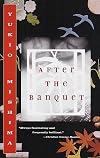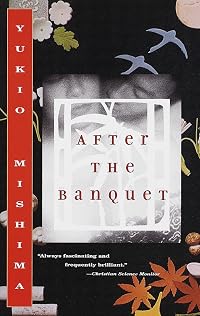
After the banquet
by Yukio Mishima
On This Page
Description
Redoubtable middle-aged Kazu falls hopelessly in love with Yuken Noguchi, idealist politician of the Radical Party. The problem is, Noguchi cannot see practical politics for what it is: a form of ideological prostitution. Kazu, who has come up in the world the hard way, bears no illusions - Noguchi, for all his bookish wisdom, has a lot of them. Kazu is the proprietor of a Setsugoan, an After-Snow-Retreat, where she is in the habit of entertaining the high-and-the-mighty of Japan. One day show more after a banquet, Tamaki, former ambassador to Germany, collapses in the toilet. The subsequent hullabaloo manages to throw Noguchi and Kazu together, and this gentleman of sixty and woman of fifty find themselves falling head-over-heels in love like teenagers. They become man and wife, and soon afterwards, Noguchi is chosen to run for office by the Radical Party. What is essentially an ideological fight for him, however, is just a fight for victory for his wife. Her methods, which are not wholly fair and aboveboard, invite Noguchi's wrath and their relationship soon begins to crack. And soon, Caesar's wife is attacked: then events proceed at a pace which nobody can control. show lessTags
Recommendations









Member Recommendations

Member Reviews
After the banquet (1960) falls about a third of the way through Mishima's impressively-long list of books - the fact that it appeared in English only a couple of years after its original Japanese publication is an indication of Mishima's reputation at the time. It's basically a political satire in form: a self-made businesswoman marries a gentlemanly, old-style politician and engages herself on his behalf in an election campaign full of dirty tricks on both sides. Mishima evidently made it a little too realistic, as the former foreign minister Hachiro Arita (who had just fought an election in rather similar circumstances) successfully sued him for invasion of privacy.
It feels rather old-fashioned as a novel, because of the way Mishima show more keeps his distance from both the main characters, showing us what they are thinking and feeling indirectly and mostly through externals - clothes, physical settings, food, weather. We aren't allowed to sympathise too closely either with Kazu's frenetic need to drive events or with Noguchi's self-deceiving ethical stance, but we do get to see how they fail to communicate with each other almost from the beginning of the story. We do very clearly see Mishima's absolute contempt for the way Japan's post-war political machine operated in an environment free of any sort of ideological commitment, driven only by self-interest, cronyism and hard cash. He doesn't really need to spell out where they learnt that from, but there are a couple of significant passing mentions of US military bases. Probably the closest we come to a genuine emotion in the book is in Kazu's (doomed) desire to anchor her anomalous life within the norms of Japanese society, as symbolised by her aspiration to be buried in Noguchi's family tomb.
Probably not a major work, but interesting, anyway. show less
It feels rather old-fashioned as a novel, because of the way Mishima show more keeps his distance from both the main characters, showing us what they are thinking and feeling indirectly and mostly through externals - clothes, physical settings, food, weather. We aren't allowed to sympathise too closely either with Kazu's frenetic need to drive events or with Noguchi's self-deceiving ethical stance, but we do get to see how they fail to communicate with each other almost from the beginning of the story. We do very clearly see Mishima's absolute contempt for the way Japan's post-war political machine operated in an environment free of any sort of ideological commitment, driven only by self-interest, cronyism and hard cash. He doesn't really need to spell out where they learnt that from, but there are a couple of significant passing mentions of US military bases. Probably the closest we come to a genuine emotion in the book is in Kazu's (doomed) desire to anchor her anomalous life within the norms of Japanese society, as symbolised by her aspiration to be buried in Noguchi's family tomb.
Probably not a major work, but interesting, anyway. show less
There's a reason people love Mishima even after so long, and for those new to his work this would be the ideal place to start. A woman in her fifties entertains guests at her restaurant, and feels drawn to a semi-retired politician in his sixties. They embark on a quiet romance leading to marriage. But he is a stubborn man born of old Japanese custom, and expects no need to compromise in his new life. She, on the other hand, is active, energetic, always looking for ways to be true to herself. When her husband is nominated as the Radical candidate in the local elections, how will she manage to contain her passion for interference and for action?
On reading this novel, one wonders what attracts the two characters - Noguchi, a traditional and very straight-laced man, and Kazu, a self-made and life-loving woman - to each other. Clearly Noguchi must feel some subconscious attraction to the sense of joie de vivre and exuberance demonstrated by this woman he agrees to marry. He is living the last stage of his life, and perhaps she offers a sense of renewal, even though he is repelled by many of her aspects on a conscious level and attempts to change her. Kazu, in her turn, is attracted by Noguchi's respectability since she is a woman of no background. He gives her a name linked to a family of a higher class than her own. Being a woman who is full of life, it is ironic that she feels show more a sense of achievement in picturing her name on the Noguchi headstone at the cemetery.
Nevertheless, it is doubtful that their marriage can survive their natural differences, and the novel treats us to many episodes of their "culture clash," which is also symbolic of the era during which Japan was struggling to modernize after their defeat in World War II. Noguchi and pre-war Japanese ways of living march off to their slow death, while Kazu and modern ways of being thrive. show less
Nevertheless, it is doubtful that their marriage can survive their natural differences, and the novel treats us to many episodes of their "culture clash," which is also symbolic of the era during which Japan was struggling to modernize after their defeat in World War II. Noguchi and pre-war Japanese ways of living march off to their slow death, while Kazu and modern ways of being thrive. show less
What a book--talk about writing relationships that feel realer than life itself! Mishima is a master--Kazu at once represents the modern of the Japanese woman, and the success all women can attain: she's independently wealthy, influential, and can use her feminine beauty and tact as a weapon in conversation and politics. On the other hand, her husband Noguchi--a man she's attracted to for his stubbornness and aloofness--wants her to conform to his ideal of a housewife--something she cannot, ultimately, do. Watching married life slowly destroy Kazu's self respect is insidiously realistic, and so the drama unfolds beautifully.
I found the premise a bit hard to swallow. Really, a “liberated” business owner with many wealthy male friends and boundless energy, falling in love with such a wet noodle? On the positive side , the novel was an interesting look at 1950s Japan: its politics, the descriptions of an expanding Tokyo, and men’s/women's relationships, a world where every word spoken, every gesture between them are ruled by tradition, multiple meanings and possibly dire consequences.
This is a good novel and it’s a good revelatory novel.
"After the Banquet" isn't just a snapshot of late-1950s Tokyo politics and it isn't just a fictionalized account of a real event—that Mishima lost a court case to. "After the Banquet" is a portrait of a two people with diametrically opposed personalities, values, and especially needs that overwhelmed whatever tenuous or superficial love they had. That Mishima has again opened the doors to the thoughts and motivations of such real characters makes this novel particularly praiseworthy.
If the thesis that every Mishima novel is autobiographical or at the least has the footprints of his own personal values is true, with the exception of the potboilers, I find it interesting that the show more sympathetic protagonist is Kazu and not Nogouchi. Kazu, a woman who lives for the now, for the living, breathing moment. Kazu is the protagonist, whose emotions, modern sensibilities, and success clashed with Nogouchi’s needs to save face and to carry on with an antiquated, class-defined lifestyle (that shares many similarities with Mishima’s own), is the star and soul of this novel.
Also, considering his dramatic works as well, e.g. "Madame de Sade," that thesis must be mistaken. show less
"After the Banquet" isn't just a snapshot of late-1950s Tokyo politics and it isn't just a fictionalized account of a real event—that Mishima lost a court case to. "After the Banquet" is a portrait of a two people with diametrically opposed personalities, values, and especially needs that overwhelmed whatever tenuous or superficial love they had. That Mishima has again opened the doors to the thoughts and motivations of such real characters makes this novel particularly praiseworthy.
If the thesis that every Mishima novel is autobiographical or at the least has the footprints of his own personal values is true, with the exception of the potboilers, I find it interesting that the show more sympathetic protagonist is Kazu and not Nogouchi. Kazu, a woman who lives for the now, for the living, breathing moment. Kazu is the protagonist, whose emotions, modern sensibilities, and success clashed with Nogouchi’s needs to save face and to carry on with an antiquated, class-defined lifestyle (that shares many similarities with Mishima’s own), is the star and soul of this novel.
Also, considering his dramatic works as well, e.g. "Madame de Sade," that thesis must be mistaken. show less
Psychologically complex, After the Banquet is the tragic story of Kazu, a middle-aged female entrepreneur in post-WWII Japan, who fives up her successful restaurant at the request of her husband shortly after falling in love with and marrying this man, a former politician. This novel had an unexpected feminist slant and would make a lovely introduction to Mishima's body of work.
Members
- Recently Added By
Published Reviews
ThingScore 75
Lists

Japanese Literature
230 works; 37 members
Author Information

Yukio Mishima, the pseudonym for Hiraoka Kimitake, was born in Tokyo in 1925. His work covers many styles: poetry, essays, modern Kabuki ja Noh drama, and novels. Among his masterpieces are The Temple of the Golden Pavilion, and the four-volume novel Sea of Fertility, which outlines the Japanese experience in the 20th century. Each of the four show more volumes in this series has a distinct title--Spring Snow, Runaway Horses, The Temple of Dawn, and Five Signs of a God's Decay--and they were published over a six-year period, from 1965-1970. Mishima's plays include Tenth Day Chrysanthemum, and the Kabuki piece The Moon Like a Drawn Bow. Although Mishima was been nominated three times for the Nobel Prize for Literature, he never received it. Nevertheless, he is considered by many critics as one of the most important Japanese novelists of the 20th century. Yukio Mishima died by his own hand in 1970, committing seppuku (ritual disembowelment). (Bowker Author Biography) show less
Some Editions
Series
Belongs to Publisher Series
Common Knowledge
- Canonical title
- After the Banquet; After the banquet
- Original title
- 宴のあと; 宴のあと (Utage no Ato) (Utage no Ato)
- Alternate titles
- Utage no Ato
- Original publication date
- 1960-11-15
- People/Characters
- Kazu Fukuzawa; Yuken Noguchi; Soichi Yamazaki
- Important places
- Tokyo, Japan
- Important events
- Tokyo gubernatorial election (1959)
- First words
- The Setsugoan—the After-the-Snow Retreat—stood on high ground in a hilly part of Koishikawa district of Tokyo.
- Last words
- (Click to show. Warning: May contain spoilers.)I shall be delighted to be present on the night of the reopening.
- Original language
- Japanese
Classifications
- Genres
- General Fiction, Fiction and Literature
- DDC/MDS
- 895.635 — Literature & rhetoric Literatures of other languages Literatures of East and Southeast Asia Japanese Japanese fiction 1945–2000
- LCC
- PL833 .I7 .U813 — Language and Literature Languages and literatures of Eastern Asia, Africa, Oceania Languages of Eastern Asia, Africa, Oceania Japanese language and literature Japanese literature Individual authors and works
- BISAC
Statistics
- Members
- 713
- Popularity
- 40,035
- Reviews
- 9
- Rating
- (3.70)
- Languages
- 13 — Danish, Dutch, English, Estonian, Finnish, French, German, Greek, Italian, Japanese, Portuguese, Romanian, Spanish
- Media
- Paper, Ebook
- ISBNs
- 28
- UPCs
- 1
- ASINs
- 13