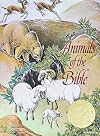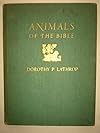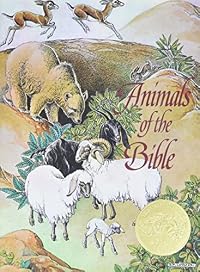
Animals of the Bible: A Picture Book
by Helen Dean Fish (Editor)
On This Page
Description
The Old and New Testaments of the King James Version are the sources for the thirty-one stories about animals; the illustrations include the flora of biblical lands and portray the animals with reverence.Tags
Recommendations









Member Reviews
This was the very first book to be awarded the Randolph Caldecott Medal for the “most distinguished American picture book for children.”
Dorothy Lathrop’s black and white illustrations are wonderful. It is clear that she has experience drawing animals from real life. From the creation to Noah’s Ark, Daniel in the lion’s den, and on to the new testament, the drawings are detailed and life-like. Lathrop also took pains to include accurate depictions of the flora of the area depicted.
So why only one star?
The book was conceived and planned by Helen Dean Fish, who selected the texts used from the King James Bible. In some cases, the animal is but a small mention in the text (Abraham’s Ram or Jonah and the Great Fish). She did show more nothing to write these as child-friendly stories. I cannot imagine a child sitting still for any of these verses. If I needed a child’s picture book of Bible stories, I’d pick a different book.
That’s really a pity, because Lathrup’s drawings are magnificent. I’d rate the illustrations 5***** - but I still wouldn’t recommend the book. show less
Dorothy Lathrop’s black and white illustrations are wonderful. It is clear that she has experience drawing animals from real life. From the creation to Noah’s Ark, Daniel in the lion’s den, and on to the new testament, the drawings are detailed and life-like. Lathrop also took pains to include accurate depictions of the flora of the area depicted.
So why only one star?
The book was conceived and planned by Helen Dean Fish, who selected the texts used from the King James Bible. In some cases, the animal is but a small mention in the text (Abraham’s Ram or Jonah and the Great Fish). She did show more nothing to write these as child-friendly stories. I cannot imagine a child sitting still for any of these verses. If I needed a child’s picture book of Bible stories, I’d pick a different book.
That’s really a pity, because Lathrup’s drawings are magnificent. I’d rate the illustrations 5***** - but I still wouldn’t recommend the book. show less
The Caldecott Medal, named for nineteenth-century English artist Randolph Caldecott, is the premier children's illustration prize in the United States, and was first awarded in 1938. Animals of the Bible, which pairs quotations from the King James Bible, edited and presented by Helen Dean Fish, with black and white artwork by Dorothy P. Lathrop, was the first book to win the Caldecott. It is an advanced, text-heavy picture-book, and profiles many of the important animals of both the Hebrew Bible and the Christian Gospels, from the serpent who beguiled Eve, and the dove which Noah released from his ark, to the Palm Sunday colt, and the manger animals that were present during the Nativity. Each animal that appears in the biblical passage show more quoted, is then depicted in the accompanying illustration.
Less of a biblical storybook than a biblical sampling - perhaps it can be considered a young person's reference? - Animals of the Bible is not a title I would have picked up, in the normal course of events. Although interested in the ways in which these stories have been retold for children (I wish I remembered the name of collection I had myself, as a young girl!), as well as in the original text itself, a book which features brief biblical snippets paired with artwork is not really how I would have chosen to approach the subject. Having recently decided to read the entire Caldecott corpus, however (because clearly I don't have enough themed reading projects going already!), I picked it up this past weekend at the library, and discovered (perhaps not so surprisingly) that I was a bit disappointed with the first Caldecott. The quotations were fine, of course - the King James Bible, even when inaccurate as a translation, is quite beautiful - and the artwork was interesting. But being familiar with Lathrop's fairy-tale work - the illustrations she contributed to some of Walter de la Mare's books, for instance - I was not as impressed as I'd hoped to be. I'll have to see if The Fairy Circus, for which Lathrop won a Newbery Honor in 1932, and which I hope to read in the next few weeks for another ongoing project, is any better. show less
Less of a biblical storybook than a biblical sampling - perhaps it can be considered a young person's reference? - Animals of the Bible is not a title I would have picked up, in the normal course of events. Although interested in the ways in which these stories have been retold for children (I wish I remembered the name of collection I had myself, as a young girl!), as well as in the original text itself, a book which features brief biblical snippets paired with artwork is not really how I would have chosen to approach the subject. Having recently decided to read the entire Caldecott corpus, however (because clearly I don't have enough themed reading projects going already!), I picked it up this past weekend at the library, and discovered (perhaps not so surprisingly) that I was a bit disappointed with the first Caldecott. The quotations were fine, of course - the King James Bible, even when inaccurate as a translation, is quite beautiful - and the artwork was interesting. But being familiar with Lathrop's fairy-tale work - the illustrations she contributed to some of Walter de la Mare's books, for instance - I was not as impressed as I'd hoped to be. I'll have to see if The Fairy Circus, for which Lathrop won a Newbery Honor in 1932, and which I hope to read in the next few weeks for another ongoing project, is any better. show less
I am atheist, raised in household that was pragmatic and didn't pay attention to church. I have no problem with the book, and in fact I do think it was worthy of the award because the pictures are gorgeous and do support the intent of the editor, as revealed by the texts she chose. I do have a problem in that several of the texts did not get pictures, but oh well.
I also see the B&W art as appropriate to the style of the pictures and the intent of the book. To me, they seem more reverent - colors would be gaudy, showing off... and isn't vanity a sin? Yes, I know colors have been used historically in many many very reverent images - but I agree with Lathrop's choice to let them be subtle.
I did read every word, which was difficult because show more I don't have the background. Some of the stories I could not figure out, could not make real sense of. But I imagine any child who rec'd this book back then did know more about the stories than I, so I can't fault the book for that. show less
I also see the B&W art as appropriate to the style of the pictures and the intent of the book. To me, they seem more reverent - colors would be gaudy, showing off... and isn't vanity a sin? Yes, I know colors have been used historically in many many very reverent images - but I agree with Lathrop's choice to let them be subtle.
I did read every word, which was difficult because show more I don't have the background. Some of the stories I could not figure out, could not make real sense of. But I imagine any child who rec'd this book back then did know more about the stories than I, so I can't fault the book for that. show less
What a strange little book is the first-ever Caldecott. Fish collected every single mention of animals anywhere in the King James Bible, and then Lathrop illustrated most of them. Strange concept. The illustrations are, in the edition I had, rather faded and poorly reproduced, but still well done. The animals are all very rounded and fuzzy and cute – even the Leviathan. Probably a great book to have at Sunday school, but I don’t know as you need to have one at home. The illustrations are black and white, so they could also be used as coloring pages at Sunday school. (pannarrens)
I liked this more than I expected, but I still rate it a "two" (low level of personal enjoyment). It's a different kind of reading and most likely won't appeal to many children these days, but I learned a few new things and appreciated the delicate pencil illustrations. I wonder if a colorized version would be worth doing.
Each chapter deals with an animal mentioned in the Bible, with the Bible verse written in paragraph form alongside the picture. It's been a while since I've read anything biblical, so the style of writing was a slog - however, I learned some new things!
For example, the origin of the term "scapegoat" and that a "behemoth" could be a hippo (I always thought it was a generic big huge monstery-thing) AND, it was show more interesting to revisit some classic Bible stories, such as Jonah and the Great Fish. show less
Each chapter deals with an animal mentioned in the Bible, with the Bible verse written in paragraph form alongside the picture. It's been a while since I've read anything biblical, so the style of writing was a slog - however, I learned some new things!
For example, the origin of the term "scapegoat" and that a "behemoth" could be a hippo (I always thought it was a generic big huge monstery-thing) AND, it was show more interesting to revisit some classic Bible stories, such as Jonah and the Great Fish. show less
This review also appears on my blog.
Animals feature prominently in the Bible. Animals of the Bible: A Picture Book collects passages from the King James Bible, selected by Helen Dean Fish, that relate to animals, and pairs them with illustrations by Dorothy P. Lathrop.
For children's literature, two awards are preeminent: the Newbery Medal, first awarded in 1922, for children's literature; and the Caldecott Medal, first awarded in 1938, for picture books. Each has been awarded to some truly outstanding literature, over the years.
It has also, apparently, been awarded to some less-than-excellent books.
Animals of the Bible is less of a picture book, and more a series of drawings, each with an (extended) epigraph selected from the Bible. One show more can hardly criticize the quality of a set of Biblical quotations, each at most, perhaps, a dozen verses together, but it can be said that the text certainly forms no story, nor teaches anything in particular, nor has any coherent theme. It's more what I would expect from a Bible-themed calendar than a Caldecott winner.
Even the illustrations are something of a mixed bag. The animals are, as the introduction insists, generally relatively lifelike. The humans, though... well, just look at them. The prodigal son, there, looks as flat and oddly-posed as a thirteenth-century Madonna. Worse, really--especially in comparison to the substantially more realistic swine.
I suppose it was overly optimistic of me to assume that this book must be very good, just because it was a Caldecott winner--particularly since it was the first Caldecott winner. It's remained in print, all these years, on strength (I imagine) of that award. But it doesn't measure up to its successors. show less
Animals feature prominently in the Bible. Animals of the Bible: A Picture Book collects passages from the King James Bible, selected by Helen Dean Fish, that relate to animals, and pairs them with illustrations by Dorothy P. Lathrop.
For children's literature, two awards are preeminent: the Newbery Medal, first awarded in 1922, for children's literature; and the Caldecott Medal, first awarded in 1938, for picture books. Each has been awarded to some truly outstanding literature, over the years.
It has also, apparently, been awarded to some less-than-excellent books.
Animals of the Bible is less of a picture book, and more a series of drawings, each with an (extended) epigraph selected from the Bible. One show more can hardly criticize the quality of a set of Biblical quotations, each at most, perhaps, a dozen verses together, but it can be said that the text certainly forms no story, nor teaches anything in particular, nor has any coherent theme. It's more what I would expect from a Bible-themed calendar than a Caldecott winner.
Even the illustrations are something of a mixed bag. The animals are, as the introduction insists, generally relatively lifelike. The humans, though... well, just look at them. The prodigal son, there, looks as flat and oddly-posed as a thirteenth-century Madonna. Worse, really--especially in comparison to the substantially more realistic swine.
I suppose it was overly optimistic of me to assume that this book must be very good, just because it was a Caldecott winner--particularly since it was the first Caldecott winner. It's remained in print, all these years, on strength (I imagine) of that award. But it doesn't measure up to its successors. show less
A truly beautiful book that ties beloved and well known Bible stories and brings the animals in them to life with gorgeous illustrations.
Members
- Recently Added By
Lists

Caldecott Medal Books
91 works; 15 members

Books Read in 2021
5,361 works; 113 members
Author Information
All Editions
Awards and Honors
Awards
Common Knowledge
- Canonical title
- Animals of the Bible: A Picture Book
- Original publication date
- 1937
Classifications
Statistics
- Members
- 407
- Popularity
- 75,851
- Reviews
- 14
- Rating
- (3.04)
- Languages
- English
- Media
- Paper
- ISBNs
- 6
- ASINs
- 9