The Kraken Wakes
by John Wyndham
On This Page
Description
It started with fireballs raining down from the sky and crashing into the oceans' depths. Then ships began sinking mysteriously and later 'sea tanks' emerged from the depths to claim people ... For journalists Mike and Phyllis Watson, what at first appears to be a curiosity becomes a global calamity. Helpless, they watch as humanity struggles to survive now that water - one of the compounds upon which life depends - is turned against them. Finally, sea levels begin their inexorable rise ...Tags
Recommendations




























Member Recommendations


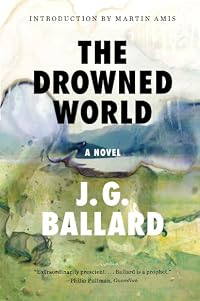
bertilak Two different accounts of extreme increases of sea level.

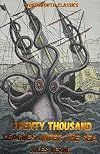
divinenanny Almost the same premis, but expanded and modernised.


anonymous user There are similarities in style and content between Hoyle and Wyndham. Two classics of British Sci Fi.
Member Reviews
Rising sea levels, mob rule in London, political point scoring when a crisis demands action, journalists suffering from PTSD - no it's not this weeks news headlines, it's John Wyndham's 1953 sci-fi disaster novel "The Kraken Wakes". Through the eyes of a married couple of journalists it tells the story of a world threatened by a mysterious alien invasion, based in the deepest oceans. An interesting mix of historical setting (the world is very much 1953) and timeless observations on human nature. Also a cracking read!
'The Kraken Wakes' has stood the test of time even though it is very much of its time - including the satire on the Cold War politics of the early 1950s, on industrial relations, on the media, its pre-Suez belief in the British Empire as a viable superpower and the gender relations.
It is also a very fine science fiction horror which has the human race thrown back into pre-industrial civilisation by a threat from the skies which mimics the trajectory of 'War of The Worlds' from beginning to end but has the aliens be new masters of the ocean deeps.
This should be a Lovecraftian theme but there is no trace of the American master. It is a very British dystopia with much controlled emotion, naval discipline and wry humour while the gender show more aspect shows the masculine and feminine as different but equal - with the feminine often far the cleverer.
The protagonists, two journalists balancing duty to country and humanity against getting the news out and being very responsible about it too, start off being much like the Myrna Loy and William Powell characters in 'The Thin Man', a general trope of mid-century popular movies.
However, this moves on with the story until what we have is not only a satire and a science fiction adventure but a rather good popular novel with believable characters. The core of the novel seems 'real' even if the carapace surrrounding it is fantastic and satirical in turns.
There is, of course, the influence of the war and international confrontation but not in any didactic sense. The politicians and special interests do their thing and the communists are absurd but humanity is saved ultimately by boffins and the discipline of the Royal Navy.
The faith in boffins is very much of that curious period when boffins (basically the scientific community) were heroes of the hour, given a great deal of credit for beating the Nazis, and were regarded as dogged thinkers who would eventually come up with the solution to any problem.
In the end (though it is the very end), they do. This spirit of boffindom is exemplified by the character of Professor Bocker (who perhaps shares genetic code with Challenger and Quatermass) who sticks to his guns as a rational actor amidst the usual hysteria of a media-driven free society.
There is some serious excitement in the well constructed story, divided into three parts, like novella, covering the three phases of the invasion - the descent from the skies (well in 1950s tradition), the invasions of the land and the rising of the tides.
We never see the aliens but we get a strong impression of their nature. Human contact with them is filmic in its presentation. The 'Escondido raid' could easily be an extended scene from one of the better British war films (also popular in the 1950s).
The science is plausible for the time. The atom bomb is just a tool rather than a threat just for existing. The whole story is an extension into fantasy of the existential threat of the Second World War with the same ethos of necessary and accepted ruthlessness on both sides.
At one point Professor Bocker gives an account of what is necessary - that ruthless exterminatory enemies require exterminatory methods in return - that might well shock the modern reader but which was the mentality of the final bombing raids on Germany.
This was also a steeling of the people emotionally for a response to Soviet expansion if it ever came to that. With the atom bomb uninventable, the British Empire might have to use it and in force and so such bombs are automatically deployed against the threat from the Deeps.
The satirical aspects of the tale may make the Soviets absurd in their ideology (good-humouredly so, in the same vein as national socialism had been ridiculed a decade earlier) but they are also directed at the home front.
Bosses and workers are treated with equal cynical good humour as are politicians and media barons. Ordinary journalists and the middle classes just doing their job with a sense of duty to the nation are the implicit heroes. The masses are in danger of going brute under pressure.
Interestingly, the armed forces are never treated in this way - there is still the respect accorded them (which remains to this day in British culture) for winning not only the last war but the next one and the one after that. Politicians are despised, the armed forces never.
The cultural bias could have come straight out of the 1926 General Strike as much as the Second World War. The basis of the nation and of the empire is the educated middle class, science, sound administration and the armed forces. It is what will restore civilisation. How very English!
Written after the 'Day of the Triffids' (1951) and before 'The Chrysalids' (1955) and 'The Midwich Cuckoos' (1957), Wyndham produced a line of exemplary English science fiction in the 1950s even if his approach was possibly justifiably critiqued as 'cosy catastrophe' by Brian Alldiss.
But it was much more than that. Wyndham captures a peculiarly English sense that a somewhat muddle-through but functioning system was highly vulnerable not to internal but to external inhuman threats, metaphors for post-war and post-imperial anxiety about the 'other'.
He was actually a child, in terms of science fiction, of the American pulps where he targeted his short stories so what we see is a marriage of American and British styles reintroducing science fiction as a relatively serious expression of British concerns traced through the decade.
Britain at that time was learning that it was not an imperial superpower (exemplified by the fiasco at Suez in 1956) and it was not even a very strong economy. Winning the war proved to have given no benefit and American partners were becoming American overlords.
'The Kraken Wakes' is at the beginning of that trajectory and is worth reading for getting the 'feel' of the time from an accomplished writer who had had wide experience of life.
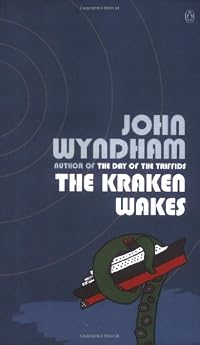
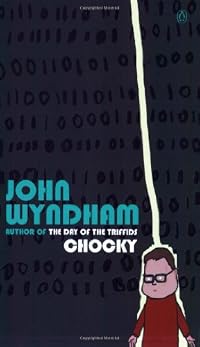
[Incidentally, the cover art for the current series of Penguin Editions of Wyndham's work must be the worst I have ever seen for failing to capture the spirit of the contents. The reasoning process of the publishers here is beyond my comprehension] show less
It is also a very fine science fiction horror which has the human race thrown back into pre-industrial civilisation by a threat from the skies which mimics the trajectory of 'War of The Worlds' from beginning to end but has the aliens be new masters of the ocean deeps.
This should be a Lovecraftian theme but there is no trace of the American master. It is a very British dystopia with much controlled emotion, naval discipline and wry humour while the gender show more aspect shows the masculine and feminine as different but equal - with the feminine often far the cleverer.
The protagonists, two journalists balancing duty to country and humanity against getting the news out and being very responsible about it too, start off being much like the Myrna Loy and William Powell characters in 'The Thin Man', a general trope of mid-century popular movies.
However, this moves on with the story until what we have is not only a satire and a science fiction adventure but a rather good popular novel with believable characters. The core of the novel seems 'real' even if the carapace surrrounding it is fantastic and satirical in turns.
There is, of course, the influence of the war and international confrontation but not in any didactic sense. The politicians and special interests do their thing and the communists are absurd but humanity is saved ultimately by boffins and the discipline of the Royal Navy.
The faith in boffins is very much of that curious period when boffins (basically the scientific community) were heroes of the hour, given a great deal of credit for beating the Nazis, and were regarded as dogged thinkers who would eventually come up with the solution to any problem.
In the end (though it is the very end), they do. This spirit of boffindom is exemplified by the character of Professor Bocker (who perhaps shares genetic code with Challenger and Quatermass) who sticks to his guns as a rational actor amidst the usual hysteria of a media-driven free society.
There is some serious excitement in the well constructed story, divided into three parts, like novella, covering the three phases of the invasion - the descent from the skies (well in 1950s tradition), the invasions of the land and the rising of the tides.
We never see the aliens but we get a strong impression of their nature. Human contact with them is filmic in its presentation. The 'Escondido raid' could easily be an extended scene from one of the better British war films (also popular in the 1950s).
The science is plausible for the time. The atom bomb is just a tool rather than a threat just for existing. The whole story is an extension into fantasy of the existential threat of the Second World War with the same ethos of necessary and accepted ruthlessness on both sides.
At one point Professor Bocker gives an account of what is necessary - that ruthless exterminatory enemies require exterminatory methods in return - that might well shock the modern reader but which was the mentality of the final bombing raids on Germany.
This was also a steeling of the people emotionally for a response to Soviet expansion if it ever came to that. With the atom bomb uninventable, the British Empire might have to use it and in force and so such bombs are automatically deployed against the threat from the Deeps.
The satirical aspects of the tale may make the Soviets absurd in their ideology (good-humouredly so, in the same vein as national socialism had been ridiculed a decade earlier) but they are also directed at the home front.
Bosses and workers are treated with equal cynical good humour as are politicians and media barons. Ordinary journalists and the middle classes just doing their job with a sense of duty to the nation are the implicit heroes. The masses are in danger of going brute under pressure.
Interestingly, the armed forces are never treated in this way - there is still the respect accorded them (which remains to this day in British culture) for winning not only the last war but the next one and the one after that. Politicians are despised, the armed forces never.
The cultural bias could have come straight out of the 1926 General Strike as much as the Second World War. The basis of the nation and of the empire is the educated middle class, science, sound administration and the armed forces. It is what will restore civilisation. How very English!
Written after the 'Day of the Triffids' (1951) and before 'The Chrysalids' (1955) and 'The Midwich Cuckoos' (1957), Wyndham produced a line of exemplary English science fiction in the 1950s even if his approach was possibly justifiably critiqued as 'cosy catastrophe' by Brian Alldiss.
But it was much more than that. Wyndham captures a peculiarly English sense that a somewhat muddle-through but functioning system was highly vulnerable not to internal but to external inhuman threats, metaphors for post-war and post-imperial anxiety about the 'other'.
He was actually a child, in terms of science fiction, of the American pulps where he targeted his short stories so what we see is a marriage of American and British styles reintroducing science fiction as a relatively serious expression of British concerns traced through the decade.
Britain at that time was learning that it was not an imperial superpower (exemplified by the fiasco at Suez in 1956) and it was not even a very strong economy. Winning the war proved to have given no benefit and American partners were becoming American overlords.
'The Kraken Wakes' is at the beginning of that trajectory and is worth reading for getting the 'feel' of the time from an accomplished writer who had had wide experience of life.
[Incidentally, the cover art for the current series of Penguin Editions of Wyndham's work must be the worst I have ever seen for failing to capture the spirit of the contents. The reasoning process of the publishers here is beyond my comprehension] show less
As a teenager I read "Triffids" and absolutely loved it - which lead me on a Wyndham reading spree. One of which was "Kraken" - which as a teenager really bored me. Having a yen to revisit some of these and many either available as audio via the library or free on Audible, I listened to this to see if my initial opinion remained the same. I certainly enjoyed it more this time but it's pacing is off. It only really gets exciting in the final third. The buildup is too long and the end is very reminiscent of how Triffids ends.
I always love John Wyndham books, something about the matter of fact, somewhat old fashioned voice to the protagonists. They are a bit dated and you could say sexist, but there is usually a strong female character proving the 1950s male characters wrong. In The Kraken Wakes we have a mysterious alien invasion and it shows how ill-equipped we are to deal with a war with a creature so different to us. It works well as a parable about climate change and sea level change, as well as exploring how quickly society can break down, and how ineffective government can be in a time of crisis. Reading this in late 2018 I couldn't help thinking of Brexit parallels.
I was pleasantly surprised by this. Depressingly not having read neither Day of the Triffids nor The War of the Worlds yet, but being a huge fan of black and white B-Movies, I was hoping this book would tap into that "quaint" view of science that often seems to come through in the "sci fi" of the 50s.
And in a way, it lived up to that expectation. But at the same time, it was also more than that - a fascinating slice into the mindset of the post-war world. An exploration of a time of uncertainty - rapid technological progress amongst a shuffling, threatening backdrop of all-too-global politics. These threads of the book, along with the reaction of the press and the public it lays out, still resonate today, perhaps for all the same show more reasons.
The book progresses at a good, interesting speed, and it quickly becomes clear that this is a 'what if' affair. In the same way that 'Death at Intervals' by Jose Saramago focuses not on the problem at hand, but on how it affects whole populations, so The Kraken Wakes also becomes a mirror to ourselves. "Science fiction" is a misnomer. This is a book on coping with change, conflict and, most of all, unknowability.
Recommended. show less
And in a way, it lived up to that expectation. But at the same time, it was also more than that - a fascinating slice into the mindset of the post-war world. An exploration of a time of uncertainty - rapid technological progress amongst a shuffling, threatening backdrop of all-too-global politics. These threads of the book, along with the reaction of the press and the public it lays out, still resonate today, perhaps for all the same show more reasons.
The book progresses at a good, interesting speed, and it quickly becomes clear that this is a 'what if' affair. In the same way that 'Death at Intervals' by Jose Saramago focuses not on the problem at hand, but on how it affects whole populations, so The Kraken Wakes also becomes a mirror to ourselves. "Science fiction" is a misnomer. This is a book on coping with change, conflict and, most of all, unknowability.
Recommended. show less
Typical Wyndham, which is a Good Thing. This one gets off to a slow start, building gradually over several years, before the world realizes that the situation is dire. Published in 1953, the Cold War is heavily present through most of the book, but almost everything that happens could just as well take place in the present. Outside of the use of radio as the primary method of disseminating news, most of the technology and attitudes are familiar. Which is pretty scary. There are strong, unavoidable parallels to the current situation with climate change, and the general attitude of "We don't know what to do, so let's pretend it isn't happening." We see governments acting as governments do, military acting as military does, regular people show more acting as regular people do, and media following the orders of government rather more than one would expect today. The hero is the usual competent, stoic type, but with an unexpected interlude of PTSD . Then there's his wife, the ever-resourceful Phyllis. She provides most of the personality in the book (although that isn't necessarily saying a lot). As much as I liked the pair of them, I wanted to take a pen and cross out the word "darling" every time they used it. Especially when it was used multiple times in a single conversation. While The Kraken Wakes is not going to replace The Day of the Triffids in my affections, I did like it very much. show less
I re-read most of the John Wyndham books just before joining Goodreads, 8 or 9 years ago. I was bowled over by this one and now re-reading again I am even further impressed. For a start there is no action - it is all reportage - and just as riveting and perilous as any immediate action would have been. First published in 1953 it is beautifully written and constructed and far from sounding dated and old-fashioned. In fact while we may have moved on from the simplistic cold war agendas, replace aliens (or possible aliens) with runaway climate change and it is horrifyingly up to date.
Members
- Recently Added By
Lists

Mythical Monsters of the World
199 works; 79 members

Dystopian and Apocalyptic Literature
350 works; 74 members

Ten Books That Have Stayed With Me
160 works; 29 members
1950s
340 works; 22 members

Books Read in 2023
5,547 works; 145 members

Ocean Setting
33 works; 5 members

Books With Complete Sentence Titles
374 works; 15 members

Favorite Science Fiction
452 works; 216 members
Author Information

Some Editions
Series
Belongs to Publisher Series
Work Relationships
Is contained in
Is retold in
Has the adaptation
Is abridged in
Common Knowledge
- Canonical title*
- Invasjon fra dypet
- Original title
- The Kraken Wakes
- Alternate titles*
- Out Of The Deeps
- Original publication date
- 1953
- People/Characters
- Mike Watson; Phyllis Watson; Alastair Bocker; Muriel Flynn; Captain Winters; Matet
- Important places
- London, England, UK; Rose Cottage; Cornwall, England, UK; Escondida
- First words
- The nearest iceberg looked firmly grounded.
- Last words
- (Click to show. Warning: May contain spoilers.)And we got through last time...'
- Original language*
- Engels
*Some information comes from Common Knowledge in other languages. Click "Edit" for more information.
Classifications
Statistics
- Members
- 2,113
- Popularity
- 9,664
- Reviews
- 58
- Rating
- (3.69)
- Languages
- 14 — Czech, Danish, Dutch, English, Estonian, Finnish, French, German, Italian, Norwegian (Bokmål), Norwegian, Portuguese, Spanish, Swedish
- Media
- Paper, Audiobook, Ebook
- ISBNs
- 37
- ASINs
- 46