On This Page
Description
An unmarried by mathematically precise Englishman dismisses his valet for heating his shaving water two degrees cooler than usual. He hires a French valet to replace him and the two of them set off to travel around the world in eighty days - a supposedly possible feat, now that the Indian railways have been built. If they succeed they will win a fortune off the other members of the Reform Club..
Tags
Recommendations






























Member Recommendations





Member Reviews
Original review from 2013:
Phileas Fogg, an English gentleman who is so devoted to routine that he makes robots look like slackers, decides one day to take up a challenge to travel around the world in 80 days. He takes along a carpet bag, half his fortune, and his very surprised, just-hired servant, Passepartout, who had rather looked forward to working for someone with a quiet existence. Along the way they must contend with travel mishaps, poor weather and a suspicious detective, Fix, who believes Fogg is a bank robber choosing a very unusual way of fleeing the country.
What struck me about this book upon rereading was the sense of anxiety that hit me almost from the start. This is probably a more personal thing, but I cannot stand to be show more late or delayed for anything, so the slightest mishap or setback to Fogg's quest was bound to have me a-quiver with worry. It was as though I believed that the ending would change this time (I've read the book a few times before). Or perhaps I was remembering the worry I felt on previous readings. At any rate, this may explain why my copy of Around the World in Eighty Days is much less battered and dog-eared than my copies of Journey to the Centre of the Earth and Twenty Thousand Leagues Under the Sea.
One thing that did amuse me was a translator's note toward the end of the book, when all the clocks in London struck the same hour: "A somewhat remarkable eccentricity on the part of the London clocks!" Sassy!
This book is recommended if you like travel, The Amazing Race, or Verne's other work. For further reading, check out Michael Palin's Around the World in Eighty Days, in which he attempts to retrace Phileas Fogg's steps within the same amount of time.
Addendum from 2026:
I reread this after watching the first two episodes of the David Tennant adaptation from 2021 (I am going to finish it; I just take a long time to watch TV series). It was useful to have some of the adaptation under my belt because then I had a sense of how much it deviated from the source text. So far there have been deviations, but I am largely OK with them. On this reread, I once again felt that high anxiety about possible and actual setbacks to Fogg’s trip and still chuckled at the sassy translator’s note. (I wish this edition credited the translator...) But what jumped out at me this time round was the problematic language about non-European cultures, particularly Indigenous people in the U.S. The scene in which the Sioux warriors board the train is a stereotypical “Western movie” kind of scene. Not great.
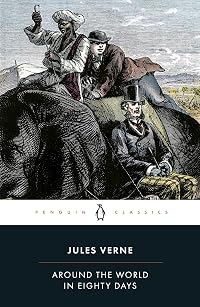
I’m also not sure what my 2013 self meant when describing this book’s condition as “much less battered and dog-eared” than the other two Verne books I have in these Puffin Classics editions: the spine has multiple cracks, the cover edges are dinged up, part of the front cover is ripping off at the spine, and three of the four cover corners are creased from being accidentally folded over and restored to their normal position. I don’t think the descriptor “much” is quite accurate. It may be less dog-eared, sure, but it’s not pristine. show less
Phileas Fogg, an English gentleman who is so devoted to routine that he makes robots look like slackers, decides one day to take up a challenge to travel around the world in 80 days. He takes along a carpet bag, half his fortune, and his very surprised, just-hired servant, Passepartout, who had rather looked forward to working for someone with a quiet existence. Along the way they must contend with travel mishaps, poor weather and a suspicious detective, Fix, who believes Fogg is a bank robber choosing a very unusual way of fleeing the country.
What struck me about this book upon rereading was the sense of anxiety that hit me almost from the start. This is probably a more personal thing, but I cannot stand to be show more late or delayed for anything, so the slightest mishap or setback to Fogg's quest was bound to have me a-quiver with worry. It was as though I believed that the ending would change this time (I've read the book a few times before). Or perhaps I was remembering the worry I felt on previous readings. At any rate, this may explain why my copy of Around the World in Eighty Days is much less battered and dog-eared than my copies of Journey to the Centre of the Earth and Twenty Thousand Leagues Under the Sea.
One thing that did amuse me was a translator's note toward the end of the book, when all the clocks in London struck the same hour: "A somewhat remarkable eccentricity on the part of the London clocks!" Sassy!
This book is recommended if you like travel, The Amazing Race, or Verne's other work. For further reading, check out Michael Palin's Around the World in Eighty Days, in which he attempts to retrace Phileas Fogg's steps within the same amount of time.
Addendum from 2026:
I reread this after watching the first two episodes of the David Tennant adaptation from 2021 (I am going to finish it; I just take a long time to watch TV series). It was useful to have some of the adaptation under my belt because then I had a sense of how much it deviated from the source text. So far there have been deviations, but I am largely OK with them. On this reread, I once again felt that high anxiety about possible and actual setbacks to Fogg’s trip and still chuckled at the sassy translator’s note. (I wish this edition credited the translator...) But what jumped out at me this time round was the problematic language about non-European cultures, particularly Indigenous people in the U.S. The scene in which the Sioux warriors board the train is a stereotypical “Western movie” kind of scene. Not great.
I’m also not sure what my 2013 self meant when describing this book’s condition as “much less battered and dog-eared” than the other two Verne books I have in these Puffin Classics editions: the spine has multiple cracks, the cover edges are dinged up, part of the front cover is ripping off at the spine, and three of the four cover corners are creased from being accidentally folded over and restored to their normal position. I don’t think the descriptor “much” is quite accurate. It may be less dog-eared, sure, but it’s not pristine. show less
What a fantastic, thrilling, gripping story this is. What a nail-biter! Filled with fun characters, vivid locations, and a sense of desperate urgency, Around the World in Eighty Days by Jules Verne is deservedly a classic. I listened to this on audiobook read by Jim Dale and enjoyed every minute (except the truly nauseating little talk, added by the publisher, at the end. But I will rant about that later).
I was surprised to realize that I had probably never read the unabridged version of this story. I have a vague recollection of one of those Great Illustrated Classics, with a truly terrifying illustration of Passepartout in the opium den. Though I'm familiar with many of Verne's plots, I haven't really sat down with one of his books show more as an adult reader. I see I will have to rectify that.
Phileas Fogg is an eccentric English gentleman who has followed an unvarying pattern — to the minute — for most of his life. He is meticulous down to the temperature of his shaving water, and when his manservant brings him water that is two degrees too cold, Mr. Fogg has no alternative but to fire him. We arrive at the house in Savile Row the day the new servant, Passepartout, is to begin work. Passepartout is delighted at the prospect of a well-ordered, established life, but it is not to be. That very night, Fogg makes a twenty-thousand-pound bet at his club that he can travel around the world in eighty days. To the astonishment of his colleagues, who are well accustomed to his precise and unvarying life, Fogg sets out that very evening on his madcap voyage.
There is an interesting correlation between this story and that of Les Misérables; though completely opposite in tone and plot, both feature a legalistic, misled police inspector trailing the hero on all his journeys. Both inspectors step in to wreak ruin upon their quarry at the worst possible moment, and both, in the end, are foiled. That is probably as far as the comparison goes, but isn't it interesting? Les Misérables was published in 1862, and Around the World in Eighty Days in serial form in 1873.
I love Verne's descriptions; they are often so wryly humorous. Anyone who thinks classics are boring and slow really ought to read this book. He says that Fogg is "like an incarnation of the god of punctuality," and continually calls Passepartout a "dear fellow." Inspector Fix is also a very humorous and yet well-rounded character. Of Mrs. Aouda, alas, we do not see much.
I can't praise Jim Dale's reading enough; it was wonderful. His voices for the characters were superb. The only weakness was his voice for Mrs. Aouda, but it seems a common failing among male actors; they never can get the women's voices so well as the female actors can get the men's. But apart from that small quibble, I loved Dale's interpretation, especially of the beloved Passepartout! I will always hear his slightly breathless, emphatic, strongly accented voice in my head when I think of the character. (I should mention that another thing I love about audiobooks is that I learn how to pronounce all the words and names... Passepartout is pronounced "Paspertoo;" who knew?).
And now for the banal little talk at the end, given by the son of the man who started the Listening Library company (now owned by Random House). First off, the poor man's voice is not a pleasure to listen to after Dale's warm, rolling tones. It's nasally, effeminate, and just plain annoying. Even had his script been wonderful, it would have been hard to appreciate, read by that unfortunate voice.
And what he says is bad enough on its own account. Does Listening Library commend Verne for being interested in other countries and cultures, for opening new vistas to his readers, and demonstrating a vivid curiosity about the fascinating world around him? Do they praise his enthusiasm for the exotic and share his excitement for the geographical limitations that technology was removing? Oh no. Instead, the publishers chose to disparage his work as "unacceptable" by today's standards in its portrayal of "certain social structures" and "other cultures." Verne, they self-righteously sniff, displays a staggering "naivete" and "lack of appreciation and experience" for the various cultures that his characters encounter.
Sure, Verne had an imperfect understanding of the many cultures in his book. Do we, in chronological snobbery, really think our appreciation of every culture and "social structure" so perfect? Actually I was rather disappointed that the publisher did not actually mention the specific issues with the story, preferring rather to take the safe route of vague, lofty accusation. It's a good thing readers are generally intelligent enough to pick out these things for ourselves — where, oh where would we be without Listening Library to mold our minds? And there are textual refutations to their sweeping claims, if they would but condescend to play fair and be specific about what's giving them indigestion.
I find it absurd and unfair to judge a historical figure by modern standards. I think if any sermon must be made of the book's relative level of 21st-century political correctness or lack thereof (again, assuming we readers aren't astute enough to pick it out for ourselves), it ought to focus on the themes of the story rather than passing judgment on the author.
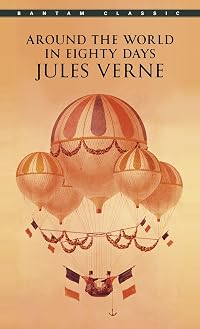
The cover art for this audiobook is further proof of the publisher's cluelessness. It features a large hot-air balloon... which Phileas Fogg never takes. Verne mentions a balloon for about two seconds as a method of travel that would most certainly not work for Mr. Fogg — and then the cover sports one prominently. *sigh*
But I don't want to leave you with all this negativity. The rating I am giving is strictly for the book. Random House/Listening Library's hamfisted approach is such a pity, because the actual production was excellent. I enjoyed the ethnic music that opened each new chapter, and of course Dale was great. And I suppose it's good the publishers didn't excise the parts they didn't like; this is unabridged, after all. But it's a 50th anniversary tribute to Listening Library's first audiobook production, which was this book. It might look bad if they interfered with the actual text itself.
If you think you are intelligent enough to perceive ideas that are in alignment with their historical setting (and actually, perhaps, ahead of their time) — if you're sure you won't suddenly morph into a bigot under Verne's pernicious influence — you really ought to give this book a try. It's funny, well written, and adventurous, and you'll enjoy every minute of Phileas Fogg's eighty days around the world. I certainly did. Highly recommended! show less
I was surprised to realize that I had probably never read the unabridged version of this story. I have a vague recollection of one of those Great Illustrated Classics, with a truly terrifying illustration of Passepartout in the opium den. Though I'm familiar with many of Verne's plots, I haven't really sat down with one of his books show more as an adult reader. I see I will have to rectify that.
Phileas Fogg is an eccentric English gentleman who has followed an unvarying pattern — to the minute — for most of his life. He is meticulous down to the temperature of his shaving water, and when his manservant brings him water that is two degrees too cold, Mr. Fogg has no alternative but to fire him. We arrive at the house in Savile Row the day the new servant, Passepartout, is to begin work. Passepartout is delighted at the prospect of a well-ordered, established life, but it is not to be. That very night, Fogg makes a twenty-thousand-pound bet at his club that he can travel around the world in eighty days. To the astonishment of his colleagues, who are well accustomed to his precise and unvarying life, Fogg sets out that very evening on his madcap voyage.
There is an interesting correlation between this story and that of Les Misérables; though completely opposite in tone and plot, both feature a legalistic, misled police inspector trailing the hero on all his journeys. Both inspectors step in to wreak ruin upon their quarry at the worst possible moment, and both, in the end, are foiled. That is probably as far as the comparison goes, but isn't it interesting? Les Misérables was published in 1862, and Around the World in Eighty Days in serial form in 1873.
I love Verne's descriptions; they are often so wryly humorous. Anyone who thinks classics are boring and slow really ought to read this book. He says that Fogg is "like an incarnation of the god of punctuality," and continually calls Passepartout a "dear fellow." Inspector Fix is also a very humorous and yet well-rounded character. Of Mrs. Aouda, alas, we do not see much.
I can't praise Jim Dale's reading enough; it was wonderful. His voices for the characters were superb. The only weakness was his voice for Mrs. Aouda, but it seems a common failing among male actors; they never can get the women's voices so well as the female actors can get the men's. But apart from that small quibble, I loved Dale's interpretation, especially of the beloved Passepartout! I will always hear his slightly breathless, emphatic, strongly accented voice in my head when I think of the character. (I should mention that another thing I love about audiobooks is that I learn how to pronounce all the words and names... Passepartout is pronounced "Paspertoo;" who knew?).
And now for the banal little talk at the end, given by the son of the man who started the Listening Library company (now owned by Random House). First off, the poor man's voice is not a pleasure to listen to after Dale's warm, rolling tones. It's nasally, effeminate, and just plain annoying. Even had his script been wonderful, it would have been hard to appreciate, read by that unfortunate voice.
And what he says is bad enough on its own account. Does Listening Library commend Verne for being interested in other countries and cultures, for opening new vistas to his readers, and demonstrating a vivid curiosity about the fascinating world around him? Do they praise his enthusiasm for the exotic and share his excitement for the geographical limitations that technology was removing? Oh no. Instead, the publishers chose to disparage his work as "unacceptable" by today's standards in its portrayal of "certain social structures" and "other cultures." Verne, they self-righteously sniff, displays a staggering "naivete" and "lack of appreciation and experience" for the various cultures that his characters encounter.
Sure, Verne had an imperfect understanding of the many cultures in his book. Do we, in chronological snobbery, really think our appreciation of every culture and "social structure" so perfect? Actually I was rather disappointed that the publisher did not actually mention the specific issues with the story, preferring rather to take the safe route of vague, lofty accusation. It's a good thing readers are generally intelligent enough to pick out these things for ourselves — where, oh where would we be without Listening Library to mold our minds? And there are textual refutations to their sweeping claims, if they would but condescend to play fair and be specific about what's giving them indigestion.
I find it absurd and unfair to judge a historical figure by modern standards. I think if any sermon must be made of the book's relative level of 21st-century political correctness or lack thereof (again, assuming we readers aren't astute enough to pick it out for ourselves), it ought to focus on the themes of the story rather than passing judgment on the author.
The cover art for this audiobook is further proof of the publisher's cluelessness. It features a large hot-air balloon... which Phileas Fogg never takes. Verne mentions a balloon for about two seconds as a method of travel that would most certainly not work for Mr. Fogg — and then the cover sports one prominently. *sigh*
But I don't want to leave you with all this negativity. The rating I am giving is strictly for the book. Random House/Listening Library's hamfisted approach is such a pity, because the actual production was excellent. I enjoyed the ethnic music that opened each new chapter, and of course Dale was great. And I suppose it's good the publishers didn't excise the parts they didn't like; this is unabridged, after all. But it's a 50th anniversary tribute to Listening Library's first audiobook production, which was this book. It might look bad if they interfered with the actual text itself.
If you think you are intelligent enough to perceive ideas that are in alignment with their historical setting (and actually, perhaps, ahead of their time) — if you're sure you won't suddenly morph into a bigot under Verne's pernicious influence — you really ought to give this book a try. It's funny, well written, and adventurous, and you'll enjoy every minute of Phileas Fogg's eighty days around the world. I certainly did. Highly recommended! show less
Book 269 - Jules Verne - Around the World in 80 Days
Another trip to my youth and again another that was recently dramatised for the BBC. I can’t help but say that although I thoroughly enjoyed their journey, it doesn’t half take liberties with text. Two whole opening episodes that take up a few short sentences in the book as Phileas Fogg traverses from the Reform Club through France and Italy to Africa.
Fogg is a much more outgoing but extremely fastidious character and the book makes it clear that he is more than able to carry through on the task of circumnavigating the globe to be back before Christmas…although in the book’s case the 80 days are up on 21st Dec and not Christmas Eve as portrayed in the TV series.
Fogg is a bit of show more a Victorian daredevil and his valet, Passepartout, helps bring this out even more…as they escape a case of mistaken identity in Africa to the rescue of a potential human sacrifice in India on to a wonderful race through America to reach the east coast and catch a ship to Europe.
Through all of this he is pursued by Police Detective Fix who reckons he is an international thief who has stolen £55 000…it is ridiculous…it is due to paper thin evidence…but it works…
What follows is the best of Victorian farce as Fogg races to get back to the Reform Club before the 80 days are up.
It is charming and challenging…of its time and all about timing.
Brilliant…another wonderful read show less
Another trip to my youth and again another that was recently dramatised for the BBC. I can’t help but say that although I thoroughly enjoyed their journey, it doesn’t half take liberties with text. Two whole opening episodes that take up a few short sentences in the book as Phileas Fogg traverses from the Reform Club through France and Italy to Africa.
Fogg is a much more outgoing but extremely fastidious character and the book makes it clear that he is more than able to carry through on the task of circumnavigating the globe to be back before Christmas…although in the book’s case the 80 days are up on 21st Dec and not Christmas Eve as portrayed in the TV series.
Fogg is a bit of show more a Victorian daredevil and his valet, Passepartout, helps bring this out even more…as they escape a case of mistaken identity in Africa to the rescue of a potential human sacrifice in India on to a wonderful race through America to reach the east coast and catch a ship to Europe.
Through all of this he is pursued by Police Detective Fix who reckons he is an international thief who has stolen £55 000…it is ridiculous…it is due to paper thin evidence…but it works…
What follows is the best of Victorian farce as Fogg races to get back to the Reform Club before the 80 days are up.
It is charming and challenging…of its time and all about timing.
Brilliant…another wonderful read show less
I love Jules Verne. He's a ton of fun to read. The adventure stuff is fun, of course, but he also creates awesome characters. Nemo's probably his best-known, but the supremely phlegmatic Phineas Fogg of this book is nearly as memorable. His complete disinterest in exploring the places he passes through is sortof anathema to me, but maybe that's what makes him so fascinating; when I think of traveling around the world, it's with the purpose of seeing it, whereas he sees the entire thing simply as a series of obstacles to be overcome. It's remarkable in its pointlessness; at the end of the trip he has gained no money and experienced little of the cultures he's passed through. He made the trip solely to prove he could do it. (Sure, there's show more that one gain he seems pleased by at the end, but he hardly planned for that, so it has to be removed as a motive.)
The only thing I remembered about this story was that the climax involves a hot air balloon, which turns out not to be true. So that was a surprise.
ps phlegmatic is my new word. This book taught it to me. I'm gonna use it all the time. Sweet. show less
The only thing I remembered about this story was that the climax involves a hot air balloon, which turns out not to be true. So that was a surprise.
ps phlegmatic is my new word. This book taught it to me. I'm gonna use it all the time. Sweet. show less
Having watched the miniseries with David Tennant for the third time, I thought I ought really to read the original in order to better understand how many liberties the adaptation took.
The answer is "All of them - and good on it for that."
I had known about the whole sati episode, so I was prepared for some racism. I wasn't however prepared for so much racism. Aouda is an acceptable heroine only because as a Parsee she is of the "highest of the native races of India", and "received a thoroughly English education [...], and, from her manners and intelligence, would be thought an European", and "spoke English with great purity", and her relative had made enough money to be made a baronet somehow. Meanwhile "the savage Papuans [...] are in show more the lowest scale of humanity, but are not, as has been asserted, cannibals," um. Um. I guess you're trying to be even-handed, Jules, but no, please just stop talking about people. Sadly there's more of this, so much more, and it's deeply embedded in the plot - so the miniseries had the best idea to just burn it down and start from scratch as a "vaguely inspired by distant recollections of".
Aouda does get to make a pretty fantastic marriage proposal. It's a pity: she could do a lot better than some rich dude who proves that it's possible to travel around the world in 80 days if you have (in 2022 money) millions of pounds to throw at every obstacle in your path and don't mind occasionally skipping bail and fomenting mutiny. show less
The answer is "All of them - and good on it for that."
I had known about the whole sati episode, so I was prepared for some racism. I wasn't however prepared for so much racism. Aouda is an acceptable heroine only because as a Parsee she is of the "highest of the native races of India", and "received a thoroughly English education [...], and, from her manners and intelligence, would be thought an European", and "spoke English with great purity", and her relative had made enough money to be made a baronet somehow. Meanwhile "the savage Papuans [...] are in show more the lowest scale of humanity, but are not, as has been asserted, cannibals," um. Um. I guess you're trying to be even-handed, Jules, but no, please just stop talking about people. Sadly there's more of this, so much more, and it's deeply embedded in the plot - so the miniseries had the best idea to just burn it down and start from scratch as a "vaguely inspired by distant recollections of".
Aouda does get to make a pretty fantastic marriage proposal. It's a pity: she could do a lot better than some rich dude who proves that it's possible to travel around the world in 80 days if you have (in 2022 money) millions of pounds to throw at every obstacle in your path and don't mind occasionally skipping bail and fomenting mutiny. show less
I have no idea if I’ve read this before – I don’t think so, but it’s hard to tell since I’ve seen versions of the films enough times over the decades to know the story. Except, well, they’re not the story. I don’t think any of the movies I’ve seen – I can think of two, off the top of my head, one starring David Niven and the other Steve Coogan – are at all faithful to the book. Yes, Phineas Fogg accepts a challenge to travel around the world in eighty days. Yes, he thinks he’s failed, only to discover that by travelling east he has gained a day. Yes, he has adventures along the way, and even rescues a young woman who becomes his wife at the end of the book. But in the novel, he meets her in India, when he rescues show more her from suttee. And I don’t recall a Scotland Yard detective on Fogg’s trail for much of his travels – he believes Fogg stole £50,000 shortly before leaving London. And the final section, in which a desperate Fogg, Passepartout, Fix and Aouda race across the USA to catch a ship to Liverpool… the big set-piece is driving a train over a damaged bridge at high speed so the bridge doesn’t collapse under it. Much of the prose is larded with geography lessons, and while Verne’s didactism is one of the more charming aspects of his novels, here it seems overdone. True, I’m coming at the book more than a century later, as a member of a society considerably better-informed about world geography, and a highly-educated member of that society with an interest in other countries… So much of the exposition was superfluous as far as I was concerned. Further, Fogg’s characterisation as unemotional and po-faced hardly made him a sympathetic protagonist. Perhaps Verne intended this so the reader would indeed think Fogg was the bank robber, but it only made him feel like he had zero depth. Unfortunately, I’m not convinced, from what I remember, that the film adaptations are especially superior. The book is, I suspect, the best version of the story. Which is a bit of a shame. show less
Jules Verne’s Around the World in Eighty Days is an absolute joy. This gleeful romp, wherein Phileas Fogg places a bet with some associates at the Reform Club that he can indeed perform the titular feat in that prescribed timeframe. Verne is at his wittiest, with a wonderful cast of characters: Fogg, one of literature’s great eccentrics; his loyal and resourceful servant Passepartout; and the comically inept Detective Fix, in hot pursuit of Fogg who has become a suspect in a recent bank robbery. Along the way Verne provides panoramic travelogue summaries for each new locale, which colorfully set the scenes. The story flows like a giddy Wes Anderson screenplay - and, in my view, that’s a compliment to both Anderson and Verne.
Members
- Recently Added By
Lists

The Guardian's 1000 Novels Everyone Must Read
1,005 works; 551 members

1001 Books You Must Read Before You Die
1,448 works; 1,133 members

Read the book and saw the movie
1,170 works; 195 members

Favourite Books
1,819 works; 316 members

Best of French Literature
138 works; 27 members

Favourite 19th century fiction
257 works; 62 members

Best Adventure Stories
66 works; 15 members

Unread books
1,063 works; 83 members

Top Five Books of 2013
1,562 works; 721 members

Best Books About Journeys and Quests
117 works; 30 members

19th Century
190 works; 16 members

1001 Children's Books You Must Read Before You Grow Up
774 works; 101 members
Out of Copyright
244 works; 14 members

150 Best Novels Selected by Brander Matthews (1883)
150 works; 7 members

Western World's Greatest Books - Project Gutenberg
295 works; 15 members

Best Science Fiction Novels
816 works; 430 members

Blue Pyramid 1,276 Best Books of All Time
1,248 works; 32 members
One Book, Many Authors
441 works; 40 members

1,001 BYMRBYD Concensus
723 works; 27 members

Epic Fiction
42 works; 12 members

Asia
178 works; 7 members

Newark Public Library's 1904 List of a Thousand of the Best Novels
95 works; 5 members

Books Read in 2014
2,343 works; 89 members

Watched the Movie, Probably Won't Read the Book
185 works; 34 members

Books With Numbers in the Title
308 works; 13 members
Works That Inspired Disney Movies
119 works; 13 members

Best Science Fiction Originally Published in a Language Other Than English
449 works; 34 members
United Kingdom
82 works; 5 members

Literature in Translation
113 works; 5 members

Books Read in 2023
5,638 works; 147 members
Overdue Podcast
806 works; 9 members

Books Read in 2016
4,666 works; 199 members
Books Read in 2015
3,299 works; 129 members

Evan's Reading List 2020
12 works; 1 member

Generation Joshua
115 works; 3 members

Books Read in 2017
4,249 works; 130 members
Reading LIst
648 works; 1 member

Read in 1999
62 works; 1 member

Recommended Reading List
219 works; 1 member

Recommended Reading : 600 Classics Reviewed, Editors of Salem Press, 2015
634 works; 6 members

Favorite Books in Translation
320 works; 133 members
Works Referenced in The League of Extraordinary Gentlemen
122 works; 6 members

Favorite Kids Books (chapter, middle grade)
170 works; 4 members
Folio Society
831 works; 53 members

Books Read in 2025
4,128 works; 98 members

Books Read in 2026
1,995 works; 67 members

el
1,139 works; 1 member

Books referenced in the Astral Library
60 works; 1 member

Works Cited in The Life and Death of Democracy by John Keane
278 works; 1 member

Books Read in 2021
5,361 works; 114 members

Before Austen Comes Aesop
318 works; 9 members

Elevenses
316 works; 88 members

Books Read in 2012
816 works; 34 members

Books Read in 2012 (Numbered)
168 works; 6 members
Books With Time Words in the Title
160 works; 4 members
Books available on Open Library
171 works; 4 members

Books Read in 2013
1,630 works; 51 members
Favorite Childhood Books
1,651 works; 519 members

Sonlight Books
1,487 works; 25 members
Honey For a Child's Heart
1,152 works; 25 members

Unshelved Book Clubs
579 works; 5 members

French Fiction of the 18th and 19th Centuries in English Translation
169 works; 3 members
Puffin Books 70th anniversary handbook recommendations
537 works; 10 members

Books Read in 2024
4,727 works; 128 members
Author Information

2,850+ Works 112,785 Members
Jules Verne was born on February 8, 1828 in Nantes, France. He wrote for the theater and worked briefly as a stockbroker. He is considered by many to be the father of science fiction. His most popular novels included Journey to the Center of the Earth, Twenty Thousand Leagues Under the Sea, and Around the World in Eighty Days. Several of his works show more have been adapted into movies and TV mini-series. In 1892, he was made a Chevalier of the Legion of Honor in France. He died on March 24, 1905 at the age of 77. (Bowker Author Biography) Jules Verne (1828-1905) is the author of numerous adventure stories grounded in popularizations of science. (Publisher Provided) show less
Some Editions
Awards and Honors
Awards
Distinctions
Notable Lists
Series

Belongs to Publisher Series
Roman für alle (64)
Geração Público (1)
Die grosse Jules Verne Ausgabe (Band 6)
Dean's Classics (13)
Airmont Classics (24)
Grandes Novelas de Aventuras (XXXIV)
Corticelli [Mursia] (26)
Tus libros (37)
Elsevier pockets (JVW11)
Penguin Clothbound Classics (2021*)
Work Relationships
Is contained in
Journey to the Center of the Earth / Twenty Thousand Leagues Under the Sea / Round the World in Eighty Days by Jules Verne
Twenty Thousand Leagues Under the Sea / The Mysterious Island / Journey to the Center of the Earth / Around the World in Eighty Days by Jules Verne
Zwanzigtausend Meilen unter dem Meer / Reise um die Erde in achtzig Tagen / Fünf Wochen im Ballon. 3 Welterfolge in 1 Band by Jules Verne
The Works of Jules Verne: Twenty Thousand Leagues Under the Sea, A Journey to the Center of the Earth, From the Earth to the Moon, Round the Moon, Around the World in Eighty Days, Short Stories by Jules Verne
Around the World in 80 Days / A Journey to the Centre of the Earth / Twenty Thousand Leagues Under the Sea by Jules Verne
Around the World in Eighty Days / From the Earth to the Moon / 20,000 Leagues Under the Sea by Jules Verne
Amazing Journeys: Journey to the Center of the Earth, From the Earth to the Moon, Circling the Moon, 20,000 Leagues Under the Seas, and Around the World in 80 Days by Jules Verne
Omnibus of Jules Verne: Around the World in Eighty Days/ From the Earth to the Moon / Twenty Thousand Leagues Under the Sea / The Blockade Runners by Jules Verne
Twenty Thousand Leagues Under the Sea / Around the World in Eighty Days / The Blockade Runners / From the Earth to the Moon and a Trip Around It by Jules Verne
Collected Novels: Around the World in 80 Days / The Clipper of the Clouds / Journey to the Centre of the Earth / From the Earth to the Moon / Twenty Thousand Leagues Under the Sea by Jules Verne
Jules Verne - Romane (Vier Bände im Schuber): 20.000 Meilen unter den Meeren - In 80 Tagen um die Welt - Reise zum Mittelpunkt der Erde - Von der Erde zum Mond by Jules Verne
International Collector's Library Classics 19 volumes: Crime & Punishment; Twenty Thousand Leagues Under the Sea; Mysterious Island; Magic Mountain; Around the World in 80 Days; Count of Monte Cristo; Camille; Quo Vadis; Hunchback of Notre Dame; Nana; Scaramouche; Pinocchio; Fernande; War and Peace; The Egyptian; From the Earth to the Moon; Candide; Treasure of Sierra Madre; Siddhartha/Steppenwolf by Jules Verne
Voyages extraordinaires : Michel Strogoff et autres romans: Michel Strogoff et autres romans by Jules Verne
The Ultimate Science Fiction Mega Collection: 24 of the Best Sci-Fi Books of All Time: A Journey to the Center of the Earth, 20,000 Leagues Under the Sea, Around the World in 80 Days, John Carter of Mars Trilogy, The War of the Worlds, The Time Machine, Frankenstein, Dr. Jekyll and Mr. Hyde, 3 Ray Bradbury Stories, Flatland, & More by Jules Verne
Is retold in
Has the (non-series) sequel
Has the adaptation
Classics Illustrated Deluxe #7: Around the World in 80 Days (Classics Illustrated Deluxe Graphic Nove) by Jules Verne
Reading & Training : Jules Verne : Around the world in eighty days [book + sound recording] by CIDEB
Is abridged in
Is parodied in
Inspired
Has as a commentary on the text
Has as a student's study guide
Has as a teacher's guide
Common Knowledge
- Canonical title
- Around the World in Eighty Days
- Original title
- Le Tour du monde en quatre-vingts jours
- Alternate titles
- Around the World in 80 Days
- Original publication date
- 1872 (serial) (serial); 1873 (book) (book)
- People/Characters
- Phileas Fogg; Jean Passepartout; Fix; Francis Cromarty; Aouda; John Bunsby (show all 15); William Batulcar; Stamp Proctor; William Hitch; John Sullivan; Samuel Fallentin; Gauthier Ralph; Thomas Flanagan; Andrew Stuart; Samuel Wilson
- Important places
- London, England, UK; Paris, France; Brindisi, Apulia, Italy; Suez, Egypt; Mumbai, Maharashtra, India (as Bombay, India); Kholby, India (fictional?) (show all 23); Bundelkhand, India (region); Allahabad, Uttar Pradesh, India (officially known as Prayagraj); Kolkata, West Bengal, India (as Calcutta, India); Singapore; Hong Kong, China; Shanghai, China; Yokohama, Kanagawa Prefecture, Japan; San Francisco, California, USA; Ogden, Utah, USA; Medicine Bow, Wyoming, USA; Fort Kearny, Nebraska, USA; Omaha, Nebraska, USA; Chicago, Illinois, USA; New York, New York, USA; Cobh, County Cork, Ireland (as Queenstown, Ireland); Dublin, Ireland; Liverpool, England, UK
- Related movies
- Around the World in Eighty Days (1956 | IMDb); Around the World with Willy Fog (1983 | IMDb); Around the World in 80 Days (1989 | IMDb); Around the World in 80 Days (1999 | IMDb); Around the World in 80 Days (2004 | IMDb); Around the World in 80 Days (2021 | IMDb)
- First words
- Mr. Phileas Fogg lived, in 1872, at No. 7, Saville Row, Burlington Gardens, the house in which Sheridan died in 1814.
In the year 1872, No. 7 Savile Row, Burlington Gardens -- the house where Sheridan died in 1814 -- was occupied by Phileas Fogg, Esq.
(William Butcher's translation).
In the year 1872, the house at number 7 Savile Row, Burlington Gardens - the house in which Sheridan died in 1814 - was lived in by Phileas Fogg, Esq., one of the oddest and most striking members of the Reform Club, even thou... (show all)gh he seemed determined to avoid doing anything that might draw attention to himself.
(Penguin 2004 edition translation) - Last words
- (Click to show. Warning: May contain spoilers.)Truly, would you not for less than that make the tour around the world?
(Click to show. Warning: May contain spoilers.)In truth, wouldn't anyone go around the world for less?
(William Butcher's translation) - Publisher's editor*
- Pierre-Jules Hetzel
- Original language
- French
- Disambiguation notice
- This LT work should be the complete text of Jules Verne's 1873 novel, Around the World in Eighty Days. Please do not combine it with any abridgements, adaptations, young readers' versions, pop-up books, graphic novels,... (show all) annotated editions, multi-title compendiums, single volumes of a multi-volume edition, or other, similar works based on the original. Thank you.
*Some information comes from Common Knowledge in other languages. Click "Edit" for more information.
Classifications
Statistics
- Members
- 20,261
- Popularity
- 288
- Reviews
- 303
- Rating
- (3.83)
- Languages
- 40 — Arabic, Catalan, Chinese, Czech, Danish, Dutch, English, Estonian, Finnish, French, German, Galician, Greek, Hebrew, Hungarian, Icelandic, Italian, Japanese, Kannada, Korean, Latvian, Lithuanian, Malayalam, Malay, Norwegian (Bokmål), Norwegian, Polish, Romanian, Russian, Slovak, Slovenian, Spanish, Swahili, Swedish, Thai, Turkish, Urdu, Welsh, Portuguese (Portugal), Portuguese (Brazil)
- Media
- Paper, Audiobook, Ebook
- ISBNs
- 1,528
- UPCs
- 14
- ASINs
- 520