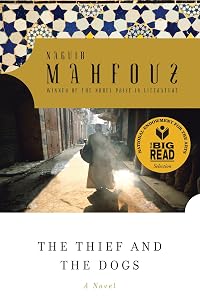
The Thief and the Dogs
by Naguib Mahfouz
On This Page
Description
First published in 1961, this novel by a Nobel Prize-winning author tells the story of a man who blames an unjust society for his ill fortune. He reverts to old, thieving habits, and eventually brings himself to destruction in a cruel world.Tags
Recommendations

















Member Recommendations
Member Reviews
"The Thief and the Dogs" is one of Naguib Mahfouz's looks at the underclass in Egypt. Having previously read "Midaq Alley," I knew what to expect: a dense, heavy, literary novella full of politics, philosophy, and self-doubt.
Naguib Mahfouz eventually won a Nobel Prize and survived an assassination attempt that came after religion fanatics criticized him. He is a critically beloved author whose library is long and well-received throughout the world.
The book follows Said Mahran, a petty criminal just released from prison. Although he initially wonders what to do, he quickly reconnects with his old life. He seeks revenge against his ex-wife who cheated on him, tries to steal from his ex-mentor, and finds a cleric whose advise is tinged show more with politics.
Mahran is a tragic character. He simply cannot escape his past and is never sure which way to turn, so he ends up moving from one location to the other throughout the book, almost as if he is lost. "The Thief and the Dogs" was slow. I enjoyed the italicized first-person narration from Mahran.
Mahfouz was a contemporary of more well known existentialists like Albert Camus and Jean-Paul Sartre. In comparison, I found Mahfouz more interesting because of the color he adds. Unfortunately, I haven't connected with any of the existential authors since I was in my late teens and took "The Stranger" from my older brother's shelf. Perhaps I have lost the luxury of academic thought. show less
Naguib Mahfouz eventually won a Nobel Prize and survived an assassination attempt that came after religion fanatics criticized him. He is a critically beloved author whose library is long and well-received throughout the world.
The book follows Said Mahran, a petty criminal just released from prison. Although he initially wonders what to do, he quickly reconnects with his old life. He seeks revenge against his ex-wife who cheated on him, tries to steal from his ex-mentor, and finds a cleric whose advise is tinged show more with politics.
Mahran is a tragic character. He simply cannot escape his past and is never sure which way to turn, so he ends up moving from one location to the other throughout the book, almost as if he is lost. "The Thief and the Dogs" was slow. I enjoyed the italicized first-person narration from Mahran.
Mahfouz was a contemporary of more well known existentialists like Albert Camus and Jean-Paul Sartre. In comparison, I found Mahfouz more interesting because of the color he adds. Unfortunately, I haven't connected with any of the existential authors since I was in my late teens and took "The Stranger" from my older brother's shelf. Perhaps I have lost the luxury of academic thought. show less
This book is what I'd expect Dostoevsky to write if he was on crank listening to Blag Flag. I loved the hatred that seethed through each page. Revenge is the driving force of this book. After spending 4 years in an Egyptian prison Said Mahran is freed only to find that his wife, friend, and mentor betrayed him. He immediately plans revenge vowing to kill the dogs that let him down.
The pace of the book is fast and developed differently from my expectations. I did like the way Mahfouz gave us direct insight into Said's thoughts... dark thoughts they were too. Excellent book.
Favorite passages:
"What does a man need in this country, Said?" and without waiting for an answer he said, "He needs a gun and a book: the gun will take care of the show more past, the book is for the future..."
What a lot of graves there are, laid out as far as the eye can see. Their headstones are like hands raised in surrender, though they are beyond being threatened by anything. A city of silence and truth, where success and failure, murderer and victim, come together, where thieves and policemen lie side by side in peace for the first and last time. show less
The pace of the book is fast and developed differently from my expectations. I did like the way Mahfouz gave us direct insight into Said's thoughts... dark thoughts they were too. Excellent book.
Favorite passages:
"What does a man need in this country, Said?" and without waiting for an answer he said, "He needs a gun and a book: the gun will take care of the show more past, the book is for the future..."
What a lot of graves there are, laid out as far as the eye can see. Their headstones are like hands raised in surrender, though they are beyond being threatened by anything. A city of silence and truth, where success and failure, murderer and victim, come together, where thieves and policemen lie side by side in peace for the first and last time. show less
Said Maufoud is recently released from prison and is intent on revenge against his betrayors. The plot depicts his obsession with this, and contrasts society's influence with his personal responsibility for his destructive path. In the end, there is no conclusive answer as to which is more accountable for the outcome.
This novella by the Nobel Prize winning author is set in Egypt after the 1952 Revolution, and describes the events following the release of a young man who is released from a Cairo prison after serving a four year sentence for grand theft. He was betrayed by two former colleagues, who both have become wealthy from their gains, which began in a noble quest to steal from wealthy residents of the city in support of the Revolution. Upon his release he visits the first traitor, who has married his wife and taken in his young daughter, who screams in horror and refuses to greet him when he sees her. He is consumed with anger, and with the help of former companions, he plans his revenge on the two men and his ex-wife. He is unsuccessful in his show more attempts, and he becomes more desperate, as the city and state police slowly descend upon him.
This was a good read, in the existential style of Camus' The Stranger. show less
This was a good read, in the existential style of Camus' The Stranger. show less
Set in Egypt, Said Mahran has just been released from prison. He plans to take revenge on those who he feels are responsible for his imprisonment. He ex-wife is now married to his enemy, his young daughter does not recognize him, and his revolutionary mentor has changed sides. This is the story of a disillusionment, hypocrisy, and failing to take advantage of second chances. Said’s thoughts are indicated in italics, while the main storyline is written in standard format. It is more of a character study than thriller, though it does contain action. I think I may have enjoyed it more if I understood more about the Egyptian political context of the time period. I read the English translation from the original Arabic by Trevor Le Gassick show more and M.M. Badawi. show less
Very tight and fast-paced. Not like any Mahfouz I've read before. As someone else notes, something like Dostoyevsky re the focus on Said's galloping mental state, but while I read it, I was thinking of Camus.
The introduction describes this as impressionistic rather than realistic and I agree. A burglar is released from jail and wants revenge on those who put him there. I can't say I really got alot from it, since it mostly took place inside the burglars head, I didn't get much of a feeling for him or any of the other characters. I have one more by Mahfouz so I will see how that goes.
Members
- Recently Added By
Author Information

344+ Works 19,212 Members
Naguib Mahfouz was born in Cairo, Egypt on December 11, 1911. He received a degree in philosophy from the University of Cairo. He took on several civil service and government department jobs to supplement his income while writing, but retired from that career in 1971. During his lifetime, he wrote more than 30 novels including The Games of Fate, show more The Cairo Trilogy, Children of Gebelawi, The Thief and the Dogs, Autumn Quail, Small Talk on the Nile, and Miramar. He received numerous awards including the Egyptian State Prize, the Presidential Medal from the American University in Cairo, and the Nobel Prize for Literature in 1988. He died as a result of a head injury on August 30, 2006 at the age of 94. (Bowker Author Biography) show less
Some Editions
Awards and Honors
Awards
Notable Lists
Series
Belongs to Publisher Series
Rainbow pocketboeken (125)
Work Relationships
Common Knowledge
- Canonical title
- The Thief and the Dogs
- Original title
- Al-liss wa'l-kilaab (Arabic) (Arabic)
- Original publication date
- 1961
- People/Characters
- Said Mahran; Nur; Nabawiyya; Ra'uf 'Ilwan; Tarzan
- Important places
- Cairo, Egypt
- First words
- Once more he breathed the air of freedom.
- Last words
- (Click to show. Warning: May contain spoilers.)But finally, because he had to succumb, and not caring, he surrounded. Not caring at all now.
Classifications
- Genres
- Fiction and Literature, General Fiction
- DDC/MDS
- 892.736 — Literature & rhetoric Literatures of other languages Afro-Asiatic literatures Arabic (Egypt, Lebanon, Palestine, Saudi Arabia, Sudan) Arabic fiction 1945–2000
- LCC
- PJ7846 .A46 .L513 — Language and Literature Oriental languages and literatures Oriental philology and literature Arabic Arabic literature Individual authors or works
- BISAC
Statistics
- Members
- 530
- Popularity
- 56,603
- Reviews
- 12
- Rating
- (3.65)
- Languages
- 12 — Arabic, Catalan, Danish, Dutch, English, French, German, Hebrew, Italian, Portuguese, Russian, Spanish
- Media
- Paper, Ebook
- ISBNs
- 23
- ASINs
- 5