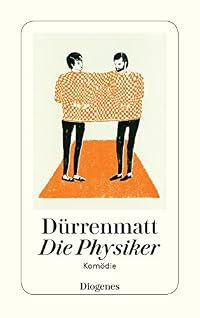
The Physicists
by Friedrich Dürrenmatt
On This Page
Description
Johann Mobius, the world's greatest physicist, is locked away in a madhouse along with two other scientists. Why? Because he is haunted by recurring visions of King Solomon, and the other two are convinced they are Einstein and Newton. But are these three actually mad? Or are they playing a murdererous game with the world at stake? This darkly comic satire probes the cost of sanity among men of science and whether it is the mad who are the truly sane.An L.A. Theatre Works full-cast show more performance featuring Anne Gee Byrd, Matthew Patrick Davis, Bruce Davison, John de Lancie, Matt Gaydos, Harry Groener, Christopher Guilmet, Melinda Page Hamilton, Gregory Itzin, Roma Maffia and Missy Yager.The Physicists is part of L.A. Theatre Works' Relativity Series featuring science-themed plays. Major funding for the Relativity Series is provided by the Alfred P. Sloan Foundation to enhance public understanding of science and technology in the modern world. show lessTags
Recommendations




















Member Recommendations
Member Reviews
The fact is, there's nothing more scandalous than a miracle in the realm of science.
Three of history's greatest physicists meet in a drawing-room: Newton, Einstein and Möbius. Newton has a bottle of cognac hidden in the fireplace. Einstein has just strangled a woman to death. And Möbius is being visited by the ghost of King Solomon, who is telling him the secrets of a Unified Field Theory.
Except the drawing-room belongs to a Swiss insane asylum, and the three men are patients.
What follows is a playful mash-up of a country-house murder-mystery with a scientific drama-of-ideas. At first the execution reminded me of Tom Stoppard – high praise round my way, because I think Stoppard's one of the greatest writers alive. But while show more Stoppard's work is always discursive, and never tries to convince you of a particular position, Dürrenmatt takes a more polemic approach here – especially in the second act, where the characters are increasingly fixated on the dangers of scientific discoveries falling into the wrong hands.
She considered me an unrecognized genius. She didn't realize that today it is the duty of a genius to remain unrecognized.
Great line. Of course when this was first performed in 1962, the Cold War was still on and this felt more of a live issue. It was less than 20 years since the real Einstein had famously said that if he'd known what the results of nuclear research would be, he would have become a watchmaker. (He also said, ‘The discovery of nuclear chain reactions need not bring about the destruction of mankind any more than did the discovery of matches,’ but no one remembers that one.)
These are still crucial questions, but I think the sophistication of the debate has slightly overtaken the moral of this play. Nevertheless, there is a huge amount of fun and intellectual enjoyment to be had here, with jokes and theories and interesting dramatic ideas on every page. I'd love to see it staged – but if waiting for your local theatre to get on board seems daunting, the ideas involved make this well worth reading in the meantime. show less
Three of history's greatest physicists meet in a drawing-room: Newton, Einstein and Möbius. Newton has a bottle of cognac hidden in the fireplace. Einstein has just strangled a woman to death. And Möbius is being visited by the ghost of King Solomon, who is telling him the secrets of a Unified Field Theory.
Except the drawing-room belongs to a Swiss insane asylum, and the three men are patients.
What follows is a playful mash-up of a country-house murder-mystery with a scientific drama-of-ideas. At first the execution reminded me of Tom Stoppard – high praise round my way, because I think Stoppard's one of the greatest writers alive. But while show more Stoppard's work is always discursive, and never tries to convince you of a particular position, Dürrenmatt takes a more polemic approach here – especially in the second act, where the characters are increasingly fixated on the dangers of scientific discoveries falling into the wrong hands.
She considered me an unrecognized genius. She didn't realize that today it is the duty of a genius to remain unrecognized.
Great line. Of course when this was first performed in 1962, the Cold War was still on and this felt more of a live issue. It was less than 20 years since the real Einstein had famously said that if he'd known what the results of nuclear research would be, he would have become a watchmaker. (He also said, ‘The discovery of nuclear chain reactions need not bring about the destruction of mankind any more than did the discovery of matches,’ but no one remembers that one.)
These are still crucial questions, but I think the sophistication of the debate has slightly overtaken the moral of this play. Nevertheless, there is a huge amount of fun and intellectual enjoyment to be had here, with jokes and theories and interesting dramatic ideas on every page. I'd love to see it staged – but if waiting for your local theatre to get on board seems daunting, the ideas involved make this well worth reading in the meantime. show less
A comedic play about a trio of men who believe they are physicists, in a madhouse, where a series of murders are committed. As the plot unravels into a spy drama, the question of what's real and not real becomes blurred... only to be quashed toward the end when the parable of this Cold War play is laid bare.
A quirky play from Switzerland. The central theme is that of three physicists who are committed to an asylum because they are not in contact with reality. One believes he is Albert Einstein, one believes he is Sir Isaac Newton, and the other one is Mobius. A sort of not-so typical entry in the scientists wanting to take over the world genre. This one has a couple of twists that lead to a bit of a surprise ending. The discussions between characters are typical of the time it was written, during the early 1960s, when society was obsessed with the coming nuclear holocaust, but it is still a good discussion of the intersection of science, ethics, business, and government. It loses a lot in the final wrap up speech, where the author suddenly show more begins to channel Pat Robertson, and blame the entire situation on turning away from God. show less
A strange play, though it had its popularity and was performed on Broadway by Robert Shaw and Jessica Tandy. Much of the play is humorous, with one patient of the sanitarium believing he is Sir Isaac Newton, another believing he is Einstein, and they seem quite harmless except for the habit of murdering the nurses. The ending takes a bad turn into Cold War politics but on the whole a very interesting work.
This was great! Very funny, quite absurd, but dealing with science in a critical way that has to be acknowledged and is still relevant today.
A comedic play about a trio of men who believe they are physicists, in a madhouse, where a series of murders are committed. As the plot unravels into a spy drama, the question of what's real and not real becomes blurred... only to be quashed toward the end when the parable of this Cold War play is laid bare.
Merged review:
A comedic play about a trio of men who believe they are physicists, in a madhouse, where a series of murders are committed. As the plot unravels into a spy drama, the question of what's real and not real becomes blurred... only to be quashed toward the end when the parable of this Cold War play is laid bare.
Merged review:
A comedic play about a trio of men who believe they are physicists, in a madhouse, where a series of murders are committed. As the plot unravels into a spy drama, the question of what's real and not real becomes blurred... only to be quashed toward the end when the parable of this Cold War play is laid bare.
Thought-provoking play and quite funny too!
Members
- Recently Added By
Lists

CH-Autoren (Swiss Authors)
265 works; 9 members

Plays I Like
230 works; 31 members

Plays about science and scientists
33 works; 2 members

Books You Read During High School (For School)
301 works; 53 members

1960s
281 works; 16 members

German Literature
514 works; 55 members

Books I've read
87 works; 2 members

Read in school
24 works; 1 member

Philip Ward's Lifetime Reading Plan
592 works; 22 members

Favourite Books
1,817 works; 309 members

20th Century Literature
1,161 works; 55 members

Books Read in 2018
4,360 works; 110 members

Favourite Theatre of the Absurd
30 works; 4 members
1960s, Best books published therein
254 works; 22 members
School Made Us Read It
380 works; 196 members
Author Information

364+ Works 13,213 Members
Durrenmatt was born near Bern, Switzerland, the son of a Protestant clergyman. He studied philosophy and theology and originally planned to become a painter. "All of a sudden," he has said, "I began to write, and I just had no time to finish my University degree." He has called his first play, It Is Written (1947), "a wild story of Anabaptists show more during the Reformation." When it was first produced in Zurich, it caused a minor theatrical scandal because of its somewhat unorthodox sentiments. The Marriage of Mr. Mississippi, his first successful comedy, was produced in Munich in 1952 and, as adapted by Maximillian Slater with the title Fools are Passing Through, had a brief off-Broadway production in 1958. With this play he became established as one of the most popular European dramatists writing in German. His seventh play, The Visit (1956), which starred Alfred Lunt and Lynn Fontanne on Broadway, received the N.Y. Drama Critics Circle Award in 1959. Brooks Atkinson called it "devastating. A bold, grisly drama of negativism and genius." (Bowker Author Biography) show less
Some Editions
Awards and Honors
Series
Belongs to Publisher Series
Work Relationships
Is contained in
Has the adaptation
Has as a study
Common Knowledge
- Canonical title
- The Physicists
- Original title
- Die Physiker
- Alternate titles*
- Die Physiker : Neufassung 1980
- Original publication date
- 1962
- People/Characters
- Fraulein Doktor Mathilde von Zahnd; Marta Boll; Monika Stettler; Murillo; Uwe Sievers; McArthur (show all 9); Herbert George Beutler; Ernest Heinrich Ernesti; Johann Wilhelm Möbius
- Important places
- Les Cerisiers (psychiatric hospital | fictional)
- Important events*
- Atomic Testing
- Dedication*
- Für
Therese Giehse - First words
- Man darf doch rauchen?
- Quotations*
- Was einmal gedacht wurde, kann nicht mehr zurückgenommen werden.
- Last words*
- (Click to show. Warning: May contain spoilers.)Nur noch die Geige Einsteins ist zu hören.
- Blurbers*
- Irma Voser
- Original language
- German
- Disambiguation notice
- In the 1980 "new edition" of this play, there are only minor deviations, not enough to warrant splitting the two editions.
*Some information comes from Common Knowledge in other languages. Click "Edit" for more information.
Classifications
Statistics
- Members
- 2,139
- Popularity
- 9,489
- Reviews
- 14
- Rating
- (4.04)
- Languages
- 12 — Czech, Dutch, English, Estonian, French, German, Hungarian, Italian, Slovenian, Spanish, Turkish, Welsh
- Media
- Paper, Audiobook, Ebook
- ISBNs
- 37
- ASINs
- 25