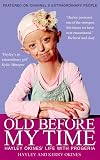
Old Before My Time: Hayley Okines' Life with Progeria
by Hayley Okines
On This Page
Description
Hayley Okines is like no other 13-year-old schoolgirl.In Old Before My Time, Hayley and her mum Kerry reflect on her unusual life. Share Hayley’s excitement as she travels the world meeting her pop heroes Kylie, Girls Aloud and Justin Bieber and her sadness as she loses her best friend to the disease at the age of 11.
Now as she passes the age of 13 – the average life expectancy for a child with progeria – Hayley talks frankly about her hopes for the future and her pioneering drug show more trials in America which could unlock the secrets of ageing for everyone...
. show less
Tags
Recommendations


































Member Recommendations
meggyweg Another biography/memoir of a person dealing with a horrific physical condition. Jean-Dominique Bauby lost his fight. I hope Hayley Okines will not.

Member Reviews
When Kerry Okines became pregnant in 1997, she and her husband, Mark, looked forward to the typical experiences of raising a child. Within a few months of their new daughter, Hayley’s, birth, however, they realized that she was not developing normally. She was not gaining weight, only an ounce or two between health visitor appointments. Kerry noticed small lumps on Hayley’s abdomen which the doctor dismissed as “nothing to worry about.” By the time Hayley was six months old, the Okines were convinced there was a problem. The doctor’s began getting concerned around Hayley’s first birthday.
Following several months of testing, the doctors concluded that Hayley had Hutchinson-Gilford Progeria Syndrom, a disorder that causes show more children to age eight times faster than normal. At eighteen months, she could hold conversations with adults. She knew the names of colours and could count to 10. Her mother wrote, “She definitely seemed much wiser and more inquisitive than other 20-month-old toddlers.”
But physically, she was subject to the same diseases as elderly people–arthritis, joint stiffness, fragile bones, aging skin, dental problems. “Children with progeria die of heart disease or strokes at an average age of thirteen years.”
Kerry wrote that there were only 40 other known cases of progeria in the world and only one other case in the United Kingdom beside Hayley. There was no known cure and the situation was having a negative effect on Kerry and Mark’s relationship. They were not married at the time but married later on when Hayley and her younger brother and sister requested they do so. At one point she contemplated killing Hayley and committing suicide.
She was finally able to find other families who had faced the diagnosis and were able to provide support. She also learned of the Sunshine Progeria Reunion where all the children in the world with progeria and their families were able to meet in the United States every year to share experiences and be with other children just like them. The Progeria Research Foundation provided information about the disease and, perhaps more importantly, encouraged her to make every minute count instead of worrying about what might or might not happen.
One of the problems faced by the children with progeria was having people stare at them. Kerry realized that people were curious and suggested that instead of staring, ask questions to learn about the condition.
Kerry and Mark decided to go public with their story to help educated the public. Because of that, the media has been a major part of their lives. That provided with opportunities that most other children never have–meeting celebrities (like Prince Charles and Justin Bieber), going on vacations, getting on television, getting gifts, etc.
Some of the chapters are written by Kerry and some by Hayley. Hayley wrote that she didn’t remember a lot of the things that happened to her when she was very young, such as some trips, meeting Prince Charles, and winning awards. She notes that she had lots of friends in school but “didn’t like it if everyone is like, ‘Hello, Hayley.’ It’s hard work being a star.”
In 2002, scientists were able to discover the DNA mutation that caused progeria and began looking for a drug to slow it down if not cure it. Hayley was among the children who first tested the drug. She hoped it would help her grow hair and grow taller. She later took part in a second drug test, also successfully.
One thing that bothered me about the story was Kerry and Mark seemed to feel entitled to having people donate money to finance their vacations. I know they had medical expenses but England does provide health coverage and their trips to the US were important for psychological and health reasons. I know they appreciated the help they received. But I felt they felt they deserved more because of Hayley’s progeria.
I liked comparing Kerry’s view of what was happening with Hayley’s perspective of the same incidents. The book has a lot of pictures and is very positive about living with a child who has a terminal illness. It provides a lot of information about the symptoms of the disease and how people cope with it. On the whole, it is very positive.
So far as I have been able to find on-line since finishing the book, Hayley is still alive and functioning.
I got this e-book from a free Amazon download. show less
Following several months of testing, the doctors concluded that Hayley had Hutchinson-Gilford Progeria Syndrom, a disorder that causes show more children to age eight times faster than normal. At eighteen months, she could hold conversations with adults. She knew the names of colours and could count to 10. Her mother wrote, “She definitely seemed much wiser and more inquisitive than other 20-month-old toddlers.”
But physically, she was subject to the same diseases as elderly people–arthritis, joint stiffness, fragile bones, aging skin, dental problems. “Children with progeria die of heart disease or strokes at an average age of thirteen years.”
Kerry wrote that there were only 40 other known cases of progeria in the world and only one other case in the United Kingdom beside Hayley. There was no known cure and the situation was having a negative effect on Kerry and Mark’s relationship. They were not married at the time but married later on when Hayley and her younger brother and sister requested they do so. At one point she contemplated killing Hayley and committing suicide.
She was finally able to find other families who had faced the diagnosis and were able to provide support. She also learned of the Sunshine Progeria Reunion where all the children in the world with progeria and their families were able to meet in the United States every year to share experiences and be with other children just like them. The Progeria Research Foundation provided information about the disease and, perhaps more importantly, encouraged her to make every minute count instead of worrying about what might or might not happen.
One of the problems faced by the children with progeria was having people stare at them. Kerry realized that people were curious and suggested that instead of staring, ask questions to learn about the condition.
Kerry and Mark decided to go public with their story to help educated the public. Because of that, the media has been a major part of their lives. That provided with opportunities that most other children never have–meeting celebrities (like Prince Charles and Justin Bieber), going on vacations, getting on television, getting gifts, etc.
Some of the chapters are written by Kerry and some by Hayley. Hayley wrote that she didn’t remember a lot of the things that happened to her when she was very young, such as some trips, meeting Prince Charles, and winning awards. She notes that she had lots of friends in school but “didn’t like it if everyone is like, ‘Hello, Hayley.’ It’s hard work being a star.”
In 2002, scientists were able to discover the DNA mutation that caused progeria and began looking for a drug to slow it down if not cure it. Hayley was among the children who first tested the drug. She hoped it would help her grow hair and grow taller. She later took part in a second drug test, also successfully.
One thing that bothered me about the story was Kerry and Mark seemed to feel entitled to having people donate money to finance their vacations. I know they had medical expenses but England does provide health coverage and their trips to the US were important for psychological and health reasons. I know they appreciated the help they received. But I felt they felt they deserved more because of Hayley’s progeria.
I liked comparing Kerry’s view of what was happening with Hayley’s perspective of the same incidents. The book has a lot of pictures and is very positive about living with a child who has a terminal illness. It provides a lot of information about the symptoms of the disease and how people cope with it. On the whole, it is very positive.
So far as I have been able to find on-line since finishing the book, Hayley is still alive and functioning.
I got this e-book from a free Amazon download. show less
i'm going to start book reviews again. i stopped cause i was so busy. but i do need to write reviews again...even if it's not for every book.
i loved this book. i had seen documentaries on Hayley before, but reading her story was a wonderful thing too. i love memoirs and i speed through this one. Hayley had Progeria where she ages 8 times faster making her really 100 at only the age of 13. She is strong with all the tests she goes through, she doesn't let anything get in her way. even if you're not a fan of memoirs i suggest you read this book. :)
i loved this book. i had seen documentaries on Hayley before, but reading her story was a wonderful thing too. i love memoirs and i speed through this one. Hayley had Progeria where she ages 8 times faster making her really 100 at only the age of 13. She is strong with all the tests she goes through, she doesn't let anything get in her way. even if you're not a fan of memoirs i suggest you read this book. :)
Before reading:
Won as a first reads ARC. Author's home page: http://hayleyspage.com/
HGPS is a tragic disease that is, or resembles, or mimics, premature aging. I'm hoping the book will strike a good balance between personal story and scientific information.
After reading:
More personal than scientific, the storytelling alternates between Hayley and her mother. The writing is not highly polished, making it a good teaching text. Because there are so few people with progeria, and because Hayley has been participating in clinical trials, the book provides a unique perspective.
Won as a first reads ARC. Author's home page: http://hayleyspage.com/
HGPS is a tragic disease that is, or resembles, or mimics, premature aging. I'm hoping the book will strike a good balance between personal story and scientific information.
After reading:
More personal than scientific, the storytelling alternates between Hayley and her mother. The writing is not highly polished, making it a good teaching text. Because there are so few people with progeria, and because Hayley has been participating in clinical trials, the book provides a unique perspective.
I've watched a few of the documentaries that include Hayley and definitely think her story is better absorbed that way. This book was written mostly by her mother and is quite choppy in all aspects. It doesn't go in chronological order and it just doesn't seem to flow very well.
Her story is a very good one - just not so much when put in book form.
Her story is a very good one - just not so much when put in book form.
I could put the book down. It's such a heartbreaking yet uplifting story. It's a must read for anyone.
This was a fun short read, It was so interesting to see how medical advances can help people so much! I hope she lives a long and healthy life!
An interesting story from the view of a mother whose child has progeria, and her daughter.
Members
- Recently Added By
Author Information
3 Works 88 Members
Classifications
- Genres
- Biography & Memoir, Nonfiction, General Nonfiction
- DDC/MDS
- 362.196042092 — Society, government, & culture Social problems and social services Social Welfare People with physical illnesses Services to people with specific conditions Diseases
- LCC
- RC580 .P7 — Medicine Internal medicine Internal medicine
- BISAC
Statistics
- Members
- 84
- Popularity
- 380,501
- Reviews
- 8
- Rating
- (3.75)
- Languages
- English
- Media
- Paper, Ebook
- ISBNs
- 3
- ASINs
- 2