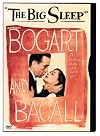
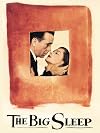
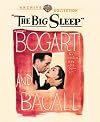
The Big Sleep [1946 film]
by Howard Hawks (Director), Leigh Brackett (Screenwriter), William Faulkner (Screenwriter), Jules Furthman (Screenwriter)
On This Page
Description
L.A. private eye Philip Marlowe takes on a blackmail case and follows a trail peopled with murderers, pornographers, nightclub rogues and the spoiled rich.Tags
Recommendations










Member Reviews
Fantastic story with awesome craftmanship. Highly descriptive scenes and characters. Philip Marlowe is the archetypal tough, serious, wisecracking, seen-everything ex-cop, yet honest with his own set of inviolable principles. The story begins as Marlow consults with California oil millionaire who is pathetically frail and disabled. He is unable to curb or protect his two daughters, in their twenties, and is being blackmailed due to their gambling and involvement in pornography. Having seen the movie w/ Bogart and Bacall, I'd say the book was much better. The complex plot and interactions were not as comprehensibly laid out in the film. Nevertheless, seeing the movie first helped to set the scene for reading the book. A-1 classy writing. show more Unlike Hammett, Chandler manages to be gritty without being too grisly. show less
A private detective on a blackmail case runs into some murders.
2.5/4 (Okay).
Every now and then there'll be a fun bit of dialog that hints at how good the book is, but that's about all this has going for it.
2.5/4 (Okay).
Every now and then there'll be a fun bit of dialog that hints at how good the book is, but that's about all this has going for it.
2024 movie #204. 1946. Philip Marlow (Bogart) takes a case involving blackmail, murder, kidnapping and Lauren Bacall. The plot hardly matters, it's all about the dialog and the chemistry between Bogart and Bacall. I've seen it before but it stands up to repeated viewing.
Ratings
Members
- Recently Added By
Lists

Great Films Based on Books
319 works; 140 members
Author Information

Howard Hawks, an American producer, writer, and director, grew up in California, studied engineering, and served in the Army Air Corps during World War I. For 45 years he made movies in all of the standard Hollywood genres: popular "screwball comedies" like His Girl Friday (1940) and Bringing Up Baby (1938), westerns like Red River (1948) and Rio show more Bravo (1959), musicals like Gentlemen Prefer Blondes (1953), gangster films like Scarface (1932), adventure films like To Have and Have Not (1944), and private-eye melodramas like The Big Sleep (1946). These were not run-of-the-mill movies, however, for Hawks infused them with his own style and themes. He tended to use a symmetrical structure and sparse dialogue, depending on concrete visual images to reveal character in action. Although he worked with some of the best writers in Hollywood (Ben Hecht, Jules Furthman, and William Faulkner, for example), he allowed his actors to add or alter lines, believing that improvisation improved the verisimilitude of a film. Hawks received only one Academy Award nomination in his career, for Sergeant York (1941), but he was given the Lifetime Achievement Award by the Academy in 1975. (Bowker Author Biography) show less


Born in an old Mississippi family, William Faulkner made his home in Oxford, seat of the University of Mississippi. After the fifth grade he went to school only off and on-lived, read, and wrote much as he pleased. In 1918, refusing to enlist with the "Yankees," he joined the Canadian Air Force, and was transferred to the British Royal Air Force. show more After the war he studied a little at the University, did house painting, worked as a night superintendent at a power plant, went to New Orleans and became a friend of Sherwood Anderson, then to Europe and back home to Oxford. By this time he had written two novels. The Sound and the Fury followed in 1929. Financial success came with Sanctuary in 1931, which he assisted in filming. Faulkner 's novels are intense in their character portrayals of disintegrating Southern aristocrats, poor whites, and African Americans. A complex stream-of-consciousness rhetoric often involves Faulkner in lengthy sentences of anguished power. Most of his tales are set in the mythical Yoknapatawpha County, Mississippi, and are characterized by the use of many recurring characters from families of different social levels spanning more than a century. His best subjects are the old, dying South and the newer materialistic South. As I Lay Dying (1930), is a grotesquely tragicomic story about a family of poor southern whites. With Absalom, Absalom! (1936); the difficult parts of his famous short novel "The Bear" (published in Go Down, Moses, 1942); and the allegorical A Fable (1954), a non-Yoknapatawpha novel set in France during World War I; Faulkner returned to an innovative and difficult style that most readers have trouble with. Yet, interspersed among such works are collections of easily read stories originally published in popular magazines. There seems to be a growing sentiment among critics that the Snopes trilogy-The Hamlet (1940), The Town (1957), and The Mansion (1959)-for the most part an example of Faulkner's "moderate" style, could well be among his most important works. Faulkner was awarded the 1949 Nobel Prize for literature "for his powerful and artistically independent contribution to the new American novel," but it would appear now that he also deserved to win that honor for his contribution to world literature. When reporting his death, the Boston Globe quoted Faulkner's having once told an interviewer: "Since man is mortal, the only immortality for him is to leave something behind him that is immortal since it will always move. That is the artist's way of scribbling "Kilroy was here" on the wall of the final and irrevocable oblivion through which he must some day pass." In addition to the Nobel Prize, Faulkner received the Howells Medal of the American Academy of Arts and Letters in 1950, and in 1951 he was given the National Book Award for his Collected Stories Collected Stories. For his novel A Fable he received the National Book Award for the second time, as well as the Pulitzer Prize in 1955. The Reivers (1962) was awarded the Pulitzer Prize in 1963. In 1957 and 1958, he was the University of Virginia's first writer-in-residence, and in January 1959 he accepted an appointment as consultant on contemporary literature to the Alderman Library of that university. Although Faulkner was not without honors in his lifetime and has received world recognition since then, it is surprising to learn that, when Malcolm Cowley edited The Portable Faulkner in 1946, he found that almost all of Faulkner's books were out of print. By arranging selections from the works to form a continuous chronicle, Cowley deserves much of the credit for making readers aware of the way in which Faulkner was creating a fictive world on a scale grander than that of any novelist since Balzac. William Faulkner died in Oxford, Mississippi, in 1962. (Bowker Author Biography) show less

All Editions
Awards and Honors
Awards
Notable Lists
Series
Belongs to Publisher Series
Warner home video greatest classic films collection (Murder mysteries)
Work Relationships
Is contained in
Is an adaptation of
Has as a study
Has as a supplement
Common Knowledge
- Canonical title
- The Big Sleep [1946 film]
- Original title
- The Big Sleep
- Original publication date
- 1946-08-22
- People/Characters
- Philip Marlowe
- Important places*
- Indiana, Verenigde Staten
- Related movies
- The Big Sleep (1946 | IMDb)
- Canonical DDC/MDS
- 791.43
- Canonical LCC
- PN1995.D4
- Disambiguation notice
- This is the motion picture. Under no circumstances should it be combined with the book it is based on.
*Some information comes from Common Knowledge in other languages. Click "Edit" for more information.
Classifications
Statistics
- Members
- 321
- Popularity
- 97,834
- Reviews
- 4
- Rating
- (4.23)
- Languages
- 5 — Dutch, English, French, Italian, Spanish
- ISBNs
- 15
- UPCs
- 9
- ASINs
- 18