On This Page
Description
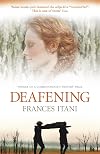
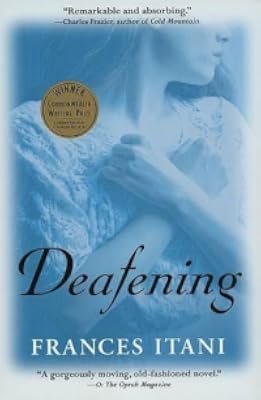
Left profoundly deaf from scarlet fever, Grania O'Neill grows up protected from the hearing world and learning sign language, but her life changes when she falls in love with Jim Lloyd, a hearing man, on the eve of the Great War.Tags
Recommendations

















Member Recommendations
Member Reviews
Deafening tells the story of Grawnia, a girl in a rural Canadian town at the beginning of the 20th century, who has lost her hearing due to scarlet fever. The story spans just over about fifteen years of her life, starting from when she is a very young girl learning how to communicate with people after losing her hearing, to going to school for the deaf, to falling in love and getting married, to living through WWI.
The Review
I don’t know what it is about books about Canadians in WWI, but I feel like I’ve read more of them in the past few years than I have of all other nationalities in all other wars combined. I’ve read some brilliant ones that I have/will come back to again and again, but you wouldn’t think it’s a subject show more matter I would enjoy reading about. It’s usually emotionally raw (in at least portions of it) and it tears you to bits, but it keeps drawing me back for more…
This book was definitely one of those about WWI that I will be coming back to again. I loved this book so very, very much.
It was a bit hard to get into at first. It’s a quiet novel, so felt a little bit slow-paced even though there was always something going on, whether it was Grawnia’s adjustment to being involved with the deaf community, or whether it’s about her husband Jim’s experiences in the war.
I’ve never read any books before where the main character is a deaf person, but I love how this gave me such an insight into the life of someone who would not be able to hear a thing. It was brilliant to get a glimpse into that. And even the way the book is narrated, it just seemed to embody that soundlessness – when you’re reading about Gawnia, you don’t hear the noise of anything else that is going on, it’s just focused exactly on what is important at that exact moment.
The Bottom Line
What an utterly beautiful book! It was a bit slow moving at times, but totally worth getting into. I want to say that this is one of the best books I’ve read this year, but seeing as I’ve now read five books this year… it doesn’t really express how much I loved it. show less
The Review
I don’t know what it is about books about Canadians in WWI, but I feel like I’ve read more of them in the past few years than I have of all other nationalities in all other wars combined. I’ve read some brilliant ones that I have/will come back to again and again, but you wouldn’t think it’s a subject show more matter I would enjoy reading about. It’s usually emotionally raw (in at least portions of it) and it tears you to bits, but it keeps drawing me back for more…
This book was definitely one of those about WWI that I will be coming back to again. I loved this book so very, very much.
It was a bit hard to get into at first. It’s a quiet novel, so felt a little bit slow-paced even though there was always something going on, whether it was Grawnia’s adjustment to being involved with the deaf community, or whether it’s about her husband Jim’s experiences in the war.
I’ve never read any books before where the main character is a deaf person, but I love how this gave me such an insight into the life of someone who would not be able to hear a thing. It was brilliant to get a glimpse into that. And even the way the book is narrated, it just seemed to embody that soundlessness – when you’re reading about Gawnia, you don’t hear the noise of anything else that is going on, it’s just focused exactly on what is important at that exact moment.
The Bottom Line
What an utterly beautiful book! It was a bit slow moving at times, but totally worth getting into. I want to say that this is one of the best books I’ve read this year, but seeing as I’ve now read five books this year… it doesn’t really express how much I loved it. show less
This is a tender and deeply moving book. Frances Itani tells the story of a deaf woman (loosely inspired on her own deaf grandmother), waiting for her young husband’s return from WWI with superb prose. The complexity of what is or isn’t communicate in every relationship, the loneliness of disconnect, and ultimately the healing power of love, family and friendship is weaved through the plot with mastery.
I am looking forward to Itani’s next book.
I am looking forward to Itani’s next book.
This story is filled with such tragedy. In Part I Grania O'Neill is just five years old when she loses her hearing after a bout with scarlet fever. Her family is desperate to make her normal, to help her fit in the the hearing world. Her grandmother and sister devote themselves to helping her cope. When it is obvious she can't, Grania, at nine years old, is sent away to a boarding school for the deaf. Part II covers one year. The year is 1915 and Grania is now 19 and working at Gibson Hospital. She meets and marries a hearing man, Jim Lloyd. In Part III Jim has gone to help in the war effort as a medic. The violence he encounters at this time assaults his senses to the core, but it is the thought of Grania and their love that sustains show more him. Part IIII (that is deliberate) covers 1917 - 1918. Jim has been gone for two years and Grania remains vigilant for his letters and watchful of the changing war efforts. The book ends with Part V, 1919 and the end of the war. So much has changed during this time. So many people have died and relationships are forever changed. I won't spoil the end except to say it was beautifully written. A book I couldn't put down. show less
I was hoping to enjoy this and be moved by it more than I was in the end. It was well written and the first portion of the novel was very engaging, the characters were likeable and I found Grania's experience growing up deaf very interesting. Once the story shifted to WWI and Jim's (Grania's husband) experiences in France as a stretcher bearer, I lost my connection. I'm not sure how to describe it, the only thing I can think of is that Itani's way of writing the WWI experience didn't feel very authentic. Sometimes it felt like things cobbled together from various history books. I think I also had a hard time caring about Jim because the story doesn't really say too much about how his relationship with Grania developed before they got show more married and his voice never felt totally distinct from hers. Overall, it was an enjoyable read and there were several touching moments in it, but it dragged after the first third and never completely picked up again. show less
This book was sent to me from Canada by a cousin of the author after we'd had a discussion about historically-based fiction. I very much enjoyed it and wish that Itani's work was more available in the U.S. She wrote Deafening in part to honor her grandmother, who grew up deaf from scarlet fever.
Intense research made the details of everyday lives from 1903 to 1919 feel very personal and visceral, and we are made to feel the privations brought by World War I. Sound, both its absence and intensity, is a thread throughout the story, as is isolation.
Reading Deafening made me think about how diferently we seem to regard hardships today, even how differently we define them, complain about them, seek compensation and blame for them.
Intense research made the details of everyday lives from 1903 to 1919 feel very personal and visceral, and we are made to feel the privations brought by World War I. Sound, both its absence and intensity, is a thread throughout the story, as is isolation.
Reading Deafening made me think about how diferently we seem to regard hardships today, even how differently we define them, complain about them, seek compensation and blame for them.
A touching, endearing story and often brutal when referring to life on the Western front during the First World War. The relationship of Grania with the people around her is charmingly expressed especially with her husband Jim, or as she calls him Chim.
4.25 stars
Grania was left deaf after a bout of scarlet fever when she was 5. She was finally sent to a school for the deaf at 9 years old, and by then was very good at lip reading, and she did speak some. Just before World War I, she met and married her husband, Jim, a hearing man, who went to war two weeks after their wedding to serve as a stretcher bearer (carrying wounded men off the battlefield).
I really enjoyed reading about the deaf culture near the beginning of the 20th century. Later in the book, it shifts between Grania's and Jim's perspectives during the war. I found both stories intriguing. I thought Itani did a good job describing the war scenes and I loved Grania and Jim's relationship, as well as Grania's relationships show more with her grandmother and sister. I really liked this and I don't know why it took me so long to read it. show less
Grania was left deaf after a bout of scarlet fever when she was 5. She was finally sent to a school for the deaf at 9 years old, and by then was very good at lip reading, and she did speak some. Just before World War I, she met and married her husband, Jim, a hearing man, who went to war two weeks after their wedding to serve as a stretcher bearer (carrying wounded men off the battlefield).
I really enjoyed reading about the deaf culture near the beginning of the 20th century. Later in the book, it shifts between Grania's and Jim's perspectives during the war. I found both stories intriguing. I thought Itani did a good job describing the war scenes and I loved Grania and Jim's relationship, as well as Grania's relationships show more with her grandmother and sister. I really liked this and I don't know why it took me so long to read it. show less
Members
- Recently Added By
Lists

International IMPAC Dublin Literary Award
179 works; 6 members

World War I Fiction
94 works; 15 members

Canada Reads Winners and Nominees
129 works; 9 members

Most Popular Books Tagged Ontario
35 works; 2 members

Canadian Fiction
11 works; 1 member

Some of my Favourite Historical Fiction
15 works; 1 member

Pleasant Surprises
18 works; 1 member
Author Information

16 Works 1,591 Members
Some Editions
Awards and Honors
Series

Belongs to Publisher Series
BvT (0305)
A tot vent (418)
Common Knowledge
- Original title
- Deafening
- Original publication date
- 2003
- People/Characters
- Grania O'Neill; Jim Lloyd
- Important places
- Deseronto, Ontario, Canada; Belleville, Ontario, Canada; Ypres, West Flanders, Belgium
- Important events
- World War I
- Epigraph
- The Artificial Method is a system founded by one Heinicke, a Saxon, who pursued successfully the occupations of farmer, soldier, schoolmaster, and chanter...This system aims at developing by unnatural processes, the power of ... (show all)speech, and the educating of the ear. It takes a much longer time to educate the pupils by this system thatn by other methods, and more painful efforts on the part of the pupil. Indeed in many cases it is so painful to the poor deaf-mute as to cause blood to issue from the mouth. Canadian Illustrated News, August 1, 1874
- Dedication
- For my son, Russell Stoshi Itani. And for my remarkable Grandmother Gertrude (Freeman) Stoliker (1898-1987) And for the nine and a half million who died serving their countries. 1914-1919
- First words
- 1902
"Your name," Mamo says. "This is the important word. If you can say your name, you can tell the world who you are." - Last words
- (Click to show. Warning: May contain spoilers.)This time, she did not pull away to see if he wanted to speak.
- Blurbers
- Frazier, Charles; MacLeod, Alistair; Dunmore, Helen
Classifications
- Genres
- General Fiction, Fiction and Literature, Historical Fiction
- DDC/MDS
- 813.54 — Literature & rhetoric American literature in English American fiction in English 1900-1999 1945-1999
- LCC
- PR9199.3 .I83 .D43 — Language and Literature English English Literature English literature: Provincial, local, etc.
- BISAC
Statistics
- Members
- 797
- Popularity
- 35,005
- Reviews
- 27
- Rating
- (3.78)
- Languages
- 7 — Catalan, Dutch, English, French, German, Portuguese, Spanish
- Media
- Paper, Audiobook, Ebook
- ISBNs
- 31
- ASINs
- 5