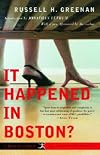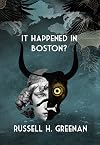
It Happened in Boston?
by Russell H. Greenan
On This Page
Description
Originally published in 1968 to critical acclaim, Russell H. Greenan's brilliant, audacious mystery novel It Happened in Boston? quickly became an underground sensation and has emerged over forty years later as a genuine cult classic. In this breathtakingly imaginative book-now appearing in audio for the first time-we enter the mind of an unnamed artist of prodigious talent and intelligence who is determined to correct the world's wrongs via a direct confrontation with the Almighty, no show more matter what the consequences. A spellbinding tale told by a memorably unreliable narrator, It Happened in Boston? places you inside a vivid world that brilliantly and surprisingly interweaves art, genius, love, madness, betrayal, God ... and murder. In 2003 IHIB? was reprinted by the Modern Library with a new introduction by celebrated writer Jonathan Lethem and an afterword by the author, both included in this audio version. show lessTags
Recommendations













Member Recommendations


Member Reviews
“Lately I’ve come to feel that the pigeons are spying on me. What other explanation could there be?”
That’s the intriguing opening of this extremely odd book.
Apparently this is a cult classic, although that escaped my notice till recently.
I can see why it achieved that status.
This is one of the strangest books I’ve ever read. Told in the first person by an artist whose skill rivals DaVinci’s, the story unfolds as the artist slowly but relentlessly loses his mind. It’s not any easy book to read, but it becomes compelling quickly.
There are time shifts that are only noticeable after the fact; this is one way the author shows us the slowly growing confusion in the narrator’s mind.
Recommended if you like seriously odd books. show more CAVEAT: There’s an unpleasant animal death, to say nothing of the numerous humans who meet their demise. show less
That’s the intriguing opening of this extremely odd book.
Apparently this is a cult classic, although that escaped my notice till recently.
I can see why it achieved that status.
This is one of the strangest books I’ve ever read. Told in the first person by an artist whose skill rivals DaVinci’s, the story unfolds as the artist slowly but relentlessly loses his mind. It’s not any easy book to read, but it becomes compelling quickly.
There are time shifts that are only noticeable after the fact; this is one way the author shows us the slowly growing confusion in the narrator’s mind.
Recommended if you like seriously odd books. show more CAVEAT: There’s an unpleasant animal death, to say nothing of the numerous humans who meet their demise. show less
How's this for an opening line:
"LATELY I have come to feel that the pigeons are spying on me."
That's the first sentence zinger from It Happened in Boston? (1968), the debut novel replete with astonishing zinger sentences from one of the most unjustly neglected* writers of the past fifty years, Russell H. Greenan.
Greenan's first published sentence in a book zings for many reasons; allow me to zero in, briefly, on a few. First, the sentence serves as a microcosm, in thirteen lucky words, for the brilliant, intentionally unbalanced, balance of the 273 page novel. If I explained in too much specific details what I meant by "microcosm" it just wouldn't match the captivating kookiness of Greenan's novel on the one hand, and its genre-bending show more erudition on the other, where the contemporary art world, world history, mystery, mythology, mysticism, and "fantasy" in the old-school, James Branch Cabell or Jorge Luis Borges sense of the word—the fantastic— intermingle in our narrator-artist's transformative "reveries" that propel him, within the span of minutes, to other planets, alternate realities, the Middle Ages, and back to antique galleries and public gardens (when he's not in some psychiatric ward) in the backstreets of a photographically rendered Boston as fully realized as Leopold Blooms' day in Dublin.
Secondly, notice that Greenan used the word "feel" instead of "think" or "believe" in the first sentence. Why "feel"? Why not "perceive" or "observe" or "notice"? Probably because He, our oddball but genius narrator, is an artist. That he is an artist is not a delusion. Like many artists, he feels things deeply—more deeply than most. He also sees things more deeply than most. Things that ordinary souls would call delusions, hallucinations. Not only are the pigeons spying on him (and later haranguing him), but he can travel through time, throughout the eons of recorded history and a myriad of cultures.
"One day I dined with Aristides or with Vespasian, the next I ate with the Yorubas or gnawed a reindeer bone in the Dordogne. In swift succession I looked upon the glory of Cyrus the Great, the savagery of Chaka, the courage of Cortez, the splendor of Sheng-tsu, the folly of Nero, the fury of Timour and the cunning of the Medici. I heard Mozart play and Dr. Johnson talk. . . ."
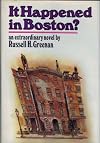
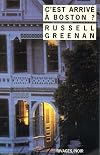
Clearly, our narrator is as erudite as he is nuts. But, lest I stray further from the first sentence of It Happened in Boston?, let me say lastly that in its amazing microcosm of an even more amazing book, I'm reminded of what Lydia Davis accomplishes less effectively in her short short story-abstracts in which implications billow out from a brevity of words, and interpretations are trusted solely to the reader's knowledge and imagination. Imagine an entire novel of first sentences like that, how artistically twisted (a compliment) that could become—sort of like the off-kilter visual of the apartment building on the front cover of the first edition's dust jacket—and that is, without question, the exciting experience of reading It Happened in Boston?
* Russell H. Greenan's most recent novel, his fourteenth, Nether Netherland, was published in England in 2014, when he was eighty-eight. He's ninety now. Visit him at his excellent website that chronicles the entirety of his unique career. show less
"LATELY I have come to feel that the pigeons are spying on me."
That's the first sentence zinger from It Happened in Boston? (1968), the debut novel replete with astonishing zinger sentences from one of the most unjustly neglected* writers of the past fifty years, Russell H. Greenan.
Greenan's first published sentence in a book zings for many reasons; allow me to zero in, briefly, on a few. First, the sentence serves as a microcosm, in thirteen lucky words, for the brilliant, intentionally unbalanced, balance of the 273 page novel. If I explained in too much specific details what I meant by "microcosm" it just wouldn't match the captivating kookiness of Greenan's novel on the one hand, and its genre-bending show more erudition on the other, where the contemporary art world, world history, mystery, mythology, mysticism, and "fantasy" in the old-school, James Branch Cabell or Jorge Luis Borges sense of the word—the fantastic— intermingle in our narrator-artist's transformative "reveries" that propel him, within the span of minutes, to other planets, alternate realities, the Middle Ages, and back to antique galleries and public gardens (when he's not in some psychiatric ward) in the backstreets of a photographically rendered Boston as fully realized as Leopold Blooms' day in Dublin.
Secondly, notice that Greenan used the word "feel" instead of "think" or "believe" in the first sentence. Why "feel"? Why not "perceive" or "observe" or "notice"? Probably because He, our oddball but genius narrator, is an artist. That he is an artist is not a delusion. Like many artists, he feels things deeply—more deeply than most. He also sees things more deeply than most. Things that ordinary souls would call delusions, hallucinations. Not only are the pigeons spying on him (and later haranguing him), but he can travel through time, throughout the eons of recorded history and a myriad of cultures.
"One day I dined with Aristides or with Vespasian, the next I ate with the Yorubas or gnawed a reindeer bone in the Dordogne. In swift succession I looked upon the glory of Cyrus the Great, the savagery of Chaka, the courage of Cortez, the splendor of Sheng-tsu, the folly of Nero, the fury of Timour and the cunning of the Medici. I heard Mozart play and Dr. Johnson talk. . . ."
Clearly, our narrator is as erudite as he is nuts. But, lest I stray further from the first sentence of It Happened in Boston?, let me say lastly that in its amazing microcosm of an even more amazing book, I'm reminded of what Lydia Davis accomplishes less effectively in her short short story-abstracts in which implications billow out from a brevity of words, and interpretations are trusted solely to the reader's knowledge and imagination. Imagine an entire novel of first sentences like that, how artistically twisted (a compliment) that could become—sort of like the off-kilter visual of the apartment building on the front cover of the first edition's dust jacket—and that is, without question, the exciting experience of reading It Happened in Boston?
* Russell H. Greenan's most recent novel, his fourteenth, Nether Netherland, was published in England in 2014, when he was eighty-eight. He's ninety now. Visit him at his excellent website that chronicles the entirety of his unique career. show less
It Happened in Boston? had me worried for a hot minute. It started slowly and seemed to have little direction, while its overbearing protagonist and overly-clever prosing began to remind me of my experience with A Confederacy of Dunces, a book I never warmed too. Perhaps it's a flaw of mine, but I tend to become a bit impatient with indulgent novels that exist as literary puzzleboxes and cod-cerebral waft rather than as stories.
Happily, there were enough moments of quality to keep me engaged – usually a good sentence here and there – before the book finally found a gear about halfway through with Littleboy's gut-wrenching encounter with a malicious philistine. From then on, I was completely happy to be in author Russell H. Greenan's show more company, because the individual moments of quality began to be woven into a story that, while still not entirely to my tastes (I found the ending underwhelming), was nevertheless compelling. While not a particularly memorable experience for me, it would be a 5-star read for the right sort of reader. show less
Happily, there were enough moments of quality to keep me engaged – usually a good sentence here and there – before the book finally found a gear about halfway through with Littleboy's gut-wrenching encounter with a malicious philistine. From then on, I was completely happy to be in author Russell H. Greenan's show more company, because the individual moments of quality began to be woven into a story that, while still not entirely to my tastes (I found the ending underwhelming), was nevertheless compelling. While not a particularly memorable experience for me, it would be a 5-star read for the right sort of reader. show less
Truly awesome book about an artist who wants to meet God. The art world of galleries and openings and forgery and theft. Boston shines through on practically every page in all its 1960s glory. The main character is nuts in a mostly likeable way. Tragedy can be so funny.
It's hard to understand how this book isn't better known. The prevailing "common wisdom" is that Greenan's work isn't better known as a whole because it's hard to put in a genre or describe. If so that's a sad indication of the state of our species.
I'm reluctant to say much more about it, as almost any bit of information might spoil some of the fun of this great novel.
Check it out.
I'm reluctant to say much more about it, as almost any bit of information might spoil some of the fun of this great novel.
Check it out.
Other books have unreliable narrators; in this one even the page numbers have question marks.
A highly peculiar and disturbing read. The protagonist is by turns witty or intriguing, and then appalling- not in an un-pc way, but in a sociopathic insanity kind of way. There were moments during this book that I actually cringed. That said, it is well-written and certainly compelling.
Members
- Recently Added By
Author Information

19 Works 398 Members
Some Editions
Series
Belongs to Publisher Series
Common Knowledge
- Canonical title
- It Happened in Boston?
- Original title
- It Happened in Boston?
- Original publication date
- 1968
- Important places
- Boston, Massachusetts, USA
Classifications
Statistics
- Members
- 238
- Popularity
- 137,001
- Reviews
- 11
- Rating
- (4.21)
- Languages
- English, French, German
- Media
- Paper, Audiobook, Ebook
- ISBNs
- 15
- ASINs
- 4