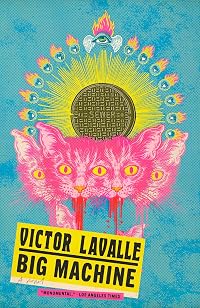
Big Machine: A Novel
by Victor LaValle
On This Page
Description
Ricky Rice is a middling hustler with a lingering junk habit, a bum knee, and a haunted mind. A survivor of a suicide cult, he scrapes by as a porter at a bus depot in Utica, New York, until one day a mysterious letter arrives, summoning him to enlist in a band of paranormal investigators comprised of former addicts and petty criminals, all of whom had at some point in their wasted lives heard what may have been the voice of God. Infused with the wonder of a disquieting dream and laced with show more Victor LaValle's fiendish comic sensibility, Big Machine is a mind-rattling mystery about doubt, faith, and the monsters we carry within us. show lessTags
Recommendations




Member Recommendations

Member Reviews
When Ricky receives a bus ticket to Burlington, Vermont and a letter telling him it’s time to honour a promise he made several years earlier, he walks out of his latest in a line of dead-end jobs to do just that. At journey’s end he finds other misfits and they are put to work looking for clues to the existence of the paranormal. Just what a cult-surviving junkie needs. After some time finding his feet Ricky is selected for a field mission and that’s where things really start to get weird.
This novel fits somewhere in the bracket of if Murakami wrote noir or Chandler wrote magical realism. Even though the reader doesn’t really know what’s going on until late into the story it’s still a fascinating read. The narrator of the show more tale has an interesting turn of phrase and is more than likeable enough. The writer mixes things up quite well, playing with your emotions throughout where one minute you’re on a downer but a few paragraphs later you’re laughing again. There are some big themes examined along the way with race, religion and cults at the forefront but the story is never compromised and even with a slowish start it’s never less than entertaining. show less
This novel fits somewhere in the bracket of if Murakami wrote noir or Chandler wrote magical realism. Even though the reader doesn’t really know what’s going on until late into the story it’s still a fascinating read. The narrator of the show more tale has an interesting turn of phrase and is more than likeable enough. The writer mixes things up quite well, playing with your emotions throughout where one minute you’re on a downer but a few paragraphs later you’re laughing again. There are some big themes examined along the way with race, religion and cults at the forefront but the story is never compromised and even with a slowish start it’s never less than entertaining. show less
Doubt is the big machine. It grinds up the delusions of men and women.
"I'm not here to spread bad news, Ricky. Listen to my words. The Voice called Judah. Of all the folks it might've picked, it picked a runaway slave Do you understand what that means?"
The Dean tapped the wooden match against the stone fireplace.
"Means it's ours, Ricky. The Voice chose us. Despised by many, but not the Voice. The American Negro finally got its god."
This wacky and highly entertaining rollercoaster ride of a novel begins in Union Station in Utica, New York. Ricky Rice is a 40 year old black janitor in the station, a survivor of a suicide cult that his parents belonged to in Queens, NY during his childhood, years spent in show more foster care, and a series of menial jobs and failed love affairs. He is a former junkie who has been clean for several years, but he still keeps a stash of heroin handy in case the urge to shoot up becomes too strong. He receives a envelope at work on a winter day in 2005, which contains a one way bus ticket to Burlington, Vermont, and a mysterious note that informs him that it's time to honor the promise he made in Cedar Rapids, Iowa three years before.
Ricky decides to take a chance, since there is little for him in Utica, and embarks on the trip. He is taken to a compound and meets six other African Americans, all former substance abusers or petty criminals who received similar requests. They are met by the Dean, an older man who tells them they have been called because each of them once heard the Voice, a powerful supernatural being who originally spoke to and enriched a former 18th century slave. Those who have heard the Voice are all poor African Americans, dispossessed and despised by the larger society and by traditional Christian religions. The seven are titled the Unlikely Scholars, and are charged with deciphering hidden external and internal clues to locate the Voice, in exchange for free room & board at the compound. Several months later, Ricky is called by the Dean, and he is sent to California on a mission that promises to be as dangerous as it is mysterious, in the company of an attractive woman at the compound who he has seen but knows nothing about.
The novel includes flashbacks to Ricky's childhood, the crisis that led him to hear the Voice, and the story of the mysterious woman, which is intertwined with the events of the increasingly bizarre mission, which is much better read than described in a review. LaValle expertly mixes a rich stew filled with elements of the supernatural and science fiction, along with a unique literary style filled with humor and pathos, which will appeal to a wide variety of readers. I'd highly encourage everyone to read this book, but please make sure that your seat belt is tightly fastened before take off. show less
"I'm not here to spread bad news, Ricky. Listen to my words. The Voice called Judah. Of all the folks it might've picked, it picked a runaway slave Do you understand what that means?"
The Dean tapped the wooden match against the stone fireplace.
"Means it's ours, Ricky. The Voice chose us. Despised by many, but not the Voice. The American Negro finally got its god."
This wacky and highly entertaining rollercoaster ride of a novel begins in Union Station in Utica, New York. Ricky Rice is a 40 year old black janitor in the station, a survivor of a suicide cult that his parents belonged to in Queens, NY during his childhood, years spent in show more foster care, and a series of menial jobs and failed love affairs. He is a former junkie who has been clean for several years, but he still keeps a stash of heroin handy in case the urge to shoot up becomes too strong. He receives a envelope at work on a winter day in 2005, which contains a one way bus ticket to Burlington, Vermont, and a mysterious note that informs him that it's time to honor the promise he made in Cedar Rapids, Iowa three years before.
Ricky decides to take a chance, since there is little for him in Utica, and embarks on the trip. He is taken to a compound and meets six other African Americans, all former substance abusers or petty criminals who received similar requests. They are met by the Dean, an older man who tells them they have been called because each of them once heard the Voice, a powerful supernatural being who originally spoke to and enriched a former 18th century slave. Those who have heard the Voice are all poor African Americans, dispossessed and despised by the larger society and by traditional Christian religions. The seven are titled the Unlikely Scholars, and are charged with deciphering hidden external and internal clues to locate the Voice, in exchange for free room & board at the compound. Several months later, Ricky is called by the Dean, and he is sent to California on a mission that promises to be as dangerous as it is mysterious, in the company of an attractive woman at the compound who he has seen but knows nothing about.
The novel includes flashbacks to Ricky's childhood, the crisis that led him to hear the Voice, and the story of the mysterious woman, which is intertwined with the events of the increasingly bizarre mission, which is much better read than described in a review. LaValle expertly mixes a rich stew filled with elements of the supernatural and science fiction, along with a unique literary style filled with humor and pathos, which will appeal to a wide variety of readers. I'd highly encourage everyone to read this book, but please make sure that your seat belt is tightly fastened before take off. show less
Throughout most of this novel, I kept asking myself, what the hell am I reading? I couldn't get a handle on if it was just a fiction novel, a horror novel, a suspense novel, hell, maybe even a bit of a science fiction novel.
In the end, I didn't care, because it was a damn good novel. I haven't read a lot of LaValle's work, but I'm trying to remedy that, based on the bit that I have read. I enjoy the man's writing, I enjoy his characters, and I especially enjoy the fact that I have no farking clue where he's going to take me.
This novel's a bit of a mindfuck, but I mean that in the most complimentary of ways. Really enjoyed it.
In the end, I didn't care, because it was a damn good novel. I haven't read a lot of LaValle's work, but I'm trying to remedy that, based on the bit that I have read. I enjoy the man's writing, I enjoy his characters, and I especially enjoy the fact that I have no farking clue where he's going to take me.
This novel's a bit of a mindfuck, but I mean that in the most complimentary of ways. Really enjoyed it.
Synopsis:
A brokedown junkie, ex-cultist and mass murder survivor gets a mysterious invitation to become an Unlikely Scholar investigating odd phenomena across America.
Review:
Wow, wow, wow, wow, wow. Big Machine rocked my world. Stylistically, it’s a mash-up of Haruki Murakami and Stephen King, with a bit of Ralph Ellison for good measure.
When junkie Ricky Rice becomes an Unlikely Scholar under way mysterious circumstances, he finds himself scouring newspapers for stories that give evidence to The Voice. His journey grows ever more wild, and as he travels across the country from Vermont to northern California on the trail of the Voice and something more human and more ominous, he reflects back on the journey that got him to this point. show more His childhood in a cult, his years as a junkie and petty criminal, and his efforts to stay on the straight and narrow become more than just a life story. It’s a Pilgrim’s Progress founded on doubt–but a doubt that might be stronger than the faith of some.
LaValle has a lot to say about American fanaticism of all stripes. The social commentary here is fascinating, specific, and outrageously funny. Ricky Rice will become one of my favorite characters for the unique voice LaValle gives him, at once guileless and sneaky, wise and foolish, a street smart risk taker who has survived way too much.
The story is wild beyond imagining, with horror elements that don’t hold back. LaValle is not genre-slumming here. He genuinely wants to freak us out.
I was fortunate enough to hear LaValle read a large chunk of the opening of this book, and I was hooked. Definitely planning to read more of his work. show less
A brokedown junkie, ex-cultist and mass murder survivor gets a mysterious invitation to become an Unlikely Scholar investigating odd phenomena across America.
Review:
Wow, wow, wow, wow, wow. Big Machine rocked my world. Stylistically, it’s a mash-up of Haruki Murakami and Stephen King, with a bit of Ralph Ellison for good measure.
When junkie Ricky Rice becomes an Unlikely Scholar under way mysterious circumstances, he finds himself scouring newspapers for stories that give evidence to The Voice. His journey grows ever more wild, and as he travels across the country from Vermont to northern California on the trail of the Voice and something more human and more ominous, he reflects back on the journey that got him to this point. show more His childhood in a cult, his years as a junkie and petty criminal, and his efforts to stay on the straight and narrow become more than just a life story. It’s a Pilgrim’s Progress founded on doubt–but a doubt that might be stronger than the faith of some.
LaValle has a lot to say about American fanaticism of all stripes. The social commentary here is fascinating, specific, and outrageously funny. Ricky Rice will become one of my favorite characters for the unique voice LaValle gives him, at once guileless and sneaky, wise and foolish, a street smart risk taker who has survived way too much.
The story is wild beyond imagining, with horror elements that don’t hold back. LaValle is not genre-slumming here. He genuinely wants to freak us out.
I was fortunate enough to hear LaValle read a large chunk of the opening of this book, and I was hooked. Definitely planning to read more of his work. show less
In LaValle’s strange and wonderful Big Machine, a former heroin addict named Ricky Rice is offered an opportunity to leave behind his life as a janitor and join the Unlikely Scholars, an underground group of African American social outcasts stationed at the Washburn Library in rural Vermont. The Scholars have been recruited to search for the Voice of God by scouring newspaper articles for paranormal events. Ricky, a survivor of a suicide cult, wrestles with doubt, faith and addiction as he is sent on a cross-country mission to destroy a rogue Scholar who has subverted the Washburn Library’s message, preaching vengeance for the dispossessed.
LaValle’s take on race and religious fanaticism is sharp and incisive, but he stops short of show more outright cynicism. His characters are so graced with humor and humanity that what could be a bizzaro horror story is elevated into a thoughtful, funny examination of belief. It is, without a doubt, the weirdest and most over-the-top book I’ve ever loved. show less
LaValle’s take on race and religious fanaticism is sharp and incisive, but he stops short of show more outright cynicism. His characters are so graced with humor and humanity that what could be a bizzaro horror story is elevated into a thoughtful, funny examination of belief. It is, without a doubt, the weirdest and most over-the-top book I’ve ever loved. show less
Although it started slowly for me, I was quickly drawn into this tale of Ricky Rice, a 40-ish African-American and a former petty criminal and heroin addict (who still keeps a stash, just in case) who receives a mysterious envelope at his place of employment (a bus station in Utica, NY, where he cleans toilets) with a bus ticket to a remote region of Vermont. He debates whether to go, but finds himself on the bus and, ultimately, at the equally mysterious Washburn Library, where he and his fellow Unlikely Scholars (all from similar backgrounds) are expected to read newspapers looking for interesting items, although they are not told what these interesting items are. The story of how they try to figure it out, work together or apart, show more adjust to being treated with respect and having the necessities of life provided for them, as well as life in the middle of nowhere, etc., is compelling, and the reader starts to learn about Ricky's background as part of a cult, and more. Lavalle has insight into and compassion for the dispossessed, the outcasts of society, the people we don't look at when we see them on the street, and there were many sentences I read that made me sit up and say "wow." He can make sharp and pointed comments on race, class, and the lives of the poor and struggling.
When Ricky and another Unlikely Scholar, Adele, are sent on a mission to California to deal with a rogue Unlikely Scholar who could cause trouble for the library, the story takes a turn to the supernatural and, ultimately, the melodramatic, and I had more trouble dealing with this section, although I still admired Lavalle's writing. Because I don't read horror or science fiction, I could only understand the "devils" and "angels" as psychological metaphors rather than real beings; perhaps this is how Lavalle intends them, as he I believe he intended the monster/devil in The Devil in Silver, but they certainly had "real" effects on Ricky. I am unsure how I feel about this material.
The novel deals with big ideas, especially about faith and doubt, and how God does or doesn't talk to individuals. "Doubt is the big machine. It grinds up the delusions of women and men." Of course the cult Ricky grew up in came to a bad end. (I was going to write "Don't all cults come to a bad end?," but then I realized that the ones that don't become "religions.") The reader learns about the horror of it as Ricky is struggling to understand what is going on out in California, in the marshes under the town of Garland, somewhere on the San Francisco Bay, and what the rogue Scholar, Solomon Clay, is up to. When Ricky and Adele venture into this underworld, it is truly creepy.
I can't really describe this novel more concretely without giving too much away. There are mysteries of the present, and mysteries of the past, and mysteries that are left unsolved that are, probably, unsolvable. I continue to think Victor Lavalle is a very impressive writer, even as I struggled with the supernatural parts of this book. show less
When Ricky and another Unlikely Scholar, Adele, are sent on a mission to California to deal with a rogue Unlikely Scholar who could cause trouble for the library, the story takes a turn to the supernatural and, ultimately, the melodramatic, and I had more trouble dealing with this section, although I still admired Lavalle's writing. Because I don't read horror or science fiction, I could only understand the "devils" and "angels" as psychological metaphors rather than real beings; perhaps this is how Lavalle intends them, as he I believe he intended the monster/devil in The Devil in Silver, but they certainly had "real" effects on Ricky. I am unsure how I feel about this material.
The novel deals with big ideas, especially about faith and doubt, and how God does or doesn't talk to individuals. "Doubt is the big machine. It grinds up the delusions of women and men." Of course the cult Ricky grew up in came to a bad end. (I was going to write "Don't all cults come to a bad end?," but then I realized that the ones that don't become "religions.") The reader learns about the horror of it as Ricky is struggling to understand what is going on out in California, in the marshes under the town of Garland, somewhere on the San Francisco Bay, and what the rogue Scholar, Solomon Clay, is up to. When Ricky and Adele venture into this underworld, it is truly creepy.
I can't really describe this novel more concretely without giving too much away. There are mysteries of the present, and mysteries of the past, and mysteries that are left unsolved that are, probably, unsolvable. I continue to think Victor Lavalle is a very impressive writer, even as I struggled with the supernatural parts of this book. show less
To preface this review, I'll just say that I'm not good with the supernatural. I don't read fantasy, sci-fi or horror novels. Generally speaking, they either bore me, annoy me, and or at worst, insult my intelligence. Also, I'm an atheist. However, the fact that I still wanted to pick up this book after reading the description, and the fact that I still gave this book 5 stars after finishing it says a lot in my book. LaValle is doing a lot of different things here, from urban realism to allegory, from philosophical novel to mystical fantasy, and I would say that LaValle is about 95% successful. And those parts he's successful at?--he's 200% successful. I've mostly broken my college habit of marking up my books, but it was very hard to show more resist the urge with this one. There's so much to chew on, to look back on, to ponder for a very long time to come. If I were a college English professor, I would go out of my way to build a course around this book. I particularly love the way the book looks at faith and doubt, not as opposites, but as a system of checks and balances to keep religious fanaticism at bay. show less
Members
- Recently Added By
Published Reviews
ThingScore 75
In Victor LaValle's spectacular new novel, "Big Machine," race and religion are the subterranean tributaries that threaten to destroy America's underclass, even as they help to sustain it. Along with Junot Diaz, Lev Grossman, Kelly Link and Kevin Brockmeier, LaValle is part of an increasingly high-profile and important cohort of writers who reinvent outmoded literary conventions, particularly show more the ghettos of genre and ethnicity that long divided serious literature from popular fiction. In that spirit, the epigraph for "Big Machine" is from John Carpenter's remake of "The Thing," and in LaValle's acknowledgments he thanks not just Thomas Paine but also Octavia Butler, Stephen King, Shirley Jackson and "my man Ambrose Bierce," all of whom stand as spiritual godparents to this sprawling, fantastical work. show less
added by kidzdoc
The Big Machine is what urban fantasy looks like when it’s grown up and the writer isn’t relying on paranormal clichés to flesh out an epic tale of good versus evil. Not that you can pigeon-hole this novel—it’s a dizzying slipstream mashup of genres and memes and tropes and legends wrapped around a cross-cultural love story. This is a story that has depth, richness; a heart and a show more soul. Above all, it has a soul. show less
added by kidzdoc
“Big Machine” wants to be a big novel about big ideas, particularly Christianity and race in America, past and present. If not big in size, the novel does seem long. LaValle lavishes considerable detail on Ricky’s childhood survival of a mini-Jonestown, and Ricky narrates in an often rich vernacular, but way too many pages are devoted to getting people in and out of cars, in and out of show more clothes, and in and out of tight scrapes — hallmarks of novels that try to be big sellers. show less
added by Shortride
Lists

End of Your Life Book Club
134 works; 4 members

Shirley Jackson Award Winners and Shortlist 2007-2020
77 works; 6 members
Talk Discussions
Past Discussions
Big Machine by Victor LaValle in African/African American Literature (February 2013)
Author Information

55+ Works 8,149 Members
Victor D. LaValle is an assistant professor in the graduate writing program at Columbia University. He lives in Brooklyn, New York.
Awards and Honors
Awards
Common Knowledge
- Original publication date
- 2009-08-11
- People/Characters
- Ricky Rice; Adele Henry; Solomon Clay; The Dean; Lake; Judah Washburn (show all 8); Snooky Washburn; Claude
- Important places
- Utica, New York, USA; Burlington, Vermont, USA; Garland, California, USA; Queens, New York, New York, USA
- Epigraph
- "Nobody trusts anybody now, and we're all very tired."
--From John Carpenter's The Thing - Dedication
- For Oakland, City Full of Good
- First words
- Don't look for dignity in public bathrooms.
- Quotations
- Doubt is the big machine. It grinds up the delusions of men and women.
Did every story about black folks have to be such a downer?
Oppression doesn't make people noble. Give any of us a little comfort, and we'll kill to keep it. The despised becomes despicable.
I like America, where believers eddy around one another like currents of air. Even our atheists are devout! To be an American is to be a believer. I don't have much faith in institutions, but I still believe in people. - Last words
- (Click to show. Warning: May contain spoilers.)But we're not going to do that.
- Publisher's editor
- Jackson, Chris
- Blurbers
- Bloom, Amy; Def, Mos; Doerr, Anthony; Brockmeier, Kevin
- Original language
- English, US
Classifications
Statistics
- Members
- 774
- Popularity
- 36,238
- Reviews
- 28
- Rating
- (3.63)
- Languages
- English
- Media
- Paper, Audiobook, Ebook
- ISBNs
- 9
- ASINs
- 4