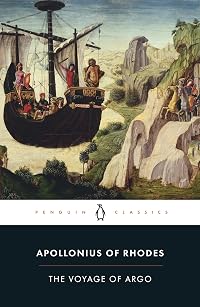
The Argonautica
by Apollonius of Rhodes
On This Page
Description
The Argonautika, the only surviving epic of the Hellenistic era, is a retelling of the tale of Jason and the Golden Fleece, probably the oldest extant Greek myth. Peter Green's lively, readable verse translation captures the swift narrative movement of Apollonios's epic Greek. This expanded paperback edition contains Green's incisive commentary, introduction, and glossary. Alternate spelling: Argonautica, Apollonius RhodiusTags
Recommendations













Member Recommendations
andejons Both epics connects to the Iliad and the Odyssey, even if the Argonautica is a prequel of sorts and the Aeneid is a sequel. Also, both Jason and Aeneas as well as Medea and Dido shows similar traits.
40
Member Reviews
The Penguin Epics snippet from The Voyage of the Argo by Apollonius of Rhodes is superb. Jason and the Golden Fleece retells the narrative from the Argonauts arrival at the kingdom of Amycus through to Jason's completion of the task set by the keeper of the Fleece, Aeetes. The tale is everything that could be asked for from an Epic - the action is terrific, the romance believable and emotional, and the historical setting vividly conjured.
One of the elements of Jason that works well is that it is not just about the lead character. A few of the Argonauts crop up regularly and while Jason is clearly the lead hero, his is a band of followers that merit their own characters. As they are not faceless, their actions and roles impact on the show more rest of the team. The deaths of two characters early on in this snippet plunges the Argonauts into grief. Too often elsewhere, the death of a comrade has no real meaning but here such depth of feeling demonstrates a kinship worth being a part of.
The action sequences are great from the very beginning of the snippet when Argonaut Polydeuces takes on King Amycus in a boxing match. While this is not a blow-by-blow account, it is a great rendition of martial sport told by a writer who clearly understood what he was talking about. Apollonius is also wise to include the gods but to not deliver them an automaticity in that they too are striving for success. This is a useful reminder of the Greek understanding of the world in that reliance on divine intervention alone could not be enough for success.
Romance is not always easy but Apollonius hits some terrific notes between Medea and Jason. His depiction of the passion that Medea holds within her after Eros has hit her with love's arrow is highly believable. Medea finds herself in a very familiar female quandry - the powerful but dangerous stranger is the person she is drawn to. The steps she takes to move from the obligation she has to her family and the self-doubt it inspires make for such a rich and impressive character. The conflict between loyalty and love makes each step of her rebellion a difficult choice for Medea. To a great extent Medea is the star of this particular snippet.
The morality of Jason is relatively simple. Good deeds performed without desire for personal gain are rewarded while the arrogant are not. The soothsayer Phineus is the embodiment of this. It transpires that he slightly arrogantly took his foresight too far and failed to show due respect to Zeus who punished him harshly. He was otherwise a good man and the Argonauts provide him with the greatest reward which is release from his curse. One other character who had supported Phineus prior to the Argonauts arrival is also rewarded.
With any epic, the place and culture matter just as much as the tale and the key at the back of the book helps slightly though it would still require further information to really get to grips with where and who. The snippet does though get the balance right between having enough names to capture the imagination without delving into lists. Apollonius gives lineage to most characters and the places he describes are identifiable enough to be traceable for a modern reader. Older legends are touched on such as the battles between the gods for supremacy as well as tales from the outer reaches of Greek knowledge such as the Caucasian mountains. This is an old tale though and it is really fascinating to catch glimpses of people that affect later stories.
Jason and the Golden Fleece is a snippet from the epic and the only negative that can truly be felt is that it leaves the reader wanting the rest. show less
One of the elements of Jason that works well is that it is not just about the lead character. A few of the Argonauts crop up regularly and while Jason is clearly the lead hero, his is a band of followers that merit their own characters. As they are not faceless, their actions and roles impact on the show more rest of the team. The deaths of two characters early on in this snippet plunges the Argonauts into grief. Too often elsewhere, the death of a comrade has no real meaning but here such depth of feeling demonstrates a kinship worth being a part of.
The action sequences are great from the very beginning of the snippet when Argonaut Polydeuces takes on King Amycus in a boxing match. While this is not a blow-by-blow account, it is a great rendition of martial sport told by a writer who clearly understood what he was talking about. Apollonius is also wise to include the gods but to not deliver them an automaticity in that they too are striving for success. This is a useful reminder of the Greek understanding of the world in that reliance on divine intervention alone could not be enough for success.
Romance is not always easy but Apollonius hits some terrific notes between Medea and Jason. His depiction of the passion that Medea holds within her after Eros has hit her with love's arrow is highly believable. Medea finds herself in a very familiar female quandry - the powerful but dangerous stranger is the person she is drawn to. The steps she takes to move from the obligation she has to her family and the self-doubt it inspires make for such a rich and impressive character. The conflict between loyalty and love makes each step of her rebellion a difficult choice for Medea. To a great extent Medea is the star of this particular snippet.
The morality of Jason is relatively simple. Good deeds performed without desire for personal gain are rewarded while the arrogant are not. The soothsayer Phineus is the embodiment of this. It transpires that he slightly arrogantly took his foresight too far and failed to show due respect to Zeus who punished him harshly. He was otherwise a good man and the Argonauts provide him with the greatest reward which is release from his curse. One other character who had supported Phineus prior to the Argonauts arrival is also rewarded.
With any epic, the place and culture matter just as much as the tale and the key at the back of the book helps slightly though it would still require further information to really get to grips with where and who. The snippet does though get the balance right between having enough names to capture the imagination without delving into lists. Apollonius gives lineage to most characters and the places he describes are identifiable enough to be traceable for a modern reader. Older legends are touched on such as the battles between the gods for supremacy as well as tales from the outer reaches of Greek knowledge such as the Caucasian mountains. This is an old tale though and it is really fascinating to catch glimpses of people that affect later stories.
Jason and the Golden Fleece is a snippet from the epic and the only negative that can truly be felt is that it leaves the reader wanting the rest. show less
Okay, this was surprisingly good! I haven't really liked much of the ancient greek the class I'm reading these for has assigned, but this one caught me off guard!
I was a little hesitant going in since Hunter literally says in the preface "no one... is more conscious than I am of the failings of my translation"... Umm, cmon dude have a little confidence? It's a prose translation, so it's not accurate to the original metered verse, but as a non-scholar I didn't really mind that. Obviously when changing the form of a work this drastically you need to take some liberties, but I felt it was entirely adequate and much easier to read than the other epic poems that my professor has assigned. On top of that, I actually enjoyed it instead of show more slogging along-- this was a story I was unfamiliar with, and I found myself actively avoiding spoilers, for a work written thousands of years ago! I hesitate to use the word "riveting" but this was the closest classical literature to a page-turner I've ever read. This edition also has maps in the front, and it's really funny to watch how bad these guys are at navigation, but the overall effect is sort of like reading a high-fantasy novel that's set in a familiar location, so that's cool too.
A lot of people seemed to not like Jason's character but I found him a lot more interesting than Heracles for example. He's a lot more human, and this makes for a more realistic story. I wouldn't say he's relatable but the emotional journey was a lot more believable than some of the older Greek works (and I understand that this is a sort of aggregation of things written centuries before so that plays a role in its sophistication). Medea was obviously my favorite character, I found myself sympathizing with her the most throughout, and her speech on Drepane was quite powerful. I felt really bad for her, she deserved so much better!
So yeah that gets me to the failings of this poem, which are pretty common to the Greek I've read, which is listing people and misogyny lol. There's quite a bit of just listing names that contemporary readers would be familiar with, and it got frustrating to the point that I would just skip over those sections and figure out who's who later. This was made worse by the fact that the footnotes were all at the end instead of the bottom of each page, and I just didn't feel motivated to read them all, so I'm sure I missed important context. Also, I won't excuse misogyny just because it's old; after having read ancient literature that actually treats women as people (like the Homeric Hymn to Demeter) Apollonius honestly has no excuse :))) show less
I was a little hesitant going in since Hunter literally says in the preface "no one... is more conscious than I am of the failings of my translation"... Umm, cmon dude have a little confidence? It's a prose translation, so it's not accurate to the original metered verse, but as a non-scholar I didn't really mind that. Obviously when changing the form of a work this drastically you need to take some liberties, but I felt it was entirely adequate and much easier to read than the other epic poems that my professor has assigned. On top of that, I actually enjoyed it instead of show more slogging along-- this was a story I was unfamiliar with, and I found myself actively avoiding spoilers, for a work written thousands of years ago! I hesitate to use the word "riveting" but this was the closest classical literature to a page-turner I've ever read. This edition also has maps in the front, and it's really funny to watch how bad these guys are at navigation, but the overall effect is sort of like reading a high-fantasy novel that's set in a familiar location, so that's cool too.
A lot of people seemed to not like Jason's character but I found him a lot more interesting than Heracles for example. He's a lot more human, and this makes for a more realistic story. I wouldn't say he's relatable but the emotional journey was a lot more believable than some of the older Greek works (and I understand that this is a sort of aggregation of things written centuries before so that plays a role in its sophistication). Medea was obviously my favorite character, I found myself sympathizing with her the most throughout, and her speech on Drepane was quite powerful. I felt really bad for her, she deserved so much better!
So yeah that gets me to the failings of this poem, which are pretty common to the Greek I've read, which is listing people and misogyny lol. There's quite a bit of just listing names that contemporary readers would be familiar with, and it got frustrating to the point that I would just skip over those sections and figure out who's who later. This was made worse by the fact that the footnotes were all at the end instead of the bottom of each page, and I just didn't feel motivated to read them all, so I'm sure I missed important context. Also, I won't excuse misogyny just because it's old; after having read ancient literature that actually treats women as people (like the Homeric Hymn to Demeter) Apollonius honestly has no excuse :))) show less
Best parts:
1. The metaphors. Lots of excellent ones here, much akin to the Iliad.
2. Medea shows up halfway in and steals the show. She might be the only interesting character, but she's interesting enough on her own to make up for the perfunctoriness of the rest. The gender relationships between men and women are a source of conflict throughout the text, and that is never more apparent than through the tensions inherent to Medea's character, simultaneously magically powerful and societally disempowered. Certainly a recipe for tragedy, though tragedy is not very present here.
3. Detailed nautical descriptions, if you're into that. I certainly am.
1. The metaphors. Lots of excellent ones here, much akin to the Iliad.
2. Medea shows up halfway in and steals the show. She might be the only interesting character, but she's interesting enough on her own to make up for the perfunctoriness of the rest. The gender relationships between men and women are a source of conflict throughout the text, and that is never more apparent than through the tensions inherent to Medea's character, simultaneously magically powerful and societally disempowered. Certainly a recipe for tragedy, though tragedy is not very present here.
3. Detailed nautical descriptions, if you're into that. I certainly am.
First, a note as to the version I read: I was very satisfied with the Peter Green translation of The Argonautika, it’s clear from his introduction that he has a passion for this story, and the extensive glossary, maps, and analysis of the text demonstrates that he has the expertise for the job of translation as well. Green keeps the text in the form of an epic poem, and there are segments of beautiful and evocative imagery. I’d highly recommend the Green translation.
That being said, the subject of Green’s efforts is less impressive. You can’t help but compare The Argonautika to the other epic poems of antiquity like The Iliad, The Odyssey, and The Aeneid, and when such a comparison is made it’s hard not to find The Argonautika show more wanting. Compared to the other epics, with their interesting and complex main characters, Jason is rather boring. His sole characterization is “hero on a quest,” and there’s oh so little to differentiate him from any generic hero in any generic tale. When one of his shipmates suggests that Jason intentionally left behind Herakles so that he would not be outshined by that superior hero I wished that it was true, as it would at least imbue Jason with some individuality. Sadly, this was not the case.
Jason’s dullness is made more serious by the fact that he is surrounded by more interesting characters. As I mentioned, Herakles is one of his original shipmates, and while they are quickly separated, the crew of the Argo more than once stumbles across some place that was or would become part of Herakles’ journey. Orpheus is also a shipmate of Jason, and his musical ability saves the crew more than once. Even Achilles is referenced, though still a baby. All these characters are more interesting than Jason, and the tales that concern them are all more engaging than Jason’s quest for the golden fleece (which is perhaps the first ever MacGuffin). Medeia (Medea) gets her fair share of the spotlight in The Argonautika as well, and while she’s interesting, she oscillates between hyper-competent potion master and a helpless crying and begging damsel a few times too many for the story. Furthermore, The Argonautika ends before it gets to Medea’s most interesting actions. For those you’ll have to read Euripides.
Not only does the abrupt end of The Argonautika do a disservice to Medea, but it also makes the final book of the epic very anticlimactic, and doesn’t make much sense. Apollonius ends the story with a line about Jason and his crew reaching home “with no further adventures,” leaving completely unresolved the fact that Jason would there have to confront Pelias once again, the one who sent Jason on the quest in the first place. Compare this to the homecoming depicted in The Odyssey and it becomes very clear why Homer and his works so vastly outshine Apollonius and The Argonautika today. The story of Jason’s quest isn’t a bad one, it just pales in comparison to the other ancient epic poems, which still feel fresh today in a way that The Argonautika does not. show less
That being said, the subject of Green’s efforts is less impressive. You can’t help but compare The Argonautika to the other epic poems of antiquity like The Iliad, The Odyssey, and The Aeneid, and when such a comparison is made it’s hard not to find The Argonautika show more wanting. Compared to the other epics, with their interesting and complex main characters, Jason is rather boring. His sole characterization is “hero on a quest,” and there’s oh so little to differentiate him from any generic hero in any generic tale. When one of his shipmates suggests that Jason intentionally left behind Herakles so that he would not be outshined by that superior hero I wished that it was true, as it would at least imbue Jason with some individuality. Sadly, this was not the case.
Jason’s dullness is made more serious by the fact that he is surrounded by more interesting characters. As I mentioned, Herakles is one of his original shipmates, and while they are quickly separated, the crew of the Argo more than once stumbles across some place that was or would become part of Herakles’ journey. Orpheus is also a shipmate of Jason, and his musical ability saves the crew more than once. Even Achilles is referenced, though still a baby. All these characters are more interesting than Jason, and the tales that concern them are all more engaging than Jason’s quest for the golden fleece (which is perhaps the first ever MacGuffin). Medeia (Medea) gets her fair share of the spotlight in The Argonautika as well, and while she’s interesting, she oscillates between hyper-competent potion master and a helpless crying and begging damsel a few times too many for the story. Furthermore, The Argonautika ends before it gets to Medea’s most interesting actions. For those you’ll have to read Euripides.
Not only does the abrupt end of The Argonautika do a disservice to Medea, but it also makes the final book of the epic very anticlimactic, and doesn’t make much sense. Apollonius ends the story with a line about Jason and his crew reaching home “with no further adventures,” leaving completely unresolved the fact that Jason would there have to confront Pelias once again, the one who sent Jason on the quest in the first place. Compare this to the homecoming depicted in The Odyssey and it becomes very clear why Homer and his works so vastly outshine Apollonius and The Argonautika today. The story of Jason’s quest isn’t a bad one, it just pales in comparison to the other ancient epic poems, which still feel fresh today in a way that The Argonautika does not. show less
In ancient times, many legends were told around campfires and courtyards, legends of powerful men and ravishing women, blades and witches and dragons. For thousand of years, these stories were passed down from storyteller to storyteller, until one day, humans found they could write symbols on things and never have to remember a thing afterward.
Years later, this writing had evolved into a highly specialized art form known as poetry. This early poets wrote down the most fascinating legends, using their highly evolved sense of wonder and silver tongues to craft fine epic tales.
Apollonios of Rhodes never got the memo. Memo's hadn't been invented, and if so, he strikes me as the stubborn fool that would write the story of Jason show more anyways.
Argonautika revolves around the minor legend of Jason and his quest for the redemption of his father's throne. Even to the Greeks, I doubt he was that important. He isn't the most interesting character of this most uninteresting epic. That distinction belongs to Medea (yes, that Medea), a young woman who falls for a brown-eyed handsome man and betrays her father.
For my money, read Euripedes's play, or discover Jason's story through a modern retelling of the legend (heck, watch the stop-action movie, it's pretty straightforward). Just don't waste your time with Apollonois. Peter Green tries, but somethings are better left buried.
More Original Reviews & Writings @ http://motorcyclesshotguns.blogspot.com/ show less
Years later, this writing had evolved into a highly specialized art form known as poetry. This early poets wrote down the most fascinating legends, using their highly evolved sense of wonder and silver tongues to craft fine epic tales.
Apollonios of Rhodes never got the memo. Memo's hadn't been invented, and if so, he strikes me as the stubborn fool that would write the story of Jason show more anyways.
Argonautika revolves around the minor legend of Jason and his quest for the redemption of his father's throne. Even to the Greeks, I doubt he was that important. He isn't the most interesting character of this most uninteresting epic. That distinction belongs to Medea (yes, that Medea), a young woman who falls for a brown-eyed handsome man and betrays her father.
For my money, read Euripedes's play, or discover Jason's story through a modern retelling of the legend (heck, watch the stop-action movie, it's pretty straightforward). Just don't waste your time with Apollonois. Peter Green tries, but somethings are better left buried.
More Original Reviews & Writings @ http://motorcyclesshotguns.blogspot.com/ show less
I decided to read both the Loeb Classical Library (vol. I – Apollonius Rhodius – Argonautica) and the Penguin Classics (Apollonius of Rhodes – The Voyage of Argo) editions of the story of the quest for the Golden Fleece. The Loeb Classical Library edition uses the translation by R. C. Seaton, which was first published in 1912. The Penguin Classics version uses the E. V. Rieu translation which was first published in 1959.
The two translations are quite different, and the Rieu translation undoubtedly benefited from the existence of Seaton’s translation. He uses that advantage to fairly good effect, by producing a narrative that is easier to read and has a better flow. The Loeb book has the advantage of providing the Greek and show more English side by side, and in this case seems to follow the Greek more closely.
Looking at just the first sentence, which provides a good example of the difference in translations, we have the following:
Seaton produces the following translation:
“Beginning with thee, O Phoebus, I will recount the famous deeds of men of old, who at the behest of King Pelias, down through the mouth of Pontus and between the Cyanean rocks, sped well-benched Argo in quest of the golden fleece.”
Rieu produces something quite different, he uses part of the narrative to provide an introduction type paragraph, and then a very short sentence to start the narrative:
“Moved by the god of song, I set out to commemorate the heroes of old who sailed the good ship Argo up the Straits into the Black Sea and between the cyanean Rocks in quest of the Golden Fleece
It was King Pelias who sent them out. …”
One can see here that Seaton provides the name of the god of song, while Rieu is more about providing the information than the name of the deity, and that is true throughout the translation, though not to say that he never provides the name, especially with the more well-known deities.
Ultimately, the Penguin Classics edition with the Rieu translation is better suited for a casual read, while the Loeb Classical edition with Seaton’s translation is probably more suited for study, especially considering the Greek and English are side by side. Both editions are decent, but I am left wondering if it is possible to produce a more readable version which also provides more of the depth that one gets with the Loeb translation. show less
The two translations are quite different, and the Rieu translation undoubtedly benefited from the existence of Seaton’s translation. He uses that advantage to fairly good effect, by producing a narrative that is easier to read and has a better flow. The Loeb book has the advantage of providing the Greek and show more English side by side, and in this case seems to follow the Greek more closely.
Looking at just the first sentence, which provides a good example of the difference in translations, we have the following:
Seaton produces the following translation:
“Beginning with thee, O Phoebus, I will recount the famous deeds of men of old, who at the behest of King Pelias, down through the mouth of Pontus and between the Cyanean rocks, sped well-benched Argo in quest of the golden fleece.”
Rieu produces something quite different, he uses part of the narrative to provide an introduction type paragraph, and then a very short sentence to start the narrative:
“Moved by the god of song, I set out to commemorate the heroes of old who sailed the good ship Argo up the Straits into the Black Sea and between the cyanean Rocks in quest of the Golden Fleece
It was King Pelias who sent them out. …”
One can see here that Seaton provides the name of the god of song, while Rieu is more about providing the information than the name of the deity, and that is true throughout the translation, though not to say that he never provides the name, especially with the more well-known deities.
Ultimately, the Penguin Classics edition with the Rieu translation is better suited for a casual read, while the Loeb Classical edition with Seaton’s translation is probably more suited for study, especially considering the Greek and English are side by side. Both editions are decent, but I am left wondering if it is possible to produce a more readable version which also provides more of the depth that one gets with the Loeb translation. show less
A solid piece of classical literature. I read my copy from Perseus Digital Library and I was thrilled with the story. The descriptors are sharp and the plot, although sometimes complex by means of the way the sentences were arranged (and I assume the way it was translated) it was still a great journey and one that I feel bettered for reading. I recommend this to all interested in the classics.
3.65 stars.
3.65 stars.
Members
- Recently Added By
Published Reviews
Apollonius dramatically closed the distance between the writer and the reader in what is, arguably, the prototype of a new genre in literature; the poet used the epic form to write a traditional tale of high romance and adventure, but the Argonautica is historically unique in its psychological insight and personal point of view.
added by Tomhartley
Lists

Narrative verse for pleasure
75 works; 8 members

100 Books to Read in a Lifetime (That Are Older Than 200 Years)
415 works; 175 members

CCE 1000 Good Books List
1,033 works; 12 members

covers with paintings / paintings as covers .
37 works; 1 member

Western Canon
206 works; 2 members

water on the brain: maritime fiction
74 works; 18 members

Philip Ward's Lifetime Reading Plan
592 works; 22 members

Book Titles Mentioned In Newberry Medal And Honor Books
884 works; 3 members

euripides ranked
23 works; 1 member
Talk Discussions
Past Discussions
argonautica in Challenge: Loeb Classical Library (December 2014)
Author Information
29+ Works 3,519 Members
Some Editions
Awards and Honors
Notable Lists
Series
Belongs to Publisher Series
Penguin Epics (6)
Work Relationships
Contains
Has the adaptation
Is abridged in
Common Knowledge
- Canonical title
- The Argonautica
- Original title
- Ἀργοναυτικά
- Alternate titles
- Jason and the Golden Fleece
- Original publication date
- 3rd Century BCE
- People/Characters
- Jason [Argonaut]; Achilles; Medea; Aeëtes; Agenor; Hercules (as Herakles) (show all 9); Telamon; Aeolus; Orpheus
- Important places
- Iolchos, Thessaly, Greece; Bosporus; Colchis; Aeaea
- First words
- Beginning with thee, O Pheobus, I will recount the famous deeds of men of old, who, at the behest of King Pelias, down through the mouth on Pontus and between the Cyanean rocks, sped well-beched Argo in quest of the golden fl... (show all)eece.
- Last words
- (Click to show. Warning: May contain spoilers.)Be gracious, race of blessed chieftains! And may these songs year after year be sweeter to sing among men. For now have I come to the glorious end your toils; for no adventure befell you as ye came home from Aegina, and no tempest of winds opposed you; but quietly did ye skirt the Cecropian land and Aulis inside of Euboea and the Opuntian cities of the Locrians, and gladly did ye step forth upon the beach of Pagasae.
- Original language
- Greek (Ancient) (Ancient)
- Disambiguation notice
- The Argonautica is the title of two major epics from antiquity: the Argonautica (actually title Ἀργοναυτικά in Greek) of Apollonius of Rhodes is a Greek epic poem written in the 3rd century BCE; and The Argonautic... (show all)a of Gaius Valerius Flaccus is a Latin epic poem written in the 2nd century CE. Both deal with the same basic story, Jason's search for the Golden Fleece.
Classifications
- Genres
- Poetry, Fiction and Literature
- DDC/MDS
- 883.01 — Literature & rhetoric Classical & modern Greek literatures Classical Greek epic poetry and fiction Pseudo-Callisthenes
- LCC
- PA3872 .E5 — Language and Literature Greek language and literature. Latin language and literature Greek literature Individual authors
- BISAC
Statistics
- Members
- 2,438
- Popularity
- 7,996
- Reviews
- 25
- Rating
- (3.76)
- Languages
- 12 — Catalan, Dutch, English, French, German, Greek (Ancient), Greek, Italian, Polish, Spanish, Swedish, Turkish
- Media
- Paper, Audiobook, Ebook
- ISBNs
- 89
- UPCs
- 1
- ASINs
- 49
