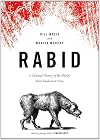
Rabid: A Cultural History of the World's Most Diabolical Virus
by Bill Wasik, Monica Murphy
On This Page
Description
A maddened creature, frothing at the mouth, lunges at an innocent victim—and with a bite, transforms its prey into another raving monster. It's a scenario that underlies our darkest tales of supernatural horror, but its power derives from a very real virus, a deadly scourge known to mankind from our earliest days. In this fascinating exploration, journalist Bill Wasik and veterinarian Monica Murphy chart four thousand years in the history, science, and cultural mythology of rabies.The most show more fatal virus known to science, rabies kills nearly 100 percent of its victims once the infection takes root in the brain. A disease that spreads avidly from animals to humans, rabies has served as a symbol of savage madness and inhuman possession throughout history. Today, its history can help shed light on the wave of emerging diseases—from AIDS to SARS to avian flu—with origins in animal populations.From Greek myths to zombie flicks, from the laboratory heroics of... show lessTags
Recommendations






















Member Recommendations

Member Reviews
I don't know if rabies really is "the world's most diabolical virus" or not, but it's got to be a very strong contender. Certainly it's a disease I've always found horrifically fascinating, with its unusual means of making its way through the body, its essentially 100% fatality rate, its effect of modifying animal behavior to help itself spread, and its position high, high up on the list of awful ways to die.
I might have liked a little bit more science in this "cultural history" of rabies, but the chapters that do delve into the medical science of the disease are excellent, especially the one that explores, in detail, Louis Pasteur's development of the rabies vaccine. Other sections are much more focused on the cultural part, and show more sometimes drift a bit from the focus on rabies into such topics as other diseases that pass to humans from animals, humanity's mixed attitudes towards dogs, and the way that rabies may have inspired (and definitely resonates with) fiction and folklore about humans who become bestial, including werewolves, vampires, and zombies. It's mostly pretty interesting rambling, though, so overall I found it well worth the read. show less
I might have liked a little bit more science in this "cultural history" of rabies, but the chapters that do delve into the medical science of the disease are excellent, especially the one that explores, in detail, Louis Pasteur's development of the rabies vaccine. Other sections are much more focused on the cultural part, and show more sometimes drift a bit from the focus on rabies into such topics as other diseases that pass to humans from animals, humanity's mixed attitudes towards dogs, and the way that rabies may have inspired (and definitely resonates with) fiction and folklore about humans who become bestial, including werewolves, vampires, and zombies. It's mostly pretty interesting rambling, though, so overall I found it well worth the read. show less
Everyone has weird interests that don’t really make sense. One of mine is that I’ve always been fascinated by the disease rabies. How it works, its cultural history, its effects, its terrifying possibilities. This interest just isn’t something explored much in literature or nonfiction, at least not that I’ve run across. When I asked for a recommendation for rabies-themed novels, this suggestion immediately interested me and I ordered it in a rush.
No matter how interesting the subject or well done the writing, I read non-fiction slowly. A flaw for sure. This one fascinated me from the beginning; the writing style helped bring the subject material to life in a smooth, non-pretentious manner. Not dry at all, and perhaps sometimes show more taking liberties with humor, I hold no complaints for the writing form. I do think sometimes the authors tended to drag on a point of view too long, or overemphasize certain sections where it became slightly tedious.
The book focuses mainly on the dog and how it has been the main vehicle for the virus, at least in the perceived notions of mankind. In fact bats may be more to blame, as is credited briefly in the book, but since the nonfiction piece focuses on the culture and society’s outlook on the disease, it focuses more on canines than anything else. I was intrigued by some of the history with the dog and legends.
There’s a lot tied into Greek mythology and the history of the dog and hellhounds, as well as the original treatment processes for the misunderstood disease. They’re put inside creatively named chapters such as “The Middle Rages.” ‘In the Beginning’ was the first part after the fascinating intro. From Ayurveda, which I always found interesting, makes me inclined to believe they were more on the right track in ancient times than others. Some of the treatments were just awful. Reading these chapters brought to mind my courses in humanities last year.
Celsus’ recommendation at the end of the chapter? *Shudders* The poor people were already suffering from rabies, I’m sure this made it a much worse death!
“If he cannot swim, let him sink under and drink, then lift him out; if he can swim, push him under at intervals so that he drinks his fill of water even against his will; for so his thirst and dread of water are removed at the same time.”
“If this proto-waterboarding happens to spur muscle spasms in the subject, Celsus recommends he be “taken straight from the tank and submerged into a bath of hot oil.”
Mythology continues awhile, and while I found the information about the origin of rage and name derivations like lycos and rage intriguing, I was especially wanting more information on the cultural invention of vampires and shapeshifters.
I’ve read some information in personal studies on how rabies influenced these legends, but I don’t think the authors fully explored this as much as they could have. It seems they strangely skirted over this a little. Why, I don’t know.
When I did a week doing different posts on Edgar Allen Poe for The Paperback Stash, I came to the conclusion that he may have died from rabies, but more likely from the political corruption of that time. I appreciate the authors putting in the theory he died from this disease and the evidence supporting the theory.
King Louis was best chapter of the book, its crowning glory. I already had such respect for the man but this chapter gives even more indepth details into his life and how much he accomplished. Fascinating, a true hero in the sense of the word. Not only for his accomplishments, but for his courage in those times to try unconventional methods. Pasteur was definitely a genius ahead of his time and I’m glad his colleagues got him out of the duel an opponent that took issue with his methods proposed. If he had died in a senseless fight, the immunology methods he nursed, the rabies treatments, may have been delayed by countless years.
The methods researchers had to employ before are sobering: several men held the rabid dog down while another extracted saliva from its reaching, snarling snout. If they were bit, they were shot instantly. Yikes!
I found it hauntingly sad how it played out and was written about the first human he saved, the small child the village saved up for and sent his way to be rescued. He waited by the bedside of Joseph Meister by night, worried he would die despite his intentions, overjoyed when he was saved. When his treatments worked and through the years he met more success, Pasteur created clinics and research facilities. As an adult, Meister was one of the first to donate, and one of the most sizable contributions.
Meister is such a success, but meets a sad end that’s written strangely on pg. 148:
“Pasteur’s remains were interred not in the Pantheon but instead, according to his family’s wishes, in a specially appointed crypt beneath the Institut Pasteur. There, fifteen years later, his wife, Marie, would be laid to rest also. Mosaics depicting Pasteur’s research triumphs watched over the tombs – and so did Joseph Meister, who, years after being the first to be vaccinated against the horror of rabies, became the concierge of the institute. When the Nazis, on occupying Paris, attempted to visit the Pasteur crypt in 1940, Meister bravely refused to unlock the gate for them. Soon after this discouraging event, he took his own life.”
The chapter for King Louis showed the scientific establishment against him, even when his vaccinations took off. The coma induced attempts and trials by Dr. Rodney Willoughby when discussed modern day survivors hints that more exploration should be given in researching if his theories are correct. There was a lot of hope, but still over six years later he never got the research money and not enough funding has been supplied elsewhere to explore the theory for treatment. The chapter Island of the Mad Dogs explores how Bali, previous rabies free, became alarmingly busy with rabies through one dog spreading it swiftly. There it was a struggle to encourage the government to vaccinate rather than actively and savagely destroy the dogs.
These all show one thing – much of the fight against the disease is delayed by human ignorance. Not only in Louis Pasteur’s personal battles with the hostile community of his day, but even with the proposed treatments of the 90’s. Only continued persistence from Janice Girardi (and maybe fueled in part by outraged protests from animal groups) encouraged Bali to begin vaccinating island wide.
The conclusion makes a cool point I didn’t know – that rabies is now being seen as one possible way to break the blood-brain barrier. This has always been a frustrating barrier preventing treatments for certain ailments, and there are only limited theories of how to break it. Isolating certain components in rabies may be used to develop a way to get into the system in a way that actually reaches the brain in the way it needs the treatment, making the brain barrier cease to exist for these stubborn ailments.
Whether this will ever be developed and whether it will work remains to be seen. It could be a major medical breakthrough. It has already been shown to work in mice by delivering large amounts of an Anti-Alzheimer’s RNAi to their brains.
As the book notes, it would be a wonderful irony to take the disease that has destroyed so many minds of man in the past and use it to save the minds of many in the future. Of course my silly mind thought of zombies stories and planet of the ape sequels coming to life with this theory too!
Overall an excellent book I’m so happy I picked up. I took away a star because I felt some of the cultural explorations were a little lacking and some too explored, and even if it’s a cultural history, I’d still have enjoyed further exploration about the mechanics of the virus itself. I guess that will be learned by picking up another book on the subject.
The book takes this modern chapter’s hope to end with a beautiful note going back into its starting point with mythology on page 236: “One is reminded of Orpheus, who, in search of his dead love Eurydice, employed his beautiful music to retrieve her from the underworld. ‘Cerberus stood agape,’ records the poet, ‘and his triple jaws forgot to bark.’ show less
No matter how interesting the subject or well done the writing, I read non-fiction slowly. A flaw for sure. This one fascinated me from the beginning; the writing style helped bring the subject material to life in a smooth, non-pretentious manner. Not dry at all, and perhaps sometimes show more taking liberties with humor, I hold no complaints for the writing form. I do think sometimes the authors tended to drag on a point of view too long, or overemphasize certain sections where it became slightly tedious.
The book focuses mainly on the dog and how it has been the main vehicle for the virus, at least in the perceived notions of mankind. In fact bats may be more to blame, as is credited briefly in the book, but since the nonfiction piece focuses on the culture and society’s outlook on the disease, it focuses more on canines than anything else. I was intrigued by some of the history with the dog and legends.
There’s a lot tied into Greek mythology and the history of the dog and hellhounds, as well as the original treatment processes for the misunderstood disease. They’re put inside creatively named chapters such as “The Middle Rages.” ‘In the Beginning’ was the first part after the fascinating intro. From Ayurveda, which I always found interesting, makes me inclined to believe they were more on the right track in ancient times than others. Some of the treatments were just awful. Reading these chapters brought to mind my courses in humanities last year.
Celsus’ recommendation at the end of the chapter? *Shudders* The poor people were already suffering from rabies, I’m sure this made it a much worse death!
“If he cannot swim, let him sink under and drink, then lift him out; if he can swim, push him under at intervals so that he drinks his fill of water even against his will; for so his thirst and dread of water are removed at the same time.”
“If this proto-waterboarding happens to spur muscle spasms in the subject, Celsus recommends he be “taken straight from the tank and submerged into a bath of hot oil.”
Mythology continues awhile, and while I found the information about the origin of rage and name derivations like lycos and rage intriguing, I was especially wanting more information on the cultural invention of vampires and shapeshifters.
I’ve read some information in personal studies on how rabies influenced these legends, but I don’t think the authors fully explored this as much as they could have. It seems they strangely skirted over this a little. Why, I don’t know.
When I did a week doing different posts on Edgar Allen Poe for The Paperback Stash, I came to the conclusion that he may have died from rabies, but more likely from the political corruption of that time. I appreciate the authors putting in the theory he died from this disease and the evidence supporting the theory.
King Louis was best chapter of the book, its crowning glory. I already had such respect for the man but this chapter gives even more indepth details into his life and how much he accomplished. Fascinating, a true hero in the sense of the word. Not only for his accomplishments, but for his courage in those times to try unconventional methods. Pasteur was definitely a genius ahead of his time and I’m glad his colleagues got him out of the duel an opponent that took issue with his methods proposed. If he had died in a senseless fight, the immunology methods he nursed, the rabies treatments, may have been delayed by countless years.
The methods researchers had to employ before are sobering: several men held the rabid dog down while another extracted saliva from its reaching, snarling snout. If they were bit, they were shot instantly. Yikes!
I found it hauntingly sad how it played out and was written about the first human he saved, the small child the village saved up for and sent his way to be rescued. He waited by the bedside of Joseph Meister by night, worried he would die despite his intentions, overjoyed when he was saved. When his treatments worked and through the years he met more success, Pasteur created clinics and research facilities. As an adult, Meister was one of the first to donate, and one of the most sizable contributions.
Meister is such a success, but meets a sad end that’s written strangely on pg. 148:
“Pasteur’s remains were interred not in the Pantheon but instead, according to his family’s wishes, in a specially appointed crypt beneath the Institut Pasteur. There, fifteen years later, his wife, Marie, would be laid to rest also. Mosaics depicting Pasteur’s research triumphs watched over the tombs – and so did Joseph Meister, who, years after being the first to be vaccinated against the horror of rabies, became the concierge of the institute. When the Nazis, on occupying Paris, attempted to visit the Pasteur crypt in 1940, Meister bravely refused to unlock the gate for them. Soon after this discouraging event, he took his own life.”
The chapter for King Louis showed the scientific establishment against him, even when his vaccinations took off. The coma induced attempts and trials by Dr. Rodney Willoughby when discussed modern day survivors hints that more exploration should be given in researching if his theories are correct. There was a lot of hope, but still over six years later he never got the research money and not enough funding has been supplied elsewhere to explore the theory for treatment. The chapter Island of the Mad Dogs explores how Bali, previous rabies free, became alarmingly busy with rabies through one dog spreading it swiftly. There it was a struggle to encourage the government to vaccinate rather than actively and savagely destroy the dogs.
These all show one thing – much of the fight against the disease is delayed by human ignorance. Not only in Louis Pasteur’s personal battles with the hostile community of his day, but even with the proposed treatments of the 90’s. Only continued persistence from Janice Girardi (and maybe fueled in part by outraged protests from animal groups) encouraged Bali to begin vaccinating island wide.
The conclusion makes a cool point I didn’t know – that rabies is now being seen as one possible way to break the blood-brain barrier. This has always been a frustrating barrier preventing treatments for certain ailments, and there are only limited theories of how to break it. Isolating certain components in rabies may be used to develop a way to get into the system in a way that actually reaches the brain in the way it needs the treatment, making the brain barrier cease to exist for these stubborn ailments.
Whether this will ever be developed and whether it will work remains to be seen. It could be a major medical breakthrough. It has already been shown to work in mice by delivering large amounts of an Anti-Alzheimer’s RNAi to their brains.
As the book notes, it would be a wonderful irony to take the disease that has destroyed so many minds of man in the past and use it to save the minds of many in the future. Of course my silly mind thought of zombies stories and planet of the ape sequels coming to life with this theory too!
Overall an excellent book I’m so happy I picked up. I took away a star because I felt some of the cultural explorations were a little lacking and some too explored, and even if it’s a cultural history, I’d still have enjoyed further exploration about the mechanics of the virus itself. I guess that will be learned by picking up another book on the subject.
The book takes this modern chapter’s hope to end with a beautiful note going back into its starting point with mythology on page 236: “One is reminded of Orpheus, who, in search of his dead love Eurydice, employed his beautiful music to retrieve her from the underworld. ‘Cerberus stood agape,’ records the poet, ‘and his triple jaws forgot to bark.’ show less
I'm hovering between three and four stars for this book.
Rabies is a fascinating topic. The disease, once symptoms show (in particular hydrophobia), had a 100% fatality rate until less than a decade ago. Even now, it's uncertain whether a natural partial immunity exists within some people, or if the protocols recently discovered are responsible for people's survival. This uncertainty is something that has existed throughout all of rabies history. The question of what caused the disease ended in the discovery of viruses, and the creation of a vaccine created the very field of immunology. Rabies demanded innovation, as it is the disease the lives on most prominently within our very psyches.
The book digs deep into rabies' grip on us. It show more talks about rabies in folklore, how it relates to the vampire, the werewolf, and especially the modern zombie. The etymology of the name of the disease itself is fascinating, as is how it has influenced our feelings towards dogs, and more, how our very love of dogs has us vulnerable and how that love can't really be overcome.
This is a fascinating book, and a worthy one. I'm glad so many of my friends are intrigued by it and I hope they'll pick it up eventually. While it's no [b: The Hot Zone|16220|Hot Stuff (Hot Zone, #1)|Carly Phillips|https://images.gr-assets.com/books/1388663492s/16220.jpg|23640095], if you've an interest in folklore and history, and a love of dogs, I think this will be a book you'll enjoy. show less
Rabies is a fascinating topic. The disease, once symptoms show (in particular hydrophobia), had a 100% fatality rate until less than a decade ago. Even now, it's uncertain whether a natural partial immunity exists within some people, or if the protocols recently discovered are responsible for people's survival. This uncertainty is something that has existed throughout all of rabies history. The question of what caused the disease ended in the discovery of viruses, and the creation of a vaccine created the very field of immunology. Rabies demanded innovation, as it is the disease the lives on most prominently within our very psyches.
The book digs deep into rabies' grip on us. It show more talks about rabies in folklore, how it relates to the vampire, the werewolf, and especially the modern zombie. The etymology of the name of the disease itself is fascinating, as is how it has influenced our feelings towards dogs, and more, how our very love of dogs has us vulnerable and how that love can't really be overcome.
This is a fascinating book, and a worthy one. I'm glad so many of my friends are intrigued by it and I hope they'll pick it up eventually. While it's no [b: The Hot Zone|16220|Hot Stuff (Hot Zone, #1)|Carly Phillips|https://images.gr-assets.com/books/1388663492s/16220.jpg|23640095], if you've an interest in folklore and history, and a love of dogs, I think this will be a book you'll enjoy. show less
The fascinating history of the rabies virus and humanity's attempts to control and conquer it. As I read this book it became clear that rabies has effected my life, imagination, and fears even though I have never known anyone to contract it. The disease was so prevalent for so long that it has impacted Western thought and literature in innumerable ways. An absolutely riveting read.
This is a cultural history of rabies. Bill Wasik is a journalist, and Monica Murphy a veterinarian, and they've put together an amazing, and amazingly readable, account of the history, mythology, and science of rabies, the only disease we know that has a nearly 100% fatality rate.
Rabies kills, and while it's doing that, it drives is victims mad, with interludes of lucidity when they know what's happening to them. It also, though most of history, mostly reached us through the most familiar of our domestic animals, our dogs.
This is perhaps why rabies seems so tied to our myths of vampires and zombies.
The authors present to us the history not only of the cultural effects of rabies, but of the efforts to understand and control it.
For me show more personally, the most fascinating section is the one about Louis Pasteur. One of the founders of medical microbiology, Pasteur didn't just give us the pasteurization that makes our milk products safe. He also took the principle of vaccination that Edward Jenner had discovered when he created the smallpox vaccine in the 1790s, and expanded and developed it to create new vaccines--most notably for anthrax and for rabies. Pasteur is just an extremely interesting figure, and amazing in his dedication to, and success at, applying science to save lives.
The most appalling section, in some respects, is the return of rabies to Bali, to a great extent because authorities were so resistant to following sound advice from experts and instead committed themselves to approaches that only looked cheaper and easier in the short run. It's a valuable example of how to do things wrong.
Overall, an absorbing and revelatory book Highly recommended.
I borrowed this audiobook from my local library. show less
Rabies kills, and while it's doing that, it drives is victims mad, with interludes of lucidity when they know what's happening to them. It also, though most of history, mostly reached us through the most familiar of our domestic animals, our dogs.
This is perhaps why rabies seems so tied to our myths of vampires and zombies.
The authors present to us the history not only of the cultural effects of rabies, but of the efforts to understand and control it.
For me show more personally, the most fascinating section is the one about Louis Pasteur. One of the founders of medical microbiology, Pasteur didn't just give us the pasteurization that makes our milk products safe. He also took the principle of vaccination that Edward Jenner had discovered when he created the smallpox vaccine in the 1790s, and expanded and developed it to create new vaccines--most notably for anthrax and for rabies. Pasteur is just an extremely interesting figure, and amazing in his dedication to, and success at, applying science to save lives.
The most appalling section, in some respects, is the return of rabies to Bali, to a great extent because authorities were so resistant to following sound advice from experts and instead committed themselves to approaches that only looked cheaper and easier in the short run. It's a valuable example of how to do things wrong.
Overall, an absorbing and revelatory book Highly recommended.
I borrowed this audiobook from my local library. show less
This was a funny book to read directly after a horror book about a killer computer virus, as this deals with another killer virus and uses a lot of the same language to describe it. Rabies is terrifying, and I don't know why I'm not dead from it as I regularly handled bats as a teenager. They just lived in the log cabin I worked in and the babies would fall off the ceiling so I'd stick them back on the wall every morning. Turns out that's really bad. The history of what people thought was happening before we completely understood the virus was interesting and sad. The fear of water is the leading symptom that was identified even back then. Thank goodness there's a cure, thanks Michael Scott.
Though quite interesting, the book is (as I saw some reviewers mention before I checked the book out myself) a bit meandering, and doesn't exactly focus on its central topic in the way it proclaims. It wanders through folklore, medicine, history, culture, through speculation and documented history without much rhyme or reason on when or where.
(Though to my knowledge and checking references most of it is accurate, I've also found a few inconsistencies or things I know to be incorrect from other reading or research.)
Some of the 'speculations' are supported by general science or historians and their best guesses . . . some feel incredibly random and very dubious. (For example, speculating why a particular author used rabies as a key plot show more in her novel, first brings up that she grew up with multiple medical professionals in her household and in that era, likely was familiar with rabies from thence; very sensible. The book discards this however and says that surely it is more likely due to a movie about Pasteur which was seen by a full 10% of the USA population at the time, so certainly she must have seen it, and it influenced her writing.)
Personally (especially having done a lot of reading on the folklore, history, and development in literature myself over the years) I find the assumption presented that rabies is behind the vampire mythos (in addition, of course, to the werewolf myth, and a number of others) to be rather dubious.
Suggestions that zombies became popular in media after and because of the World Trade Center disaster of 9/11 was another seemingly wild leap - particularly considering that zombie movies long predate 2001, including at least a few of the still most definitive/cult classic titles. show less
(Though to my knowledge and checking references most of it is accurate, I've also found a few inconsistencies or things I know to be incorrect from other reading or research.)
Some of the 'speculations' are supported by general science or historians and their best guesses . . . some feel incredibly random and very dubious. (For example, speculating why a particular author used rabies as a key plot show more in her novel, first brings up that she grew up with multiple medical professionals in her household and in that era, likely was familiar with rabies from thence; very sensible. The book discards this however and says that surely it is more likely due to a movie about Pasteur which was seen by a full 10% of the USA population at the time, so certainly she must have seen it, and it influenced her writing.)
Personally (especially having done a lot of reading on the folklore, history, and development in literature myself over the years) I find the assumption presented that rabies is behind the vampire mythos (in addition, of course, to the werewolf myth, and a number of others) to be rather dubious.
Suggestions that zombies became popular in media after and because of the World Trade Center disaster of 9/11 was another seemingly wild leap - particularly considering that zombie movies long predate 2001, including at least a few of the still most definitive/cult classic titles. show less
Members
- Recently Added By
Lists

Books Read in 2014
2,343 works; 89 members

Weirdo Nonfiction
138 works; 3 members

Books Read in 2025
4,128 works; 98 members
Author Information

5 Works 1,173 Members

1 Work 934 Members
Some Editions
Awards and Honors
Distinctions
Common Knowledge
- Alternate titles
- Rabid
- Original publication date
- 2012
- People/Characters
- Xenophon; Actaeon; Saint Hubert; Saint Eustace; Saint Quiteria; Arnod Paole (show all 19); Johannes Fluckinger; Richard Mead; James Duff; Marie Caroline Manners; Benjamin Rush; James Mease; Frederick Benteen; Louis Pasteur; Emile Roux; Joseph Meister; Alfred Vulpian; Dr. Rodney Willoughby; Jeanna Giese
- Dedication
- For our "creatures" - Emmett and Mia
- First words
- Introduction
Ours is a domesticated age.
For more than a week, Achilles sulks while the Trojan War carries on without him. - Last words
- (Click to show. Warning: May contain spoilers.)To euthanize it—which a BAWA vet mercifully did, moments later, with the customary overdose of anesthesia—was merely to acknowledge its departure.
(Click to show. Warning: May contain spoilers.)"Cerberus stood agape," records the poet, "and his triple jaws forgot to bark." - Blurbers
- Johnson, Steven; Zimmer, Carl; Hohn, Donovan; Anderson, Chris
Classifications
- Genres
- General Nonfiction, Science & Nature, History, Nonfiction
- DDC/MDS
- 614.5 — Applied science & technology Medicine & health Epidemics, Poisons, Alternative Medicine Incidence of and public measures to prevent specific diseases and kinds of diseases
- LCC
- RC148 .W37 — Medicine Internal medicine Internal medicine Infectious and parasitic diseases
- BISAC
Statistics
- Members
- 947
- Popularity
- 28,082
- Reviews
- 55
- Rating
- (3.59)
- Languages
- English
- Media
- Paper, Audiobook, Ebook
- ISBNs
- 10
- ASINs
- 2