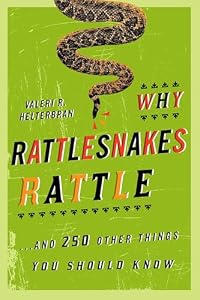
Why Rattlesnakes Rattle: ...and 250 Other Things You Should Know
by Valeri R. Helterbran 
On This Page
Description
A follow-up to Helterbran's popular Why Flamingos Are Pink: ...and 250 other Things You Should Know, this entertaining volume identifies more of the surprising explanations for the facts, tales, and lore associated with day-to-day living and the world around us. Organized into seven categories, this book tells you why birds perched on power lines aren't electrocuted; the origins of such expressions as "swan song" and "willy nilly;" and the science behind such phenomena as ball lightning, show more blue glaciers, red tide, and thunder snow. More than a mere compendium of trivia, this book is a springboard for learners of all ages. show lessTags
Recommendations









Member Recommendations

Member Reviews
Usually, I rather enjoy books like this, these little collections of random interesting facts, but I have to say, this one kind of left me cold. I think it's mostly that it's too heavy on the "random" part and too light on the "interesting" part. There are certainly a few examples of the sort of thing I expect from such a book: little bits of information that make me go, "Huh, I didn't know that!" and feel ever-so-slightly richer for having corrected that lack. But a lot of it is stuff that really is just common knowledge (e.g."What is a lobbyist?", "What is a blog?"), or else so obscure and odd that I find it difficult to imagine hardly anyone actually asking the questions it somehow feels the need to answer (e.g. "Why do we swear by show more Alexander's beard?"). Some of the questions seem like surely they must have interesting stories behind them, to merit inclusion, but quickly disappoint. Like, why does Pittsburgh have an "h" on the end of it? Eh, well, it just does. For a while, the post office tried to change as part of an attempt to make place name spellings more regular, but people who lived there didn't like it, so they changed it back. Gosh, riveting stuff! Thanks for telling me that! And probably at least half of the entries just define or give the etymological histories of various words and phrases, some of which do have fairly colorful histories behind them and some of which, um, don't. Even the more interesting subjects are presented in a writing style that's not making any particular attempt to be engaging, though. And I'm afraid the pictures don't help, either. They're all small, muddy black-and-white photos, few of which illustrate anything useful. Many of them relate only very tangentially to things mentioned in passing, enough so that I suspect some of them are an attempt to inject a sense of playfulness that's missing in the text, but mostly they just make the whole thing look amateurish.
All of which probably sounds more relentlessly negative than I really want to be. Because, honestly, it's not bad. I did learn a few things from it, and it's probably a perfectly fine book to keep in the bathroom and browse through while you're taking care of business, if that's something you like to do. It's just that, if you want a collection of interesting facts you didn't know and probably should have, there are way better examples out there. show less
All of which probably sounds more relentlessly negative than I really want to be. Because, honestly, it's not bad. I did learn a few things from it, and it's probably a perfectly fine book to keep in the bathroom and browse through while you're taking care of business, if that's something you like to do. It's just that, if you want a collection of interesting facts you didn't know and probably should have, there are way better examples out there. show less
 This review was written for LibraryThing Early Reviewers.
This book is a series of short (1-2 page) articles answering fairly specific questions (e.g., "What is Gout?" "Who Was Vince Lombardi?"), grouped into 7 chapters by theme (Nature, The Human Body, Language, Holidays, Humanities/Culture, Cuisine, and Geography). In its original incarnation, the book was a newspaper column, and it never really gets away from that--the answers are short and exactly to the point, with little room for long excursus on related topics (though this, to the author's credit, does occasionally happen). I didn't detect any factual errors in the book, but it was a rather lifeless affair overall.
When one compares it to the Uncle John's Bathroom Reader series (and let's be honest, that's where a book like this will be show more read), it falls a bit flat. The style is much more educational and straightforward (unsurprising, given the author's background in education), without the flair for humor or entertainment that the Bathroom Readers possess in spades; it also lacks the longer articles in the BR series (sometimes 3-4 pages long) that allow for more in-depth coverage of a topic.
The formatting, too, is a bit prosaic; the spacing of the text rows makes for relatively easy reading but it's dull to look at, and the rather mundane black and white photography inserted only adds to the amateurish feel of the whole thing. A redesign of the interior would probably go a long way toward making the book more appealing, as well as a tweaking of the style and depth of the articles.
It's not a bad book; it's just not a great one. Give it a read once you've burned through Uncle John and the like. show less
When one compares it to the Uncle John's Bathroom Reader series (and let's be honest, that's where a book like this will be show more read), it falls a bit flat. The style is much more educational and straightforward (unsurprising, given the author's background in education), without the flair for humor or entertainment that the Bathroom Readers possess in spades; it also lacks the longer articles in the BR series (sometimes 3-4 pages long) that allow for more in-depth coverage of a topic.
The formatting, too, is a bit prosaic; the spacing of the text rows makes for relatively easy reading but it's dull to look at, and the rather mundane black and white photography inserted only adds to the amateurish feel of the whole thing. A redesign of the interior would probably go a long way toward making the book more appealing, as well as a tweaking of the style and depth of the articles.
It's not a bad book; it's just not a great one. Give it a read once you've burned through Uncle John and the like. show less
This review was written for LibraryThing Early Reviewers.This was well written with an inclusive mix of topics. It has a fairly serious tone, lacking the humor of the Imponderables series, which is not bad, just different. The author is an educator and shows a love for education that is admirable in today’s society.
This review was written for LibraryThing Early Reviewers.Taken from Valeri Helterbran’s column in the Ligonier Echo, Why rattlesnakes rattle : ---and 250 other things you should know is a book of facts, divided into seven main sections, sometimes a bit arbitrarily. Each question, such as “What is dry cleaning?” or “What is a tycoon?”, is followed by a short answer. Occasionally there are illustrations and/or a website for further information. There is an index which allows for quick checks to see if a wanted fact is covered in the book. The author also provides a short resource section but gave no book titles nor web addresses for the organizations/professional societies listed, certainly a weakness in this type of book.
The author starts by listing why lifelong learning is important show more and many ways to accomplish this goal, her book being one of them. Written in easy to understand language, the book can be picked up and sections read in any order. The book reminded me of the children’s classic Tell me why by Arkady Leokum with its strong emphasis on science and customs but Helterbran goes further by having sections on word usage, holidays and other things. But the depth of Leokum cannot be overlooked. Helterbran spreads her pure science over several sections so the index becomes necessary to find items such as on medicine and chemistry which are in the Humanities section. And be aware that, writing for a Pennsylvania newspaper, there are questions of interest to residents of that state.
There are illustrations but not where especially needed. I know what a sporran is but, had I not, a picture would be so much better than just text. The paragraphs on the difference between carat and karat would have been improved by having a chart with the differences between diamond weights, say using a round diamond. There is no picture of the Pennsylvania flag to accompany an explanation of its symbolism. Yet there are pictures accompanying articles where not really necessary. We all know what a cat looks like, what a mound of snow entails, etc., but not what a sundog or cenotaph looks like.
In spite of the reservations listed, I would recommend this book, especially for young readers, along with her previous title, Why flamingos are pink. If you enjoy lifelong learning and love quirky facts, this book is for you. show less
The author starts by listing why lifelong learning is important show more and many ways to accomplish this goal, her book being one of them. Written in easy to understand language, the book can be picked up and sections read in any order. The book reminded me of the children’s classic Tell me why by Arkady Leokum with its strong emphasis on science and customs but Helterbran goes further by having sections on word usage, holidays and other things. But the depth of Leokum cannot be overlooked. Helterbran spreads her pure science over several sections so the index becomes necessary to find items such as on medicine and chemistry which are in the Humanities section. And be aware that, writing for a Pennsylvania newspaper, there are questions of interest to residents of that state.
There are illustrations but not where especially needed. I know what a sporran is but, had I not, a picture would be so much better than just text. The paragraphs on the difference between carat and karat would have been improved by having a chart with the differences between diamond weights, say using a round diamond. There is no picture of the Pennsylvania flag to accompany an explanation of its symbolism. Yet there are pictures accompanying articles where not really necessary. We all know what a cat looks like, what a mound of snow entails, etc., but not what a sundog or cenotaph looks like.
In spite of the reservations listed, I would recommend this book, especially for young readers, along with her previous title, Why flamingos are pink. If you enjoy lifelong learning and love quirky facts, this book is for you. show less
This review was written for LibraryThing Early Reviewers.I like books of random facts, and this book does not disappoint. Each entry has a few paragraphs, providing more information than your standard trivia books of one-line “did you know” factoids. I was also pleasantly surprised to come across several things I hadn’t known and was actually curious to find out (it’s easy to find facts I didn’t know but most of them aren’t particularly interesting). Unlike many books of trivia, this one is just fine to read straight through, or you can turn to any random page. And with the thorough index, this book could even be relatively useful to keep around, more than just for entertainment.
This review was written for LibraryThing Early Reviewers."Why Rattlesnakes Bite And 250 Other Things You Should Know" is, according to the author, Valeri R. Helterbran, "rooted in the ... newspaper column" she writes for the Ligonier, PA newspaper. That column is titled, "Things Every Kid Should Know" which explains the elementary questions asked and answered throughout the book. Trivia enthusiasts probably won't find anything new or extraordinary, but readers will find plenty that targets a younger audience. In the preface she encourages her readers to be 'lifelong learners' - a wonderful aspiration!
Each chapter is divided by topic: Nature and Environment, Language, Holidays and Special Occasions, and Cuisine, just to name a few. She answers questions such as "What is a Swan Song?", "What Is show more a Blog?" (helpfully providing the pronunciation ("blawg")), and "What Is a Gerund?". While some questions do seem above the level of the intended reader (e.g.: "What Is a Mid-Life Crisis?" and "What Is a Shylock?") most will be of interest to readers of all ages. Included are photographs taken by and/or of family members and friends, as well as items probably found around her home (such as lunch bags, "What Is Hyperventilation?", and a pink flamingo brooch, "What Is a Rhinestone?"). The author also answers questions posed by friends and family as listed in the back. For many of the answers (but not in every chapter) she does provide an example of usage: for the question about the origin of the word 'windfall', she uses the word in three different sentences.
Helterbran's writing style is straight forward and to the point - she takes each question and answer seriously. A couple of nitpicky things: In the preface she begins, "Lifelong learning is a passion of mine", however by the second paragraph it switches to third person. Not a huge deal, but confusing on a basic level. Also, why list "Google.com" as a resource? Shouldn't this information be the result of a little bit more research than that?
This book is a fun read, albeit not especially new trivia territory. If you know young children, or, really anyone, who has an interest in learning more about all kinds of things, this book would be a good start. show less
Each chapter is divided by topic: Nature and Environment, Language, Holidays and Special Occasions, and Cuisine, just to name a few. She answers questions such as "What is a Swan Song?", "What Is show more a Blog?" (helpfully providing the pronunciation ("blawg")), and "What Is a Gerund?". While some questions do seem above the level of the intended reader (e.g.: "What Is a Mid-Life Crisis?" and "What Is a Shylock?") most will be of interest to readers of all ages. Included are photographs taken by and/or of family members and friends, as well as items probably found around her home (such as lunch bags, "What Is Hyperventilation?", and a pink flamingo brooch, "What Is a Rhinestone?"). The author also answers questions posed by friends and family as listed in the back. For many of the answers (but not in every chapter) she does provide an example of usage: for the question about the origin of the word 'windfall', she uses the word in three different sentences.
Helterbran's writing style is straight forward and to the point - she takes each question and answer seriously. A couple of nitpicky things: In the preface she begins, "Lifelong learning is a passion of mine", however by the second paragraph it switches to third person. Not a huge deal, but confusing on a basic level. Also, why list "Google.com" as a resource? Shouldn't this information be the result of a little bit more research than that?
This book is a fun read, albeit not especially new trivia territory. If you know young children, or, really anyone, who has an interest in learning more about all kinds of things, this book would be a good start. show less
This review was written for LibraryThing Early Reviewers.Why Rattlesnakes Rattle is the follow-up book of random facts and explanations to Why Flamingos are Pink, also by Helterbran. This book, compared to other informational tidbit books I've read before, is geared towards a much younger audience, and as such, can be quite placating at times.
While several of the facts in the book were interesting, I had issue with some. My biggest complaint, however, was not the credibility of some of the resources, but rather the amateurish photographs interlaced between segments, some having hardly anything to do with the corresponding material. Ink illustrations would have worked much better, as would have professional black and white photographs. My second biggest complaint was with the copy editing in show more some cases (for example, "i.e." does not mean "for example"). My third biggest complaint was the slant towards Pennsylvania-based information, an obvious product of the author's employer at the time of this book's writing.
All in all, this book may be of some value to a younger reader, but may not be of interest to an older reader, used to "the rest of the story."
As for me, I'd prefer a book that actually answers the title's question ("Why do rattlesnakes rattle?"), which this book, oddly enough, doesn't. show less
While several of the facts in the book were interesting, I had issue with some. My biggest complaint, however, was not the credibility of some of the resources, but rather the amateurish photographs interlaced between segments, some having hardly anything to do with the corresponding material. Ink illustrations would have worked much better, as would have professional black and white photographs. My second biggest complaint was with the copy editing in show more some cases (for example, "i.e." does not mean "for example"). My third biggest complaint was the slant towards Pennsylvania-based information, an obvious product of the author's employer at the time of this book's writing.
All in all, this book may be of some value to a younger reader, but may not be of interest to an older reader, used to "the rest of the story."
As for me, I'd prefer a book that actually answers the title's question ("Why do rattlesnakes rattle?"), which this book, oddly enough, doesn't. show less
This review was written for LibraryThing Early Reviewers.Members
- Recently Added By
Author Information

4 Works 29 Members
Valeri R. Helterbran is a LibraryThing Author, an author who lists their personal library on LibraryThing.
Common Knowledge
- Dedication
- To Buddy, Rob, Ben, and my dad, Richard S. Russell
- First words
- Lifelong learning is a passion of mine.
Classifications
- Genres
- Reference, Nonfiction, General Nonfiction, Science & Nature
- DDC/MDS
- 031.02 — Computer science, information & general works Encyclopedias & books of facts General encyclopedic works in American English Miscellanies and Factbooks
- LCC
- AG243 .H376 — General Works Dictionaries and other general reference works Dictionaries and other general reference works
- BISAC
Statistics
- Members
- 21
- Popularity
- 1,226,942
- Reviews
- 10
- Rating
- (3.45)
- Languages
- English
- Media
- Paper, Ebook
- ISBNs
- 2