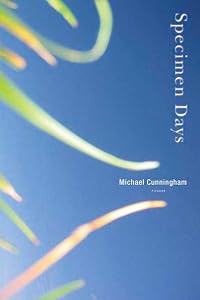
Specimen Days: A Novel
by Michael Cunningham
On This Page
Description
A highly anticipated, bold new novel from the Pulitzer Prize-winning author of The Hours—three linked visionary narratives set in the ever-mysterious, turbulent city of New YorkIn each section of Michael Cunningham's new book, we encounter the same group of characters: a young boy, an older man, and a young woman. "In the Machine" is a ghost story which takes place at the height of the Industrial Revolution, as human beings confront the alienated realities of the new machine age. "The show more Children's Crusade," set in the early twenty-first century, plays with the conventions of the noir thriller as it tracks the pursuit of a terrorist band which is detonating bombs seemingly at random around the city. The third part, "Like Beauty," evokes a New York 150 years into the future, when the city is all but overwhelmed by refugees from the first inhabited planet to be contacted by the people of Earth. Presiding over each episode of this interrelated whole is the prophetic figure of the poet Walt Whitman, who promised his future readers, "It avails not, neither distance nor place...I am with you, and know how it is."
SPECIMEN DAYS is a genre-bending, haunting, and transformative ode to life in our greatest city—a work of surpassing power and beauty by one of the most original and daring writers at work today.
. show less
Tags
Recommendations







Member Recommendations
Member Reviews
I bought Specimen Days by Michael Cunningham quite a while ago without really knowing what it was about or what to expect. As I started reading, I felt strangely like I was hovering above the characters watching them go about their lives. The use of Walt Whitman's work to weave these three stories set in different times together intrigued me and kept me wondering where Cunningham was going. As I read what in many ways felt like three novellas tied together by some common elements I couldn't help but think about the remnants we leave behind as we travel through life, remnants that might mean the world to us and nothing to someone else or might feel like nothing to us but change someone else's life. Cunningham's characters aren't all show more necessarily likable but they are engaging and even relatable in an uncomfortable way that seems to bring to mind some of the less desirable aspects of one's self as one wonders what one would do in similar circumstances. Specimen Days draws distinct parallels between the things we choose to see and the things we choose not to see as we go about our daily lives. In the three story lines, which almost feel like they have an air of reincarnation about them, Specimen Days puts human interaction - really all interaction between beings - under a microscope to examine if we really know ourselves and others as well as we think they do and even seems to question our view of life itself. show less
He wanted to tell her that he was inspired and vigilant and recklessly alone, that his body contained his unsteady heart and something else, something he felt but could not describe: porous and spiky, shifting with flecks of thought, with urge and memory; salted with brightness, flickerings of white and green and pale gold; something that loved stars because it was made of the same substance. He needed to tell her it was impossible, it was unbearable, to be so continually mistaken for a misshapen boy with a walleye and a pumpkin head and a habit of speaking in fits.
He said, "I celebrate myself, and what I assume you shall assume." It was not what he'd hoped to tell her.
Why haven't I read this delicious puzzle-of-a-book before? Why has show more only ONE of my GR friends read it? This carefully crafted, beautifully written, genre-defying little treasure is in the same vein as [b:Cloud Atlas|49628|Cloud Atlas|David Mitchell|https://images.gr-assets.com/books/1406383769s/49628.jpg|1871423], but much shorter and less complicated to follow.
Each of the three 100-page novellas that makes up this novel:
a) takes part in New York City
b) features a man named Simon, a woman named Cat(herine/areen), and a boy named Lucas, (and also, weirdly, a bowl) all of whom take a turn being the main character (except for the bowl)
c) has a character who compulsively quotes Walt Whitman
"In the Machine" is historical fiction set during the Industrial Age, with young Lucas (featured in my opening excerpt) trying to fill the shoes of his dead brother, Simon, by filling his factory position, becoming primary breadwinner for his ailing Irish immigrant parents, and trying to win the heart of Simon's fiancee, Catherine.
Maybe it was time to quit the unit, though if she did it now it would look like she was running away. In fact, she'd been thinking of quitting for some time. You got a little crazy, working the nuts. You listened to every lunatic with the same patience; you reminded yourself over and over that any one of these people might really and truly be about to torch a grade school or blow up a store or kill somebody just because he was well-known. Bartenders must start seeing a world full of drunks; lawyers must see it as largely made up of the vengefully injured. Forensic psychologists got infected by paranoia. You knew, better than the average citizen, that the world contains a subworld, where the residents do as most people do, pay rent and buy groceries, but have a little something extra going on. They receive personal messages from their televisions sets or are raped nightly by a sitcom star or have discovered that the cracks on the sidewalk between Broadway and Lafayette spell out the names of the aliens who are posing as world leaders.
In "The Children's Crusade," Cat is a brilliant, troubled forensic psychologist answering threatening calls for the NYPD in the aftermath of 9/11. A black woman working in a white man's world, she uses her "queenly bearing, schoolmarm diction" to enforce her credibility. When she misses flagging an adolescent caller who goes on to commit an act of terrorism, she finds herself drawn into a larger plot.
She might have been beautiful. "Beautiful" was of course an approximation. An earthly term. The nearest word in her language was "keeram," which more or less meant "better than useful." It was as close as her people came to a lofty abstraction. The bulk of their vocabulary pertained to weather conditions, threats of various kinds, and that which could be eaten, traded, or burned for fuel.
She was by Earth standards a four-and-a-half-foot-tall lizard with prominent nostrils and eyes slightly smaller than golf balls. But Simon believed she might have been glorious on her own planet. She might have been better than useful there.
"Like Beauty" takes place about 150 years in the future, in a NYC which is essentially a nostalgic theme park for foreign tourists, inhabited by down-on-their-luck actors and Nadian refugees from the first inhabited planet with which Earth made contact. Simon is an illegal AI programmed with an urge to travel to Colorado, across the abandoned ruins of middle America.
What's amazing is how well all these stories work. I connected with the characters, lingered over the Mr. Cunningham's prose, dissected Mr. Whitman's poetry (which I clearly need to go back and reread!), and thoroughly enjoyed the entire novel. show less
He said, "I celebrate myself, and what I assume you shall assume." It was not what he'd hoped to tell her.
Why haven't I read this delicious puzzle-of-a-book before? Why has show more only ONE of my GR friends read it? This carefully crafted, beautifully written, genre-defying little treasure is in the same vein as [b:Cloud Atlas|49628|Cloud Atlas|David Mitchell|https://images.gr-assets.com/books/1406383769s/49628.jpg|1871423], but much shorter and less complicated to follow.
Each of the three 100-page novellas that makes up this novel:
a) takes part in New York City
b) features a man named Simon, a woman named Cat(herine/areen), and a boy named Lucas, (and also, weirdly, a bowl) all of whom take a turn being the main character (except for the bowl)
c) has a character who compulsively quotes Walt Whitman
"In the Machine" is historical fiction set during the Industrial Age, with young Lucas (featured in my opening excerpt) trying to fill the shoes of his dead brother, Simon, by filling his factory position, becoming primary breadwinner for his ailing Irish immigrant parents, and trying to win the heart of Simon's fiancee, Catherine.
Maybe it was time to quit the unit, though if she did it now it would look like she was running away. In fact, she'd been thinking of quitting for some time. You got a little crazy, working the nuts. You listened to every lunatic with the same patience; you reminded yourself over and over that any one of these people might really and truly be about to torch a grade school or blow up a store or kill somebody just because he was well-known. Bartenders must start seeing a world full of drunks; lawyers must see it as largely made up of the vengefully injured. Forensic psychologists got infected by paranoia. You knew, better than the average citizen, that the world contains a subworld, where the residents do as most people do, pay rent and buy groceries, but have a little something extra going on. They receive personal messages from their televisions sets or are raped nightly by a sitcom star or have discovered that the cracks on the sidewalk between Broadway and Lafayette spell out the names of the aliens who are posing as world leaders.
In "The Children's Crusade," Cat is a brilliant, troubled forensic psychologist answering threatening calls for the NYPD in the aftermath of 9/11. A black woman working in a white man's world, she uses her "queenly bearing, schoolmarm diction" to enforce her credibility. When she misses flagging an adolescent caller who goes on to commit an act of terrorism, she finds herself drawn into a larger plot.
She might have been beautiful. "Beautiful" was of course an approximation. An earthly term. The nearest word in her language was "keeram," which more or less meant "better than useful." It was as close as her people came to a lofty abstraction. The bulk of their vocabulary pertained to weather conditions, threats of various kinds, and that which could be eaten, traded, or burned for fuel.
She was by Earth standards a four-and-a-half-foot-tall lizard with prominent nostrils and eyes slightly smaller than golf balls. But Simon believed she might have been glorious on her own planet. She might have been better than useful there.
"Like Beauty" takes place about 150 years in the future, in a NYC which is essentially a nostalgic theme park for foreign tourists, inhabited by down-on-their-luck actors and Nadian refugees from the first inhabited planet with which Earth made contact. Simon is an illegal AI programmed with an urge to travel to Colorado, across the abandoned ruins of middle America.
What's amazing is how well all these stories work. I connected with the characters, lingered over the Mr. Cunningham's prose, dissected Mr. Whitman's poetry (which I clearly need to go back and reread!), and thoroughly enjoyed the entire novel. show less
Specimen Days is an unusual novel, beautifully written and gloriously strange — the best kind of novel, the kind that keeps you thinking and wondering long after the cover has been closed. The book is divided into three sections, each one connected by character, setting, iconic images and the poetry of Walt Whitman. In each section, the same three characters appear — a man, a woman and a deformed child — but each section is told from a different character’s point of view. Although it is never stated, I got the sense that reincarnation is at work, and each character in their new time is a continuation and evolution of who they were before.
The first section is set in Victorian New York, among sweatshops, ironworks and extreme show more poverty, in an age just beginning to become industrialized. The boy, so struck by Whitman’s Leaves of Grass (which he calls “the Book”) that he cannot help but recite lines from it at odd and inappropriate moments, has taken his dead brother’s job at a factory. He becomes convinced that ghosts haunt the machines around him and that the machines love the people who work them so much that they want to consume the people themselves. The boy feels compelled to save his brothers fiancee from such a fate.
The second section, set in present-day New York, follows a forensic psychologist for the NYC police department as she is caught up in a strange terrorist plot involving children blowing themselves and a randomly chosen stranger up in an effort to change the course of human history. The children, all unwanted and abandoned, were raised by a woman calling herself Walt Whitman in an apartment where the walls, floors and ceilings have been covered with pages from Leaves of Grass. For me, this was the most compelling section, although all three stories were fascinating.
The final story is set 150 years into the future. It begins in a New York that has devolved into an amusement park, but the story moves outside the confines of the city for the first time. The characters — an android who compulsively recites Whitman due to his “poetry chip,” an intelligent alien lizard and a deformed but wise young boy — go on a quest together that takes them across a ruined America to Denver and the promise of a more hopeful future. This was the strangest story of them all, but the common threads of character and theme keep it grounded.
Each story is ultimately about love: how it begins, how it can end and what it compels us to do for and to each other. But I think this novel is also a warning about how disconnected we are becoming from the Earth and nature — connection to nature is a strong theme in Leaves of Grass – and the inevitable consequences of that disconnect. Each time there is an attempt to reconnect, to alter the direction that society is going, and a failure to do so. But despite these failures, there is still hope — hope embodied in Whitman’s enduring words, in the persistence of love, in the continuing quest for a reunion with the natural world and the cosmos. The ultimate fate of that quest remains unknown as the novel ends, and there is hope in that too. show less
The first section is set in Victorian New York, among sweatshops, ironworks and extreme show more poverty, in an age just beginning to become industrialized. The boy, so struck by Whitman’s Leaves of Grass (which he calls “the Book”) that he cannot help but recite lines from it at odd and inappropriate moments, has taken his dead brother’s job at a factory. He becomes convinced that ghosts haunt the machines around him and that the machines love the people who work them so much that they want to consume the people themselves. The boy feels compelled to save his brothers fiancee from such a fate.
The second section, set in present-day New York, follows a forensic psychologist for the NYC police department as she is caught up in a strange terrorist plot involving children blowing themselves and a randomly chosen stranger up in an effort to change the course of human history. The children, all unwanted and abandoned, were raised by a woman calling herself Walt Whitman in an apartment where the walls, floors and ceilings have been covered with pages from Leaves of Grass. For me, this was the most compelling section, although all three stories were fascinating.
The final story is set 150 years into the future. It begins in a New York that has devolved into an amusement park, but the story moves outside the confines of the city for the first time. The characters — an android who compulsively recites Whitman due to his “poetry chip,” an intelligent alien lizard and a deformed but wise young boy — go on a quest together that takes them across a ruined America to Denver and the promise of a more hopeful future. This was the strangest story of them all, but the common threads of character and theme keep it grounded.
Each story is ultimately about love: how it begins, how it can end and what it compels us to do for and to each other. But I think this novel is also a warning about how disconnected we are becoming from the Earth and nature — connection to nature is a strong theme in Leaves of Grass – and the inevitable consequences of that disconnect. Each time there is an attempt to reconnect, to alter the direction that society is going, and a failure to do so. But despite these failures, there is still hope — hope embodied in Whitman’s enduring words, in the persistence of love, in the continuing quest for a reunion with the natural world and the cosmos. The ultimate fate of that quest remains unknown as the novel ends, and there is hope in that too. show less
In this homage to Walt Whitman, Cunningham uses the same trifectal approach that worked so well in The Hours. The first two parts were winners, but the futuristic strangeness of the third part was pretty puzzling for someone like me who is firmly grounded in reality. However, that is the section that has consumed me since I finished the book. I'm still trying to wrap my head around how the story of a lizard-like alien and an experimental simulated human escaping from certain annihilation could be so oddly compelling.
The three novellas in this book could be read independently but then you would miss the genius of how the author characterizes Simon, Lucas, and Catherine in different roles in different times. In addition, each of the show more stories set in New York City is written in a different genre. "In the Machine" is a ghost story set during the Industrial Revolution, "The Children's Crusade" is a post-9/11 police procedural/thriller, and "Like Beauty" as mentioned is a post-apocalyptic tale that delightfully stretches credibility. It's challenging to find the commonalities linking these stories so separated by time and type. Of course, the most obvious connection is the life-affirming Whitman being channeled by the various characters in the bleakest of situations.
My copy of Leaves of Grass has been dusted off and will be read in the remaining days of National Poetry Month. I celebrate this daring follow-up to one of my favorite novels. show less
The three novellas in this book could be read independently but then you would miss the genius of how the author characterizes Simon, Lucas, and Catherine in different roles in different times. In addition, each of the show more stories set in New York City is written in a different genre. "In the Machine" is a ghost story set during the Industrial Revolution, "The Children's Crusade" is a post-9/11 police procedural/thriller, and "Like Beauty" as mentioned is a post-apocalyptic tale that delightfully stretches credibility. It's challenging to find the commonalities linking these stories so separated by time and type. Of course, the most obvious connection is the life-affirming Whitman being channeled by the various characters in the bleakest of situations.
My copy of Leaves of Grass has been dusted off and will be read in the remaining days of National Poetry Month. I celebrate this daring follow-up to one of my favorite novels. show less
Okay, Cunningham can write, certainly: he has stylistic skills, knows how to portray believable characters and can compose interesting stories with them, often with literary references (cf. The Hours and Virginia Woolf). He also shows this in this book, which consists of three parts. The first has a quite explicit Dickensian slant, the second is in line with the best psychological thrillers, and the third with the most fascinating material from the dystopian science fiction world. Cunningham also makes some connections between the three stories, although they take place in three time periods: silly links such as a bowl that suddenly appears in each of the stories (it is not clear to me why), intriguing ones such as names of characters show more that return (Simon, Luke, Catherine), and the like. At the beginning of the book, Cunningham included a quote from Walt Whitman, the personification of exuberant American individualism, which hints that people always struggle with the same feelings regardless of new times. Is this the unifying theme? By the way, Whitman constantly returns in the stories, almost always in the form of quotes, turning him into a gimmick. Did Cunningham want to illustrate with this book that time and place don't matter in human lifes, and that everyone (even a ‘humanised robot’) actually just wants the same thing: a little security and happiness? At the risk of sounding harsh: isn’t that a bit cheesy? I don't know, this novel didn't convince me. show less
Cunningham attempts to capture the spirit of Walt Whitmans' work Leaves of Grass in this unique tripartite novel. Inhabiting the past, present, and future, a separate but related cast of characters revolving around a man, woman, and youg boy exhibit Whitman's idea that "every atom belonging to me as good belongs to you." Each story takes place in New York in different time periods. The opening story is situated within the period of the Industrial Revolution and looks at humanity's reaction to this new age of machines. The middle story, set in the current era, presents a society still dealing with terrorist jitters and explores the dangers of impressionable minds exposed to an irrational group-think mentality. The final futuristic show more setting comes full circle in that now we encounter a machine (in the form of a man) musing on the ways of humanity.
This is not a book for the passive reader wanting only to be entertained. Instead, it demands active engagement. Having only read through it once as of this writing, I remain intrigued by the work, yet undecided as to my satisfaction with it as a whole. Parts of it were fascinating, yet others left me unsatisfied and scratching my head in wonder. Whether that dis-satisfaction arises from the quality of the writing or my inability to connect certain dots is a question that can only be answered following a second reading. show less
This is not a book for the passive reader wanting only to be entertained. Instead, it demands active engagement. Having only read through it once as of this writing, I remain intrigued by the work, yet undecided as to my satisfaction with it as a whole. Parts of it were fascinating, yet others left me unsatisfied and scratching my head in wonder. Whether that dis-satisfaction arises from the quality of the writing or my inability to connect certain dots is a question that can only be answered following a second reading. show less
Conclusive evidence that you can have too many stories about people who quote Whitman compulsively.
Cunningham is usually a good writer: I was very impressed by The Hours. However, this book doesn't quite come off. He has three stories in different generic styles: historical fiction, contemporary crime, and science fiction. These all have different characters, settings and periods, but they intersect in various ways, and all bring in the voice of Walt Whitman as a linking theme. Unfortunately, Cunningham clearly doesn't get on very well with any of the three genres he has picked. The dreadful plot-clichés that he has to resort to are all the more obvious because each story is necessarily rather short.
The Whitman idea is dangerous, too: show more if you introduce a far more powerful and original voice than your own into a book, there's always the risk of it making your ideas look a bit silly, and I think that is what happens here. Whitman's exuberance, which is sometimes a bit absurd when you see it in isolation, suddenly starts to look developed and grown-up when it's set against the weaknesses of Cunningham's flimsy structure.
I suppose that's a positive result, in a way, but really you might as well cut out the middleman and buy a copy of Leaves of grass instead. show less
Cunningham is usually a good writer: I was very impressed by The Hours. However, this book doesn't quite come off. He has three stories in different generic styles: historical fiction, contemporary crime, and science fiction. These all have different characters, settings and periods, but they intersect in various ways, and all bring in the voice of Walt Whitman as a linking theme. Unfortunately, Cunningham clearly doesn't get on very well with any of the three genres he has picked. The dreadful plot-clichés that he has to resort to are all the more obvious because each story is necessarily rather short.
The Whitman idea is dangerous, too: show more if you introduce a far more powerful and original voice than your own into a book, there's always the risk of it making your ideas look a bit silly, and I think that is what happens here. Whitman's exuberance, which is sometimes a bit absurd when you see it in isolation, suddenly starts to look developed and grown-up when it's set against the weaknesses of Cunningham's flimsy structure.
I suppose that's a positive result, in a way, but really you might as well cut out the middleman and buy a copy of Leaves of grass instead. show less
Members
- Recently Added By
Lists

Best Contemporary Literary Fiction (Around the Last 30 Years)
400 works; 124 members

Slipstream or Interstitial Fiction
160 works; 19 members

Books Set in New York City
127 works; 22 members

Dystopian and Apocalyptic Literature
350 works; 74 members

2000s decade
85 works; 7 members

Best 21st Century Books (So Far)
679 works; 86 members

Llibres que he llegit el 2022
32 works; 1 member

Books Read in 2006
424 works; 8 members

2000s (the decade, not the century)
184 works; 11 members
BingoDOG - Genre Benders
74 works; 13 members

Biggest Disappointments
606 works; 165 members

Books With Time Words in the Title
160 works; 4 members
Author Information

38+ Works 23,426 Members
Michael Cunningham was born November 6, 1952 in Cincinnati, Ohio and grew up in Pasadena, California. He received a B.A. in English literature from Stanford University and an M.F.A. in creative writing from the University of Iowa. Cunningham is the recipient of a Guggenheim Fellowship in 1993 and a Whiting Writers' Award in 1995. In 1999, he show more received the Pulitzer Prize for Fiction and the PEN/Faulkner Award for his novel, The Hours, which was later made into an Oscar-winning 2002 movie of the same name starring Nicole Kidman, Meryl Streep and Julianne Moore. Cunningham taught at the Fine Arts Work Center in Provincetown, Massachusetts and in the creative writing M.F.A. program at Brooklyn College. He is a senior lecturer of creative writing at Yale University. show less
Some Editions
Awards and Honors
Awards
Distinctions
Series
Belongs to Publisher Series
Иллюминатор (81)
Work Relationships
Was inspired by
Common Knowledge
- Canonical title*
- Stralende dagen
- Original title
- Specimen Days
- Alternate titles*
- Избранные дни
- Original publication date
- 2005
- People/Characters
- Catherine; Simon; Lucas
- Important places
- New York, New York, USA
- Epigraph
- Fear not O Muse! truly new ways and days receive, surround you,
I candidly confess a queer, queer race, of novel fashion,
And yet the same old human race, the same within, without,
Faces and hearts the same,... (show all) feelings the same, yearnings the same,
The same old love, beauty and use the same. -- Walt Whitman - Dedication
- This novel is dedicated to the memory of my mother, Dorothy
- First words
- Walt said that the dead turned into grass, but there was no grass where they'd buried Simon.
- Last words
- (Click to show. Warning: May contain spoilers.)He rode on then, through the long grass toward the mountains.
*Some information comes from Common Knowledge in other languages. Click "Edit" for more information.
Classifications
Statistics
- Members
- 2,093
- Popularity
- 9,918
- Reviews
- 50
- Rating
- (3.46)
- Languages
- 14 — Catalan, Czech, Dutch, English, Finnish, French, German, Hungarian, Italian, Polish, Portuguese, Russian, Spanish, Swedish
- Media
- Paper, Audiobook, Ebook
- ISBNs
- 56
- ASINs
- 12