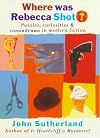
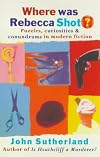
Where Was Rebecca Shot? Puzzles, Curiosities, and Conundrums in Modern Fiction
by John Sutherland
Puzzles in Classic Fiction (4)
On This Page
Description
This is a literary criticism of 20th-century fiction, detailing puzzles, conundrums and anomalies in our favourite works and most revered narratives, from high literature to pulp fiction.Tags
Recommendations











Member Recommendations
Member Reviews
This book is John Sutherland's fourth collection of literary oddities and puzzles, a series that includes "Is Heathcliff a Murderer?: Great Puzzles in Nineteenth-Century Literature," "Can Jane Eyre Be Happy? : More Puzzles in Classic Fiction", and "Who Betrays Elizabeth Bennet? : Further Puzzles in Classic Fiction".
This work includes 38 "puzzles" (each a separate, brief chapter), on a variety of works of classic and popular fiction. Among the works discussed are Women in Love (DH Lawrence), The Secret Agent and Heart of Darkness (both by Joseph Conrad), To the Lighthouse (Virginia Woolf), Ulysses (James Joyce), Lord of the Flies (Wm Golding), Lucky Jim (Martin Amis), The Odessa File (Frederick Forsyth), The Old Man and the Sea show more (Hemingway), Bonfire of the Vanities (Tom Wolfe), Midnight's Children (Rushdie), Beloved (Toni Morrison), A Clockwork Orange (Anthony Burgess), The Firm (John Grisham) and the eponymous Rebecca (Daphne du Maurier). Among other authors whose work is examined are Henry James, Evelyn Waugh, Edgar Wallace, Agatha Christie, James Ballard, Dorothy Sayers, Graham Greene, Thomas Pynchon, PD James, Kazuo Ishiguro, AS Bryant, David Morrell, and Malcolm Bradbury. Even a nominally non-fiction work is included: Future Shock (by Alvin Toffler), although as Sutherland notes, in some ways that work turned out to be laughably fictional.
The puzzles and conundrums are odd little tidbits of a kind that might be especially noticeable to pedants and sharp-eyed literalists. Here's an example. In "Lord of the Flies", the boys steal Piggy's glasses to start a fire by focusing the sun's rays; in fact, however, eyeglass lenses would be useless for such a task, as they defocus rather than focus. In considering the puzzle, Sutherland also explores various other puzzles and improbabilities raised by the book (such as the location of the boy's island), some of which have been explored by previous commentators. Another mystery is the age of Morrison's "Beloved" -- purposely ambiguous and "both child and adult". Then, in Chandler's "the Big Sleep", there's the mystery of who kills the chauffeur Owen Taylor. The director and screenwriters of the movie telegrammed the question to Chandler, who replied "NO IDEA". Sutherland shows that Chandler was being cagy; his careful reading of the book reveals a likely answer. As for "Where was Rebecca Shot", Sutherland explores multiple mysteries, including who sets fire to Manderley. His peculiar answer? Rebecca!
I found this work entertaining; however, the particular conundrums and mysteries were commonly of trivial import. Still, this is a work likely to appeal to those bibliophiles for whom fictional works have a reality that transcends mere ink on pages. show less
This work includes 38 "puzzles" (each a separate, brief chapter), on a variety of works of classic and popular fiction. Among the works discussed are Women in Love (DH Lawrence), The Secret Agent and Heart of Darkness (both by Joseph Conrad), To the Lighthouse (Virginia Woolf), Ulysses (James Joyce), Lord of the Flies (Wm Golding), Lucky Jim (Martin Amis), The Odessa File (Frederick Forsyth), The Old Man and the Sea show more (Hemingway), Bonfire of the Vanities (Tom Wolfe), Midnight's Children (Rushdie), Beloved (Toni Morrison), A Clockwork Orange (Anthony Burgess), The Firm (John Grisham) and the eponymous Rebecca (Daphne du Maurier). Among other authors whose work is examined are Henry James, Evelyn Waugh, Edgar Wallace, Agatha Christie, James Ballard, Dorothy Sayers, Graham Greene, Thomas Pynchon, PD James, Kazuo Ishiguro, AS Bryant, David Morrell, and Malcolm Bradbury. Even a nominally non-fiction work is included: Future Shock (by Alvin Toffler), although as Sutherland notes, in some ways that work turned out to be laughably fictional.
The puzzles and conundrums are odd little tidbits of a kind that might be especially noticeable to pedants and sharp-eyed literalists. Here's an example. In "Lord of the Flies", the boys steal Piggy's glasses to start a fire by focusing the sun's rays; in fact, however, eyeglass lenses would be useless for such a task, as they defocus rather than focus. In considering the puzzle, Sutherland also explores various other puzzles and improbabilities raised by the book (such as the location of the boy's island), some of which have been explored by previous commentators. Another mystery is the age of Morrison's "Beloved" -- purposely ambiguous and "both child and adult". Then, in Chandler's "the Big Sleep", there's the mystery of who kills the chauffeur Owen Taylor. The director and screenwriters of the movie telegrammed the question to Chandler, who replied "NO IDEA". Sutherland shows that Chandler was being cagy; his careful reading of the book reveals a likely answer. As for "Where was Rebecca Shot", Sutherland explores multiple mysteries, including who sets fire to Manderley. His peculiar answer? Rebecca!
I found this work entertaining; however, the particular conundrums and mysteries were commonly of trivial import. Still, this is a work likely to appeal to those bibliophiles for whom fictional works have a reality that transcends mere ink on pages. show less
Another collection of puzzling things in fiction, this time focusing on 20th century novels. There's an entertaining chapter at the end with comments from authors and editors responding to some elements of the puzzles.
Ratings
Members
- Recently Added By
Author Information

133+ Works 5,096 Members
John Sutherland was born on October 9, 1938. After graduating from the University of Leicester in 1964, he began his academic career as an assistant lecturer in Edinburgh. He specializes in Victorian fiction, 20th century literature, and the history of publishing. He is Lord Northcliffe Professor Emeritus of Modern English Literature at University show more College, London and is currently teaching at the California Institute of Technology. He writes for The Guardian and is a well-known literary reviewer. He is the author of more than 20 books including Stephen Spender: The Authorized Biography, How to Read a Novel: A User's Guide, The Boy Who Loved Books, Curiosities of Literature, 50 Literature Ideas You Really Need to Know, Lives of the Novelists: A History of Fiction in 294 Lives, and Magic Moments: Life-Changing Encounters with Books, Film, Music. He is also the co-author, with Stephen Fender, of Love, Sex, Death and Words: Tales from a Year in Literature. (Bowker Author Biography) show less
Series

Common Knowledge
- Canonical title
- Where Was Rebecca Shot? Puzzles, Curiosities, and Conundrums in Modern Fiction
- Original publication date
- 1998
- First words
- Marianne Moore's formulation -- about poetry giving us real toads in imaginary gardens -- can be reversed for fiction.
- Quotations
- We can work out the date of Stevens's expedition ... Ominous dates. ... the Suez crisis dominated British current affairs. ... Stevens is not returning to a golden evening ... there are no remains -- except in the sense of `c... (show all)orpse'.
(on The Remains of the Day)
... the plane must have been drying out under its tarpaulin in the desert for eight years. It is entirely covered with sand. Almasy `digs' it out : with what? ... Having shifted tons of sand ... he moves, single-handed, the p... (show all)lane out on to the level, so it can take off. How, single-handed, does he `swing the prop'? ... sand would have penetrated moving parts of the machinery and would have to be meticulously dusted out. ... Almasy merely pours in his can of petrol -- and the engine starts!
(on The English Patient) - Last words
- (Click to show. Warning: May contain spoilers.)Equally terse, and piquant was a postcard from Jeanette Winterson, decorated with oranges, in reply to my chapter ("Is Jeanette's Mother Gay?"): "Dear John Sutherland, Who knows? Best wishes, J. W."
Classifications
- Genres
- Nonfiction, Literature Studies and Criticism
- DDC/MDS
- 808.3 — Literature & rhetoric Literature, rhetoric & criticism Rhetoric and collections of literary texts from more than two literatures Rhetoric of fiction
- LCC
- PR881 .S92 — Language and Literature English English Literature Prose Prose fiction. The novel
Statistics
- Members
- 144
- Popularity
- 227,883
- Reviews
- 2
- Rating
- (3.62)
- Languages
- English
- Media
- Paper
- ISBNs
- 2