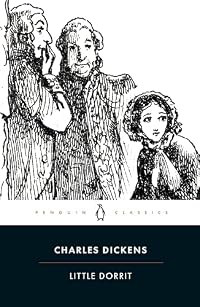
Little Dorrit
by Charles Dickens
On This Page
Description
Little Dorrit grows up in the Marshalsea debtor's prison, where her father has been imprisoned ever since her birth. When Mr Dorrit's debt is excused, he is anxious to forget his inglorious past and be accepted back into the best circles of society. Dickens criticizes the hierarchical society which would demand such an impossible thing of a man, and also questions which class of their acquaintance are good people and true friends. When one of London's biggest banks fail, everyone is show more affected, high and low alike.. show less
Tags
Recommendations











Member Recommendations
FutureMrsJoshGroban They are both wonderful love stories, and they are both my favorite books by the respective authors.
14
Member Reviews
Corruption; inept officialdom; capitalism, the pretensions of social class and status: few elements of Victorian life seem to escape Dickens’ scrutiny in Little Dorrit.
Published in monthly instalments between 1855 and 1857, first reactions from the critics were not very favourable. They completely overlooked the social critique element and focused their attention instead on what they considered an unnecessarily incoherent plot and insubstantial, two-dimensional figures. Fortunately the mid twentieth century saw a revival of interest in the novel and a significant shift in attitude. In fact attitudes shifted so far that George Bernard Shaw claimed Little Dorrit was a more seditious text than Marx’s Das Kapital while George Orwell show more declared that ”in Little Dorrit, Dickens attacked English institutions with a ferocity that has never since been approached.”
Much of Dickens’ ire in Little Dorrit is focused on government bureaucracy. He brings it to life with the wonderfully imaginative invention of the Circumlocution Office. It’s a government department run entirely it seems by the incompetent and the inept (ring any bells???). Its sole purpose is to frustrate and obstruct anyone who has the temerity to ask for information or assistance. Forms need to be filled in just to request permission to fill in more forms to ask for an appointment.(the Soviets learned a thing or two from the Circumlocution Office methinks).
Some of his greatest anger is directed at debtors’ prisons such as the notorious Marshalsea in which people who owed money were imprisoned until they repaid their debts. It was an impossible situation because they were not allowed to work so had to rely on family or friends to help pay bills and to provide food and clothing. Such becomes the fate of William Dorrit who moves his entire family into the Marshalsea when he becomes a bankrupt. His youngest daughter Amy (the Little Dorrit of the title) is born within its walls, becoming a true child of the Marshalsea.
But even in prison the appearance of gentility and the gradations of class and status must be maintained. The Marshalsea inhabitants refer to themselves as “collegians” rather than prisoners; Papa Dorrit pretends ignorance about the fact his daughters go out to work every day to put food on the table, and openly solicits financial gifts from visitors, masks their true nature by calling them “tributes” and ‘testimonials’. As his status within the prison rises and he becomes the longest-serving resident, so his consciousness of his status increases, going into orbit when he is released upon discovery that he is in fact a very wealthy man.
What Dickens shows is the personal cost of such esteem for one’s position in life. Mr Dorrit is so blinkered by his sense of his own importance that he fails to connect with the one person who loves him without question – his daughter Amy. Though she has loved him without question for decades, cared for him and undergone personal suffering so that he would be spared, he does not recognise the debt he owes her. Instead he subjects her to criticism over petty mistakes and castigates her when she doesn’t wholeheartedly welcome and adopt the trappings of the family’s new-found wealth. Does he repent on his deathbed as characters do in so many novels? I won’t spoil the plot by disclosing that; you’ll just have to read the novel yourself.
The Dorrits are a far cry from the epitome of the happy loving families found in Dickens’s earlier works. None of the families in Little Dorrit actually fit that particular description being neither loving nor happy. They’re all rather dysfunctional in fact. When Arthur Clenhome, one of the book’s good guys, returns to London from China where he ran the family business for twenty years he gets as much of a welcome from his mother as if he’d just returned from a weekend in Brighton.
Like most of Dickens’ big novels, the plot does require attention to keep all the threads intact but this book isn’t anywhere as complicated as Bleak House. It also relies on a remarkable series of coincidences – the first two characters we meet in a prison in France not only turn up again in London many many chapters later and somehow manage to play key roles in the plot. But it wouldn’t be Dickens without coincidence would it. Nor would it be Dickens without a wildly extravagant female character. Just as Dombey and Son has the dippy Miss Lucretia Tox, and Martin Chuzzlewit has the drunken nurse Sarah Gamp, in Little Dorrit Dickens serves up the garrulous Flora Finching to entertain with her gushing and breathless simpering talk of nothing in particular. A brilliant invention.
So in case you haven’t twigged by now, yes I did enjoy this book. And yes I would definitely read it again. show less
Published in monthly instalments between 1855 and 1857, first reactions from the critics were not very favourable. They completely overlooked the social critique element and focused their attention instead on what they considered an unnecessarily incoherent plot and insubstantial, two-dimensional figures. Fortunately the mid twentieth century saw a revival of interest in the novel and a significant shift in attitude. In fact attitudes shifted so far that George Bernard Shaw claimed Little Dorrit was a more seditious text than Marx’s Das Kapital while George Orwell show more declared that ”in Little Dorrit, Dickens attacked English institutions with a ferocity that has never since been approached.”
Much of Dickens’ ire in Little Dorrit is focused on government bureaucracy. He brings it to life with the wonderfully imaginative invention of the Circumlocution Office. It’s a government department run entirely it seems by the incompetent and the inept (ring any bells???). Its sole purpose is to frustrate and obstruct anyone who has the temerity to ask for information or assistance. Forms need to be filled in just to request permission to fill in more forms to ask for an appointment.(the Soviets learned a thing or two from the Circumlocution Office methinks).
Some of his greatest anger is directed at debtors’ prisons such as the notorious Marshalsea in which people who owed money were imprisoned until they repaid their debts. It was an impossible situation because they were not allowed to work so had to rely on family or friends to help pay bills and to provide food and clothing. Such becomes the fate of William Dorrit who moves his entire family into the Marshalsea when he becomes a bankrupt. His youngest daughter Amy (the Little Dorrit of the title) is born within its walls, becoming a true child of the Marshalsea.
But even in prison the appearance of gentility and the gradations of class and status must be maintained. The Marshalsea inhabitants refer to themselves as “collegians” rather than prisoners; Papa Dorrit pretends ignorance about the fact his daughters go out to work every day to put food on the table, and openly solicits financial gifts from visitors, masks their true nature by calling them “tributes” and ‘testimonials’. As his status within the prison rises and he becomes the longest-serving resident, so his consciousness of his status increases, going into orbit when he is released upon discovery that he is in fact a very wealthy man.
What Dickens shows is the personal cost of such esteem for one’s position in life. Mr Dorrit is so blinkered by his sense of his own importance that he fails to connect with the one person who loves him without question – his daughter Amy. Though she has loved him without question for decades, cared for him and undergone personal suffering so that he would be spared, he does not recognise the debt he owes her. Instead he subjects her to criticism over petty mistakes and castigates her when she doesn’t wholeheartedly welcome and adopt the trappings of the family’s new-found wealth. Does he repent on his deathbed as characters do in so many novels? I won’t spoil the plot by disclosing that; you’ll just have to read the novel yourself.
The Dorrits are a far cry from the epitome of the happy loving families found in Dickens’s earlier works. None of the families in Little Dorrit actually fit that particular description being neither loving nor happy. They’re all rather dysfunctional in fact. When Arthur Clenhome, one of the book’s good guys, returns to London from China where he ran the family business for twenty years he gets as much of a welcome from his mother as if he’d just returned from a weekend in Brighton.
Like most of Dickens’ big novels, the plot does require attention to keep all the threads intact but this book isn’t anywhere as complicated as Bleak House. It also relies on a remarkable series of coincidences – the first two characters we meet in a prison in France not only turn up again in London many many chapters later and somehow manage to play key roles in the plot. But it wouldn’t be Dickens without coincidence would it. Nor would it be Dickens without a wildly extravagant female character. Just as Dombey and Son has the dippy Miss Lucretia Tox, and Martin Chuzzlewit has the drunken nurse Sarah Gamp, in Little Dorrit Dickens serves up the garrulous Flora Finching to entertain with her gushing and breathless simpering talk of nothing in particular. A brilliant invention.
So in case you haven’t twigged by now, yes I did enjoy this book. And yes I would definitely read it again. show less
After a couple of novels that steered away, Dickens returns to the sympathetic child motif and resurrects one of his most commercially successful instances. Little Amy Dorrit resembles Little Nell of the Curiosity Shop in her name and for a fierce devotion to her father, but quickly proves herself more capable. Whereas Nell was a victim of her father's will, Amy assumes control of the family even at her tender age, finding situations and training for her siblings. Certainly she's less tiresome to read about, and Dickens brings a stronger structure to this story, but I wish he'd applied it more evenly. It has a promising start but it's a hard novel to get into, with little or nothing at stake through its entire first half. Only in its show more second does it become more apparent that our protagonists have something to lose or gain.
Dickens does an interesting flip from Hard Times as he is now siding with industry, defending its innovations against government red tape. He's still a far cry from neglecting the downtrodden. A highlight for me were the scenes of unrequited love, very well portrayed for my male gaze at least. It's belatedly occurred to me that Dickens' idealized women, like Amy Dorrit for example, are robbed of the ability to feel or express anger. They can be mortified or shamed by injustice, but they can never get mad about it and that lends a hollow note to their characterization in any modern reading. Possibly it's suiting, then, that (with honourable mention of Young John Chivery) my favourite character was Miss Wade, despite her negative portrayal. Dickens has never so conflated dignity and self-respect with the sin of pride. I thought Tattycoram made the right choice to try her, after I was beginning to grit my teeth every time Mr. Meagles asked her to start counting.
And then there's poor, forgotten Cavalletto. What happened to that guy? show less
Dickens does an interesting flip from Hard Times as he is now siding with industry, defending its innovations against government red tape. He's still a far cry from neglecting the downtrodden. A highlight for me were the scenes of unrequited love, very well portrayed for my male gaze at least. It's belatedly occurred to me that Dickens' idealized women, like Amy Dorrit for example, are robbed of the ability to feel or express anger. They can be mortified or shamed by injustice, but they can never get mad about it and that lends a hollow note to their characterization in any modern reading. Possibly it's suiting, then, that (with honourable mention of Young John Chivery) my favourite character was Miss Wade, despite her negative portrayal. Dickens has never so conflated dignity and self-respect with the sin of pride. I thought Tattycoram made the right choice to try her, after I was beginning to grit my teeth every time Mr. Meagles asked her to start counting.
And then there's poor, forgotten Cavalletto. What happened to that guy? show less
Is this the longest book I've ever read? It sure felt like it. Not that I didn't enjoy it...it features some seriously good prose, humor, and awesome characters (Pancks, I love you). I didn't think there existed a Victorian hero who was more emo than John Thornton, but I believe Arthur Clennam fits the bill.
It's interesting to me how Dickens seems to care much more for some characters than others. For some characters, he takes great pains to engineer a detailed resolution and describe it to the reader; other people just wander off into the sunset to reap the nebulous consequences of their choices.
It's interesting to me how Dickens seems to care much more for some characters than others. For some characters, he takes great pains to engineer a detailed resolution and describe it to the reader; other people just wander off into the sunset to reap the nebulous consequences of their choices.
And so we come to the end of the lockdown library books. This is the last one of all and I’ve finished it before the libraries reopen, although they’ve announced that they’re preparing to. I grabbed ‘Little Dorrit’ in a panic on the final day of the libraries, as it’s long and I remembered trying and failing to read it as a teenager. I recall exactly where I gave up: in the Circumlocution Office. Appropriately enough, I got bogged down there. I’ve probably watched some part of a TV adaptation, but retained nothing of the plot if so. It was pretty clear from the beginning where things were going, though.
I took a long time to read ‘Little Dorrit’ as it is an uncommonly gloomy novel and I was in no mood for that. (Also I show more was distracted by proofreading a friend’s book about fascism and re-watching Hannibal for the third time.) I haven’t read most of Dickens, just [b:A Tale of Two Cities|1953|A Tale of Two Cities|Charles Dickens|https://i.gr-assets.com/images/S/compressed.photo.goodreads.com/books/1344922523l/1953._SY75_.jpg|2956372], [b:Hard Times|5344|Hard Times|Charles Dickens|https://i.gr-assets.com/images/S/compressed.photo.goodreads.com/books/1348651243l/5344._SX50_.jpg|6751955], and [b:Nicholas Nickleby|325085|Nicholas Nickleby|Charles Dickens|https://i.gr-assets.com/images/S/compressed.photo.goodreads.com/books/1352758388l/325085._SY75_.jpg|4993095], and found ‘Little Dorrit’ by far the most depressing, not to mention the longest, thus far. I couldn’t help suspecting that Dickens wrote it while preoccupied with money worries, thus dragging out the plot in order to increase the number of instalments. There are many characters in this 850 page tome and all of them are unhappy, predominantly due to intersections of money and pride. The writing is vivid and insightful and the characterisation excellent, yet the whole was very dispiriting. Even the few characters who ostensibly achieved some level of happy ending did not seem likely to be content, in my view.
I was disappointed that Harriet, aka Tattycoram, went back to the Meagles with adject apologies. While she clearly wasn’t happy with Miss Wade (a character who seemed intended as an adject warning of Why Women Should Be Humble), the Meagles treated her in such a horribly patronising manner. Her return to them emphasised how few other options she had, although they did seem likely to treat her a bit better in the absence of Pet. Little Dorrit, meanwhile, ends up marrying Clennam while he’s ill and imprisoned in the Marshalsea. I anticipated this, yet still think it has uncomfortably Freudian overtones. She is playing the same role in the same place with her husband as she did with her late father! Said husband may be less querulous and prideful, but they’re still stuck in debtor’s prison and Little Dorrit is presumably still responsible to some extent for her siblings as their father’s fortune was all lost. For all Little Dorrit’s nostalgia, the Marshalsea is consistently depicted as a depressing, claustrophobic place that weighs upon the physical and mental health of its inhabitants. The sense of community there is of a brittle, defensive kind. It appears to the reader like play-acting society outside the prison walls, while Dickens also shows adeptly that the supposedly authentic wealthy society is no less false, ridiculous, and unhappy. Those with no money, with a little money, and with all the money seem equally oppressed by fear about it. The sudden suicide of Mr Merdle was the most shocking twist in the book, not one that I expected at all. He remained a mysterious cypher to both the reader and the other characters, a mere pile of cheques shuffling awkwardly around in a coat. The fact that people worshiped him for his wealth still seems like a depressingly relevant warning today.
The characters in ‘Little Dorrit’ are its great strength and their voices appear remarkably strong and distinctive. Flora’s muddled way of speaking and Mr Dorrit’s pomposity were especially notable and the one conversation between them very funny. Despite the Victorian morality that weighed heavily upon the female characters, I did appreciate the fact that several of them imposed their will on the world through mere strength of character, rather than money or social position.I refer mainly to Miss Wade and Mrs Clennam here. Unfortunately, they do so in almost uniformly unpleasant ways. Those characters who use a high social position to push others down are likewise unappealing, yet their conduct is depicted with impressive conviction. Mrs Merdle’s behaviour is terrible, but her manipulations are extraordinarily adept. One wonders how much she could have achieved with something more than snobbery to turn her mind to. To balance these clever, constrained women, Dickens also depicts several very stupid young men pushed into positions of responsibility that they are utterly unsuitable for. Indeed, it seemed to me that the men of the book were uniformly less self-aware than the women.
Dickens is certainly keenly aware of human flaws and how they aggregate into social problems. His analysis of English xenophobia and racism seems startlingly apposite in light of Brexit:
Hours after finishing ‘Little Dorrit’, I had a lovely dream of reading light and fun YA novels. It was disappointing to wake up and realise that my only remaining unread books are a mixture of non-fiction about Nazis, Mao, Robespierre, climate change, and capitalism, with the odd piece of weighty literature (e.g [b:War and Peace|656|War and Peace|Leo Tolstoy|https://i.gr-assets.com/images/S/compressed.photo.goodreads.com/books/1413215930l/656._SY75_.jpg|4912783]). As soon as the libraries reopen, I will mask up and raid their shelves for something remotely cheerful. In short, I might have appreciated ‘Little Dorrit’ a lot more if I wasn’t reading it out of necessity rather than choice and had I a less anxiety-ridden outlook upon the world. show less
I took a long time to read ‘Little Dorrit’ as it is an uncommonly gloomy novel and I was in no mood for that. (Also I show more was distracted by proofreading a friend’s book about fascism and re-watching Hannibal for the third time.) I haven’t read most of Dickens, just [b:A Tale of Two Cities|1953|A Tale of Two Cities|Charles Dickens|https://i.gr-assets.com/images/S/compressed.photo.goodreads.com/books/1344922523l/1953._SY75_.jpg|2956372], [b:Hard Times|5344|Hard Times|Charles Dickens|https://i.gr-assets.com/images/S/compressed.photo.goodreads.com/books/1348651243l/5344._SX50_.jpg|6751955], and [b:Nicholas Nickleby|325085|Nicholas Nickleby|Charles Dickens|https://i.gr-assets.com/images/S/compressed.photo.goodreads.com/books/1352758388l/325085._SY75_.jpg|4993095], and found ‘Little Dorrit’ by far the most depressing, not to mention the longest, thus far. I couldn’t help suspecting that Dickens wrote it while preoccupied with money worries, thus dragging out the plot in order to increase the number of instalments. There are many characters in this 850 page tome and all of them are unhappy, predominantly due to intersections of money and pride. The writing is vivid and insightful and the characterisation excellent, yet the whole was very dispiriting. Even the few characters who ostensibly achieved some level of happy ending did not seem likely to be content, in my view.
The characters in ‘Little Dorrit’ are its great strength and their voices appear remarkably strong and distinctive. Flora’s muddled way of speaking and Mr Dorrit’s pomposity were especially notable and the one conversation between them very funny. Despite the Victorian morality that weighed heavily upon the female characters, I did appreciate the fact that several of them imposed their will on the world through mere strength of character, rather than money or social position.
Dickens is certainly keenly aware of human flaws and how they aggregate into social problems. His analysis of English xenophobia and racism seems startlingly apposite in light of Brexit:
In the first place, they were vaguely persuaded that every foreigner had a knife about him; in the second, they held it to be a sound constitutional national axiom that he ought to go home to his own country. They never thought of inquiring how many of their own countrymen would be returned upon their hands from divers parts of the world, if the principle were generally recognised; they considered it practically and peculiarly British. In the third place, they had a notion that it was a sort of divine visitation upon a foreigner that he was not an Englishman, and that all kinds of calamities happened to his country because it did things that England did not, and did not do things that England did. In this belief, to be sure, they had been carefully trained by the Barnacles and Stiltstalkings, who were always proclaiming to them, officially and unofficially, that no country which failed to submit itself to those two large families could possibly hope to be under the protection of Providence; and who, when they believed it, disparaged them in private as the most prejudiced people under the sun.
Hours after finishing ‘Little Dorrit’, I had a lovely dream of reading light and fun YA novels. It was disappointing to wake up and realise that my only remaining unread books are a mixture of non-fiction about Nazis, Mao, Robespierre, climate change, and capitalism, with the odd piece of weighty literature (e.g [b:War and Peace|656|War and Peace|Leo Tolstoy|https://i.gr-assets.com/images/S/compressed.photo.goodreads.com/books/1413215930l/656._SY75_.jpg|4912783]). As soon as the libraries reopen, I will mask up and raid their shelves for something remotely cheerful. In short, I might have appreciated ‘Little Dorrit’ a lot more if I wasn’t reading it out of necessity rather than choice and had I a less anxiety-ridden outlook upon the world. show less
As part of my rest-of-my-life project, I tackled another large Dickens novel to start the year. There’s no getting around it: the fact that Mr. Dickens was paid by the installment clearly meant that many of his books are, um, longer than they need to be. Enjoyable? Yes. Amazingly plotted? Yes. Exceptional characters? Yes. Moving? Yes. But increasingly I am coming to the conclusion that they’re too damn long. Of course, Dickens wouldn’t be Dickens otherwise. Still.
Which leaves us with this tale of rags to riches to rags, the infamous Marshalsea Prison for debtors (where Dickens’ father spent time), and the absolutely lovable, self-effacing, gentle, too-good-to-be-true (or believable) Little Dorrit. The characters, as always, are show more much of the attraction; the plot threatens at a few points to be nearly incomprehensible (but never crosses that line); the tying-up of loose ends at the end of the book requires some rather silly inventions but it is, after all, Dickens, and so the novel succeeds despite all of this. If it’s not quite at the level of Bleak House or David Copperfield, it is also not terribly far from those masterpieces either. It took me quite some time to decide which novel to read this year and I read widely to help me decide. Definitely recommended. show less
Which leaves us with this tale of rags to riches to rags, the infamous Marshalsea Prison for debtors (where Dickens’ father spent time), and the absolutely lovable, self-effacing, gentle, too-good-to-be-true (or believable) Little Dorrit. The characters, as always, are show more much of the attraction; the plot threatens at a few points to be nearly incomprehensible (but never crosses that line); the tying-up of loose ends at the end of the book requires some rather silly inventions but it is, after all, Dickens, and so the novel succeeds despite all of this. If it’s not quite at the level of Bleak House or David Copperfield, it is also not terribly far from those masterpieces either. It took me quite some time to decide which novel to read this year and I read widely to help me decide. Definitely recommended. show less
A true delight, Dickens' second masterpiece, coming soon after Bleak House. The 19th of Dickens' 24 major works, and the 11th of his novels, Dorrit was written over a span of two years, and brings us into CD's final act, as he begins to lavish careful attention on his works and aims to realise his characters far more greatly, and tie his works together. Dorrit is more diffuse than Bleak House yet feels even more like a novel rather than a serialised work.
The lead characters, Amy Dorrit - a child of a debt-ridden family, whose essential goodness has created a community in the most unlikely of places - and Arthur Clennam, the soulful sailor uncovering his family's ill deeds, are like most of Dickens' lead characters to date: a bit show more vanilla. This alone is a step back from Bleak House although they continue to greatly reflect the world around them, and in this case their positive qualities form a part of the novel's plea for sanity and simplicity in an increasingly material world.
The novel excels in its portrayal of Victorian England's ludicrous class system, through the absolutely fantastic caricatures of the Meagles and the Merdles, and in examining the idiocy of a culture that refuses to allow the downtrodden any relief. The Marshalsea - a real debtors' prison in which Dickens' father spent time, which had closed down shortly before the novel was written - is vividly realised, and the delightful supporting characters, from Mrs. Plornish to the conflicted Pancks, from the babbling Flora Finching to the eternally hilarious Mr. F's Aunt, still provide much merriment and intrigue. And the groaning, heaving mass that is Clennam and Co is perhaps Dickens' most powerful individual symbol.
At the heart of the work is Mr. Dorrit, a portrait of pathos like many prior, but far more interesting and realistic than any Dickensian character we have yet seen. A really strong work (with an equally beautiful and faithful BBC adaptation) that I heartily recommend. show less
The lead characters, Amy Dorrit - a child of a debt-ridden family, whose essential goodness has created a community in the most unlikely of places - and Arthur Clennam, the soulful sailor uncovering his family's ill deeds, are like most of Dickens' lead characters to date: a bit show more vanilla. This alone is a step back from Bleak House although they continue to greatly reflect the world around them, and in this case their positive qualities form a part of the novel's plea for sanity and simplicity in an increasingly material world.
The novel excels in its portrayal of Victorian England's ludicrous class system, through the absolutely fantastic caricatures of the Meagles and the Merdles, and in examining the idiocy of a culture that refuses to allow the downtrodden any relief. The Marshalsea - a real debtors' prison in which Dickens' father spent time, which had closed down shortly before the novel was written - is vividly realised, and the delightful supporting characters, from Mrs. Plornish to the conflicted Pancks, from the babbling Flora Finching to the eternally hilarious Mr. F's Aunt, still provide much merriment and intrigue. And the groaning, heaving mass that is Clennam and Co is perhaps Dickens' most powerful individual symbol.
At the heart of the work is Mr. Dorrit, a portrait of pathos like many prior, but far more interesting and realistic than any Dickensian character we have yet seen. A really strong work (with an equally beautiful and faithful BBC adaptation) that I heartily recommend. show less
This took me two whole months to read. This is a shame, because it starts out pretty good. "Little Dorrit" is really Amy, a girl born in debtors' prison where her father has languished for over twenty years; one could bring one's wife and children along if one desired. All the stuff about how Dorrit came to the prison, and his life there, and Amy's life there, is fantastic stuff, that usual Dickens mixture of the comic and the real. Meanwhile, a man named Arthur Clennam has come home after decades overseas, now that his father is dead, and he soon meets Little Dorrit and aims to help her. His visit to the Circumlocution Office, a government department devoted to stopping the government from doing anything effective, is Dickens at his show more savage and comic best.
The problem is, every time the narrative moves away from Little Dorrit, it becomes bogged down in some of the dullest characters I can ever remember from a Dickens novel. Who cares about the Meagles or all the rest of them? And yet the novel just goes on and on and on.
Little Dorrit herself is one of Dickens's best psychological portraits: the chapter about her after her family has finally been released from prison and achieved riches once more is utterly devastating. Yet the novel keeps going and going after that point for hundreds of more pages, mostly neglecting its title character, and I lost all interest, even in characters like Clennam who had initially held my attention. show less
The problem is, every time the narrative moves away from Little Dorrit, it becomes bogged down in some of the dullest characters I can ever remember from a Dickens novel. Who cares about the Meagles or all the rest of them? And yet the novel just goes on and on and on.
Little Dorrit herself is one of Dickens's best psychological portraits: the chapter about her after her family has finally been released from prison and achieved riches once more is utterly devastating. Yet the novel keeps going and going after that point for hundreds of more pages, mostly neglecting its title character, and I lost all interest, even in characters like Clennam who had initially held my attention. show less
Members
- Recently Added By
Published Reviews
ThingScore 100
It tripped my social conscience and infected me for the rest of my life.
added by Cynfelyn
Lists

The Guardian's 1000 Novels Everyone Must Read
1,005 works; 549 members

Favorite Dickens novels?
16 works; 27 members

Favourite 19th century fiction
257 works; 62 members

Fiction Set Primarily in a Prison
52 works; 24 members

Favourite Books
1,817 works; 316 members

Best Books Set in London
157 works; 42 members
Books I've Read More Than Once
602 works; 49 members
Folio Society
831 works; 53 members

Unread books
1,063 works; 86 members
Harold Bloom - The Western Canon: C. The Democratic Age
336 works; 15 members

Rory Gilmore Book Club
193 works; 5 members

Victorian Period
113 works; 10 members
Books mentioned in The Diary of a Provincial Lady
59 works; 4 members

A Book For Our Times
7 works; 1 member
Good, Smart, Clean Fiction
46 works; 4 members

Books I Own But Haven't Read
144 works; 2 members

SHOULD Read Books!
354 works; 9 members

Books Bought & Received as Gifts in 2014
81 works; 1 member

Books Read in 2021
5,361 works; 114 members

Books Featured on Gilmore Girls
307 works; 21 members

Greatest Books, allegedly
484 works; 9 members

New Lifetime Reading Plan by Fadiman and Major
225 works; 5 members

Read in 2013
28 works; 2 members

The Complete Rory Gilmore Reading List
506 works; 5 members

Charles Dickens books
17 works; 1 member
Author Information

2,578+ Works 313,139 Members
Charles Dickens, perhaps the best British novelist of the Victorian era, was born in Portsmouth, Hampshire, England on February 7, 1812. His happy early childhood was interrupted when his father was sent to debtors' prison, and young Dickens had to go to work in a factory at age twelve. Later, he took jobs as an office boy and journalist before show more publishing essays and stories in the 1830s. His first novel, The Pickwick Papers, made him a famous and popular author at the age of twenty-five. Subsequent works were published serially in periodicals and cemented his reputation as a master of colorful characterization, and as a harsh critic of social evils and corrupt institutions. His many books include Oliver Twist, David Copperfield, Bleak House, Great Expectations, Little Dorrit, A Christmas Carol, and A Tale of Two Cities. Dickens married Catherine Hogarth in 1836, and the couple had nine children before separating in 1858 when he began a long affair with Ellen Ternan, a young actress. Despite the scandal, Dickens remained a public figure, appearing often to read his fiction. He died in 1870, leaving his final novel, The Mystery of Edwin Drood, unfinished. (Bowker Author Biography) show less
Some Editions
Awards and Honors
Series
Belongs to Publisher Series
Alba Clásica Maior (LIII)
Work Relationships
Is contained in
Has the adaptation
Is abridged in
Has as a reference guide/companion
Has as a study
Common Knowledge
- Canonical title
- Little Dorrit
- Original title
- Little Dorrit
- Original publication date
- 1857
- People/Characters
- Amy Dorrit; Arthur Clennam; William Dorrit; Flora Finching; Edmund Sparkler; Mrs General (show all 24); Daniel Doyce; Henry Gowan; Fanny Dorrit; Edward Dorrit; Christopher Casby; Pancks; Tattycoram; Miss Wade; Jeremiah Flintwinch; Mrs Clennam; Affery Flintwinch; Rigaud/Blandois; Maggy; Frederick Dorrit; John Chivery; Mr Merdle; Mrs Merdle; Mr Meagles
- Important places
- Marseille, Bouches-du-Rhône, Provence-Alpes-Côte d'Azur, France; London, England, UK; Marshalsea Prison, Southwark, London, England, UK
- Related movies
- Little Dorrit (1913 | IMDb); Little Dorrit (1920 | IMDb); Klein Dorrit (1934 | IMDb); Little Dorrit (1988 | IMDb); Little Dorrit (2008 | IMDb)
- First words
- Thirty years ago, Marseilles lay burning in the sun, one day.
- Quotations
- Indiani, russi, cinesi, spagnoli, portoghesi, inglesi, francesi, genovesi, napoletani, veneziani, greci, turchi, tutti i discendenti dei costruttori della Torre di Babele convenuti a Marsiglia per i loro commerci cercavano l'... (show all)ombra …
Il tanfo della prigione gravava su ogni cosa. L'aria imprigionata, la luce imprigionata, l'umidità imprigionata, gli uomini imprigionati, tutto era degradato dalla reclusione. I prigionieri erano pallidi e sparuti come il fe... (show all)rro coperto di ruggine, la pietra viscida, il legno putrido, l'aria viziata e la luce opaca.
L'altro sputò e si raschiò la gola. Subito dopo s'udì anche una serratura raschiarsi la gola e una porta sbatté.
«Guarda la luce del giorno! Giorno! Questa è la luce di otto giorni fa, di sei mesi fa, di sei anni fa, tanto è debole e scialba!»
Era semplicemente un fanfarone, uno sfacciato millantatore; ma quanto a questo, e non solo a questo, in tutte le parti del mondo la sfacciataggine nell'affermare una cosa vale più d'una prova tangibile della sua realtà.
Seguivano le interminabili domeniche dell'adolescenza quando sua madre, viso severo e cuor duro, stava seduta tutto il giorno con la Bibbia davanti, una Bibbia chiusa fra due tavolette di legno durissimo, nude e liscie, che ... (show all)sembravano chiudere anche lei, la copertina adorna d'un fregio che pareva una catena, e le costole delle pagine spruzzate di rosso quasi per collera, come se quel libro, proprio quel libro, fosse un fortilizio elevato contro ogni sentimento di dolcezza, ogni affetto naturale, ogni scambio di gentilezze.
… alla parete, incorniciato e sotto vetro, c'era anche il quadro delle Piaghe d'Egitto offuscato dalle mosche e dal fumo, piaghe di Londra.
Come il metallo più duro possiede gradi diversi di durezza, e lo stesso colore nero ha numerose sfumature, esisteva un'impercettibile differenza nell'asprezza con cui la signora Clennam trattava il resto dell'umanità e la p... (show all)iccola Dorrit.
Le stanze abbandonate e deserte da anni si erano accasciate in un malinconico letargo dal quale nulla avrebbe potuto destarle: i mobili, pochi e massicci, pareva vi si volessero nascondere piuttosto che arredarle, e dappertut... (show all)to c'era un'aria smorta come se il poco colore d'un tempo fosse fuggito a cavallo d'un raggio di sole smarrito, per farsi assorbire all'esterno dai fiori, dalle farfalle, dalle piume degli uccelli, dalle pietre preziose e così via.
La mendicità pesava su quelle spalle incurvate, si trascinava su quelle gambe malferme, abbottonava e rattoppava, puntava con gli spilli e trascinava i loro vestiti, consumava gli occhielli, trasudava dalle loro persone all'... (show all)estremità di ogni pezzetto di fettuccia sporca, e usciva dalle loro bocche col respiro fetido di alcool.
Tutti sanno che due file di persone sedute a tavola somigliano stranamente ai due lati d'una strada: vi sorgono una ventina di fabbricati incolori e tutti uguali, alle cui porte tutti bussano o suonano allo stesso modo, salen... (show all)do una rampa di scalini sempre uguali; tutte le cancellate sono dello stesso modello, e dovunque si scorgono le medesime uscite di sicurezza impraticabili in caso d'incendio; allo stesso modo le teste delle persone sono piene di infissi antiquati e inopportuni, ma tutto è valutato in modo esorbitante…
… in secondo luogo ritenevano come sano assioma nazionale e costituzionale che i forestieri dovessero tornare al loro paese. Non si preoccupavano d'informarsi quanti dei propri connazionali avrebbero dovuto rientrare dalle ... (show all)diverse parti del mondo qualora codesto principio fosse stato universalmente applicato, ma erano persuasi che fosse un principio molto pratico e molto inglese.
Se poche erano le rughe, ciò significava che il cervello non aveva mai scritto nulla sulla sua fronte. Era una donna, fredda, passata, sfiorita, che sembrava fatta di cera, e non si era mai scaldata per nulla. La signora Gen... (show all)eral non aveva opinioni personali. Il suo metodo educativo consisteva nell'impedire che si formassero opinioni. Possedeva un piccolo binario circolare di concetti, sul quale metteva in movimento certi trenini che trasportavano le opinioni degli altri e non si sorpassavano né arrivavano mai in nessun posto.
La peggiore categoria di calcoli che si possa fare nel nostro mondo quotidiano è quella, infatti, di una schiera di matematici i quali applicano la regola della sottrazione a tutto quanto riguarda i meriti e i successi altru... (show all)i, senza mai calcolare la somma dei propri.
It is true that How not to do it was the great study and object of all public departments and professional politicians all round the Circumlocution Office. It is true that every new premier and every new government, coming in... (show all) because they had upheld a certain thing as necessary to be done, were no sooner come in than they applied their utmost faculties to discovering How not to do it. It is true that from the moment when a general election was over, every returned man who had been raving on hustings because it hadn't been done, and who had been asking the friends of the honourable gentleman in the opposite interest on pain of impeachment to tell him why it hadn't been done, and who had been asserting that it must be done, and who had been pledging himself that it should be done, began to devise, How it was not to be done. It is true that the debates of both Houses of Parliament the whole session through, uniformly tended to the protracted deliberation, How not to do it. - Last words
- (Click to show. Warning: May contain spoilers.)They went quietly down into the roaring streets, inseparable and blessed; and as they passed along in sunshine and shade, the noisy and the eager, and the arrogant and the froward and the vain, fretted and chafed, and made their usual uproar.
- Original language
- English
Classifications
Statistics
- Members
- 6,270
- Popularity
- 1,959
- Reviews
- 100
- Rating
- (3.99)
- Languages
- 13 — Czech, Danish, Dutch, English, French, German, Greek, Hungarian, Italian, Polish, Portuguese, Spanish, Swedish
- Media
- Paper, Audiobook, Ebook
- ISBNs
- 267
- UPCs
- 2
- ASINs
- 207