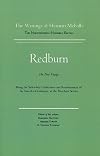
Redburn: His First Voyage, Being the Sailor-Boy, Confessions and Reminiscences of the Son-of-a-Gentleman, In the Merchant Service
by Herman Melville 
On This Page
Description
Sea voyages and the vagaries of life on a ship are constant themes in the work of Herman Melville. In the novel Redburn, Melville sharply contrasts the refined sensibilities of the title character, an upper-class American youth, with the coarse manners of his Liverpudlian shipmates. The novel is notable for its finely drawn characters and piercing social criticism..
Tags
Recommendations






































Member Reviews
A deep look at Melville's heart: There are those who read Moby-Dick and say they love it because they're supposed to, because it's marked as a classic American novel; and then there are those who love Moby-Dick because its miraculous prose, its Shakespearean characters and its spirit truly get inside them. Redburn is for the second group: any real fan of Melville's unique philosophy and thorough mastery of style will love this book. Redburn is, to be sure, no Moby-Dick -- it has none of the epic quality of that crowning jewel. But all of Melville's trademarks are here, in a plot which transcends its simple outline -- a boy from a formerly rich, now bankrupt family joins the crew of a merchant ship sailing to Liverpool and comes of age show more -- to reach the realm of genius. The poetically beautiful imagery and sparkling wit juxtaposed with profound melancholy jump out at the reader. But even more importantly, Redburn opens up a unique window on Herman Melville's soul. Elizabeth Hardwick, in her recent biography of Melville (which I also highly recommend), calls this his most personal work, and she's right -- where later works like Moby-Dick and Billy Budd hid Melville's real experiences behind an obscuring (if brilliant) curtain of fiction and the earliest novels like Typee and Omoo lacked depth in their rollickingly faithful accounts of Melville's sojourns among the Polynesians, Redburn has just the right balance of fact and fiction. It is in many ways a meditation on the author's once-illustrious father -- Allan Melville, who, just like Walter Redburn (the narrator's father) lost all his money and respect -- but it is equally a series of revelations about his youthful mind as he mulls over issues of time, the generational gap and social change. Read Redburn for a real glimpse of the man who would be the greatest American novelist. show less
Melville is one of the writers I 'saved for later'. I wanted to be able to crack open the occasional unread heavy hitter. It was a risky move. Anything goes wrong now, I will never read 'Moby Dick', and if that car in St-Lazare had driven rather than skidded into my bike back in '04, I would never have read 'Moby Dick' or 'Redburn'. That would be a pity. I would have missed watching Wellingborough, cringe green at the start, learn his ropes. It is complicated, physically taxing work that Melville describes through the young man's apprentice eyes. These are some beautiful pictures, as elegant as snowflakes and as phantom.
"There is no counting the names, that surgeons and anatomists give to the various parts of the human body; which, show more indeed, is something like a ship; its bones being the stiff standing-rigging, and the sinews the small running ropes, that manage all the motions."
Here is a passage about navigation that in the era of GPS gives me shivers, "The ship lay gently rolling in the soft, subdued ocean swell; while all around were faint white spots; and nearer to, broad, milky patches, betokening the vicinity of scores of ships, all bound to one common port, and tranced in one common calm. Here the long, devious wakes from Europe, Africa, India, and Peru converged to a line, which braided them all in one." show less
"There is no counting the names, that surgeons and anatomists give to the various parts of the human body; which, show more indeed, is something like a ship; its bones being the stiff standing-rigging, and the sinews the small running ropes, that manage all the motions."
Here is a passage about navigation that in the era of GPS gives me shivers, "The ship lay gently rolling in the soft, subdued ocean swell; while all around were faint white spots; and nearer to, broad, milky patches, betokening the vicinity of scores of ships, all bound to one common port, and tranced in one common calm. Here the long, devious wakes from Europe, Africa, India, and Peru converged to a line, which braided them all in one." show less
Moby Dick! Moby Dick! Moby Dick....forget about Moby Dick! It's a magnum opus. Thank you John Huston/Gregory Peck for the iconic movie. Thank you John Bonham for the drum solo. But if you really want to peer inside the mind of Herman Melville, read Redburn instead.
Why? For starters, you will see that magnum opus in its beta format. Redburn is a first person fictional account of Melville's first sea voyage...a round trip from New York to Liverpool. The narrator, Redburn Wellingborough, even refers to himself as Ishmael. There are two prototypes of Ahab. Captain Riga, a man with a split personality - deceptively charming to recruits, at port, and aloof as a Chinese emperor, at sea. And there's a crew member, Jackson, who bullies and show more dominates his crew mates by the sheer force of his irascible personality. Despite his terminal illness and average size, he is intimidation personified.
But Redburn is more than just a Two Years Before the Mast (Richard Dana's classic), replete though it is with sea lore. It is a glimpse inside young Melville's mind, revealing his analytic intelligence, his attention to detail, his compassion for the unfortunate, his sensitivity to social undercurrents, his wide ranging curiosity, and his wry humor.
A good percentage of the novel concerns Redburn's explorations, while on leave, of Liverpool. Melville writes with the clarity of journalist, and probes like an investigative reporter. In one section, he is heartrending in his description of Redburn's unsuccessful attempts to get aid for a starving, dying woman and her three children. In another section, he is compelling in his argument for changing shipping safety laws to protect immigrant steerage passengers on trans-Atlantic voyages. And in a chapter revealing his naivete - in relying on a fifty year old guidebook - he is charming with self deprecating humor.
I picked this book off a store shelf on a whim, partly intrigued by the Edward Gorey cover illustration, and partly because I recalled a quote from the movie Adventureland, to the effect that Melville died in obscurity and the New York Times misreported his first name. Having finished Redburn, I am inspired to read the rest of Melville's oeuvre. His personality, his halo, his soul flashes in Redburn, like - well OK then - St Elmo's fire in Moby Dick! show less
Why? For starters, you will see that magnum opus in its beta format. Redburn is a first person fictional account of Melville's first sea voyage...a round trip from New York to Liverpool. The narrator, Redburn Wellingborough, even refers to himself as Ishmael. There are two prototypes of Ahab. Captain Riga, a man with a split personality - deceptively charming to recruits, at port, and aloof as a Chinese emperor, at sea. And there's a crew member, Jackson, who bullies and show more dominates his crew mates by the sheer force of his irascible personality. Despite his terminal illness and average size, he is intimidation personified.
But Redburn is more than just a Two Years Before the Mast (Richard Dana's classic), replete though it is with sea lore. It is a glimpse inside young Melville's mind, revealing his analytic intelligence, his attention to detail, his compassion for the unfortunate, his sensitivity to social undercurrents, his wide ranging curiosity, and his wry humor.
A good percentage of the novel concerns Redburn's explorations, while on leave, of Liverpool. Melville writes with the clarity of journalist, and probes like an investigative reporter. In one section, he is heartrending in his description of Redburn's unsuccessful attempts to get aid for a starving, dying woman and her three children. In another section, he is compelling in his argument for changing shipping safety laws to protect immigrant steerage passengers on trans-Atlantic voyages. And in a chapter revealing his naivete - in relying on a fifty year old guidebook - he is charming with self deprecating humor.
I picked this book off a store shelf on a whim, partly intrigued by the Edward Gorey cover illustration, and partly because I recalled a quote from the movie Adventureland, to the effect that Melville died in obscurity and the New York Times misreported his first name. Having finished Redburn, I am inspired to read the rest of Melville's oeuvre. His personality, his halo, his soul flashes in Redburn, like - well OK then - St Elmo's fire in Moby Dick! show less
Redburn Wellingborough, a young man who idealizes his Revolutionary War era father, decides to go to sea, leaving his bereaved mother and sister and taking with him a journal written by his father that he regards as sacrosanct. The moment he leaves home, however, he is ridiculed for his antique clothing, and we become aware that we are in the Jackson Era, during which most Revolutionary Era pieties, institutions, and assumptions, including the assumption of having a prosperous family farm, have been exploded. Redburn is an outcast, a fact which is underscored when he encounters mean bullies in New York City and, even worse, the malignant Captain Riga, a Russian who defrauds him mercilessly. He acquires a friend on the voyage to show more Liverpool and, when there, he discovers that his father made his money from the slave trade. He attempts to get food for a starving mother and her children and, eventually, makes his way back to the boat for the voyage back to New York City. He has a friend who is ruthlessly and unspeakably bullied--made to engage in the most debasing sexual and social rites--and keeps a measured distance from the victim of the relentless Jackson. When he arrives back in New York, he deserts his friend, who he later learns has died. show less
Wellingborough Redburn comes from a large and illustrious New York mercantile family which has recently become impoverished because of the bankruptcy and death of his father. Needing to support himself, he decides to find employment where employment is available - the sea. This novel, like Melville's earlier Typee and Omoo, is a sort of fictionalized memoir based upon his own experiences at sea - this time his first voyage in 1839. This was not aboard a whaling ship but on a merchant vessel carrying goods and passengers from New York to Liverpool and back. Redburn is far more advanced in literary matters than his co-workers but this counts for nothing until he has learned (literally) the ropes and how to manage sails with them. His show more self-deprecating humor as this process begins and continues is a good deal of what makes this novel so entertaining. He suffers much but learns through what he suffers and because of his outstanding literary gifts and capacities for close and discerning observation gives us a very vivid view of his fellow crew members, their ship and their very arduous lives. Once in Liverpool we are treated to some very touching scenes of the poverty and vice there at that day and Henry Bolton, a young Englishman in comparable circumstances to Redburn's own is introduced. Henry joins the return trip to New York seeking to emigrate to America, but sadly comes to a tragic end despite Redburn's efforts on his behalf. This and Redburn's many speculative (i.e. Melvillean) flights of fancy ultimately turn this into quite a deep and serious work. show less
Written at speed and to order, Redburn is a much more disciplined work than the fateful self-indulgence of its predecessor Mardi and at moments even approaches the greatness of Moby Dick.
Read the full review on The Lectern
Read the full review on The Lectern
Ratings
Members
- Recently Added By
Lists

Five star books
1,767 works; 110 members

Fiction (Mostly) in Selective Bibliography of American Literature 1775-1900
431 works; 3 members

Edward Gorey Covers
150 works; 8 members
Author Information

661+ Works 78,866 Members
Herman Melville (August 1, 1819 - September 28, 1891) was born into a seemingly secure, prosperous world, a descendant of prominent Dutch and English families long established in New York State. That security vanished when first, the family business failed, and then, two years later, in young Melville's thirteenth year, his father died. Without show more enough money to gain the formal education that professions required, Melville was thrown on his own resources and in 1841 sailed off on a whaling ship bound for the South Seas. His experiences at sea during the next four years were to form in part the basis of his best fiction. Melville's first two books, Typee (1846) and Omoo (1847), were partly romance and partly autobiographical travel books set in the South Seas. Both were popular successes, particularly Typee, which included a stay among cannibals and a romance with a South Sea maiden. During the next several years, Melville published three more romances that drew upon his experiences at sea: Redburn (1849) and White-Jacket (1850), both fairly realistic accounts of the sailor's life and depicting the loss of innocence of central characters; and Mardi (1849), which, like the other two books, began as a romance of adventure but turned into an allegorical critique of contemporary American civilization. Moby Dick (1851) also began as an adventure story, based on Melville's experiences aboard the whaling ship. However, in the writing of it inspired in part by conversations with his friend and neighbor Hawthorne and partly by his own irrepressible imagination and reading of Shakespeare and other Renaissance dramatists Melville turned the book into something so strange that, when it appeared in print, many of his readers and critics were dumbfounded, even outraged. By the mid-1850s, Melville's literary reputation was all but destroyed, and he was obliged to live the rest of his life taking whatever jobs he could find and borrowing money from relatives, who fortunately were always in a position to help him. He continued to write, however, and published some marvelous short fiction pieces Benito Cereno" (1855) and "Bartleby, the Scrivener" (1853) are the best. He also published several volumes of poetry, the most important of which was Battle Pieces and Aspects of the War (1866), poems of occasionally great power that were written in response to the moral challenge of the Civil War. His posthumously published work, Billy Budd (1924), on which he worked up until the time of his death, became Melville's last significant literary work, a brilliant short novel that movingly describes a young sailor's imprisonment and death. Melville's reputation, however, rests most solidly on his great epic romance, Moby Dick. It is a difficult as well as a brilliant book, and many critics have offered interpretations of its complicated ambiguous symbolism. Darrel Abel briefly summed up Moby Dick as "the story of an attempt to search the unsearchable ways of God," although the book has historical, political, and moral implications as well. Melville died at his home in New York City early on the morning of September 28, 1891, at age 72. The doctor listed "cardiac dilation" on the death certificate. He was interred in the Woodlawn Cemetery in The Bronx, New York, along with his wife, Elizabeth Shaw Melville. (Bowker Author Biography) show less
Herman Melville has a Legacy Library. Legacy libraries are the personal libraries of famous readers, entered by LibraryThing members from the Legacy Libraries group.
Some Editions
Series
Belongs to Publisher Series
Work Relationships
Is contained in
Is abridged in
Common Knowledge
- Canonical title
- Redburn: His First Voyage, Being the Sailor-Boy, Confessions and Reminiscences of the Son-of-a-Gentleman, In the Merchant Service
- Original publication date
- 1849
- People/Characters
- Wellingborough Redburn
- Important places
- London, England, UK; Liverpool, England, UK
- Dedication
- To my younger brother, Thomas Melville now a sailor on a voyage to China, this volume is inscribed.
- First words
- "Wellingborough, as you are going to sea, suppose you take this shooting-jacket of mine along; it's just the thing--take it, it will save the expense of another."
- Last words
- (Click to show. Warning: May contain spoilers.)But yet, I, Wellingborough Redburn, chance to survive, after having passed through far more perilous scenes than any narrated in this, My First Voyage-which here I end.
- Original language
- English
Classifications
- Genres
- General Fiction, Fiction and Literature
- DDC/MDS
- 813.3 — Literature & rhetoric American literature in English American fiction in English Middle 19th Century 1830-1861
- LCC
- PZ3 .M498 — Language and Literature Fiction and juvenile belles lettres Fiction and juvenile belles lettres Fiction in English
- BISAC
Statistics
- Members
- 660
- Popularity
- 43,525
- Reviews
- 6
- Rating
- (3.89)
- Languages
- 9 — Danish, Dutch, English, Finnish, French, German, Italian, Norwegian (Bokmål), Spanish
- Media
- Paper, Audiobook, Ebook
- ISBNs
- 94
- ASINs
- 31