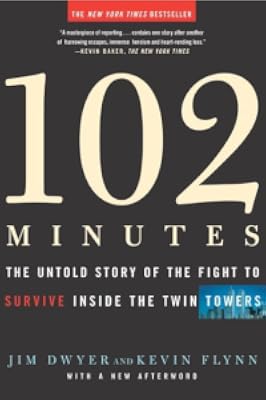
102 Minutes: The Untold Story of the Fight to Survive Inside the Twin Towers
by Jim Dwyer (Author), Kevin FLYNN (Author)
On This Page
Description
The dramatic and moving account of the struggle for life inside the World Trade Center on the morning of September 11, when every minute counted. At 8:46 AM on September 11, 2001, 14,000 people were inside the twin towers -- reading e-mails, making trades, eating croissants at Windows on the World. Over the next 102 minutes, each would become part of a drama for the ages, one witnessed only by the people who lived it -- until now. New York Times reporters Jim Dwyer and Kevin Flynn rely on show more hundreds of interviews; thousands of pages of oral histories; and phone, e-mail, and emergency radio transcripts. They cross a bridge of voices to go inside the infernos, seeing cataclysm and heroism, one person at a time, to tell the affecting, authoritative saga of the men and women -- the 12,000 who escaped and the 2,749 who perished -- who made 102 minutes count as never before. Read by Ron McLarty. show lessTags
Recommendations








Member Recommendations
Stbalbach Both use same technique of minute-by-minute disaster survivor vignettes.
50

Member Reviews
There are so many chaotic moments about 9/11 that you struggle to comprehend as actual reality.
An officer stationed at a door whose duty was to watch for falling bodies and flaming debris and to tell civilians when it was okay to run to safety. A thousand firefighters sharing four radio channels, who did not hear the warning to get out when it was a surety that Tower 1 was going to come down. People who walked down 80+ flights of stairs only to reach a courtyard with blood dripping down the windows. An $11/hour rent-a-cop who stayed at his post on a skylobby, waiting for rescue workers to come retrieve all the bodies around him. A 911 dispatcher talking to a man trapped on the floor above the impact point describing the floor melting show more and the ceiling coming down. A worker at the Marriott who was talking with a coworker in the lobby and, in that instant, there was only swirling dust and his friend had disappeared.
All that data is overwhelming and I could not keep everyone distinctly in my mind. Was he the guy in stairwell A with his friend? Which tower was this again? I know that I could not do as well collecting the stories of thousands of individuals and collating dozens of them into one narrative picture, so it makes this a hard book to rate. But there is so much to learn about humanity in the chaos and there are lessons to take away from what didn't work out on that day. show less
An officer stationed at a door whose duty was to watch for falling bodies and flaming debris and to tell civilians when it was okay to run to safety. A thousand firefighters sharing four radio channels, who did not hear the warning to get out when it was a surety that Tower 1 was going to come down. People who walked down 80+ flights of stairs only to reach a courtyard with blood dripping down the windows. An $11/hour rent-a-cop who stayed at his post on a skylobby, waiting for rescue workers to come retrieve all the bodies around him. A 911 dispatcher talking to a man trapped on the floor above the impact point describing the floor melting show more and the ceiling coming down. A worker at the Marriott who was talking with a coworker in the lobby and, in that instant, there was only swirling dust and his friend had disappeared.
All that data is overwhelming and I could not keep everyone distinctly in my mind. Was he the guy in stairwell A with his friend? Which tower was this again? I know that I could not do as well collecting the stories of thousands of individuals and collating dozens of them into one narrative picture, so it makes this a hard book to rate. But there is so much to learn about humanity in the chaos and there are lessons to take away from what didn't work out on that day. show less
"The gash in the north tower, the smoke belching from the building, the people falling from impossible heights, all showed that this was a crisis new to every eye that saw it." (pg. 79)
Reading 102 Minutes, you realize that the events of September 11, 2001, still have the power to shock you right to your core. The images are burned on our retinas but still, somehow, seem otherworldly. They just don't fit in the logical part of your brain. You can at least – charitably – understand why people reach for conspiracy theories: to try and comprehend the incomprehensible, however imperfectly. But 102 Minutes, drawing a detailed picture of that day, gives the lie to Illuminati/neo-con conspiracy theories. Yes, the experts thought the show more buildings couldn't fall, but the designers of the Titanic also thought that ship would be unsinkable. It still doesn't explain WTC7 or a number of other things, but cock-up is a better explanation than conspiracy. If facts have been obscured or redacted, it is less likely to be because of the lizard people and more likely because people with responsibility – and culpability – such as the port authorities, the fire regulators, the inefficient rescue departments, the intelligence services that missed warning signs, and so on – had reasons, however dishonest, for wanting to ensure facts didn't get out, lest revelations lead to, amongst other things, suits of corporate negligence and a casting as villain against the most wrathful American public since 1941. Particularly now, after sixteen years, it is important to resist the temptation to obscure because, sadly (and disgracefully), many people seem to have forgotten the sheer despicable outrage of it, or they have at least come to terms with it, letting it be buried by history.
The importance of books like 102 Minutes, compiled and written by Jim Dwyer and Kevin Flynn, is that it makes the incomprehensible at least in part comprehensible, not through the panacea lens of conspiracy theory, but by bringing the smaller, human stories to the fore. Adopting an approach similar to Walter Lord's stellar A Night to Remember, unfolding the Titanic disaster through the stories of individual people aboard, 102 Minutes reminds us that the events of 9/11, so horrifying in its big picture unfolding live on CNN, was also just as horrifying in its smaller scenes.
There are many little, tragic details documented. Not only acts of heroism and stoicism, such as the exhausted firefighters rushing up the staircases towards the hell, as frightened people rush down, or the faithful friend who refuses to abandon his disabled colleague, but the small, heart-breaking pivots that bring reprieve for some people and doom for others: the people who, running an errand or taking a chance meeting, find themselves above the impact when they should have been below, or below when they should have been above. The knowledge that the second plane hit square the offices of a company that had evacuated early and efficiently after the attack on the other tower, only for the workers to return having been told it was safe (pg. 93). The "thunderous percussive claps as bodies hit" (pg. 62), falling or jumping from the higher levels; a sound no-one reading this book is likely to have heard but can all too easily imagine. The fact that there was an open staircase connecting the upper floors of the south tower to the ones below the impact site, yet there was no way of communicating this fact to anyone (pg. 203). The same inexcusable communication problems which saw a large number of exhausted firefighters resting on the lower floors of the north tower, minutes from safety but not having heard the order to evacuate or learned that the tower was coming down (pg. 226). So many haunting images. There is scarcely an act of evil more incomprehensible than flying a jet full of screaming people into a building, killing thousands; scarcely any thought more sickening than that of bodies dropping around you; scarcely anything more heroic than the many acts Dwyer and Flynn document here: acts of heroism and courage and endurance that are truly humbling.
And you can't help thinking, when reading of catastrophic events in which ordinary people find themselves caught: what would you do? Or rather, what do you think you would do? It is unnerving to realize that there is no right answer. Common wisdom is that you don't be a hero, because if you are overwhelmed by fire you are a hindrance, just another body for the professional rescuers to carry out. At the same time, there were a number of people on the upper floors of the World Trade Center who would not have gotten out if they hadn't taken the initiative, and others who wouldn't have gotten out if De Martini and Ortiz – civilians, with no responsibility beyond their own hearts and consciences – had not gone around prising open doors and clearing pathways. One lesson from 9/11 – among many – is that heroism takes many forms, few of which are clear and many of which are contradictory, whilst evil is simple and easy and preys on those same contradictions and doubts in ordinary people, thriving on an environment of indecision, negligence and buck-passing, as well as a more lasting fearful tolerance or apology for extremist Islam – an undiscussed topic here. It reminds one of that old adage that one of the fundamental causes for trouble in the world is that the stupid are cocksure whilst the intelligent are full of doubt.
A key strength of 102 Minutes is that you get a feel for the life of the buildings. You come to understand their layout, their community, where the stairwells were and the elevator shafts. You come to appreciate why it was considered inconceivable that the towers might fall, and why firemen rushed to the upper floors as though they were fighting an ordinary high-rise fire. We look at it with 20-20 hindsight, but there were reasons people didn't get the hell out. 102 Minutes sees the World Trade Center attacks (note: the Pentagon attack and United 93 are not covered here) not only through the lens of the ordinary people involved but through the lens of emergency-management.
Consequently, we get a lot of (deserved) attention on the inadequacy of the fire code, the emergency planning, and the lack of communication or preparation between rescue departments. It is certainly damning that in a 9/11-style attack the much older Empire State Building would likely have evacuated its people more effectively. It simply had many more stairwells than the newer World Trade Center (pg. 109). Similarly, communication between police and fire departments would likely have saved the lives of hundreds of firefighters, not to mention many others. We get an appreciation of the pressure people were under and the mistakes made: "One plane crash. Sixteen minutes later, another plane crash. Twenty-five minutes later, word of a third plane approaching – untrue, but certainly not outside the freshly staked borders of the plausible. Then, about thirty minutes after that, the first building falls. Twenty-nine minutes later, it was over. It was as if a car going ninety miles per hour were making a ninety-degree turn every few minutes. Each moment brought fresh demands, fresh hell." (pg. 250). It was a fast-moving and ever-changing crisis, with features of inexplicable horror, and Dwyer and Flynn bring this across very well.
And yet, I find I am somewhat uneasy with the Titanic comparisons, with the painting of the attacks as the tragic negotiation of a high-rise fire. This is not only implicit – with the similarities to Walter Lord's A Night to Remember – but explicit: "At least 1,500 people in the trade center – and possibly many more – survived the initial crashes but died because they were unable to escape from their floors or elevators while the buildings stood. Those people were not killed by the planes alone any more than passengers on the Titanic were killed by the iceberg." (pg. xxiii).
Just as I feel it needs to be qualified that it was people hijacking and piloting planes, rather than 'planes', which caused the deaths (just as, in recent years, it is not so much 'trucks' or 'vehicles' that have 'killed nine' – or whatever number – in London and Nice and Berlin and Barcelona and…), I also feel I have to resist anything which diminishes the awareness that this was a deliberate, violent act by the sort of people who continue to plot more. With a focus on the inadequacy of the fire safety features of the towers and the inefficiency of the evacuation procedures, 102 Minutes risks making 9/11 seem like an unfortunate aberration rather than a deliberate act of mass murder on behalf of a hateful, foreign ideology. This is not intentional on the part of Dwyer and Flynn, for they have focused on the human stories – and done so impeccably – but it needs to be held in focus now more than ever.
Whilst useful for understanding the tragic element of the 9/11 story, the Titanic comparisons – or even referring to 9/11 as a 'disaster' rather than an 'attack – is dangerous. This may seem like splitting hairs, but it is an important point. I somewhat resist the Titanic analogy because whilst fire-safety negligence did contribute to a number of the deaths, the 9/11 attacks – unlike the Titanic – were deliberate. The building and safety planning never accounted – could never truly account – for a co-ordinated, merciless attack, of planes tipping their wings and deliberately targeting areas to cause the most structural damage, because the planners' minds could never be so depraved as those who seek to destroy rather than create. Maybe this approach made sense in 2005, when the book was written, and when it seemed as though the battles could – and would – be won, but now, sixteen years after 9/11, with the wars it spawned not only continuing but evidently lost, and with attacks continuing and advancing, it is imperative to remember just what the 9/11 attacks were, in their entirety. 102 Minutes helps with understanding this – as I hope I have made clear in this review – but it is increasingly important to remember what has become, by the passage of years, our history rather than our present.
I was young, just turned eleven years old, but I remember hearing the news and watching the news, and I am just old enough to remember some of how the world was before it: the norms of peace and security, when terror wasn't just something we were told to accept as 'part and parcel' of life in a big city. There are many coming of age now – soon to be of voting age – who were not even born when 9/11 happened. They will find it much easier to forget – or rather, ignore – the real inconvenient truths, because they have no personal recollection of a world without that constant threat of terror. They do not know what to fight for – a return to a relatively peaceful Western society – because that world, free of such despicable hate in our daily lives, is something unknown to them. 9/11 – and 102 Minutes – still has the power to shock and, more importantly, to motivate. As I was flipping through the book before I read it – as I often do with books, to idly size them up – I read a caption above a diagram on page 19, simply stating that the first plane tipped its wings to ensure maximum damage across a greater number of floors (as did the second plane). This one line alone filled me with anger. It reminds you that this was done by evil design, and there are many people – perhaps even a growing number of people – around the world who rejoice in such bloodshed. We have to remember, and decide what our response is to be, now that it is harder to hold onto the immediate revulsion and resolution that was felt. We're told, 'don't look back in anger', and the rage subsides, but so too does the impetus to do anything to remedy the problem. But those events still happened. Those bodies still hit the ground with a clap, however many years pass. At 8 a.m., their most pressing decision was how to have their coffee that morning, whether they would get to work on time. By 9 a.m. these people were beginning to debate which was better: to jump from the higher floors or to suffocate in the smoke or to burn alive in the jet fuel on the melting floors below. Many chose to jump. Some waited too long in their last decision: the flames caught up to them even as they jumped, so they burned alive as they were falling. At least one body hit a fireman crossing the plaza, killing him; one of the very good men sent to help them. Do you not still feel the outrage, the injustice of it? show less
Reading 102 Minutes, you realize that the events of September 11, 2001, still have the power to shock you right to your core. The images are burned on our retinas but still, somehow, seem otherworldly. They just don't fit in the logical part of your brain. You can at least – charitably – understand why people reach for conspiracy theories: to try and comprehend the incomprehensible, however imperfectly. But 102 Minutes, drawing a detailed picture of that day, gives the lie to Illuminati/neo-con conspiracy theories. Yes, the experts thought the show more buildings couldn't fall, but the designers of the Titanic also thought that ship would be unsinkable. It still doesn't explain WTC7 or a number of other things, but cock-up is a better explanation than conspiracy. If facts have been obscured or redacted, it is less likely to be because of the lizard people and more likely because people with responsibility – and culpability – such as the port authorities, the fire regulators, the inefficient rescue departments, the intelligence services that missed warning signs, and so on – had reasons, however dishonest, for wanting to ensure facts didn't get out, lest revelations lead to, amongst other things, suits of corporate negligence and a casting as villain against the most wrathful American public since 1941. Particularly now, after sixteen years, it is important to resist the temptation to obscure because, sadly (and disgracefully), many people seem to have forgotten the sheer despicable outrage of it, or they have at least come to terms with it, letting it be buried by history.
The importance of books like 102 Minutes, compiled and written by Jim Dwyer and Kevin Flynn, is that it makes the incomprehensible at least in part comprehensible, not through the panacea lens of conspiracy theory, but by bringing the smaller, human stories to the fore. Adopting an approach similar to Walter Lord's stellar A Night to Remember, unfolding the Titanic disaster through the stories of individual people aboard, 102 Minutes reminds us that the events of 9/11, so horrifying in its big picture unfolding live on CNN, was also just as horrifying in its smaller scenes.
There are many little, tragic details documented. Not only acts of heroism and stoicism, such as the exhausted firefighters rushing up the staircases towards the hell, as frightened people rush down, or the faithful friend who refuses to abandon his disabled colleague, but the small, heart-breaking pivots that bring reprieve for some people and doom for others: the people who, running an errand or taking a chance meeting, find themselves above the impact when they should have been below, or below when they should have been above. The knowledge that the second plane hit square the offices of a company that had evacuated early and efficiently after the attack on the other tower, only for the workers to return having been told it was safe (pg. 93). The "thunderous percussive claps as bodies hit" (pg. 62), falling or jumping from the higher levels; a sound no-one reading this book is likely to have heard but can all too easily imagine. The fact that there was an open staircase connecting the upper floors of the south tower to the ones below the impact site, yet there was no way of communicating this fact to anyone (pg. 203). The same inexcusable communication problems which saw a large number of exhausted firefighters resting on the lower floors of the north tower, minutes from safety but not having heard the order to evacuate or learned that the tower was coming down (pg. 226). So many haunting images. There is scarcely an act of evil more incomprehensible than flying a jet full of screaming people into a building, killing thousands; scarcely any thought more sickening than that of bodies dropping around you; scarcely anything more heroic than the many acts Dwyer and Flynn document here: acts of heroism and courage and endurance that are truly humbling.
And you can't help thinking, when reading of catastrophic events in which ordinary people find themselves caught: what would you do? Or rather, what do you think you would do? It is unnerving to realize that there is no right answer. Common wisdom is that you don't be a hero, because if you are overwhelmed by fire you are a hindrance, just another body for the professional rescuers to carry out. At the same time, there were a number of people on the upper floors of the World Trade Center who would not have gotten out if they hadn't taken the initiative, and others who wouldn't have gotten out if De Martini and Ortiz – civilians, with no responsibility beyond their own hearts and consciences – had not gone around prising open doors and clearing pathways. One lesson from 9/11 – among many – is that heroism takes many forms, few of which are clear and many of which are contradictory, whilst evil is simple and easy and preys on those same contradictions and doubts in ordinary people, thriving on an environment of indecision, negligence and buck-passing, as well as a more lasting fearful tolerance or apology for extremist Islam – an undiscussed topic here. It reminds one of that old adage that one of the fundamental causes for trouble in the world is that the stupid are cocksure whilst the intelligent are full of doubt.
A key strength of 102 Minutes is that you get a feel for the life of the buildings. You come to understand their layout, their community, where the stairwells were and the elevator shafts. You come to appreciate why it was considered inconceivable that the towers might fall, and why firemen rushed to the upper floors as though they were fighting an ordinary high-rise fire. We look at it with 20-20 hindsight, but there were reasons people didn't get the hell out. 102 Minutes sees the World Trade Center attacks (note: the Pentagon attack and United 93 are not covered here) not only through the lens of the ordinary people involved but through the lens of emergency-management.
Consequently, we get a lot of (deserved) attention on the inadequacy of the fire code, the emergency planning, and the lack of communication or preparation between rescue departments. It is certainly damning that in a 9/11-style attack the much older Empire State Building would likely have evacuated its people more effectively. It simply had many more stairwells than the newer World Trade Center (pg. 109). Similarly, communication between police and fire departments would likely have saved the lives of hundreds of firefighters, not to mention many others. We get an appreciation of the pressure people were under and the mistakes made: "One plane crash. Sixteen minutes later, another plane crash. Twenty-five minutes later, word of a third plane approaching – untrue, but certainly not outside the freshly staked borders of the plausible. Then, about thirty minutes after that, the first building falls. Twenty-nine minutes later, it was over. It was as if a car going ninety miles per hour were making a ninety-degree turn every few minutes. Each moment brought fresh demands, fresh hell." (pg. 250). It was a fast-moving and ever-changing crisis, with features of inexplicable horror, and Dwyer and Flynn bring this across very well.
And yet, I find I am somewhat uneasy with the Titanic comparisons, with the painting of the attacks as the tragic negotiation of a high-rise fire. This is not only implicit – with the similarities to Walter Lord's A Night to Remember – but explicit: "At least 1,500 people in the trade center – and possibly many more – survived the initial crashes but died because they were unable to escape from their floors or elevators while the buildings stood. Those people were not killed by the planes alone any more than passengers on the Titanic were killed by the iceberg." (pg. xxiii).
Just as I feel it needs to be qualified that it was people hijacking and piloting planes, rather than 'planes', which caused the deaths (just as, in recent years, it is not so much 'trucks' or 'vehicles' that have 'killed nine' – or whatever number – in London and Nice and Berlin and Barcelona and…), I also feel I have to resist anything which diminishes the awareness that this was a deliberate, violent act by the sort of people who continue to plot more. With a focus on the inadequacy of the fire safety features of the towers and the inefficiency of the evacuation procedures, 102 Minutes risks making 9/11 seem like an unfortunate aberration rather than a deliberate act of mass murder on behalf of a hateful, foreign ideology. This is not intentional on the part of Dwyer and Flynn, for they have focused on the human stories – and done so impeccably – but it needs to be held in focus now more than ever.
Whilst useful for understanding the tragic element of the 9/11 story, the Titanic comparisons – or even referring to 9/11 as a 'disaster' rather than an 'attack – is dangerous. This may seem like splitting hairs, but it is an important point. I somewhat resist the Titanic analogy because whilst fire-safety negligence did contribute to a number of the deaths, the 9/11 attacks – unlike the Titanic – were deliberate. The building and safety planning never accounted – could never truly account – for a co-ordinated, merciless attack, of planes tipping their wings and deliberately targeting areas to cause the most structural damage, because the planners' minds could never be so depraved as those who seek to destroy rather than create. Maybe this approach made sense in 2005, when the book was written, and when it seemed as though the battles could – and would – be won, but now, sixteen years after 9/11, with the wars it spawned not only continuing but evidently lost, and with attacks continuing and advancing, it is imperative to remember just what the 9/11 attacks were, in their entirety. 102 Minutes helps with understanding this – as I hope I have made clear in this review – but it is increasingly important to remember what has become, by the passage of years, our history rather than our present.
I was young, just turned eleven years old, but I remember hearing the news and watching the news, and I am just old enough to remember some of how the world was before it: the norms of peace and security, when terror wasn't just something we were told to accept as 'part and parcel' of life in a big city. There are many coming of age now – soon to be of voting age – who were not even born when 9/11 happened. They will find it much easier to forget – or rather, ignore – the real inconvenient truths, because they have no personal recollection of a world without that constant threat of terror. They do not know what to fight for – a return to a relatively peaceful Western society – because that world, free of such despicable hate in our daily lives, is something unknown to them. 9/11 – and 102 Minutes – still has the power to shock and, more importantly, to motivate. As I was flipping through the book before I read it – as I often do with books, to idly size them up – I read a caption above a diagram on page 19, simply stating that the first plane tipped its wings to ensure maximum damage across a greater number of floors (as did the second plane). This one line alone filled me with anger. It reminds you that this was done by evil design, and there are many people – perhaps even a growing number of people – around the world who rejoice in such bloodshed. We have to remember, and decide what our response is to be, now that it is harder to hold onto the immediate revulsion and resolution that was felt. We're told, 'don't look back in anger', and the rage subsides, but so too does the impetus to do anything to remedy the problem. But those events still happened. Those bodies still hit the ground with a clap, however many years pass. At 8 a.m., their most pressing decision was how to have their coffee that morning, whether they would get to work on time. By 9 a.m. these people were beginning to debate which was better: to jump from the higher floors or to suffocate in the smoke or to burn alive in the jet fuel on the melting floors below. Many chose to jump. Some waited too long in their last decision: the flames caught up to them even as they jumped, so they burned alive as they were falling. At least one body hit a fireman crossing the plaza, killing him; one of the very good men sent to help them. Do you not still feel the outrage, the injustice of it? show less
Even after almost 8 years since this unspeakable act of terrorism I found it very difficult to read this book even though it was obviously well researched and at times very uplifting. Knowing that some of the stories included were of various people's last seconds on earth brought me to tears on more than one occasion. But, I also learned so much about the buildings that I never knew before. There were only 3 staircases per building, none of which were 'fire safe' staircases, mostly because that would cut down on rentable space. Some of the elevator shafts went for 78 floors without an opening (which has since been changed in the fire code to an opening every 3 floors). Police, firemen and the port authority basically had no show more communication between departments. People standing right next to each other manning the command post gave totally opposite instructions to those unable to escape their offices. Of course, nothing of this magnitude had ever been imagined so a certain amount of miscommunication had to be expected.
The stories of heroism and unbelievable bravery bring the book up from horrific tragedy to wonderment at what human beings are capable of. I am glad that I read it and I highly recommend it. But I cannot get the image out of my head of the man who refused to leave his wheel-chair-bound friend behind and head for safety himself. show less
The stories of heroism and unbelievable bravery bring the book up from horrific tragedy to wonderment at what human beings are capable of. I am glad that I read it and I highly recommend it. But I cannot get the image out of my head of the man who refused to leave his wheel-chair-bound friend behind and head for safety himself. show less
I read this in commemoration of the fifteenth anniversary of 9/11. This book was absolutely gut wrenching. It fact it was so emotionally draining that I had to put it down at times to take a breath and remind myself that I was not trapped in a smokey tower, almost two thousand feet off the ground with no means of escape. As I read it felt like I was traveling through the towers as I spent the last moments of people lives with them.
What I take away from this book was no matter how evil the terrorists were and how destructive their act, it was overcome with pure goodness in thousands of ways and by thousands of people. Frank DiMartini and his group were directly responsible for saving 70 people before ultimately losing his life. He could show more have left the tower with his wife but he kept going up to the impact zone in order to save whoever he could. Abe Zelmanowitz wouldn't leave his paraplegic friend Ed Beyea even though he could have evacuated and saved his own life. Orio Palmer, a firefighter who arrived at the South Tower, fixed an elevator to take him to the 41st floor sky lobby and from there ran up 37 flights of stairs to go into the impact zone. Once there he gave comfort to survivors and directed them to escape routes. Countless first responders who stayed with people they were helping to evacuate even when the news finally came that the towers were in danger of falling. An act of evil on a terrible day overcome with heroism and love, that is what I take away from 9/11. show less
What I take away from this book was no matter how evil the terrorists were and how destructive their act, it was overcome with pure goodness in thousands of ways and by thousands of people. Frank DiMartini and his group were directly responsible for saving 70 people before ultimately losing his life. He could show more have left the tower with his wife but he kept going up to the impact zone in order to save whoever he could. Abe Zelmanowitz wouldn't leave his paraplegic friend Ed Beyea even though he could have evacuated and saved his own life. Orio Palmer, a firefighter who arrived at the South Tower, fixed an elevator to take him to the 41st floor sky lobby and from there ran up 37 flights of stairs to go into the impact zone. Once there he gave comfort to survivors and directed them to escape routes. Countless first responders who stayed with people they were helping to evacuate even when the news finally came that the towers were in danger of falling. An act of evil on a terrible day overcome with heroism and love, that is what I take away from 9/11. show less
This is an impressive, meticulously researched, detailed account of what went on inside the Twin Towers of the World Trade Center in the 102 minutes between the first airplane strike at 8:46:31 a.m. and the collapse of the North Tower, the second of the two towers to fall, at 10:28:25 a.m. According to the Authors' Note, ". . . accounts are drawn from 200 interviews with survivors and witnesses, thousands of pages of untranscribed radio transmissions, phone messages, e-mails, and oral histories. All sources are named and enumerated." (Indeed, the book includes extensive end-notes.) At the front of the book, they list 365 people who were in the building the morning of Sept. 11, 2001 -- people whose actions they were able to trace to some show more degree. At the end, they list 130 of that 365 who did not survive. Of course, there were thousands more people in those buildings that day, over 2,700 of whom did not survive, but it would be impossible to research the actions of every soul who was there that day.
The book moves through the disasterous morning starting with a Prologue time-stamped 8:30 a.m. which gives the reader a sense of who some of the people are who were there at the time the first plane hit. It continues tracking the fates of these people and others in the Towers whose locations and actions could be verified through records and survivors' accounts. The stories are tragic, heroic, gritty. It's amazing to think that people around the country watching TV knew more about what was happening, as far as the "big picture," than those in the Towers -- many of whom did not know that the chaos in which they found themselves had been caused by airplance strikes upon the building.
The authors don't confine themselves to the events of the morning, but also examine choices made during the planning and design of the buildings which affected people's ability to survive and escape. Here they tend to get a bit repetitive: the 1968 NYC building code, under which the Twin Towers were built, made changes that adversely impacted safety. I personally think it's not realistic to think that any building could be built to stand up to the kind of attack that occurred that day without significant loss of life. However, features of the "old" code would almost certainly have saved at least some of the lives that were lost, and they explain why at every opportunity. The book also looks at the state of disaster response in NYC. While nobody in their right mind would question the heroism of the first responders who went into the buildings that day (and these authors appear to be in their right minds!), it is obvious that poor communication probably contributed to the body count that day. They delve into the reasons for this. They also chronicle the often gracious and sometimes heroic actions of everyday civilians as they helped one another try to survivie.
There are times when the book is a bit confusing, and I had to go back a page occasionally and establish in my mind what area of which tower certain events were occurring in. This is not so much a fault of the book as it is a simple matter of the complexity of the events of that fateful day. If it is difficult to take in after years of analysis, one can hardly imagine the confusion being experienced by those there as the events unfolded. Diagrams are included in the book which are helpful to the reader in understanding the unfolding of events.
This is a good book about an extremely difficult subject, and a very moving portrayal many of the lives caught up in that terrible disaster. show less
The book moves through the disasterous morning starting with a Prologue time-stamped 8:30 a.m. which gives the reader a sense of who some of the people are who were there at the time the first plane hit. It continues tracking the fates of these people and others in the Towers whose locations and actions could be verified through records and survivors' accounts. The stories are tragic, heroic, gritty. It's amazing to think that people around the country watching TV knew more about what was happening, as far as the "big picture," than those in the Towers -- many of whom did not know that the chaos in which they found themselves had been caused by airplance strikes upon the building.
The authors don't confine themselves to the events of the morning, but also examine choices made during the planning and design of the buildings which affected people's ability to survive and escape. Here they tend to get a bit repetitive: the 1968 NYC building code, under which the Twin Towers were built, made changes that adversely impacted safety. I personally think it's not realistic to think that any building could be built to stand up to the kind of attack that occurred that day without significant loss of life. However, features of the "old" code would almost certainly have saved at least some of the lives that were lost, and they explain why at every opportunity. The book also looks at the state of disaster response in NYC. While nobody in their right mind would question the heroism of the first responders who went into the buildings that day (and these authors appear to be in their right minds!), it is obvious that poor communication probably contributed to the body count that day. They delve into the reasons for this. They also chronicle the often gracious and sometimes heroic actions of everyday civilians as they helped one another try to survivie.
There are times when the book is a bit confusing, and I had to go back a page occasionally and establish in my mind what area of which tower certain events were occurring in. This is not so much a fault of the book as it is a simple matter of the complexity of the events of that fateful day. If it is difficult to take in after years of analysis, one can hardly imagine the confusion being experienced by those there as the events unfolded. Diagrams are included in the book which are helpful to the reader in understanding the unfolding of events.
This is a good book about an extremely difficult subject, and a very moving portrayal many of the lives caught up in that terrible disaster. show less
102 minutes. Hard as that may be to believe, that's all the time that elapsed between the moment that Flight 11 struck the first Twin Tower and the instant that the second tower collapsed. I expect that all of us, at some time or another, have imagined ourselves trapped in one of those buildings and wondered what our struggle for survival would have required of us. We will never forget those horrible images of people falling or jumping from the upper floors of the Towers, nor the pictures and stories of the heroes who were everywhere that day.
At times I found 102 Minutes, by Jim Dwyer and Kevin Flynn, to be painful reading. The book took me much longer to finish than I anticipated because I could only read it for a few minutes at a time show more before having to put it down for something less depressing. In actual fact, I read the book over a period of several months, finally finishing it last night.
Through hundreds of survivor interviews and countless hours reading transcripts of telephone and radio conversations, the authors were able to recreate much of what happened in the Twin Towers on the morning of September 11, 2001. Much of what went on in the buildings was truly inspirational, with countless heroes to be found selflessly helping those too injured or physically impaired to get themselves down those dozens of flights of stairs that had to be negotiated if they were to survive.
But those 102 minutes were also filled with heartbreaking stories of the hundreds of people who were trapped in offices above the points of impact of the two crashes. Those people never had a chance of survival because their only exits to the lower floors, stairways and elevators, had already been destroyed. There was so much smoke, and the buildings so soon showed signs of being unstable, that roof top helicopter rescues were also impossible. Phone calls for help quickly changed to last messages to loved ones when the trapped realized that they were going to die.
Some of what Dwyer and Flynn learned while researching 102 Minutes will also anger the reader because, while it is true that some 12,000 of the almost 15,000 people in the buildings managed to escape, more should have gotten out alive than did. The combination of sheer chaos, poor communication systems, and building code exemptions taken over the years unnecessarily claimed hundreds of lives. Even after the first tower had collapsed, most fire fighters and policemen in the second tower had no idea that the first tower was gone or that the tower in which many of them were resting for a final attempt to reach its upper floors was in danger of an imminent collapse itself. Some 200 of them are believed to have died together that way when the second tower fell. And despite the communication problems exposed by the 1993 World Trade Center bombing, New York policemen and fire fighters still found it near impossible to communicate with each other, further limiting the chance that they and many of the tower office workers would survive the day.
But most disheartening of all is the fact that there were simply not enough stairways in either building to effectively evacuate the many thousands of people who worked in them each day. Real estate and office space is at a premium in New York and the Port Authority was able to get building code exemptions that allowed the Twin Towers to be constructed with fewer exits than they should have contained. Fewer stairways meant more office space to rent, and that's the trade off that was chosen. The fact that many of the existing stairway sections were so damaged or destroyed in the initial crashes meant that many of the survivors never had a chance.
While this is not an easy book to read, it has much to offer to those who manage it. There are many lessons to be learned from what happened on September 11, 2001 and 102 Minutes is a clear presentation of those lessons. Let's all hope that those in authority will be better prepared if something like this horror ever happens again.
Rated at: 4.0 show less
At times I found 102 Minutes, by Jim Dwyer and Kevin Flynn, to be painful reading. The book took me much longer to finish than I anticipated because I could only read it for a few minutes at a time show more before having to put it down for something less depressing. In actual fact, I read the book over a period of several months, finally finishing it last night.
Through hundreds of survivor interviews and countless hours reading transcripts of telephone and radio conversations, the authors were able to recreate much of what happened in the Twin Towers on the morning of September 11, 2001. Much of what went on in the buildings was truly inspirational, with countless heroes to be found selflessly helping those too injured or physically impaired to get themselves down those dozens of flights of stairs that had to be negotiated if they were to survive.
But those 102 minutes were also filled with heartbreaking stories of the hundreds of people who were trapped in offices above the points of impact of the two crashes. Those people never had a chance of survival because their only exits to the lower floors, stairways and elevators, had already been destroyed. There was so much smoke, and the buildings so soon showed signs of being unstable, that roof top helicopter rescues were also impossible. Phone calls for help quickly changed to last messages to loved ones when the trapped realized that they were going to die.
Some of what Dwyer and Flynn learned while researching 102 Minutes will also anger the reader because, while it is true that some 12,000 of the almost 15,000 people in the buildings managed to escape, more should have gotten out alive than did. The combination of sheer chaos, poor communication systems, and building code exemptions taken over the years unnecessarily claimed hundreds of lives. Even after the first tower had collapsed, most fire fighters and policemen in the second tower had no idea that the first tower was gone or that the tower in which many of them were resting for a final attempt to reach its upper floors was in danger of an imminent collapse itself. Some 200 of them are believed to have died together that way when the second tower fell. And despite the communication problems exposed by the 1993 World Trade Center bombing, New York policemen and fire fighters still found it near impossible to communicate with each other, further limiting the chance that they and many of the tower office workers would survive the day.
But most disheartening of all is the fact that there were simply not enough stairways in either building to effectively evacuate the many thousands of people who worked in them each day. Real estate and office space is at a premium in New York and the Port Authority was able to get building code exemptions that allowed the Twin Towers to be constructed with fewer exits than they should have contained. Fewer stairways meant more office space to rent, and that's the trade off that was chosen. The fact that many of the existing stairway sections were so damaged or destroyed in the initial crashes meant that many of the survivors never had a chance.
While this is not an easy book to read, it has much to offer to those who manage it. There are many lessons to be learned from what happened on September 11, 2001 and 102 Minutes is a clear presentation of those lessons. Let's all hope that those in authority will be better prepared if something like this horror ever happens again.
Rated at: 4.0 show less
Excellently written, filled with many tidbits and facts that I did not know in my previous readings of the subject.
I confess that the descriptions of those in the situation of trying to find a way out from floors above the point of entry of the planes that hit the tower, was so difficult to read.
Despite the sadness and sheer horror that those trapped inside the south, and north towers, I recommend this one!
I confess that the descriptions of those in the situation of trying to find a way out from floors above the point of entry of the planes that hit the tower, was so difficult to read.
Despite the sadness and sheer horror that those trapped inside the south, and north towers, I recommend this one!
Members
- Recently Added By
Published Reviews
ThingScore 100
I can't imagine there will be another act of terrorism that will terrify us the way the attack on the World Trade Center did. In "102 Minutes" Dwyer and Flynn have done a remarkable job of resisting the temptations of hindsight. They have recreated the moments in which we lost our capacity for that kind of surprise and given us a fitting tribute to the people caught up in one of the great show more dramas of our time. And for people still haunted by the events of that day, reading "102 Minutes" provides a cathartic release. show less
added by Lemeritus
Lists

Disaster Books
74 works; 19 members

Best History Books about Disasters
33 works; 19 members

Accidents, Disasters, and Tragedies
175 works; 7 members

Top Five Books of 2021
604 works; 181 members

September 11, 2001
19 works; 4 members

Books To Get From The Library
115 works; 5 members

Best Survival Stories
97 works; 15 members

LibraryThingers' 1001 Books You Must Read Before You Die
442 works; 29 members

Books Read in 2008
336 works; 8 members

Deena's Favorites--How Many have you read?
102 works; 3 members

Books I have Recommended
208 works; 1 member
Author Information

Jim Dwyer was an American reporter, columnist, and author. He was born in Manhattan on March 4, 1957. He graduated from Fordham in 1979 with a degree in general science. In 1980, he received a master's degree from the Columbia University Graduate School of Journalism. Early in his career he worked as a reporter for several New Jersey newspapers, show more The Hudson Dispatch in Union City (1980-1982), The Elizabeth Daily Journal (1982), and The Record of Hackensack (1983-1984). He then joined New York Newsday as a reporter. Later he switched to columnist, covering subways and then general topics (1986-1995). He joined the New York Times in 2001 and wrote the "About New York" column 2007-2020. He won the 1995 Pulitzer Prize for Commentary for columns in New York Newsday. He also won as part of the New York Newsday team that won the 1992 Pulitzer Prize for spot news reporting covering a subway derailment in Manhattan. He was the author or co-author of six books including; Subway Lives: 24 Hours in the Life of the Subways (1991); Two Seconds Under the Worlds (1994) with Dee Murphy, David Kocieniewski and Peg Tyre; Actual Innocence: Five Days to Execution and Other Dispatches From the Wrongly Convicted (2000) with Peter Neufeld and Barry Scheck; 102 Minutes: The Untold Story of the Fight to Survive Inside the Rwin Towers (2005) ; False Conviction: Innocence, Guilt, and Science (2014); More Awesome Than Money: Four Boys, Three Years, and a Chronicle of Ideas and Ambition in Silicon Valley (2015). Jim Dwyer died on October 8, 2020, in New York City. He was 63. (Bowker Author Biography) show less
Some Editions
Awards and Honors
Awards
Distinctions
Common Knowledge
- Alternate titles
- 102 Minutes: The Untold Story of the Fight to Survive Inside the Twin Towers
- Original publication date
- 2005
- People/Characters
- Frank De Martini; Joseph Pfeiffer; Pablo Ortiz
- Important places
- World Trade Center, New York, New York, USA
- Important events
- September 11 Attacks
- Dedication
- For Mary, Maggie, and Kevin - KF
For Julia Sullivan and Sheila Carmody and all who travel with them - JD - First words
- First into the office on the 89th floor of 1 World Trade Center, as always, Dianne DeFontes shut the door behind her, then locked it with a bolt that slid up and down, into floor and ceiling.
- Quotations
- By 9:02 the boomerang of alarm and assurance had driven Stanley Praimnath from the 81st floor to the lobby, then back again to his office. The phone was ringing as he returned, and he picked it up to hear the voice of a colle... (show all)ague from Chicago, urgently inquiring after his well-being. "Are you okay?" the woman asked Praimnath. "Yes, I'm fine," he assured her. "Stan, are you watching the monitor-are you watching the news to see what is going on?" she asked. "Yes," he assured her again. "I'm fine." As he spoke, Praimnath spun his seat around so he was facing in the direction of the window, though he was not staring out. His window looked south over New York Harbor and the Statue of Liberty, the light trails of froth cut in the slate colored water by the stready traffic of ships and tugs and ferries. From the corner of his eye, he glimpsed an unfamiliar shape on the horizon. Praimnath turned slightly, to look square out the window. An airplane. It was heading toward his office, toward his window, it seemed. He could see the red and blue marking and the letter U as it approached. He dived under his desk, screaming to God, as his colleague in Chicago listened on the phone and watched the television screen in horror. In the length of a drawn breath, the ceiling collapsed. The time was 9:02:59 A.M., and United Airlines Flight 175 now plunged through the south tower of the World Trade Center, including the room where Stanley Praimnath had jumped beneath his desk. The plane had banked slightly at the last second, its wingspan running diagonally across nine floors, from 77 to 85. The Mizuho/Fuji office was at the center of it. Praimnath's room was torn to bits. Wires and cubicles and drywall slumped into a tangle at once sinister and silent. The wing of the jet was jammed into a door; twenty feet from where Praimnath, still alive, huddled beneath his desk.
- Last words
- (Click to show. Warning: May contain spoilers.)His old paramedic shirt torn, he plodded north in the late-summer night, alone, scuffling down streets blanketed by the dust that had been the World Trade Center.
- Blurbers
- Hamill, Pete; Kurson, Robert; Cramer, Richard Ben; Atkinson, Rick
- Canonical DDC/MDS
- 974.71044
- Canonical LCC
- HV6432.7
Classifications
- Genres
- General Nonfiction, History, Nonfiction
- DDC/MDS
- 974.71044 — History & geography History of North America Northeastern United States (New England and Middle Atlantic states) New York New York (N.Y.) 2000-
- LCC
- HV6432.7 — Social sciences Social pathology. Social and public welfare. Criminology Social pathology. Social and public welfare. Criminology Crimes and offenses
- BISAC
Statistics
- Members
- 1,517
- Popularity
- 15,286
- Reviews
- 50
- Rating
- (4.13)
- Languages
- 9 — Danish, Dutch, English, Finnish, German, Italian, Norwegian (Bokmål), Portuguese, Swedish
- Media
- Paper, Audiobook, Ebook
- ISBNs
- 22
- ASINs
- 17
