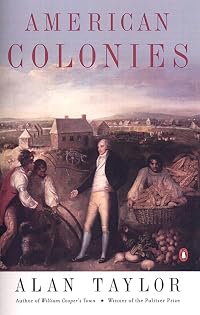
American Colonies: The Settling of North America
by Alan Taylor
The Penguin History of the United States (2001)
On This Page
Description
In the first volume in the Penguin History of the United States series, edited by Eric Foner, Alan Taylor challenges the traditional story of colonial history by examining the many cultures that helped make America, from the native inhabitants from millennia past, through the decades of Western colonization and conquest, and across the entire continent, all the way to the Pacific coast. Transcending the usual Anglocentric version of our colonial past, he recovers the importance of Native show more American tribes, African slaves, and the rival empires of France, Spain, the Netherlands, and even Russia in the colonization of North America. Moving beyond the Atlantic seaboard to examine the entire continent, American Colonies reveals a pivotal period in the global interaction of peoples, cultures, plants, animals, and microbes. In a vivid narrative, Taylor draws upon cutting-edge scholarship to create a timely picture of the colonial world characterized by an interplay of freedom and slavery, opportunity and loss. show lessTags
Recommendations















Member Reviews
This is the 20th anniversary of the book, it has held up well. Taylor shows that the 300 years of the 16th to 18th centuries were much more than the 13 colonies. Indians and African slaves were not mere footnotes but central players. Besides the British there are French, Spanish and Russian, not to mention a polyglot of other nations who settled in North America. The geographic range is vast from Alaska to the sugar islands in the Caribbean. When viewed as a whole there is a broad perspective of what happens when an over populated Europe discovers a fertile new continent. The exchange of disease, food and technology were unavoidable outcomes, with disease playing the biggest role killing off 90% of the native population. The narrative show more is by necessity broad and shallow, but intellectually stimulating. Entire books of material are found in a sentence or two. Those areas I have previously read about I appreciated the reinforcement and context. Those new to me I found the summary at times too brief to leave an impression. Reading history is the work of a lifetime, this is a useful map. I'll probably never think of the word "Colonial" the same, being of such variety and scope. It's the central thesis, and succeeds. show less
This is the most comprehensive book on pre-Revolutionary America that I've ever read. It covers everywhere and virtually everyone, from the Pilgrims that you always read about, to the slaves, women, and native people that are usually overlooked. It is sometimes grim reading. Europeans were frequently cruel to the natives. There's a lot about the conditions the slaves lived in. So many massacres, so much bloodshed.
But it's not all dismal. Some of it talks about politics, land speculation, exploration, trade, and social customs. Even if you thought you knew about pre-Revolutionary America, you're going to find a lot of stuff you didn't know. I enjoyed listening to this, but I think it would have been better in print with some maps. show more Fortunately, I know basic American geography so I was able to follow along. I really recommend this one. show less
But it's not all dismal. Some of it talks about politics, land speculation, exploration, trade, and social customs. Even if you thought you knew about pre-Revolutionary America, you're going to find a lot of stuff you didn't know. I enjoyed listening to this, but I think it would have been better in print with some maps. show more Fortunately, I know basic American geography so I was able to follow along. I really recommend this one. show less
A model work of new-style history. Taylor's book isn't a straight narrative, but it has the grip of one thanks to his eye for detail, his better than passable prose (which, in academic history, is... well, that's very high praise), and his even-handedness. The settling of North America was not a pleasant thing. As ever, the test for a work of history is whether it makes you want to read other books on the same topic, and this one did that in spades.
A friend has done an excellent review of this book, so I don't have to say anything else.
A friend has done an excellent review of this book, so I don't have to say anything else.
Fascinating, well written history of the colonial period. Taylor does a nice job of evenhandedly describing the various colonist vs native, colonist vs mother country, and white vs. black issues. I learned a lot. It even covers Russia's forays into Alaska, which I didn't know anything about. It was on such a macro-level that it breezed past facinating issues all too quickly, but it did its job as a survey really well.My interest level flagged in the descriptions of religious issues, but that is a matter of personal taste, the effects of religion were certainly important.
One of the best history books I've read, and certainly the best on early American history. It's one of those books where every paragraph makes you think, and often rethink everything you thought you knew. Highly recommended. Discussed at LH: http://www.languagehat.com/archives/002019.php
With so very many details about the colonial period in North America from such an incredibly different perspective than I got in school, this book helps make sense of some of the attitudes and institutions in place in the United States today. I'm very pleased that I learned about this book (among others) while my children are still in school and while I'm still in charge of choosing their history curriculum.
Outstanding example of detailed and useful historical narrative. So far as I could tell, it did not have any partisan ax to grind (I could be obtuse), as it presented both good and bad incidents dispassionately.
Members
- Recently Added By
Lists

Evan's Wish List
86 works; 2 members

Books in the Bibliography of Contested Continent by Peter Mancall
495 works; 1 member
Author Information

Alan Taylor has twice won the Pulitzer Prize in History, most recently for The Internal Enemy, also a National Book Award finalist. He is the Thomas Jefferson Foundation Professor of History at University of Virginia, and lives in Charlottesville.
All Editions
Awards and Honors
Awards
Distinctions
Series

Common Knowledge
- Canonical title
- American Colonies: The Settling of North America
- Original publication date
- 2001 (Viking Penguin) (Viking Penguin)
- Important places
- Colonial America
- Dedication
- For Emily
- First words
- Scholars used to think of Native American cultures as relatively static, unchanging for centuries until encountered and overwhelmed by the European invaders after 1492.
- Publisher's editor
- Wolf, Wendy; Giffords, Bruce; Corcoran, Clifford J.
- Blurbers
- Deloria, Philip J. ; Salisbury, Neal; Kerber, Linda K.
- Original language
- English
Classifications
Statistics
- Members
- 1,485
- Popularity
- 15,679
- Reviews
- 12
- Rating
- (4.10)
- Languages
- English
- Media
- Paper, Audiobook, Ebook
- ISBNs
- 10
- ASINs
- 12