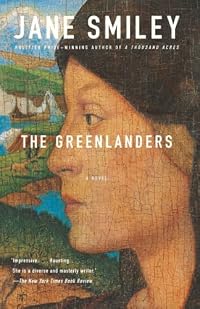
The Greenlanders
by Jane Smiley
On This Page
Description
Pulitzer Prize winner and bestselling author Jane Smiley's The Greenlanders is an enthralling novel in the epic tradition of the old Norse sagas. Set in the fourteenth century in Europe's most far-flung outpost, a land of glittering fjords, blasting winds, sun-warmed meadows, and high, dark mountains, The Greenlanders is the story of one family--proud landowner Asgeir Gunnarsson; his daughter Margret, whose willful independence leads her into passionate adultery and exile; and his son show more Gunnar, whose quest for knowledge is at the compelling center of this unforgettable book. Jane Smiley takes us into this world of farmers, priests, and lawspeakers, of hunts and feasts and longstanding feuds, and by an act of literary magic, makes a remote time, place, and people not only real but dear to us. show lessTags
Recommendations























Member Recommendations
WildMaggie Similar sense of foreboding in a historical setting where the important parts of the stories are the parts left unsaid.

themulhern Same historical period and location. Haugaard's is a book probably most appropriate for young adults.
Member Reviews
It's as if I were reading a religious tome, or maybe one of the original Sagas, in its original, as an acolyte. Each reading session, days and nights slipping by, eking me only incrementally forward, impossible to make this story take anything but the amount of time it needs to take. It will stymy speed-readers. With only three chapters in nearly 600 pages (abstractly: "Riches", "The Devil" and "Love"), scant paragraph breaks and copy as dense as the weight of a damp Greenland winter. Smiley's novel unwinds as a single, admirably constant, thread. It will require attention and persistence.
But, in short, it is worth it. Each petty squabble, each encroaching superstition, each abandoned farmstead among the vulnerable, thin band of Norse show more emigrants who constituted the titular Greenlanders increases the grey, windswept, taut feeling that these people are on their way to their own (undisclosed and historically mysterious) end. You can't let it go. You have to come along with it, yourself getting gritty winter-sand blown into your hair and eating sourmilk and dried bilberries and sharpening old inter-family feuds.
I mean, from the outset, it's hopeless. This arrogant clutch of 14th-century farmers bring incompatible Scandinavian farming techniques and undiluted disdain for the indigenous "skraelings" (Eskimo or Inuit), who continue sleek and fleshy as the Greenlanders dwindle and starve. Epidemic after gruesome epidemic decimate the steaders. They kill amongst themselves for honor or anger or fear. The land refuses to give and each year the crops and livestock weaken more. Ships stop coming, and the Greenlanders—no trees—cannot build their own.
Many of the people in the multi-generational story here are real. You can look some of them up. They happened. The place-names where they lived and worked still vaguely discernible on the land. Though they are completely vanished now, Smiley makes each of their life stories utterly plausible, such that you are confused as to where fiction stops and the surreal, remote, but *real* history of the failed colonies on Greenland begins.
It is haunting and cold-feeling and bleak. It never wavers from its calculated, saga-style prose. But it can't be ignored, and draws one back night after night until the end finally comes. show less
But, in short, it is worth it. Each petty squabble, each encroaching superstition, each abandoned farmstead among the vulnerable, thin band of Norse show more emigrants who constituted the titular Greenlanders increases the grey, windswept, taut feeling that these people are on their way to their own (undisclosed and historically mysterious) end. You can't let it go. You have to come along with it, yourself getting gritty winter-sand blown into your hair and eating sourmilk and dried bilberries and sharpening old inter-family feuds.
I mean, from the outset, it's hopeless. This arrogant clutch of 14th-century farmers bring incompatible Scandinavian farming techniques and undiluted disdain for the indigenous "skraelings" (Eskimo or Inuit), who continue sleek and fleshy as the Greenlanders dwindle and starve. Epidemic after gruesome epidemic decimate the steaders. They kill amongst themselves for honor or anger or fear. The land refuses to give and each year the crops and livestock weaken more. Ships stop coming, and the Greenlanders—no trees—cannot build their own.
Many of the people in the multi-generational story here are real. You can look some of them up. They happened. The place-names where they lived and worked still vaguely discernible on the land. Though they are completely vanished now, Smiley makes each of their life stories utterly plausible, such that you are confused as to where fiction stops and the surreal, remote, but *real* history of the failed colonies on Greenland begins.
It is haunting and cold-feeling and bleak. It never wavers from its calculated, saga-style prose. But it can't be ignored, and draws one back night after night until the end finally comes. show less
The story of three generations or so of Norse families in the slowly declining Greenland settlement in the late 14th and early 15th centuries. I say "story"... Truth is, it doesn't necessarily read very much like a novel. In some places we get dialog and insights into specific characters' points of view. In other places, it reads more like an overview of history, and in others more like we're among these people listening to news from the neighbors, and all of these different things just blend seamlessly into each other, page after page.
And there are a lot of pages. Nearly 600 of them, full of the ordinary and extraordinary details of people's lives, their disputes and loves and mistakes and changes of heart, their physical and mental show more illnesses, their hardships and hopes and tragedies and moments of pettiness and violence and beauty. It's compelling stuff, and through it all, these people, for all their differences from us, feel absolutely like real people.
This is not a fast-reading book. It's the kind of book that really only works, I think, if you just let it unspool at its own pace and take you along for its slow but immersive ride. And you know what? I think it did me an incredible favor with that. I feel like lately I've been feeling sort of stupidly stressed about my reading life. I'm not reading as many books as usual! I'm not making sufficient progress through my out-of-control TBR shelves! Whatever I'm reading, I'm constantly distracted by thinking about what I'm going to read next! Or, rather, I was. This book just sort of demanded I let all that go and just relax and enjoy the journey. Which, after all, is what pleasure reading is supposed to be about. And whaddaya know? It worked.
Rating: Slightly to my surprise, I'm giving this one 4.5/5. Sometimes, you just get the right book at the right time, and you have to show it some appreciation for that. Plus, the ending was so poignant that it's left me with unexpected emotions that still seem to be lingering after I've turned the last page and shut the covers. show less
And there are a lot of pages. Nearly 600 of them, full of the ordinary and extraordinary details of people's lives, their disputes and loves and mistakes and changes of heart, their physical and mental show more illnesses, their hardships and hopes and tragedies and moments of pettiness and violence and beauty. It's compelling stuff, and through it all, these people, for all their differences from us, feel absolutely like real people.
This is not a fast-reading book. It's the kind of book that really only works, I think, if you just let it unspool at its own pace and take you along for its slow but immersive ride. And you know what? I think it did me an incredible favor with that. I feel like lately I've been feeling sort of stupidly stressed about my reading life. I'm not reading as many books as usual! I'm not making sufficient progress through my out-of-control TBR shelves! Whatever I'm reading, I'm constantly distracted by thinking about what I'm going to read next! Or, rather, I was. This book just sort of demanded I let all that go and just relax and enjoy the journey. Which, after all, is what pleasure reading is supposed to be about. And whaddaya know? It worked.
Rating: Slightly to my surprise, I'm giving this one 4.5/5. Sometimes, you just get the right book at the right time, and you have to show it some appreciation for that. Plus, the ending was so poignant that it's left me with unexpected emotions that still seem to be lingering after I've turned the last page and shut the covers. show less
If a nearly 600 page book about life in 14th century Greenland doesn’t sound like a good time, you might be surprised. This was far from being dull, and I love how Jane Smiley immersed the reader so deftly into this world. She does it by simply expressing their customs and perception of the world without ever entering into didactic explanations. It’s a story that’s told across generations allowing for a richness in experiences, and I really feel transported when I read it. And just as life in this period could end suddenly, don’t get too attached to any of the characters, because from the beginning she shows just how quickly they can be killed off.
The book is titled ‘The Greenlanders’ but it’s definitely from a European show more colonizer perspective. That includes describing the indigenous people as “skreaelings,” which is a derogatory term, but because we see how wrong the Europeans are in their views, and how much less able they are to cope with some of the harsh world, the portrayal of the indigenous people is certainly positive.
Aside from fascinating events like hunts and an expedition into North America, interacting with people from Iceland or Norway, the power of the church and its failings, dealing with starvation and devastating sickness, etc., one really gets a sense of the hardy independence of the Greenlanders. They are always a bit leery of the church, and are not afraid to mete out justice as they see fit, like killing someone for adultery or witchcraft, and then facing a council afterwards. There is such a distance from the rest of the world that news of things like the Papal Schism, life in European cities, or what Moslem people are like, seem incredibly distant. There is a dearth of natural resources, like wood, as well as expertise. And of course we see character types which are common to all humans, at any time: the smooth talkers, the greedy hoarders, the loners, and the good people just trying to survive. It’s a bit of a tome to read, but this one is engaging from beginning to end. show less
The book is titled ‘The Greenlanders’ but it’s definitely from a European show more colonizer perspective. That includes describing the indigenous people as “skreaelings,” which is a derogatory term, but because we see how wrong the Europeans are in their views, and how much less able they are to cope with some of the harsh world, the portrayal of the indigenous people is certainly positive.
Aside from fascinating events like hunts and an expedition into North America, interacting with people from Iceland or Norway, the power of the church and its failings, dealing with starvation and devastating sickness, etc., one really gets a sense of the hardy independence of the Greenlanders. They are always a bit leery of the church, and are not afraid to mete out justice as they see fit, like killing someone for adultery or witchcraft, and then facing a council afterwards. There is such a distance from the rest of the world that news of things like the Papal Schism, life in European cities, or what Moslem people are like, seem incredibly distant. There is a dearth of natural resources, like wood, as well as expertise. And of course we see character types which are common to all humans, at any time: the smooth talkers, the greedy hoarders, the loners, and the good people just trying to survive. It’s a bit of a tome to read, but this one is engaging from beginning to end. show less
The designation "novel" covers a big range of narrative styles - and the sagas tend to be credited there. "The Greenlanders" is a saga - it is not a story with a plot and main characters, it is the story of a place, of a nation, of a time. Characters appear and disappear, people die (even people that feel like being the main characters), people appear out of nowhere and names repeat themselves. It is like real life - you don't have people that are invincible and people do not get named conveniently (or show up only after their story is revealed). And somewhere amidst all these people is the story of the Greenland settlement at the times of the Black Death, the last years of the a previously prosperous life. The saga spans decades - in show more some instances years pass in a sentence; in some instances pages are spent on the same minute or hour.
And in that story emerges a nation that does not exist anymore, a style of life that had disappeared anywhere else and that is on the verge of extinction. Because even if Greenland's original settlers belonged to a different nation, their almost full isolation and their way of life turns them into something new... which by the time the novel opens is already something old and dying.
The details of the daily life are excruciating and at the same time you do not feel as if you are reading a history book instead of the novel you expected. Even though there are main characters emerging in the book, part of the beauty of the book is that you never know who will die or when or how.
It is a very dense read - even if you want to read fast, the text slows you down with the details, the prose and the style. But in a good way - in the way in which good non-fiction slows you down when it gets technical. And still it remains a fascinating fiction. Although it is not an easy read emotionally either - deaths, hunger and human stupidity is part of the book - whatever nature does not manage to take away, humans do. The foreigners that at the beginning of the novel are a good omen and carry happiness by the end of the novel turn into the worst thing that could have happen to the community - first by just influencing it and then by effectively destroying it. It is a dying world - with the Earth going into the small Ice Age, Greenland becomes too cold and inhospitable. And yet - noone gives up - it is only the external influence that manages to break up everything.
And somewhere amongst that saga are the stories - people telling stories - of heroes and real people, of their life and the life of others. And midway through the book, some of the stories are the stories of the people that tell them, the same stories we already read. And yet - they are different - because stories belong to the teller... and every time a story is told, it changes.
It is a marvelous novel - but only if someone is prepared for the style and the scope. show less
And in that story emerges a nation that does not exist anymore, a style of life that had disappeared anywhere else and that is on the verge of extinction. Because even if Greenland's original settlers belonged to a different nation, their almost full isolation and their way of life turns them into something new... which by the time the novel opens is already something old and dying.
The details of the daily life are excruciating and at the same time you do not feel as if you are reading a history book instead of the novel you expected. Even though there are main characters emerging in the book, part of the beauty of the book is that you never know who will die or when or how.
It is a very dense read - even if you want to read fast, the text slows you down with the details, the prose and the style. But in a good way - in the way in which good non-fiction slows you down when it gets technical. And still it remains a fascinating fiction. Although it is not an easy read emotionally either - deaths, hunger and human stupidity is part of the book - whatever nature does not manage to take away, humans do. The foreigners that at the beginning of the novel are a good omen and carry happiness by the end of the novel turn into the worst thing that could have happen to the community - first by just influencing it and then by effectively destroying it. It is a dying world - with the Earth going into the small Ice Age, Greenland becomes too cold and inhospitable. And yet - noone gives up - it is only the external influence that manages to break up everything.
And somewhere amongst that saga are the stories - people telling stories - of heroes and real people, of their life and the life of others. And midway through the book, some of the stories are the stories of the people that tell them, the same stories we already read. And yet - they are different - because stories belong to the teller... and every time a story is told, it changes.
It is a marvelous novel - but only if someone is prepared for the style and the scope. show less
Smiley has written a work of historical fiction about 14th-15th century Greenland that is slow, detailed, bleak and ultimately an unforgettable reading experience. Life in Greenland over this time period is waning. By the end of the 15th century, no evidence of these settlements exists, so the entire book is shadowed by the end of times for this people. Characters die left and right; life is hard to the point of almost no scenes of joy. The constant death seems to make characters not even connect to each other because they know they will be separated. Life revolves around the arrival of ships from Iceland and Norway. These come less and less frequently and the news they bring is mainly of widespread death in Europe. Greenland waits for show more a Bishop, receives one, and waits again in vain when he dies. They’ve been forgotten by the Pope and are on their way to being forgotten by all of Europe.
The book is written, especially in the beginning, with lots of myths and stories of past Greenlanders inserted. It’s obvious that the ancestors of the Greenlanders were much more adventurous than they are now. The previous generations used to travel to Vinland and Markland and north into Greenland. These trips are never attempted anymore. In fact, there are not even any large boats by the end of the book. Other things they lose over the course of the book are their knowledge of the laws usually enforced at the Thing, as well as contact with the church.
Smiley’s writing style is bleak and spare, just like the events of the book. Though many of the actions are dramatic, the writing stays detached and with painful slowness reveals the reactions and feelings of the main characters. It took me a long time to warm up to the pace of this book, but by the end I can’t imagine it being written any other way. Smiley doesn’t help the reader, the book is only divided into 3 large sections with no chapters to pace the book. I had a hard time with this, especially for the first third of the book. When I compare this book to The Long Ships or Kristin Lavransdatter, it suffers a bit since those books I found more engaging with easier characters to connect with and love. In the end though, I feel like I know what life was like for the Greenlanders - in fact I feel liked I’ve actually lived it. I also felt a deep connection to several of the characters, despite the slow reveal of their personalities. show less
The book is written, especially in the beginning, with lots of myths and stories of past Greenlanders inserted. It’s obvious that the ancestors of the Greenlanders were much more adventurous than they are now. The previous generations used to travel to Vinland and Markland and north into Greenland. These trips are never attempted anymore. In fact, there are not even any large boats by the end of the book. Other things they lose over the course of the book are their knowledge of the laws usually enforced at the Thing, as well as contact with the church.
Smiley’s writing style is bleak and spare, just like the events of the book. Though many of the actions are dramatic, the writing stays detached and with painful slowness reveals the reactions and feelings of the main characters. It took me a long time to warm up to the pace of this book, but by the end I can’t imagine it being written any other way. Smiley doesn’t help the reader, the book is only divided into 3 large sections with no chapters to pace the book. I had a hard time with this, especially for the first third of the book. When I compare this book to The Long Ships or Kristin Lavransdatter, it suffers a bit since those books I found more engaging with easier characters to connect with and love. In the end though, I feel like I know what life was like for the Greenlanders - in fact I feel liked I’ve actually lived it. I also felt a deep connection to several of the characters, despite the slow reveal of their personalities. show less
I think this book is a stark but lovely masterpiece. Alas, no one else to whom I have ever recommended it (including my doting husband and an entire book group) has even finished it, let alone agreed with my opinion of its literary merit. Who can say why I was so transfixed by Smiley's lyrical evocation of a closed medieval society? Perhaps it was just one of those cases of the right book at the right moment for the right reader....
This is a 4 star read for me, but what an incredible reading experience. Smiley writes in the style of old Norse sagas which is hard to get into, but addictive once you get used to it. It is like a magnificent weave is being created in front of your eyes and you get into the characters' lives and then out and back in again.
These people, who really come to life in the book, sometimes die so easily and there is no dwelling upon it. It is a fascinating style that mirrors the harshness of the environment and the constant struggle and nearness of death the real Greenlanders were used to. This is a difficult book to read also because the reality is so unpleasant and the book makes it almost too real for the reader.
A space-time machine.
These people, who really come to life in the book, sometimes die so easily and there is no dwelling upon it. It is a fascinating style that mirrors the harshness of the environment and the constant struggle and nearness of death the real Greenlanders were used to. This is a difficult book to read also because the reality is so unpleasant and the book makes it almost too real for the reader.
A space-time machine.
Members
- Recently Added By
Lists

Top Five Books of 2013
1,564 works; 716 members

Female Author
1,235 works; 67 members

Winter Books
127 works; 17 members

Pleasant Surprises: Books That Exceeded Our Expectations
418 works; 143 members

1980s
356 works; 23 members

Top Five Books of 2017
757 works; 230 members

LibraryThingers' 1001 Books You Must Read Before You Die
442 works; 30 members

Dark Books for Winter Reading
71 works; 11 members

One Book, Many Authors
441 works; 40 members

Best books read in 2011
200 works; 51 members

Lesser known books of well known authors
39 works; 17 members

Books Set on Islands
190 works; 24 members

Five star books
1,755 works; 108 members
Best Books of the 20th Century
193 works; 5 members

Favorite Books from the 1980s
27 works; 3 members

Set in the Middle Ages
42 works; 9 members

A Rainbow of Books: Colors in the Title
570 works; 24 members

Books discovered on LibraryThing
256 works; 36 members

Witch Hunts
30 works; 7 members

Books Read in 2011
684 works; 20 members

20 Books Off the Beaten Path
20 works; 2 members
The Hive Recommends
62 works; 2 members

History in the long view
55 works; 3 members

Arctic novels
35 works; 5 members
Favourite Books
1,817 works; 316 members
Author Information

50+ Works 25,474 Members
Jane Smiley was born in Los Angeles, California on September 26, 1949. She received a B. A. from Vassar College in 1971 and an M.F.A. and a Ph.D from the University of Iowa. From 1981 to 1996, she taught undergraduate and graduate creative writing workshops at Iowa State University. Her books include The Age of Grief, The Greenlanders, Moo, Horse show more Heaven, Ordinary Love and Good Will, Some Luck, and Early Warning. In 1985, she won an O. Henry Award for her short story Lily, which was published in The Atlantic Monthly. A Thousand Acres received both the National Book Critics Circle Award and the Pulitzer Prize. (Bowker Author Biography) show less
Common Knowledge
- Canonical title
- The Greenlanders
- Original title
- The Greenlanders
- Original publication date
- 1988
- People/Characters
- Asgeir Gunnarsson; Margret Asgeirsdottir; Gunnar Asgeirsson; Birgitta Lavransdottir; Helga Gunnarsdottir; Kollgrim Gunnarsson (show all 9); Jon Andres Erlendsson; Skuli Gudmundsson; Bjorn Bollason
- Important places
- Gunnars Stead; Ketils Stead; Solar Fell; Gardar; Greenland
- Epigraph
- par munu eftir, undrasmatigar, guttnar toftur, i grasi finnask, paers i ardaga, attar hofdu. Afterwards they will find the chessmen, marvelous and golden in the grass, just where the ancient gods had dropped them. "Voluspa" (... (show all)"The Sayings of the Prophetess")
- Dedication
- This book is fondly dedicated to Elizabeth Stern, Duncan Campell, Frank Ponzi, and to the memory of Knud-Erik Holm-Pedersen.
- First words
- Asgeir Gunnarsson farmed at Gunnars Stead near Undir Hofdi church in Austfjord.
- Last words
- (Click to show. Warning: May contain spoilers.)And the children peeped out of the bedcloset, and Gunnar told his tale.
Classifications
Statistics
- Members
- 1,229
- Popularity
- 19,965
- Reviews
- 36
- Rating
- (3.87)
- Languages
- 5 — English, Finnish, French, German, Swedish
- Media
- Paper, Audiobook, Ebook
- ISBNs
- 23
- ASINs
- 12