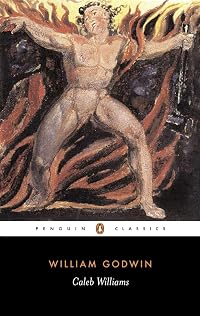
Caleb Williams
by William Godwin
On This Page
Description
Caleb Williams is hired as personal secretary to a British Squire, Fernando Falkland. In the course of his work he comes across a terrible secret from the Squire's past, and is sworn to secrecy. Falkland believes in the virtue of the upper classes and the villainy of the lower. He is uneasy in the power of a lowly servant and sets about persecuting Williams, leading to a series of adventures in an early thriller style..
Tags
Recommendations
















Member Recommendations

by Cecrow
Member Reviews
8.0/10
This is an interesting novel that carries with it all the weight of an 18th century crime-and-punishment gothic thriller, a text on social justice, and a fair representation of Roadrunner vs Wile E. Coyote. William Godwin was a visionary of no uncommon merit!
There is much here to disentangle, and if I had time and interest enough, this would be a great novel to pull apart with its important view into 18th century social (in)justice and the human malignancy that ran like a cancer through every level of society.
Subject to every man's abuse -- from the lord of the manor, to the prisoners who waste away in the dank cells of local prisons where Caleb often finds himself -- he is representative of what happens to human beings when show more tyranny rules.
Your innocence shall be of no service to you, says Squire Falkland. I laugh at so feeble a defence.
(Can you not picture him twirling his mustachios, melodramatically.)
And yet, do we not find it still to be so, in our society? Godwin's novel is a push-back, and a cry, all in one, against the original sin of inequality, of human worship of power, of the inhumanity of slavery, sometimes disguised as merely servitude. When one is in perpetual service, in whatever guise, it is difficult to distinguish tyranny from liberty.
Many of these themes are delivered with hammerhead blows, as the narrator often takes you aside and lectures you, while Caleb rests awhile in the dank dirty prison; but there is also subtlety and grace here, when Godwin remembers to let the story pull itself along. In those moments, one recognizes an immensely talented writer and a superb mind.
On the down side of it all, Caleb flails and falters just a little too often for my taste that I started to envision a skewed version of Wile E Coyote vs Roadrunner: whereas the roadrunner always gets away, in this instance Caleb always gets caught. I could only suspend my disbelief to a point -- and then I would be seized with momentary urges to slap him silly. Surely, at some point, even a complete innocent from the 18th century would gather a little more sagacity; be endowed with a smidgen more "street smarts" (I'm thinking of Moll Flanders here, for whom I longed with all my heart during some of Caleb's more imbecilic moves.)
Nonetheless, warts and all, this was very enjoyable and made a pleasant diversion, and an instructive detour into 19th century Britain; and, if you are of a more serious bent than I, may even require a few hankies to get through it all. show less
This is an interesting novel that carries with it all the weight of an 18th century crime-and-punishment gothic thriller, a text on social justice, and a fair representation of Roadrunner vs Wile E. Coyote. William Godwin was a visionary of no uncommon merit!
There is much here to disentangle, and if I had time and interest enough, this would be a great novel to pull apart with its important view into 18th century social (in)justice and the human malignancy that ran like a cancer through every level of society.
Subject to every man's abuse -- from the lord of the manor, to the prisoners who waste away in the dank cells of local prisons where Caleb often finds himself -- he is representative of what happens to human beings when show more tyranny rules.
Your innocence shall be of no service to you, says Squire Falkland. I laugh at so feeble a defence.
(Can you not picture him twirling his mustachios, melodramatically.)
And yet, do we not find it still to be so, in our society? Godwin's novel is a push-back, and a cry, all in one, against the original sin of inequality, of human worship of power, of the inhumanity of slavery, sometimes disguised as merely servitude. When one is in perpetual service, in whatever guise, it is difficult to distinguish tyranny from liberty.
Many of these themes are delivered with hammerhead blows, as the narrator often takes you aside and lectures you, while Caleb rests awhile in the dank dirty prison; but there is also subtlety and grace here, when Godwin remembers to let the story pull itself along. In those moments, one recognizes an immensely talented writer and a superb mind.
On the down side of it all, Caleb flails and falters just a little too often for my taste that I started to envision a skewed version of Wile E Coyote vs Roadrunner: whereas the roadrunner always gets away, in this instance Caleb always gets caught. I could only suspend my disbelief to a point -- and then I would be seized with momentary urges to slap him silly. Surely, at some point, even a complete innocent from the 18th century would gather a little more sagacity; be endowed with a smidgen more "street smarts" (I'm thinking of Moll Flanders here, for whom I longed with all my heart during some of Caleb's more imbecilic moves.)
Nonetheless, warts and all, this was very enjoyable and made a pleasant diversion, and an instructive detour into 19th century Britain; and, if you are of a more serious bent than I, may even require a few hankies to get through it all. show less
Published in 1794 by William Godwin to illustrate his political theories about the abuse of power over the populace by institutions and persons of influence, I think without a doubt this is one of the most miserable books that I have ever read.
Caleb Williams, a well-meaning young man, is taken into the service of Mr Falkland as secretary, a man whose early promise and happiness have been dashed for initially unexplained reasons. Initially, settling well into his new position, Caleb’s life is forever changed when he discovers the secret that Falkland has been desperate to conceal, and he finds himself trapped in a nightmarish web from which neither his friends nor the law is able to rescue him.
I certainly read this wanting to know show more what happened next, although the plot is definitely far fetched at time, and in particular the character of Falkland doesn’t altogether make sense. But cheerful it is not! show less
Caleb Williams, a well-meaning young man, is taken into the service of Mr Falkland as secretary, a man whose early promise and happiness have been dashed for initially unexplained reasons. Initially, settling well into his new position, Caleb’s life is forever changed when he discovers the secret that Falkland has been desperate to conceal, and he finds himself trapped in a nightmarish web from which neither his friends nor the law is able to rescue him.
I certainly read this wanting to know show more what happened next, although the plot is definitely far fetched at time, and in particular the character of Falkland doesn’t altogether make sense. But cheerful it is not! show less
https://fromtheheartofeurope.eu/caleb-williams-or-things-as-they-are-by-william-...
So, first of all: it’s not really all that good as a novel. The protagonist, Caleb Williams, acquires a rich patron, Mr Falkland; discovers Falkland’s dark secret, which is that he committed a murder and allowed two other people to be executed for it; and then flees Falkland’s wrath for the rest of the book, pursued by the sinister thief-taker Gines.
The long chase is not really very interesting – Godwin could have made it more vivid with descriptions of landscape and townscape, but instead just has Caleb hiding, being found by Gines, fleeing and hiding somewhere else all over again. There’s one good bit set in London (which had me looking up show more sources on the historic synagogues of the city). The chase sequence is reminiscent of the one in Frankenstein, but his daughter did it better.
The moral core of the book is the relatively short section where Caleb is imprisoned unjustly, and faces Falkland’s wrath through the justice system. Godwin was determined to expose the ways in which the judicial system in England served only to impose the will of the rich on the poor. The sections where Caleb is in prison are footnoted as if to say “I am not making this bit up”. There is a wronged young woman character who also dies tragically in prison. It appears to be impossible to hold Falkland accountable for his wrongs. These sections are passionate and fluent.
(I did wonder also if there was a bit of a spurned lover vibe between Caleb and Falkland.)
It’s also mercifully short, and we rather dragged it out by reading only four or five pages a day. show less
So, first of all: it’s not really all that good as a novel. The protagonist, Caleb Williams, acquires a rich patron, Mr Falkland; discovers Falkland’s dark secret, which is that he committed a murder and allowed two other people to be executed for it; and then flees Falkland’s wrath for the rest of the book, pursued by the sinister thief-taker Gines.
The long chase is not really very interesting – Godwin could have made it more vivid with descriptions of landscape and townscape, but instead just has Caleb hiding, being found by Gines, fleeing and hiding somewhere else all over again. There’s one good bit set in London (which had me looking up show more sources on the historic synagogues of the city). The chase sequence is reminiscent of the one in Frankenstein, but his daughter did it better.
The moral core of the book is the relatively short section where Caleb is imprisoned unjustly, and faces Falkland’s wrath through the justice system. Godwin was determined to expose the ways in which the judicial system in England served only to impose the will of the rich on the poor. The sections where Caleb is in prison are footnoted as if to say “I am not making this bit up”. There is a wronged young woman character who also dies tragically in prison. It appears to be impossible to hold Falkland accountable for his wrongs. These sections are passionate and fluent.
(I did wonder also if there was a bit of a spurned lover vibe between Caleb and Falkland.)
It’s also mercifully short, and we rather dragged it out by reading only four or five pages a day. show less
A murder is committed and two men are hanged for the crime. When our hero finds out who really did it, he is framed as a thief and imprisoned. He escapes but where can he go with a notorious thief-taker on his trail and the real murderer seeking to ensure his silence?
Although I read this because it was said to be the first detective novel, the solving of the crime is a comparatively small part of the book (about 30 pages when it took us about 100 pages to actually get to the murder). The chase is nearly 2/3 of the book, so really it deserves recognition as an early example of a chase thriller. It wasn't hugely exciting but it was an interesting picture of the time.
Although I read this because it was said to be the first detective novel, the solving of the crime is a comparatively small part of the book (about 30 pages when it took us about 100 pages to actually get to the murder). The chase is nearly 2/3 of the book, so really it deserves recognition as an early example of a chase thriller. It wasn't hugely exciting but it was an interesting picture of the time.
Young Caleb Williams is a secretary to the wealthy Mr. Falkland, a man of upstanding character and morals. When Caleb pries into Falkland’s personal affairs and discovers he has committed a serious crime, Falkland vows that he will control and persecute Caleb for the rest of his life. Caleb attempts to run away, but Falkland’s influence follows him across England and ruins any prospects he has of living a normal life. The novel was a commentary on how the wealthy aristocracy controlled the judicial system in 18th century England to the point that the common man was denied fair treatment and basic justice.
I appreciated the message Godwin was trying to get across with the novel, but the whole thing was just too dated for me. Caleb’s show more repeated refusal to fight back even when things were at their worst grew old quickly. I also thought it could have been a bit shorter. show less
I appreciated the message Godwin was trying to get across with the novel, but the whole thing was just too dated for me. Caleb’s show more repeated refusal to fight back even when things were at their worst grew old quickly. I also thought it could have been a bit shorter. show less
A rollicking thriller, though gets awfully repetitive at times. Though it was intended as a showcase for Godwin's political ideas, the story takes on a life of its own and sometimes seems to contradict his political precepts. It is perhaps at its most interesting when it does so.
William Godwin's Things as They Are; or, The Adventures of Caleb Williams was published in 1794. Though the language is a challenge (the sentences are miles long, the vocabulary is exuberant, to put it mildly), it reads as fast as a whodunnit. The appealing point is it has a social realism that feels familiar, but the characterization and narration are still over the top in an old-fashioned way. The main actors in the feud between two country gentlemen are good and evil personified, larger than life.
Godwin was an early anarchist who wrote a tome called An Enquiry Concerning the Principles of Political Justice in 1793. The book provoked strong reactions on both sides of the questions, how much government is enough and how can reason show more guide the affairs of the day. Godwin became well-known and he quickly wrote Caleb Williams to further illustrate his political ideas. The novel was a best-seller in its time.
The theme is a timeless one: the crushing of the individual by society. It’s the story of a victim of the rigid moral conventions and rotten laws designed to protect the interests of a corrupt evil ruling class. As Godwin put it in his preface to Caleb Williams, he proposed “to comprehend, as far as the progressive nature of a single story would allow, a general review of the modes of domestic and unrecorded despotism, by which man becomes the destroyer.âÂ? show less
Godwin was an early anarchist who wrote a tome called An Enquiry Concerning the Principles of Political Justice in 1793. The book provoked strong reactions on both sides of the questions, how much government is enough and how can reason show more guide the affairs of the day. Godwin became well-known and he quickly wrote Caleb Williams to further illustrate his political ideas. The novel was a best-seller in its time.
The theme is a timeless one: the crushing of the individual by society. It’s the story of a victim of the rigid moral conventions and rotten laws designed to protect the interests of a corrupt evil ruling class. As Godwin put it in his preface to Caleb Williams, he proposed “to comprehend, as far as the progressive nature of a single story would allow, a general review of the modes of domestic and unrecorded despotism, by which man becomes the destroyer.âÂ? show less
Members
- Recently Added By
Lists

1001 Books You Must Read Before You Die
1,448 works; 1,134 members

1898 C.K. Shorter List of Best 100 Novels
100 works; 34 members

18th Century
42 works; 11 members
150 Best Novels Selected by Brander Matthews (1883)
150 works; 7 members

Lovecraft's 'Supernatural Horror in Literature' Reading List
216 works; 8 members

1,001 BYMRBYD Concensus
723 works; 27 members

Best Horror Mega-List
342 works; 6 members

Haycraft Queen Cornerstones
181 works; 3 members

Jones and Newman's Horror: The 100 Best Books
100 works; 4 members

Mysteries to Read, PD
42 works; 1 member

Books mentioned in Julian Symons’ Bloody Murder
438 works; 6 members

Books Read in 2018
4,360 works; 110 members

My TBR
371 works; 3 members

el
1,139 works; 1 member
Author Information

66+ Works 2,344 Members
Writer William Godwin was born in Wisbech, Cambridgeshire on March 3, 1756. He attended Hoxton Presbyterian College and became a minister. He left the ministry in 1787 in order to become a full-time writer. His best-known works are Enquiry Concerning Political Justice (1793) and The Adventures of Caleb Williams (1794). In 1797, he married feminist show more writer Mary Wollstonecraft and they had a child who later became known as Mary Wollstonecraft Shelley the author of Frankenstein. He primarily wrote novels during his later years, including Mandeville (1817), Cloudesley (1830) and Deloraine (1833). He died on April 7, 1836. (Bowker Author Biography) show less
Some Editions
Awards and Honors
Notable Lists
Series
Belongs to Publisher Series
Work Relationships
Common Knowledge
- Canonical title
- Caleb Williams
- Original title
- Things As They Are or, the Adventures of Caleb Williams
- Original publication date
- 1794
- People/Characters
- Ferdinando Falkland; Barnabas Tyrrel; Emily Melville; Caleb Williams
- Dedication
- To Sharon and Matthew
- First words
- My life has for several years been a theatre of calamity.
William Godwin's Caleb Williams was the first entirely successful political novel in the European narrative tradition. (Introduction) - Last words
- (Click to show. Warning: May contain spoilers.)If I fail, the precaution will appear to have been wisely chosen.
(Click to show. Warning: May contain spoilers.)I began these memoirs with the idea of vindicating my character. I now have no character that I wish to vindicate: but I will finish them that thy story may be fully understood; and that, if those errors of thy life be known which thou so ardently desiredst to conceal, the world may at least not hear and repeat a half-told and mangled tale. (Postscript)
(Click to show. Warning: May contain spoilers.)What is lost is the harder, sharper quality of the first edition - its raw indignation, its sense of urgent identification with the law's victims, its gritty scaling down of political hope. (Introduction) - Original language
- English
Classifications
Statistics
- Members
- 1,363
- Popularity
- 17,482
- Reviews
- 13
- Rating
- (3.64)
- Languages
- 6 — English, French, German, Italian, Spanish, Swedish
- Media
- Paper, Audiobook, Ebook
- ISBNs
- 76
- ASINs
- 22