On This Page
Description
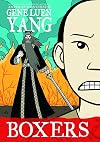
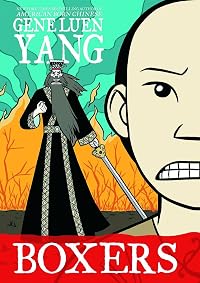
In China in 1898 bands of foreign missionaries and soldiers roam the countryside, bullying and robbing Chinese peasants. Little Bao has had enough: harnessing the powers of ancient Chinese gods, he recruits an army of Boxers--commoners trained in kung fu who fight to free China from "foreign devils."Tags
Recommendations


Member Reviews
Chinese history is not the most popular subject in the Western world - most people might have heard of the Boxer rebellion from the end of the 19th century/beginning of the 20th but without too many details. Gene Luen Yang chooses the graphic novel format to tell the story of the rebellion - or it is probably better to tell two stories from the rebellion.
In the first volume of the two interlinked stories, the main protagonist is Little Bao, a Chinese boy that loves Chinese opera and as any other boy his age, loves to dream about what he sees. The life in a Chinese village at the end of the 19th century is hard and the nature throwing floods their way does not help much. This is the time when Christianity start taking root into China, show more replacing the old gods of the Chinese. The conflict is just starting and as it usual, the missionaries are way too busy showing the new way to have any respect for the old ways - they smash the old idols, they mock and ridicule the old ways and that does not sit very well with the Chinese population. Which is why the Boxer rebellion come to be at the end - it is an honest attempt of the poor villagers to try to expel the foreigners and the Chinese that listen to them - because they believe that all bad that is happening is because of them and their actions.
And in our story, Little Bao ends up being the reluctant leader of the kung fu trained men - with the help of old world magic and the old gods - changing into one of them, teaching people how to change into them - they all march on Peking. And in between, the author manages to sneak in some old Chinese legends - about heroes and gods in the old days. Knowing how the rebellion ends, you kinda know how it all will end - but it is as always the journey to it that is interesting. It is violent, bloody and miserable. And it is not only the men - the women also join in (they actually save the men's lives before anyone take them seriously but that is just usual for the time...) and the rebellion grow day after day - both in numbers and in cruelty. Christians are bad, they need to die - no matter that they are also people or women or children. Bao turns from someone that cares about people to someone that is ready to shut his internal voices and listen to the old Gods and order atrocities. And even if the art shows the old gods alive, it is up to the reader to decide how much of it is everyone's mind and hope and how much is real.
In a way, the journey of Bao from oppressed to oppressor is the center of the story. The story taps nicely into the folklore of the Chinese people to bring the old Gods to life - literally in that novel - in an attempt to turn the time back. Which as we all know is a futile endeavor. Bookmarking his journey are the two times he sees Vibiana - once whey both are innocent children and then again when they end up on the opposite sides of the rebellion. The misunderstanding of other is what brings the conflict - from both sides - if the Christian missionaries had respected the old believes, things would not have escalated. It's a novel about accepting the differences in other people, about the clash of religions and about tolerance. And about history and the choice between the past and the present that decides what the future will be.
And at the end of the book, the fate of Bao is never shown - you are left to guess. show less
In the first volume of the two interlinked stories, the main protagonist is Little Bao, a Chinese boy that loves Chinese opera and as any other boy his age, loves to dream about what he sees. The life in a Chinese village at the end of the 19th century is hard and the nature throwing floods their way does not help much. This is the time when Christianity start taking root into China, show more replacing the old gods of the Chinese. The conflict is just starting and as it usual, the missionaries are way too busy showing the new way to have any respect for the old ways - they smash the old idols, they mock and ridicule the old ways and that does not sit very well with the Chinese population. Which is why the Boxer rebellion come to be at the end - it is an honest attempt of the poor villagers to try to expel the foreigners and the Chinese that listen to them - because they believe that all bad that is happening is because of them and their actions.
And in our story, Little Bao ends up being the reluctant leader of the kung fu trained men - with the help of old world magic and the old gods - changing into one of them, teaching people how to change into them - they all march on Peking. And in between, the author manages to sneak in some old Chinese legends - about heroes and gods in the old days. Knowing how the rebellion ends, you kinda know how it all will end - but it is as always the journey to it that is interesting. It is violent, bloody and miserable. And it is not only the men - the women also join in (they actually save the men's lives before anyone take them seriously but that is just usual for the time...) and the rebellion grow day after day - both in numbers and in cruelty. Christians are bad, they need to die - no matter that they are also people or women or children. Bao turns from someone that cares about people to someone that is ready to shut his internal voices and listen to the old Gods and order atrocities. And even if the art shows the old gods alive, it is up to the reader to decide how much of it is everyone's mind and hope and how much is real.
In a way, the journey of Bao from oppressed to oppressor is the center of the story. The story taps nicely into the folklore of the Chinese people to bring the old Gods to life - literally in that novel - in an attempt to turn the time back. Which as we all know is a futile endeavor. Bookmarking his journey are the two times he sees Vibiana - once whey both are innocent children and then again when they end up on the opposite sides of the rebellion. The misunderstanding of other is what brings the conflict - from both sides - if the Christian missionaries had respected the old believes, things would not have escalated. It's a novel about accepting the differences in other people, about the clash of religions and about tolerance. And about history and the choice between the past and the present that decides what the future will be.
And at the end of the book, the fate of Bao is never shown - you are left to guess. show less
(I can't possibly review these books separately, so I am just going to copy/paste this review into both.)
Listen, did I know ANYTHING about the Boxer Rebellion before reading these books? I probably could have told you that it was in China and MAYBE that it had something to do with opium, but that's it. Now, these books aren't a history, exactly, but are the stories of two young people (each getting their own volume) caught up in the forces surrounding the conflict.
While this doesn't attempt to tell the whole story of the rebellion, these two quick reads tell compelling stories filled with context that makes the issues feel immediate, graspable, and definitely relatable. These books should be taught in schools.
The white European show more entitlement/compulsion to both spread Christianity and make money is one of the familiar and tragic roots here. There is so much to rave about in both the art and the story-telling that I don't know where or how to start. I loved both of these volumes with a fierceness, and will definitely be urging both of my children to read them. show less
Listen, did I know ANYTHING about the Boxer Rebellion before reading these books? I probably could have told you that it was in China and MAYBE that it had something to do with opium, but that's it. Now, these books aren't a history, exactly, but are the stories of two young people (each getting their own volume) caught up in the forces surrounding the conflict.
While this doesn't attempt to tell the whole story of the rebellion, these two quick reads tell compelling stories filled with context that makes the issues feel immediate, graspable, and definitely relatable. These books should be taught in schools.
The white European show more entitlement/compulsion to both spread Christianity and make money is one of the familiar and tragic roots here. There is so much to rave about in both the art and the story-telling that I don't know where or how to start. I loved both of these volumes with a fierceness, and will definitely be urging both of my children to read them. show less
Gene Luen Yang’s Boxers, the first volume of his Boxers & Saints, tells the story of Little Bao from Shan-tung at the end of the 19th century and beginning of th 20th. He sees missionaries from Europe disrespect his people’s ways, destroying their local god and encouraging them to adopt Christianity with the threat of violence. Having grown up on operas about his people’s history and legends, Bao loved his culture and viewed the local god as a familiar, comforting presence. Feeling adrift and lost following floods, Bao learns kung-fu from a traveling merchant and channels his energy to help others. He begins to lead a movement across the country against Europeans and missionaries, initially sparing local Chinese that had converted show more to the new religion. With time, Bao and his followers become more fanatical and kill even those who follow the missionaries’ teachings, eventually burning down Hanlin Academy library in order to clear a path to the foreigners’ compound. Yang uses magical realism to show how the Boxer Rebellion was a clash between belief systems and how easily a movement can become subject to its most extreme members. He similarly demonstrates the plurality of Chinese culture at the time through the Kansu Braves, a Chinese Muslim group that was loyal to the Qing. Boxers is a great introduction to the topic for newcomers and Yang includes a guide to further reading in the back. show less
WELL HOLY HELL WAS THAT DARKER THAN I ANTICIPATED. My god. Full review to come, but jeez I need a breather.
Recommended:
Unexpectedly, yes. At the start I thought maybe for younger grades, now I'm thinking late middle or later. For a look at a history unknown in American public schools, for the whiplash turns of laughing to stunned silent darkness.
Thoughts:
Well. I certainly learned a bit of history. I laughed, particularly at our little lady being vaguely insulted at being told she had a face like an opera mask. Then abruptly my laughter ended at the conclusion of that interaction. Holy hell.
This story gets you, because you think it won't take such dark turns. At least, *I* didn't. I kept waiting to see the moments that Clarissa said she show more had to put the book down for a bit due to. Well, I found them.
The art style is lovely, I liked the simplicity that still gave such detail and life to the world and characters. The vibrant colors of the gods and fighting contrasted with the muted sepia colors of their daily lives through the villages. Story-wise, loved it. It ramped up pretty quickly, and felt like little Bao grew up exponentially faster as the story progressed. show less
Recommended:
Unexpectedly, yes. At the start I thought maybe for younger grades, now I'm thinking late middle or later. For a look at a history unknown in American public schools, for the whiplash turns of laughing to stunned silent darkness.
Thoughts:
Well. I certainly learned a bit of history. I laughed, particularly at our little lady being vaguely insulted at being told she had a face like an opera mask. Then abruptly my laughter ended at the conclusion of that interaction. Holy hell.
This story gets you, because you think it won't take such dark turns. At least, *I* didn't. I kept waiting to see the moments that Clarissa said she show more had to put the book down for a bit due to. Well, I found them.
The art style is lovely, I liked the simplicity that still gave such detail and life to the world and characters. The vibrant colors of the gods and fighting contrasted with the muted sepia colors of their daily lives through the villages. Story-wise, loved it. It ramped up pretty quickly, and felt like little Bao grew up exponentially faster as the story progressed. show less
Everybody says these books are incredible, and everybody is right. I read Saints first, which might have been "wrong" -- Boxers is a more complete story. I want to re-read Saints to see all the places where the stories link up. But I'm sure I'd want to do that with Boxers if I'd read it first, too. Required reading for anyone thinking about colonialism, Chinese or British history, or war in general. With historical scaffolding, it would work for 7th grade all the way through high school. (That is my one criticism, in fact -- I wish there were a historical note briefly explaining a bird's-eye view of the events. If you're reading it as part of a class in which you've studied the Boxer Rebellion, wonderful. Otherwise I imagine it would be show more confusing.) show less
BOXERS provides a much fuller picture of the events in China in the late 1800s-early 1900s. Little Bao and the others learn kung-fu from Red Lantern, and Bao, the youngest of his brothers, becomes the leader of the Society of the Righteous and Harmonious Fist, with a mission of freeing China from "foreign devils." When they fight, all of the Brother-Disciples take the form of Chinese gods depicted in opera; Bao's form is not a god, but the first Emperor of China.
Bao believes in his mission wholeheartedly - in a way that Vibiana, in SAINTS, never quite believes in the precepts of Christianity - but encounters moments of doubt when he is not sure who to trust or who is right. One of the Edicts is to have compassion for the weak, but the show more first emperor of China tells Bao that to show mercy is a mistake.
The two books together, BOXERS and SAINTS, show how easily a conflict escalates when neither side tries to understand, communicate, or compromise with the other. Every action becomes a reaction, revenge for hurt inflicted.
Quotes
"Good people, you're all free now. The foreign devils are all dead. Go home in peace. [...] What's wrong with you all?! Go home!"
"Bao...they're Christians. The foreign devils weren't kidnapping them, they were helping them escape. From us." [Moment of realization.] (188)
[No text, three panels; third panel depicts Christians kneeling, Brother-Disciple and Imperial soldier about to execute them] (294)
"You have to understand, Mei-wen-- I did it for China."
"For China?! What is China but a people and their stories?" (312) show less
Bao believes in his mission wholeheartedly - in a way that Vibiana, in SAINTS, never quite believes in the precepts of Christianity - but encounters moments of doubt when he is not sure who to trust or who is right. One of the Edicts is to have compassion for the weak, but the show more first emperor of China tells Bao that to show mercy is a mistake.
The two books together, BOXERS and SAINTS, show how easily a conflict escalates when neither side tries to understand, communicate, or compromise with the other. Every action becomes a reaction, revenge for hurt inflicted.
Quotes
"Good people, you're all free now. The foreign devils are all dead. Go home in peace. [...] What's wrong with you all?! Go home!"
"Bao...they're Christians. The foreign devils weren't kidnapping them, they were helping them escape. From us." [Moment of realization.] (188)
[No text, three panels; third panel depicts Christians kneeling, Brother-Disciple and Imperial soldier about to execute them] (294)
"You have to understand, Mei-wen-- I did it for China."
"For China?! What is China but a people and their stories?" (312) show less
Summary: Boxers and Saints are two complimentary books that each tell the tale of a young person on one side of the Boxer Rebellion in China.
In Boxers, in 1898, the Chinese countryside is terrorized by foreign devils and their soldiers who are raiding villages, destroying shrines, and killing peasants. After this has happened in Little Bao's village, he begins to train with a kung-fu master, Red Lantern, and so do several of the other young men. They learn the secrets of summoning the power of the ancient Chinese gods when they fight, and form the Society of the Righteous and Harmonious Fist, dedicated to wiping out the foreign devils to protect the Chinese people from their depredations and influence.
Review: This is really show more embarrassing, but before reading these books, the only thing I knew about the Boxer Rebellion was that it was when Spike had killed his first Slayer on Buffy. (In hindsight, my "World History" classes back in high school were really much more European history.) But even though Yang's version has a number of mythic/supernatural/fantasy elements to it, I think it gives a quite clear picture of what the conflict was about, and how it played out, in a way that's more complex and nuanced than you might ordinarily expect from a YA graphic novel. As you're reading each book, you first come to the conclusion that its protagonists are clearly in the right, and that they're being unfairly persecuted… but the lengths that each side is willing to go to in order to do what they think is right makes you less and less sure. Ultimately, we're left feeling like neither side is entirely in the right or in the wrong, but both wind up being changed by their violence, and both ultimately wind up a high cost - no happy endings here. It does wind up feeling very balanced, with no taking of sides - not something I'm used to encountering in my history/war stories.
The two stories are relatively independent but intertwined - Little Bao and Vibiana (from Saints) encounter one another briefly in childhood, and then again as adults in the thick of the rebellion - but they really need to be read together in order to get the whole perspective and the whole story. I don't know if there's an official recommended order, but I read Boxers (which is substantially longer) first and Saints second, which worked out well - I think knowing who Little Bao is and what he's doing with the Boxers is more important for understanding Vibiana's story than the reverse. I also liked Boxers's story a bit better, although this likely because it was a longer book, so it was more developed, and there was more action, and essentially more plot to Bao's story than to Vibiana's. I also thought the supernatural elements were better integrated in Boxers than in Saints - it made more sense to me that Bao would be summoning ancient Chinese gods than that Vibiana would be seeing Joan of Arc. But taken together, these books are present an interesting, engaging read that brings up a lot of interesting ethical questions about the nature and cost of war. 4 out of 5 stars.
Recommendation: They're pretty violent, so maybe not for younger kids, but I think these books are a really worthwhile read for anyone who wants to learn more about the Boxer Rebellion, or who is interested in a balanced perspective on what war and peace really costs a country and an individual. show less
In Boxers, in 1898, the Chinese countryside is terrorized by foreign devils and their soldiers who are raiding villages, destroying shrines, and killing peasants. After this has happened in Little Bao's village, he begins to train with a kung-fu master, Red Lantern, and so do several of the other young men. They learn the secrets of summoning the power of the ancient Chinese gods when they fight, and form the Society of the Righteous and Harmonious Fist, dedicated to wiping out the foreign devils to protect the Chinese people from their depredations and influence.
Review: This is really show more embarrassing, but before reading these books, the only thing I knew about the Boxer Rebellion was that it was when Spike had killed his first Slayer on Buffy. (In hindsight, my "World History" classes back in high school were really much more European history.) But even though Yang's version has a number of mythic/supernatural/fantasy elements to it, I think it gives a quite clear picture of what the conflict was about, and how it played out, in a way that's more complex and nuanced than you might ordinarily expect from a YA graphic novel. As you're reading each book, you first come to the conclusion that its protagonists are clearly in the right, and that they're being unfairly persecuted… but the lengths that each side is willing to go to in order to do what they think is right makes you less and less sure. Ultimately, we're left feeling like neither side is entirely in the right or in the wrong, but both wind up being changed by their violence, and both ultimately wind up a high cost - no happy endings here. It does wind up feeling very balanced, with no taking of sides - not something I'm used to encountering in my history/war stories.
The two stories are relatively independent but intertwined - Little Bao and Vibiana (from Saints) encounter one another briefly in childhood, and then again as adults in the thick of the rebellion - but they really need to be read together in order to get the whole perspective and the whole story. I don't know if there's an official recommended order, but I read Boxers (which is substantially longer) first and Saints second, which worked out well - I think knowing who Little Bao is and what he's doing with the Boxers is more important for understanding Vibiana's story than the reverse. I also liked Boxers's story a bit better, although this likely because it was a longer book, so it was more developed, and there was more action, and essentially more plot to Bao's story than to Vibiana's. I also thought the supernatural elements were better integrated in Boxers than in Saints - it made more sense to me that Bao would be summoning ancient Chinese gods than that Vibiana would be seeing Joan of Arc. But taken together, these books are present an interesting, engaging read that brings up a lot of interesting ethical questions about the nature and cost of war. 4 out of 5 stars.
Recommendation: They're pretty violent, so maybe not for younger kids, but I think these books are a really worthwhile read for anyone who wants to learn more about the Boxer Rebellion, or who is interested in a balanced perspective on what war and peace really costs a country and an individual. show less
Members
- Recently Added By
Lists

Books Read in 2014
2,344 works; 89 members

Books Read in 2016
4,666 works; 199 members
Books Read in 2015
3,299 works; 126 members

Books Read in 2023
5,638 works; 147 members
Author Information

182+ Works 22,065 Members
Gene Luen Yang was born on August 9, 1973 in California. He graduated from the University of California, Berkeley, where he majored in computer science and minored in creative writing. After graduating in 1995, he worked as a computer engineer for two years. He decided that he was meant to teach and left his job as an engineer to teach computer show more science at Bishop O'Dowd High School in Oakland, California. He is a writer of graphic novels and comics. His first published comic, Gordon Yamamoto and the King of the Geeks, was published in 1997 and won the Xeric Grant, a self-publishing grant for comic book creators. His other works include Loyola Chin and the San Peligran Order and Avatar: The Last Airbender. He won the Michael L. Printz Award in 2006 for American Born Chinese and the Eisner Award for best short story in 2009 for Eternal Smile. (Bowker Author Biography) show less
All Editions
Some Editions
Awards and Honors
Awards
Distinctions
Notable Lists
Series

Work Relationships
Is contained in
Common Knowledge
- Canonical title
- Boxers
- Original publication date
- 2013-09-10
- People/Characters
- Lee Bao; Four-Girl/Vibiana; Red Lantern Chu; Mei-wen; Father Bey
- Important places
- Shandong Province, China; China
- Important events
- Boxer Rebellion (1899-08 | 1901-09)
- Dedication
- Dedicated to the Original Art Night Crew
- First words
- Spring is my favorite time of year.
- Last words
- (Click to show. Warning: May contain spoilers.)The Gods of the Opera are fleeing.
- Blurbers
- Eggers, Dave; Schmidt, Gary
- Original language
- English
Classifications
- Genres
- Graphic Novels & Comics, Teen, Fiction and Literature
- DDC/MDS
- 741.5 — Arts & recreation Drawing & decorative arts Drawing Comic books, graphic novels, fotonovelas, cartoons, caricatures, comic strips
- LCC
- PZ7.7 .Y35 .B — Language and Literature Fiction and juvenile belles lettres Fiction and juvenile belles lettres Juvenile belles lettres
- BISAC
Statistics
- Members
- 890
- Popularity
- 30,496
- Reviews
- 53
- Rating
- (4.01)
- Languages
- English, Turkish
- Media
- Paper, Ebook
- ISBNs
- 7
- ASINs
- 2