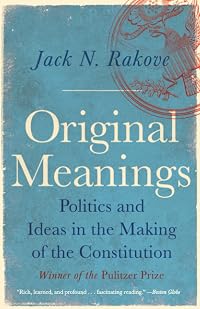
Original Meanings: Politics and Ideas in the Making of the Constitution
by Jack N. Rakove
On This Page
Description
"The most thoughtful and careful scholarly analysis to date of the extent to which the framers should control our contemporary understanding of the Constitution.". HTML:From abortion to same-sex marriage, today's most urgent political debates will hinge on this two-part question: What did the United States Constitution originally mean and who now understands its meaning best? Rakove chronicles the Constitution from inception to ratification and, in doing so, traces its complex weave of show more ideology and interest, showing how this document has meant different things at different times to different groups of Americans.
From the Trade Paperback edition.
. show less
Tags
Recommendations






Member Reviews
This is not a thrilling book. It is dense, dry, and curiously devoid of color. But it has many lessons for right now. Just as Europe is arguing in disunity, so the states saddled themselves with the essentially impossible task of unanimity to enable a constitution. And with Rhode Island not even bothering to show up for negotiations, ratification was very iffy, much like Britain vetoing banking talks today. That and the insistence by southern states on slavery added a layer of compromise and hypocrisy that stained the process.
But the chief American preoccupation today is with Originalism - trying to enforce today what we think the framers and voters accepted in 1787. But to quote one of the more prominent of the framers, Thomas show more Jefferson, that is a fool's errand:
"Some men look at constitutions with sanctimonious reverence, and deem them like the ark of the covenant, too sacred to be touched. They ascribe to the men of the preceding age a wisdom more than human, and suppose what they did to be beyond amendment."
Jefferson would scoff at The Tea Party. show less
But the chief American preoccupation today is with Originalism - trying to enforce today what we think the framers and voters accepted in 1787. But to quote one of the more prominent of the framers, Thomas show more Jefferson, that is a fool's errand:
"Some men look at constitutions with sanctimonious reverence, and deem them like the ark of the covenant, too sacred to be touched. They ascribe to the men of the preceding age a wisdom more than human, and suppose what they did to be beyond amendment."
Jefferson would scoff at The Tea Party. show less
Advertised as a historical review of what the writers of the Constitution may have understood it to mean, arguing that they may have understood it in a variety of ways based on past political experience. Probably intended as a rebuke to modern conservative "originalist" judicial philosophy. Actually, well over half the book is a very conventional account of the writing and ratifying of the Constitution, with very little discussion of how specific parts of the Constitution were understand at the time. Only the last chapters on "Rights"" (about the debates leading to the Bill of Rights) and on Madison's attempts to use originalism in later political struggles against his former Federalist allies really address the supposed focus of the show more book, and even those portions only refer to fairly narrow issues. show less
From: Our Founders: How Did They Do It?
http://wp.me/p14mpp-bI
Original Meanings: Politics and Ideas in the Making of the Constitution, Jack N. Rakove (1996).
The cover of the book boldly declares that this history is: “A deeply satisfying account of the political world from which the United States Constitution issued.”—The New York Times Book Review. I won't argue with that assessment.
“We hold these truths to be self-evident”—this remarkable assertion begins the Declaration of Independence as written by the founders of the country in 1776 after considerable heated debate and 11th hour compromises on wording. Some few years later, in 1789, the framers of the constitution began an extended and bitter debate that at times show more approached or exceeded the limits of polite argument. The goal, to write the U. S. Constitution for ratification by the people.
How did the framers manage to overcome their differences and compromise to create our constitution? I’m amazed that they could make any headway at all, but they did; and according to Rakove’s analysis the key was disciplined, open argument and, ultimately, compromise.
In the lexicon of American politics, writes Rakove, few words evoke as ambivalent a response as compromise. Compromise means fairness to some and moral failure and defeat to others. Rakove adds: “[Compromise] suggests a preference for consensus over confrontation, a willingness to meet opponents halfway rather than strive for ideological purity. … Compromise, in all its ambivalence, is a staple theme of most narrative accounts of the Federal Convention of 1787, and with good reason. In the end, the framers granted concessions to every interest that had a voice in Philadelphia, …”
I like this book, it is hard reading at times, but the research is accurate and detailed—the reader, of course, can agree or disagree with Professor Rakove’s opinions.
Carto
### show less
http://wp.me/p14mpp-bI
Original Meanings: Politics and Ideas in the Making of the Constitution, Jack N. Rakove (1996).
The cover of the book boldly declares that this history is: “A deeply satisfying account of the political world from which the United States Constitution issued.”—The New York Times Book Review. I won't argue with that assessment.
“We hold these truths to be self-evident”—this remarkable assertion begins the Declaration of Independence as written by the founders of the country in 1776 after considerable heated debate and 11th hour compromises on wording. Some few years later, in 1789, the framers of the constitution began an extended and bitter debate that at times show more approached or exceeded the limits of polite argument. The goal, to write the U. S. Constitution for ratification by the people.
How did the framers manage to overcome their differences and compromise to create our constitution? I’m amazed that they could make any headway at all, but they did; and according to Rakove’s analysis the key was disciplined, open argument and, ultimately, compromise.
In the lexicon of American politics, writes Rakove, few words evoke as ambivalent a response as compromise. Compromise means fairness to some and moral failure and defeat to others. Rakove adds: “[Compromise] suggests a preference for consensus over confrontation, a willingness to meet opponents halfway rather than strive for ideological purity. … Compromise, in all its ambivalence, is a staple theme of most narrative accounts of the Federal Convention of 1787, and with good reason. In the end, the framers granted concessions to every interest that had a voice in Philadelphia, …”
I like this book, it is hard reading at times, but the research is accurate and detailed—the reader, of course, can agree or disagree with Professor Rakove’s opinions.
Carto
### show less
2987 Original Meanings: Politics and Ideas in the Making of the Constitution, by Jack N. Rakove (read 7 Jun 1997) (Pulitzer History prize in 1997) This book I did not find a joy to read. It is erudite and awfully balanced and delves into the matter of ideas and concepts involved in the working of the 1787 constitutional convention more detailedly than I found I was interested in. So I cannot say I got as much out of reading this splendidly carefully written book as I should have. It is more intellectual in its approach to the questions it discusses so carefully than I found interesting. He shows that a blind adherence to the drafters' intent in writing the Constitution leaves something to be desired. The experience of working with and show more living under the Constitution must be considered in resolving constitutional questions. show less
Ratings
Members
- Recently Added By
Lists

LT picks: Blue Books
197 works; 39 members
Author Information

19+ Works 2,618 Members
Jack Rakove is the William Robertson Coe Professor of History and American Studies and a professor of political science at Stanford University. He is the author of, among other books, Original Meanings: Politics and Ideas in the Making of the Constitution, which won the Pulitzer Prize in 1997.
Some Editions
Awards and Honors
Work Relationships
Is contained in
Common Knowledge
- Original title
- Original Meanings: Politics and Ideas in the Making of the Constitution
- Original publication date
- 1996
- Important places
- USA; Constitutional Convention of 1787
- Important events
- Ratification of the Constitution ; Constitutional Convention (1787)
- Quotations
- Chapter VI Debating the Constitution: "It has been frequently remarked," Alexander Hamilton observed in the opening paragraph of The Federalist, "that it seems to have been reserved to the people of this country, by their co... (show all)nduct and example, to decide the important question, whether societies of men are really capable or not of establishing good government from reflection and choice, or whether they are forever destined to depend for their political constitutions on accident and force." p 131
- Canonical DDC/MDS
- 342.73029
- Canonical LCC
- KF4541
Classifications
- Genres
- Politics and Government, History, Nonfiction, General Nonfiction
- DDC/MDS
- 342.73029 — Society, government, & culture Law U.S. Constitution - Bill of Rights, Amendments North America Constitutional law--United States Basic instruments of Government, the US constitution Constitutional history
- LCC
- KF4541 — Law Law of the United States Law of the United States (Federal) Constitutional law Constitutional history of the United States
- BISAC
Statistics
- Members
- 776
- Popularity
- 36,269
- Reviews
- 5
- Rating
- (3.77)
- Languages
- English
- Media
- Paper, Audiobook, Ebook
- ISBNs
- 11
- ASINs
- 8