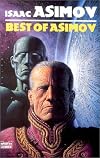
The Best of Isaac Asimov
by Isaac Asimov
On This Page
Description
Twelve stories by the modern master of science fiction represent the evolution of his writing over a period of thirty-three yearsTags
Recommendations













Member Reviews
A fine paperback collection of Asimov's best science fiction short stories, selected by Asimov himself in 1973. A decent bibliography of Asimov tacked on at the end, too. I got the book for his 1956 story "The Dead Past" which involves historians trying to use a chronoscope (or chronovisor) to view the past. The dream of every historian, I think. "Nightfall" and "The Last Question" are great stories, and well worth the few bucks I paid for the book (I had to go to several Half Price Books stores in the Metroplex before I found it). "C-Chute" was decent, so too "The Billiard Ball." "Mirror Image," a late piece from 1972, shows off Asimov's Holmesian pastichery.
3.5 stars overall
3 ⭐ Marooned off Vesta
But not for long...but that inching across the sides of the broken spaceship was scary. I felt some vertigo while reading it.
2 ⭐ Nightfall
This is about a planet with 6 suns. All of the suns have set but one, and that one is about to be covered by an eclipse. The planet has a history of its civilization expanding until, every 2K years, this happens again, then the whole planet goes mad at the sight of millions of stars in their sky, and their civilization falls again.
I can only guess at the purpose of the story: to make fun of humans and their dangerous ignorance?
2 ⭐ C Chute
A ship on its way back to Earth from Arcturus is attacked by a Kloros ship and captured. The crew is killed and a group show more of passengers is held prisoner. They all hate each other, but eventually pull together when one of them volunteers to go out the "C Chute" (where corpses are buried at space) in order to attempt to re-enter the ship from the steam chutes. The best part is the description of what it's like to walk on the outer skin of the ship.
2 ⭐ The Martian Way
The humans living on Mars are dependent on earth for their water and food. Space ships use water for their propulsion. Riled up by a politician, taxpayers on Earth are angry about the amount of water given up to Mars and its spaceships. They want to cut them off, but first earth places a limit on the amount of water that Mars can take. So one young Martian comes up with a way to get their own water.
3 ⭐ The Deep
On a planet where it's sun is dying, the residents have been living beneath the surface. but now the planet itself is dying and the cold is setting in. They must find another place to live. This species has telepathy. They developed a manner to reach across the vast distances and connect minds. With a special receiver that they have constructed, this receiver will allow the minds of all the species remaining to transfer to the new planet, once initial contact is made.
The first contact is with the mind of an infant, traveling on an airplane, with its mother. the man projecting his mind into the infant is astonished to find that his host species have no connection of their minds. Moreover, this species knows who its mother and father is. he relates this to his Superior upon return.
" 'well,' said Gan, 'without mental contact, they probably have no real conception of society and subrelationships may build up. Or was this one pathological?'
'no, no. It's universal. The female in charge was the infant's mother.'
'impossible. It's own mother?'
'of necessity. The infant had passed the first part of its existence inside its mother. Physically inside. The creature's eggs remain within the body. They are inseminated within the body. They grow within the body and emerge alive.'
'great caverns,' Gan said weakly. Distaste was strong within him. 'each creature would know the identity of its own child. Each child would have a particular father - ' " show less
3 ⭐ Marooned off Vesta
But not for long...but that inching across the sides of the broken spaceship was scary. I felt some vertigo while reading it.
2 ⭐ Nightfall
This is about a planet with 6 suns. All of the suns have set but one, and that one is about to be covered by an eclipse. The planet has a history of its civilization expanding until, every 2K years, this happens again, then the whole planet goes mad at the sight of millions of stars in their sky, and their civilization falls again.
I can only guess at the purpose of the story: to make fun of humans and their dangerous ignorance?
2 ⭐ C Chute
A ship on its way back to Earth from Arcturus is attacked by a Kloros ship and captured. The crew is killed and a group show more of passengers is held prisoner. They all hate each other, but eventually pull together when one of them volunteers to go out the "C Chute" (where corpses are buried at space) in order to attempt to re-enter the ship from the steam chutes. The best part is the description of what it's like to walk on the outer skin of the ship.
2 ⭐ The Martian Way
The humans living on Mars are dependent on earth for their water and food. Space ships use water for their propulsion. Riled up by a politician, taxpayers on Earth are angry about the amount of water given up to Mars and its spaceships. They want to cut them off, but first earth places a limit on the amount of water that Mars can take. So one young Martian comes up with a way to get their own water.
3 ⭐ The Deep
On a planet where it's sun is dying, the residents have been living beneath the surface. but now the planet itself is dying and the cold is setting in. They must find another place to live. This species has telepathy. They developed a manner to reach across the vast distances and connect minds. With a special receiver that they have constructed, this receiver will allow the minds of all the species remaining to transfer to the new planet, once initial contact is made.
The first contact is with the mind of an infant, traveling on an airplane, with its mother. the man projecting his mind into the infant is astonished to find that his host species have no connection of their minds. Moreover, this species knows who its mother and father is. he relates this to his Superior upon return.
" 'well,' said Gan, 'without mental contact, they probably have no real conception of society and subrelationships may build up. Or was this one pathological?'
'no, no. It's universal. The female in charge was the infant's mother.'
'impossible. It's own mother?'
'of necessity. The infant had passed the first part of its existence inside its mother. Physically inside. The creature's eggs remain within the body. They are inseminated within the body. They grow within the body and emerge alive.'
'great caverns,' Gan said weakly. Distaste was strong within him. 'each creature would know the identity of its own child. Each child would have a particular father - ' " show less
A selection of Asimov's short stories, by Asimov himself. What else can be said? This version has notes by the author that further explain the context in which the stories were written. I highly recommend first reading one story and then reading that story's notes to better understand Asimov's ideas and context when writing.
Of course, it includes "The Last Question" which is by and large a favourite among sci-fi fans around the world. Read it and figure out why, you won't be disappointed.
Of course, it includes "The Last Question" which is by and large a favourite among sci-fi fans around the world. Read it and figure out why, you won't be disappointed.
A good Asimov collection, but not one of my favorites.
some of the all-time classics are in this collection
Ratings
Members
- Recently Added By
Author Information

2,403+ Works 292,269 Members
Isaac Asimov was born in Petrovichi, Russia, on January 2, 1920. His family emigrated to the United States in 1923 and settled in Brooklyn, New York, where they owned and operated a candy store. Asimov became a naturalized U.S. citizen at the age of eight. As a youngster he discovered his talent for writing, producing his first original fiction at show more the age of eleven. He went on to become one of the world's most prolific writers, publishing nearly 500 books in his lifetime. Asimov was not only a writer; he also was a biochemist and an educator. He studied chemistry at Columbia University, earning a B.S., M.A. and Ph.D. In 1951, Asimov accepted a position as an instructor of biochemistry at Boston University's School of Medicine even though he had no practical experience in the field. His exceptional intelligence enabled him to master new systems rapidly, and he soon became a successful and distinguished professor at Columbia and even co-authored a biochemistry textbook within a few years. Asimov won numerous awards and honors for his books and stories, and he is considered to be a leading writer of the Golden Age of science fiction. While he did not invent science fiction, he helped to legitimize it by adding the narrative structure that had been missing from the traditional science fiction books of the period. He also introduced several innovative concepts, including the thematic concern for technological progress and its impact on humanity. Asimov is probably best known for his Foundation series, which includes Foundation, Foundation and Empire, and Second Foundation. In 1966, this trilogy won the Hugo award for best all-time science fiction series. In 1983, Asimov wrote an additional Foundation novel, Foundation's Edge, which won the Hugo for best novel of that year. Asimov also wrote a series of robot books that included I, Robot, and eventually he tied the two series together. He won three additional Hugos, including one awarded posthumously for the best non-fiction book of 1995, I. Asimov. "Nightfall" was chosen the best science fiction story of all time by the Science Fiction Writers of America. In 1979, Asimov wrote his autobiography, In Memory Yet Green. He continued writing until just a few years before his death from heart and kidney failure on April 6, 1992. (Bowker Author Biography) show less
All Editions
Some Editions
Series
Belongs to Publisher Series
Bastei Science Fiction-Special (24113)
Work Relationships
Contains
Common Knowledge
- Canonical title
- The Best of Isaac Asimov
- Original title
- The Best of Isaac Asimov
- Original publication date
- 1974
- Blurbers*
- Platt, Charles
- Original language*
- Englisch
*Some information comes from Common Knowledge in other languages. Click "Edit" for more information.
Classifications
Statistics
- Members
- 600
- Popularity
- 48,549
- Reviews
- 6
- Rating
- (3.96)
- Languages
- English, German, Italian, Russian
- Media
- Paper, Audiobook
- ISBNs
- 13
- ASINs
- 11