On This Page
Description
Fresh noir from one of the most intense, congested, and overpopulated cities in the world.Tags
Recommendations





Member Reviews
I don’t read a lot of short stories. I usually go for the meatier fare of a novel. But a good short story can be like a good chocolate – a lot of excellent flavor packed into a small bite. The stories in Manila Noir are more savory treats. Best read one or two at a time. They explore the shadowy side of a difficult society. More descriptive of a country I’ve never seen than any travel guide. After the first story, Lysley Tenorio’s Aviary, I put the book aside for a few days just to come back and appreciate it over again. The authors – Tenorio, Jessica Hagedorn, Sabina Murray, Jonas Vitman, Gina Apostol, among others – are not familiar to me but I look forward to exploring their talents further.
 This review was written for LibraryThing Early Reviewers.
Noir is defined as "Of or relating to a genre of crime literature featuring tough, cynical characters and bleak settings; Suggestive of danger or violence." Well, these are that. Not so much bleak as bland, however, and in my opinion classing them as "noir" elevates them to a plane they do not deserve to occupy. For the most part, I found these stories uninspired, pointless and instantly forgettable. With a few exceptions, they suffer from a lack of contrast or subtlety. The evil and violence exist in a world without the hint of an alternative, and therefore lose their impact. The collection does include one graphic piece, a horror komic, featuring Alexandra Trese, a character from a popular Phillipine detective series, which may be show more brilliant for all I know. I am not a visual reader, and graphic fiction leaves me cold. The editor says in her introduction that "All the fabulous and fearless writers gathered here have a deep connection and abiding love for this crazy-making, intoxicating city. There's nothing like it in the world, and they know it." Unfortunately, for this reader who has no other experience of Manila, they have failed to convey any unique atmosphere or sense of place. show less
This review was written for LibraryThing Early Reviewers.Aside from sharing the setting of Manila and the genre of crime, the stories in Manila Noir, edited by Jessica Hagedorn, have similar elements. Drug violence, abuse of women, corruption, pollution and the despoiling of Manila, transvestites, and the ubiquity of jobs in call-centers for those who can sound vaguely American are all well-represented.
The best stories play on class warfare. In “Aviary,” poor but not subjugated kids rebel against rich materialistic society as the dichotomy between want and wealth is rammed homed without any subtlety. In “A Human Right,” a woman gives her own life while helping abused women regain theirs by escaping their abusers. ”Thirteen Stations,” a well-done and supremely creepy graphic story, show more is an anti-corruption and ghost tale.
Another element shared by several of the stories is that they are somewhat disjointed, like scenes from television shows or movies, rather than fully realized short stories. This doesn’t really contribute to the noir atmosphere, it just makes them harder to follow.
Overall, Manila Noir is a gripping sample of crime fiction with an intriguing locale. show less
The best stories play on class warfare. In “Aviary,” poor but not subjugated kids rebel against rich materialistic society as the dichotomy between want and wealth is rammed homed without any subtlety. In “A Human Right,” a woman gives her own life while helping abused women regain theirs by escaping their abusers. ”Thirteen Stations,” a well-done and supremely creepy graphic story, show more is an anti-corruption and ghost tale.
Another element shared by several of the stories is that they are somewhat disjointed, like scenes from television shows or movies, rather than fully realized short stories. This doesn’t really contribute to the noir atmosphere, it just makes them harder to follow.
Overall, Manila Noir is a gripping sample of crime fiction with an intriguing locale. show less
This review was written for LibraryThing Early Reviewers.Manila Noir is my fourth experience with the intriguing noir short story series published by Akashic Books (following Boston Noir, Mexico City Noir, and Long Island Noir), a series now numbering something like fifty-six titles. Much like the first three collections I read, Manila Noir is a bit of a mixed bag. When it is good it is very, very good. The good news is that when it is "bad," the stories only sink to the level of mediocrity, not to awfulness.
The fourteen stories in the collection were written (in English) by writers, several of which now live in the United States, who were born in the Philippines. It also includes an excellent introduction to set the mood for what is to follow, one that clearly defines the elements of show more Manila-style noir that give the Filipino version of the genre a special edge. Also from the introduction, I particularly like editor Jessica Hagedorn's list of what she calls “the noir essentials:”
"…alienated and desperate characters, terse dialogue, sudden violence, betrayals left and right. And of course, there's plenty of mordant humor. And of course, there are no happy endings."
Three of the short stories particularly stand out in my memory. The first of these, by Rosario Cruz-Lucero, is an atmospheric gem entitled "A Human Right" that involves Manila death squads, childhood friends, and family loyalty that will stay with me for a long time because it considers so many questions in only seventeen pages. This is the stuff of the best coming-of-age novels.
"Comforter of the Afflicted," by F.H. Batacan (a woman who worked for Philippine intelligence for several years) is the tragic story of a woman who died, almost anonymously, in the service of others. I am particularly taken with the story's central character, an elderly priest who lends his investigative skills to an overburdened police department that depends greatly on Father Saenz's help. I believe that this priest is one of two Jesuits featured in the author's 2002 novel, Smaller and Smaller Circles, a book I am now looking to add to my To-Be-Read stack.
The third story I want to mention is Sabina Murry's (yes, if you are wondering, the collection does include stories by male authors) "Broken Glass." This is the story of a little girl who, while visiting her rich aunt, makes a grisly discovery in the walled home's lush garden. It is a highly atmospheric story that explores the relationship between Manila's rich and those who depend on them for their own survival. It is also a coming-of-age story of sorts in which a bright little girl learns a lot about the world she lives in.
Bottom Line: This is a worthy addition to a thriving series that seems to have no end (the publisher already has announced an additional fifteen titles in the works). I will, I hope, be reading more of them. If noir-styled fiction is to your liking, this just might be the series you were hoping to find. show less
The fourteen stories in the collection were written (in English) by writers, several of which now live in the United States, who were born in the Philippines. It also includes an excellent introduction to set the mood for what is to follow, one that clearly defines the elements of show more Manila-style noir that give the Filipino version of the genre a special edge. Also from the introduction, I particularly like editor Jessica Hagedorn's list of what she calls “the noir essentials:”
"…alienated and desperate characters, terse dialogue, sudden violence, betrayals left and right. And of course, there's plenty of mordant humor. And of course, there are no happy endings."
Three of the short stories particularly stand out in my memory. The first of these, by Rosario Cruz-Lucero, is an atmospheric gem entitled "A Human Right" that involves Manila death squads, childhood friends, and family loyalty that will stay with me for a long time because it considers so many questions in only seventeen pages. This is the stuff of the best coming-of-age novels.
"Comforter of the Afflicted," by F.H. Batacan (a woman who worked for Philippine intelligence for several years) is the tragic story of a woman who died, almost anonymously, in the service of others. I am particularly taken with the story's central character, an elderly priest who lends his investigative skills to an overburdened police department that depends greatly on Father Saenz's help. I believe that this priest is one of two Jesuits featured in the author's 2002 novel, Smaller and Smaller Circles, a book I am now looking to add to my To-Be-Read stack.
The third story I want to mention is Sabina Murry's (yes, if you are wondering, the collection does include stories by male authors) "Broken Glass." This is the story of a little girl who, while visiting her rich aunt, makes a grisly discovery in the walled home's lush garden. It is a highly atmospheric story that explores the relationship between Manila's rich and those who depend on them for their own survival. It is also a coming-of-age story of sorts in which a bright little girl learns a lot about the world she lives in.
Bottom Line: This is a worthy addition to a thriving series that seems to have no end (the publisher already has announced an additional fifteen titles in the works). I will, I hope, be reading more of them. If noir-styled fiction is to your liking, this just might be the series you were hoping to find. show less
This review was written for LibraryThing Early Reviewers.I won Manila Noir from LibraryThing's Early Reviewer series. I was particularly wanting this book because a) I'm a big fan of the editor, Jessica Hagedorn and b) I've enjoyed some of the other "_____ Noir" series of Akashic books. I have already read and enjoyed (inconsistent quality not withstanding) Bronx Noir, Long Island Noir, and Brooklyn Noir-yes, I live in the area [the Bronx]), and Mumbai Noir (my least favorite). I love noir as a genre and I love reading place-centered stories. I have never been to the Philippines but know many people from there and so was very interested in the place.
The book was quite satisfying in its place descriptions. By the end, I definitely felt like I knew a little bit about the country, at least show more certain parts (and certain kinds of people). I found the stories more consistently readable than is sometimes the case, and several were outstanding. I found the story told in graphic form especially entertaining, despite the fact that is not my preferred style. The stories are written in English by authors born (although not necessarily living) in the Philippines.
There are 14 stories and a very satisfying introduction by Hagedorn (an exceptionally talented and skilled writer). True to her definition of noir, there are "no happy endings" but many satisfying ones. show less
The book was quite satisfying in its place descriptions. By the end, I definitely felt like I knew a little bit about the country, at least show more certain parts (and certain kinds of people). I found the stories more consistently readable than is sometimes the case, and several were outstanding. I found the story told in graphic form especially entertaining, despite the fact that is not my preferred style. The stories are written in English by authors born (although not necessarily living) in the Philippines.
There are 14 stories and a very satisfying introduction by Hagedorn (an exceptionally talented and skilled writer). True to her definition of noir, there are "no happy endings" but many satisfying ones. show less
This review was written for LibraryThing Early Reviewers."Manila Noir," edited by Jessica Hagedorn, is one of the latest offerings from the popular series put out by Akashic Books. Hagedorn is a Filipino-born writer instrumental in introducing many American readers to the Philippines and its culture. Hagedorn could undoubtedly write an entire book of noir short stories herself as much of her work is edgy and can easily move to the dark side. Readers of "Manila Noir" may wish Hagedorn had written more than the one piece she contributed to this collection. Although most of the stories are entertaining, and it is delight to feel the atmosphere of the city of Manila, not all Hagedorn's contributors are equally talented and many of the stories fall a bit flat. Several feel more like writing-class show more assignments than serious contributions from accomplished writers. This, it should be pointed out, is not just a Hagedorn problem; many of the books in this noir series suffer from the same awkwardness.
Hagedorn divides the book into three sections. Part One is called "Us Against Them;" Part Two is entitled "Black Pearl of the Orient" and Part Three is "They Live By Night." The best writing is in Part Three. The stories in the third section read like the best noir readers have come to expect from this series. Placing these pieces toward the end of the book, however, shows that Hagedorn saved the best for last, but also gambled that the reader would make it that far in the book.
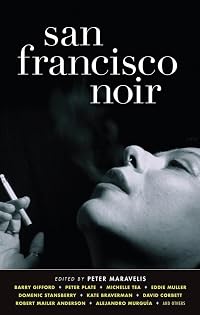
Comparing "Manila Noir" to other books in the Akashic series, it comes in the middle of the pack. It is average, decent, has a few stand-out stories and a lot of very forgettable ones. It does offer something different in the form of a graphic short story, illustrated in black & white, in the middle of the book. This will turn off readers who don't appreciate graphic stories, but may attract a new audience of readers. Overall, any reader hooked on noir will probably want to check out "Manila Noir." For those who have no experience with the series, this is not recommended as a starting point. "San Francisco Noir" edited by Peter Maravelis might be better for a series beginning. show less
Hagedorn divides the book into three sections. Part One is called "Us Against Them;" Part Two is entitled "Black Pearl of the Orient" and Part Three is "They Live By Night." The best writing is in Part Three. The stories in the third section read like the best noir readers have come to expect from this series. Placing these pieces toward the end of the book, however, shows that Hagedorn saved the best for last, but also gambled that the reader would make it that far in the book.
Comparing "Manila Noir" to other books in the Akashic series, it comes in the middle of the pack. It is average, decent, has a few stand-out stories and a lot of very forgettable ones. It does offer something different in the form of a graphic short story, illustrated in black & white, in the middle of the book. This will turn off readers who don't appreciate graphic stories, but may attract a new audience of readers. Overall, any reader hooked on noir will probably want to check out "Manila Noir." For those who have no experience with the series, this is not recommended as a starting point. "San Francisco Noir" edited by Peter Maravelis might be better for a series beginning. show less
This review was written for LibraryThing Early Reviewers.Depressing book. Most of the stories are well-written but there is a pervading sense of hopelessness throughout the stories. Murder, betrayal, drugs, sex, child abuse - noir, maybe - but not a good picture of Manila and The Phillipines. I would not recommend this book to someone who is considering a visit to the country and wants to read native fiction before travelling.
This review was written for LibraryThing Early Reviewers.Members
- Recently Added By
Author Information

All Editions
Awards and Honors
Series

Common Knowledge
- Canonical title
- Manila Noir
- Important places
- Manila, The Philippines
Classifications
Statistics
- Members
- 77
- Popularity
- 413,202
- Reviews
- 11
- Rating
- (3.25)
- Languages
- English
- Media
- Paper, Audiobook, Ebook
- ISBNs
- 5
- ASINs
- 3