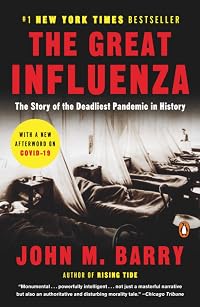
The Great Influenza: The Story of the Deadliest Pandemic in History
by John M. Barry
On This Page
Description
Health & Fitness. History. Science. Nonfiction. In the winter of 1918, at the height of World War I, history's most lethal influenza virus erupted in an army camp in Kansas, moved east with American troops, then exploded, killing as many as 100 million people worldwide. It killed more people in twenty-four weeks than AIDS has killed in twenty-four years, more in a year than the Black Death killed in a century. But this was not the Middle Ages, and 1918 marked the first collision between show more modern science and epidemic disease. Magisterial in its breadth of perspective and depth of research, THE GREAT INFLUENZA weaves together multiple narratives, with characters ranging from William Welch, founder of the Johns Hopkins Medical School, to John D. Rockefeller and Woodrow Wilson. Ultimately a tale of triumph amid tragedy, this crisis provides us with a precise and sobering model as we confront the epidemics looming on our own horizon. show lessTags
Recommendations


Member Recommendations
Member Reviews
It's rare that I bounce off a book so hard that I don't finish the first chapter, and even rarer that I then write up something about it. But while alarm bells were set ringing fairly early on by an account of a pandemic which showed not just ignorance but active disdain for the history of medicine before the nineteenth century, by John M. Barry's seeming inclination towards the Great Man view of things, and by his signalling that women would be sidelined in The Great Influenza, it was his description of the Lakota, Cheyenne and Arapaho as "primitive savages" that had me abandoning this on page 12. It is appalling that a major publishing house would print something like that in the twenty-first century.
Considering the current state of the world, this book was eerie. Recounting how the 1918 pandemic emerged and spread, this book is a work of history, but by changing a few names it could also be an in-depth report on current events. The worst part was the conclusion, in which the author discusses how prepared the world is for the spread of a similar pandemic. I had to double-check the publication date, because it's somewhat frightening how well understood and readily apparent the problems which have played out in 2020 were years previously. Excellent reading, especially if one is interested in the history of pandemics and for understanding how little humans appear to learn from them.
This was a fun book (I know that sounds wrong given the topic) about the influenza outbreak that happened at the end of WWI. I knew that it had happened, but I really didn't know how hard the United States was hit or that it likely started here. I was under the impression it took place mainly in Europe so the whole book was basically news to me.
I appreciated that Barry took the time to give a little background on the history of medicine in America and also spent a lot of time on medical research about and around influenza. I though he got a little overly sensational at times, especially when discussing possible current day epidemics. That's not to say I think it couldn't happen; I just thought his tone was a little repetitive and over show more the top.
All in all I enjoyed reading this and learned quite a bit both about the history of medicine and the social history of the outbreak. It's definitely a topic that I hope our government and medical facilities have contemplated and done some planning for in terms of future outbreaks. show less
I appreciated that Barry took the time to give a little background on the history of medicine in America and also spent a lot of time on medical research about and around influenza. I though he got a little overly sensational at times, especially when discussing possible current day epidemics. That's not to say I think it couldn't happen; I just thought his tone was a little repetitive and over show more the top.
All in all I enjoyed reading this and learned quite a bit both about the history of medicine and the social history of the outbreak. It's definitely a topic that I hope our government and medical facilities have contemplated and done some planning for in terms of future outbreaks. show less
The Greatest Killer in History
Humankind likes to think it is in control and rests comfortable in that thought. When something unknown and uncontrollable strikes, panic ensues. Just that happened when influenza struck the world in 1918, a world already weary of the first total world war, a war that led to a near suspension of democracy in the United States as Woodrow Wilson and his administration prepared to enter the conflict. John Barry not only tells the story of a disease raging rampant across the U.S. and the entire world but how humankind’s own deadly squabbling and compulsion to control, restrict, and distort information contributed to worldwide panic and, probably, millions of unnecessary deaths. His is at once a tale of show more terror, inspiration, and caution. It’s one that readers should pay particular heed to in light of the demoralizing beating truth and honesty are taking today in American society.
To truly appreciate the 1918 influenza, readers need an understanding of biology, chemistry, public health practices, medical practices, and the political and social milieu of the period. While a lot to ask, what makes Barry’s history so brilliant is how he weaves all these disciplines into the story to the point where you acquire a basic working knowledge of virology and bacteriology, in addition to a greater appreciation of modern medical science.
Barry begins with the state of medical practice and education and scientific research a century before the great influenza attack. Indeed, what a sorry state it was with no standards in sight. Over time, though, and with great skill and insight, dedicated, curious, and exacting people wrought the kind of modern medical world familiar to us today. It arrived just in time to face off with the influenza plague. What will strike you in particular is just how small the research community was, concentrated in a few institutions in the U.S., especially Johns Hopkins and the Rockefeller Institute (now Rockefeller University) and a few men and a woman, among them William Welch, Simon Flexner, Oswald Avery, William Park, Anna Williams, and a handful of others. Little known today, except to those involved in medicine and research, you learn just what giants they were and how they contributed a modern life we take for granted today.
You can’t fathom influenza without understanding something of virology and bacteriology. Barry does an excellent job of explaining and illustrating how viruses and bacteria work and how researchers isolate these organisms and devise methods for combatting them. Concomitant with this knowledge is an understanding of public health policy and techniques, which Barry threads throughout the story.
In many ways, the early part of the 20th century proved a perfect breeding ground and killing field for influenza as the Great War caused great concentrations of soldiers in camps, ports, ships, and battlefields in less than healthful conditions. As readers will learn, the times accounted for an accelerated dissemination of the influenza virus and its mutations. What also contributed to the disease, especially its capacity to strike raw terror into the hearts of people so overpowering and crippling that sister would not help sister or brother brother, is that the American government, from Washington straight down to local districts, lied to the American people about the severity and cause of the health crisis, and enlisted the media of the day to participate, all in the name of patriotism and the drive to focus and marshal resources on entering and fighting the Great War. In other words, something we find ourselves confronted with again, manipulation of our free press. Along with from 50 to 100 million deaths, two other casualties of the Great Influenza were Truth and Trust.
If you have never read this book, there’s never been a better or more important to change that. Needless to say, highly recommended. show less
Humankind likes to think it is in control and rests comfortable in that thought. When something unknown and uncontrollable strikes, panic ensues. Just that happened when influenza struck the world in 1918, a world already weary of the first total world war, a war that led to a near suspension of democracy in the United States as Woodrow Wilson and his administration prepared to enter the conflict. John Barry not only tells the story of a disease raging rampant across the U.S. and the entire world but how humankind’s own deadly squabbling and compulsion to control, restrict, and distort information contributed to worldwide panic and, probably, millions of unnecessary deaths. His is at once a tale of show more terror, inspiration, and caution. It’s one that readers should pay particular heed to in light of the demoralizing beating truth and honesty are taking today in American society.
To truly appreciate the 1918 influenza, readers need an understanding of biology, chemistry, public health practices, medical practices, and the political and social milieu of the period. While a lot to ask, what makes Barry’s history so brilliant is how he weaves all these disciplines into the story to the point where you acquire a basic working knowledge of virology and bacteriology, in addition to a greater appreciation of modern medical science.
Barry begins with the state of medical practice and education and scientific research a century before the great influenza attack. Indeed, what a sorry state it was with no standards in sight. Over time, though, and with great skill and insight, dedicated, curious, and exacting people wrought the kind of modern medical world familiar to us today. It arrived just in time to face off with the influenza plague. What will strike you in particular is just how small the research community was, concentrated in a few institutions in the U.S., especially Johns Hopkins and the Rockefeller Institute (now Rockefeller University) and a few men and a woman, among them William Welch, Simon Flexner, Oswald Avery, William Park, Anna Williams, and a handful of others. Little known today, except to those involved in medicine and research, you learn just what giants they were and how they contributed a modern life we take for granted today.
You can’t fathom influenza without understanding something of virology and bacteriology. Barry does an excellent job of explaining and illustrating how viruses and bacteria work and how researchers isolate these organisms and devise methods for combatting them. Concomitant with this knowledge is an understanding of public health policy and techniques, which Barry threads throughout the story.
In many ways, the early part of the 20th century proved a perfect breeding ground and killing field for influenza as the Great War caused great concentrations of soldiers in camps, ports, ships, and battlefields in less than healthful conditions. As readers will learn, the times accounted for an accelerated dissemination of the influenza virus and its mutations. What also contributed to the disease, especially its capacity to strike raw terror into the hearts of people so overpowering and crippling that sister would not help sister or brother brother, is that the American government, from Washington straight down to local districts, lied to the American people about the severity and cause of the health crisis, and enlisted the media of the day to participate, all in the name of patriotism and the drive to focus and marshal resources on entering and fighting the Great War. In other words, something we find ourselves confronted with again, manipulation of our free press. Along with from 50 to 100 million deaths, two other casualties of the Great Influenza were Truth and Trust.
If you have never read this book, there’s never been a better or more important to change that. Needless to say, highly recommended. show less
Shortly after the COVID pandemic began, I heard about this book. I finally read it in audiobook format narrated by Scott Brick and found it haunting. As other reviewers have said, the book tells a much broader history than the influenza pandemic. Instead, you will discover the long history of medicine and the rise of scientific medicine which only arrived in the USA around 1900.
I've studied history in detail for years. Yet, this book stood out almost uniquely for how it reflects 2020-2021 pandemic concerns. In particular, the author's closing advice at the end of the book was haunting. There were reasonable recommendations presented in the book in 2004 that could have significantly reduced the likelihood and impact of pandemics. I only show more hope the world learns better lessons from today's pandemic.
I also enjoyed how the book explains the nature of knowledge, especially as it relates to medicine and biology. When a crisis puts incredible pressure on researchers to "deliver a cure" fast, is it reasonable to cut corners?
One minor complaint relates to style... The author uses some variation of the express "influenza, only influenza" over and over and over again. The point is fair - people in 1918 consistently downplayed the significance of the pandemic because it was "just influenza." Yet the constant repetition of this phrasing throughout the book felt like overkill. show less
I've studied history in detail for years. Yet, this book stood out almost uniquely for how it reflects 2020-2021 pandemic concerns. In particular, the author's closing advice at the end of the book was haunting. There were reasonable recommendations presented in the book in 2004 that could have significantly reduced the likelihood and impact of pandemics. I only show more hope the world learns better lessons from today's pandemic.
I also enjoyed how the book explains the nature of knowledge, especially as it relates to medicine and biology. When a crisis puts incredible pressure on researchers to "deliver a cure" fast, is it reasonable to cut corners?
One minor complaint relates to style... The author uses some variation of the express "influenza, only influenza" over and over and over again. The point is fair - people in 1918 consistently downplayed the significance of the pandemic because it was "just influenza." Yet the constant repetition of this phrasing throughout the book felt like overkill. show less
Because of the grave state of the world right now, I decided I needed to know more about the 1918 Influenza pandemic. This book came highly recommended and was as daunting and informative as foretold. The author pretty much covers the entire history of medicine and research development in the United States, then includes how viruses exist, spread, and mutate. Since I was only looking for the facts about how the pandemic itself progressed, I thought this information would bore me, but oh contraire! I found myself glued to each page and engrossed in every detail. John M. Barry has done exhaustive research on the subject, and I now have a well-rounded understanding of what we are currently facing. You wouldn't think that a book written in show more 2005 could paint a picture of our future so accurately, and yet, here we are. In 1918 the American people's fight for their lives in the pandemic was hampered by the first world war and a government that withheld vital information that could have saved lives. I would have hoped in hindsight that we'd learned from that horrific experience and would be better equipped to cope with one now, but nothing seems to be further from the truth. I'm now more afraid than ever that since our pandemic has chosen to rear its ugly head in the middle of a volatile election year, we may be in for the same treatment from our leaders.
At the very end of this book, the author quotes Abraham Lincoln—"A leader must make whatever horror exists concrete. Only then will people be able to break it apart." Truer words were never spoken. show less
At the very end of this book, the author quotes Abraham Lincoln—"A leader must make whatever horror exists concrete. Only then will people be able to break it apart." Truer words were never spoken. show less
The Great Influenza: The Story of the Deadliest Pandemic in History by John M. Barry earned its reputation as an authoritative book about one of the world's great catastrophes of all times, the 1918-20 Spanish Flu pandemic. For reasons that are obvious it is quite timely now.
The Spanish Flu has been overshadowed in history by the violent end to WW I, then known as The Great War. WW I upended the long-prevailing history of Europe, ending all of its great monarchies and empires save the British Empire. The Spanish Flu, in parallel fashion but for more temporarily upended life in the U.S.
Similar to the current Covid-19 pandemic, the disease sewed panic. The author suggests that the panic was fueled by the efforts of the various governments show more to minimize it. I think the author's hypothesis is well-reasoned and strongly researched. Also, in light of the reaction to the novel Coronavirus the level of media and government attention has been, at best, a mixed blessing.
Turning from my own historical analysis to the book, it was gripping. I read the 461 pages in about twelve days. Some of the other reviewers of the books have justifiable quibbles. The prevailing one is weak editing. It was too repetitive. The literary device of repeating the last words of a previous sentence was overused. My own criticism is that the book was too often written out of chronological order. This may have been needed to give faithful mini-biographies of leading scientists and other players.
That is why I am giving the book a "four" rather than "five" on Goodreads. I highly recommend it; but beware, certain stretches may make a calm sleep afterwards difficult. show less
The Spanish Flu has been overshadowed in history by the violent end to WW I, then known as The Great War. WW I upended the long-prevailing history of Europe, ending all of its great monarchies and empires save the British Empire. The Spanish Flu, in parallel fashion but for more temporarily upended life in the U.S.
Similar to the current Covid-19 pandemic, the disease sewed panic. The author suggests that the panic was fueled by the efforts of the various governments show more to minimize it. I think the author's hypothesis is well-reasoned and strongly researched. Also, in light of the reaction to the novel Coronavirus the level of media and government attention has been, at best, a mixed blessing.
Turning from my own historical analysis to the book, it was gripping. I read the 461 pages in about twelve days. Some of the other reviewers of the books have justifiable quibbles. The prevailing one is weak editing. It was too repetitive. The literary device of repeating the last words of a previous sentence was overused. My own criticism is that the book was too often written out of chronological order. This may have been needed to give faithful mini-biographies of leading scientists and other players.
That is why I am giving the book a "four" rather than "five" on Goodreads. I highly recommend it; but beware, certain stretches may make a calm sleep afterwards difficult. show less
Members
- Recently Added By
Published Reviews
ThingScore 100
John M. Barry calls The Great Influenza "the epic story of the deadliest plague in history," but his book is somewhat more idiosyncratic than epic and in any case is not as interested in the 1918 influenza pandemic as in the careers of those American medical researchers who studied the disease.
added by John_Vaughan
Barry organizes his story as a conflict between medicine and disease. The influenza pandemic, he writes, was ''the first great collision between nature and modern science''; ''for the first time, modern humanity, a humanity practicing the modern scientific method, would confront nature in its fullest rage.'
added by pbirch01
Lists

Best History Books about Epidemics
27 works; 24 members

Disaster Books
74 works; 19 members
Vote: Science, Religion, and History Group Reads
30 works; 17 members
Best Books About Plagues and Epidemics
99 works; 17 members

Accidents, Disasters, and Tragedies
175 works; 7 members

History can be Interesting (or Horrifying or Fun...)
14 works; 2 members

For Science!
39 works; 5 members

Books about World War I
80 works; 14 members

World War I books
32 works; 8 members

10 books Bill Gates wants you to read 2020
12 works; 1 member

Unread books
1,063 works; 87 members
Talk Discussions
Past Discussions
The Great Influenza / Flu - SRH group read in 75 Books Challenge for 2014 (April 2014)
APRIL READ - The Great Influenza in The Green Dragon (June 2013)
Author Information

5+ Works 7,057 Members
John M. Barry was born in 1947. He is a widely respected journalist who has covered national politics extensively. He has used this background to write two highly acclaimed books of nonfiction. The Ambition and the Power: A True Story of Washington (1989 is an examination of use and abuse of power. In Rising Tide: The Great Mississippi Flood of show more 1927 and How It Changed America (1997), he revisits the power theme, but this time in the setting of a natural disaster. Barry is a careful researcher who documents the devastating facts of the flood and intertwines it with the fascinating story of powerful men and their selfish agendas. The conflict between the ruling class and black racists, the clash of former Senator LeRoy Percy and demagogue James K. Vardaman, the candidacy of Herbert Hoover, and the backlash election of Huey Long, all had roots in the policies surrounding the flood. Barry's political expertise comes from his years as Washington editor of Dun's Review, where he covered national politics. He has written for the Washington Post and magazines such as Sports Illustrated, Newsweek, and Esquire. The Transformed Cell: Unlocking the Mysteries of Cancer, coauthored with oncologist Steven A. Rosenberg, has been published in twelve languages. Barry maintains two homes, one in New Orleans and another in Washington, D.C. (Bowker Author Biography) show less
Some Editions
Awards and Honors
Awards
Distinctions
Notable Lists
Common Knowledge
- Canonical title*
- A Grande Gripe
- Original title
- The Great Influenza: The Epic Story of the Deadliest Plague in History
- Alternate titles
- The Great Influenza; The Great Influenza: The Epic Story of the Deadliest Pandemic in History
- Original publication date
- 2004-02-09; 2004-02-04
- People/Characters
- Oswald Avery; Hermann Biggs; Rupert Blue; Frank MacFarlane Burnet; Joe Capps; Rufus Cole (show all 29); George Creel; Harvey Cushing; Simon Flexner; William C. Gorgas; Cary Grayson; Robert Koch; Wilmer Krusen; Paul Lewis; H. C. Michie; Eugene Opie; Sir William Osler; William H. Park; Louis Pasteur; Thomas Rivers; John D. Rockefeller; Milton Rosenau; Frederick Russell; Richard Shope; Victor Vaughan; Edwin Vare; William Henry Welch; Anna Williams; Woodrow Wilson
- Important places
- Philadelphia, Pennsylvania, USA; Johns Hopkins Hospital, Baltimore, Maryland, USA
- Important events
- World War I (1914 | 1918); Influenza pandemic (1918); Disaster: Infectious Disease
- Dedication
- For Edna Rose, who didn't get to find her colors but made the world brighter anyway
To my darling Anne
and to the spirit that was Paul Lewis - First words
- Prologue: The Great War had brought Paul Lewis into the navy in 1918 as a lieutenant commander, but he never seemed quite at ease when in his uniform.
- Last words
- (Click to show. Warning: May contain spoilers.)A leader must make whatever horror exists concrete. Only then will people be able to break it apart.
- Publisher's editor
- Wolf, Wendy
- Blurbers*
- Newsweek
- Original language
- English
- Canonical DDC/MDS
- 614.51809041; 614.518; 616.921.5
- Canonical LCC
- RC150.B37; RA643-645; RA421-790.95; QR1-502; RC109-216; RC31-1245
*Some information comes from Common Knowledge in other languages. Click "Edit" for more information.
Classifications
- Genres
- History, General Nonfiction, Science & Nature, Nonfiction
- DDC/MDS
- 614.51809041 — Applied science & technology Medicine & health Epidemics, Poisons, Alternative Medicine Incidence of and public measures to prevent specific diseases and kinds of diseases Salmonella infections, bacillary diseases, clostridium infections, diphtheria, cholera, dysenteries, influenza Influenza Influenza--incidence--1900-1919
- LCC
- RC150 .B37 — Medicine Internal medicine Internal medicine Infectious and parasitic diseases
- BISAC
Statistics
- Members
- 4,957
- Popularity
- 2,833
- Reviews
- 144
- Rating
- (3.94)
- Languages
- 6 — Chinese, English, French, Spanish, Portuguese (Portugal), Portuguese (Brazil)
- Media
- Paper, Audiobook, Ebook
- ISBNs
- 24
- UPCs
- 1
- ASINs
- 14