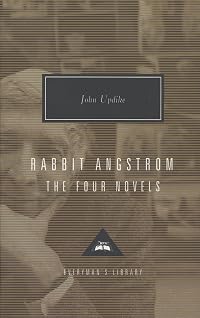
Rabbit Angstrom: A Tetralogy
by John Updike
"Rabbit" Series (Collections and Selections — Omnibus 1-4)
On This Page
Description
Four novels trace the life of Harry "Rabbit" Angstrom against the changing American society from the sixties to the eighties.Tags
Recommendations

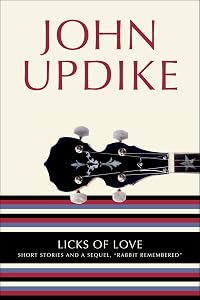




Member Recommendations
Member Reviews
In this volume, entitled Rabbit Angstrom, John Updike's four "Rabbit" novels are collected in one edition. All four books are worthy reads in their own right, but they shine in this set. Updike is giving us the story of a life, and reading only one chapter from that life simply does not give the reader the full picture.
These are, to be sure, rather odd books. They focus entirely on Harry "Rabbit" Angstrom, and his life from early adulthood until retirement and the end of his life. Each volume picks up a time slice from successive decades to update us on how Harry is doing, and how he reflects the times in which he lives. They are odd in the sense that Harry is not particularly interesting, and while he finds himself situated in drama, show more it is strictly domestic. The zeitgeist of each decade is clear in each novel, but only as it intrudes upon Harry's life. He is not a man of the world, and he certainly does not have any adventures.
What's more, one would not expect Harry to be a character capable of drawing us in for 1500 pages, spread over four novels. He is not particularly insightful or reflective (though he comes increasingly reflective with age). Indeed, he is not even particularly likeable. In the latter two novels (Rabbit is Rich, Rabbit at Rest), we see his son Nelson as a young adult. He is, to be perfectly blunt, obnoxious. Yet, I think that this suggests the reason that Harry is such a compelling character. If we saw Harry only from the perspectives of other characters, he would probably come across as similarly unsympathetic. Yet, because we are in his head so long, he feels like someone that we know well, and someone whose actions we are more willing to excuse. Harry is not describing things to us, and he is deeply honest. Even when he is not honest, it is because he is not being honest with himself - not because he is deceiving us as readers. We are treated to a character laid bare, honestly and frankly presented to us. It can be a treat. Given the length of our travels with Harry, he becomes one of the most fully realized "everyman" characters in all of literature.
There are two aspects of the novels which I suspect are greater strengths than I am in a position to evaluate. First is that if one were to read the works over one's life, Harry might mirror the reader's experiences more closely. I read all four novels over the course of approximately a year between ages 27 and 28. While Updike gives us an insight into the life and mind of a middle-aged individual pursuing security, or that of a retiree trying to find solace in a new life, I cannot match these narratives to my own experience. I suspect that these novels will only gain in power and force if one reads them again as one ages alongside Harry. Similarly, as someone born in the 1980s, every decade of Harry's lies outside of my adult experience. While I found myself consistently immersed in Updike, and Harry's understanding of each decade and its peculiarities, I only look on each as a foreigner. There are aspects of the novels which seem locked away from me for this reason, I can only discern the force of the decades through their impact on Harry.
The strongest of the four novels is Rabbit Redux, which is driven by the forceful personality of Skeeter. The scenes in the Angstrom home, of Rabbit sitting back in his chair mesmerized by the ferocious mix of intellectualism, religious zeal, and political fervor from Skeeter are equally mesmerizing for the reader. These are among the best scenes in the entire set of books. Despite being longer, the plot moves at a more riveting pace than in Rabbit, Run, the first of the series. Rabbit is Rich is equal to Redux in many ways, and gives a fantastic portrayal of the creeping influence of a mind for money - but it lacks a Skeeter. The ultimate volume of the series, Rabbit at Rest, is probably the weakest, as its slower pace matches Harry's life, but finds itself slowing to a halt during some of Harry's scenes in Pennsylvania. Nevertheless, the final sections of the book echo crucial scenes from the first novel in a rewarding way.
There is little doubt that Updike's prose is fantastic, though I found it at times troubling in these novels. He combines his rich and evocative descriptive style with mundane experience. On one hand, the aim here is clear. By doing this, he brings to mind the details that our minds pass over so easily, despite the fact that they are part of the fabric of our normal experiences (as the focus here is the suburbanite hero, Harry Angstrom). Yet, I consistently found myself preferring this prose style when it came to the more important scenes in the books: Harry's car trips in the first and fourth novels, Skeeter's speeches, etc., and I found myself occasionally frustrated with the prose during daily scenes in the middle. I've struggled with why this is, and whether it is simply a fault of my own. I suspect that the reason is that the richness and cleverness of Updike's prose suggests a disconnect between the factual details of the scenes (which I am not invested in) and their recounting. While this disconnect is likely intended, I could not apply an intellectual understanding of this to an aesthetic appreciation of the scenes. I wanted Updike to get on with it, so that I might relish his prose at other times in other places.
Despite this minor criticism (which may reveal more about the reader than the work), Updike's four novels are absolutely worth the time required to read them. Indeed, I expect to return them throughout my life, to revisit Harry and see how changes in my own life already passed through him. show less
These are, to be sure, rather odd books. They focus entirely on Harry "Rabbit" Angstrom, and his life from early adulthood until retirement and the end of his life. Each volume picks up a time slice from successive decades to update us on how Harry is doing, and how he reflects the times in which he lives. They are odd in the sense that Harry is not particularly interesting, and while he finds himself situated in drama, show more it is strictly domestic. The zeitgeist of each decade is clear in each novel, but only as it intrudes upon Harry's life. He is not a man of the world, and he certainly does not have any adventures.
What's more, one would not expect Harry to be a character capable of drawing us in for 1500 pages, spread over four novels. He is not particularly insightful or reflective (though he comes increasingly reflective with age). Indeed, he is not even particularly likeable. In the latter two novels (Rabbit is Rich, Rabbit at Rest), we see his son Nelson as a young adult. He is, to be perfectly blunt, obnoxious. Yet, I think that this suggests the reason that Harry is such a compelling character. If we saw Harry only from the perspectives of other characters, he would probably come across as similarly unsympathetic. Yet, because we are in his head so long, he feels like someone that we know well, and someone whose actions we are more willing to excuse. Harry is not describing things to us, and he is deeply honest. Even when he is not honest, it is because he is not being honest with himself - not because he is deceiving us as readers. We are treated to a character laid bare, honestly and frankly presented to us. It can be a treat. Given the length of our travels with Harry, he becomes one of the most fully realized "everyman" characters in all of literature.
There are two aspects of the novels which I suspect are greater strengths than I am in a position to evaluate. First is that if one were to read the works over one's life, Harry might mirror the reader's experiences more closely. I read all four novels over the course of approximately a year between ages 27 and 28. While Updike gives us an insight into the life and mind of a middle-aged individual pursuing security, or that of a retiree trying to find solace in a new life, I cannot match these narratives to my own experience. I suspect that these novels will only gain in power and force if one reads them again as one ages alongside Harry. Similarly, as someone born in the 1980s, every decade of Harry's lies outside of my adult experience. While I found myself consistently immersed in Updike, and Harry's understanding of each decade and its peculiarities, I only look on each as a foreigner. There are aspects of the novels which seem locked away from me for this reason, I can only discern the force of the decades through their impact on Harry.
The strongest of the four novels is Rabbit Redux, which is driven by the forceful personality of Skeeter. The scenes in the Angstrom home, of Rabbit sitting back in his chair mesmerized by the ferocious mix of intellectualism, religious zeal, and political fervor from Skeeter are equally mesmerizing for the reader. These are among the best scenes in the entire set of books. Despite being longer, the plot moves at a more riveting pace than in Rabbit, Run, the first of the series. Rabbit is Rich is equal to Redux in many ways, and gives a fantastic portrayal of the creeping influence of a mind for money - but it lacks a Skeeter. The ultimate volume of the series, Rabbit at Rest, is probably the weakest, as its slower pace matches Harry's life, but finds itself slowing to a halt during some of Harry's scenes in Pennsylvania. Nevertheless, the final sections of the book echo crucial scenes from the first novel in a rewarding way.
There is little doubt that Updike's prose is fantastic, though I found it at times troubling in these novels. He combines his rich and evocative descriptive style with mundane experience. On one hand, the aim here is clear. By doing this, he brings to mind the details that our minds pass over so easily, despite the fact that they are part of the fabric of our normal experiences (as the focus here is the suburbanite hero, Harry Angstrom). Yet, I consistently found myself preferring this prose style when it came to the more important scenes in the books: Harry's car trips in the first and fourth novels, Skeeter's speeches, etc., and I found myself occasionally frustrated with the prose during daily scenes in the middle. I've struggled with why this is, and whether it is simply a fault of my own. I suspect that the reason is that the richness and cleverness of Updike's prose suggests a disconnect between the factual details of the scenes (which I am not invested in) and their recounting. While this disconnect is likely intended, I could not apply an intellectual understanding of this to an aesthetic appreciation of the scenes. I wanted Updike to get on with it, so that I might relish his prose at other times in other places.
Despite this minor criticism (which may reveal more about the reader than the work), Updike's four novels are absolutely worth the time required to read them. Indeed, I expect to return them throughout my life, to revisit Harry and see how changes in my own life already passed through him. show less
I really enjoyed the original Rabbit Run, but I found the sequel, Rabbit Redux, to be a bit slow and filled with far too many political or society issues. Of course I do realize these were tipping points during the time the story was written, but I lost interest due to the continual use of them rather than story which for me, is what matters most. Updike is clearly one of the iconic American authors of his generation and its a book all must read along with the Hemingway, Steinbeck and many others that brought American literature into the limelight.
I read these books individually in the order that they were written and found them all satisfying. Updike possessed a unique point of view and narrative voice, turning mundane things like sitting around the country club an exercise of minute observations, and making it interesting. His characters have wrinkles and flaws, the same kind you see in people you know. He's a national treasure.
I spent the summer with Rabbit, and will really miss him. Had not read Updike before. I enjoyed his descriptions of day to day life. Poor Rabbit, so misunderstood. Definitely a fun read!
a book of serials.
updike can write really well at times. only characters i wanted to follow after one book.
( 'redux' is the best. )
more of a commentary of the author's views of the changing times than anything else. still, though, decent but not enough to make me really care what happens to rabbit.
updike can write really well at times. only characters i wanted to follow after one book.
( 'redux' is the best. )
more of a commentary of the author's views of the changing times than anything else. still, though, decent but not enough to make me really care what happens to rabbit.
Rabbit Angstrom, the main character of the series, is an unsavory sort, yet he's remained in my mind after all these years.
This is a great series by Updike. It captures the essence of a man who is just doing the best he can to survive and live. He has little insight but struggles on anyway. It is very true to life.
Members
- Recently Added By
Lists

The Top Ten: Writers Pick Their Favorite Books
240 works; 31 members

Allie's Wishlist
217 works; 2 members

Lucy's Long List
69 works; 1 member
Author Information

340+ Works 53,425 Members
American novelist, poet, and critic John Updike was born in Reading, Pennsylvania on March 18, 1932. He received an A.B. degree from Harvard University, which he attended on a scholarship, in 1954. After graduation, he accepted a one-year fellowship to study painting at the Ruskin School of Drawing and Fine Art in Oxford, England. After returning show more from England in 1955, he worked for two years on the staff of The New Yorker. This marked the beginning of a long relationship with the magazine, during which he has contributed numerous short stories, poems, and book reviews. Although Updike's first published book was a collection of verse, The Carpentered Hen and Other Tame Creatures (1958), his renown as a writer is based on his fiction, beginning with The Poorhouse Fair (1959). During his lifetime, he wrote more than 50 books and primarily focused on middle-class America and their major concerns---marriage, divorce, religion, materialism, and sex. Among his best-known works are the Rabbit tetrology---Rabbit, Run (1960), Rabbit Redux (1971), Rabbit Is Rich (1981), and Rabbit at Rest (1988). Rabbit, Run introduces Harry "Rabbit" Angstrom as a 26-year-old salesman of dime-store gadgets trapped in an unhappy marriage in a dismal Pennsylvania town, looking back wistfully on his days as a high school basketball star. Rabbit Redux takes up the story 10 years later, and Rabbit's relationship with representative figures of the 1960s enables Updike to provide social commentary in a story marked by mellow wisdom and compassion in spite of some shocking jolts. In Rabbit Is Rich, Harry is comfortably middle-aged and complacent, and much of the book seems to satirize the country-club set and the swinging sexual/social life of Rabbit and his friends. Finally, in Rabbit at Rest, Harry arrives at the age where he must confront his mortality. Updike won the Pulitzer Prize for both Rabbit Is Rich and Rabbit at Rest. Updike's other novels range widely in subject and locale, from The Poorhouse Fair, about a home for the aged that seems to be a microcosm for society as a whole, through The Court (1978), about a revolution in Africa, to The Witches of Eastwick (1984), in which Updike tries to write from inside the sensibilities of three witches in contemporary New England. The Centaur (1963) is a subtle, complicated allegorical novel that won Updike the National Book Award in 1964. In addition to his novels, Updike also has written short stories, poems, critical essays, and reviews. Self-Consciousness (1989) is a memoir of his early life, his thoughts on issues such as the Vietnam War, and his attitude toward religion. He was elected to the American Academy of Arts and Letters in 1977. He died of lung cancer on January 27, 2009 at the age of 76. (Bowker Author Biography) John Updike was born in 1932, in Shillington, Pennsylvania. Since 1957 he has lived in Massachusetts. His novels have won the Pulitzer Prize, the National Book Award, the National Book Critics Circle Award, & the Howells Medal. (Publisher Provided) John Updike was born in 1932 and attended Harvard College and the Ruskin School of Drawing and Fine Art in Oxford, England. Form 1955 to 1957 he was a staff member of The New Yorker, which he contributed numerous writings. Updike's art criticism has appeared in publications including Arts and Antiques, The New Republic, The New York Times Book Review, and Realites, among many others. He is the author of such best-selling novels as Rabbit Run and Rabbit is Rich. His many works of fiction, poetry and criticism have been awarded the Pulitzer Prize, the National Book Award, the American Book Award, and the National Book Critics Circle Award. For the past 40 years he has lived in Massachusetts. (Publisher Provided) John Updike is the author of some 50 books, including collections of short stories, poems, & criticism. His novels have won the Pulitzer Prize, the National Book Award, the National Book Critics Circle Award, & the Howells Medal. Born in Shillington, Pennsylvania, in 1932, he has lived in Massachusetts since 1957. (Publisher Provided) show less
Awards and Honors
Notable Lists
Series

Belongs to Publisher Series
Work Relationships
Contains
Common Knowledge
- Canonical title
- Rabbit Angstrom: A Tetralogy
- Alternate titles
- Rabbit Angstrom: The Four Novels
- Original publication date
- 1995
- People/Characters
- Harry "Rabbit" Angstrom; Janice Angstrom; Nelson Angstrom
- Important places
- Brewer, Pennsylvania, USA (Reading)
- First words
- The United States, democratic and various though it is, is not an easy country for a fiction-writer to enter: the slot between the fantastic and the drab seems too narrow. ("Introduction")
- Last words
- (Click to show. Warning: May contain spoilers.)Runs. (Rabbit, Run)
(Click to show. Warning: May contain spoilers.)"O.K.?" (Rabbit Redux)
(Click to show. Warning: May contain spoilers.)His. (Rabbit Is Rich)
(Click to show. Warning: May contain spoilers.)Enough. (Rabbit at Rest)
Classifications
Statistics
- Members
- 1,071
- Popularity
- 23,878
- Reviews
- 11
- Rating
- (4.15)
- Languages
- English
- Media
- Paper
- ISBNs
- 2
- ASINs
- 5