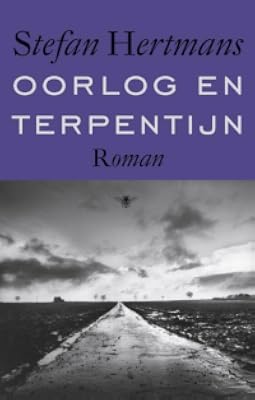
War and Turpentine
by Stefan Hertmans
On This Page
Description
"An international best seller: a vivid, masterly novel about a Flemish man who reconstructs his grandfather's story--his hopes, loves, and art, all disrupted by the First World War--from the unflinching notebooks he filled with pieces of his life. The life of Urbain Martien--artist, soldier, survivor of World War I--lies contained in two notebooks he left behind when he died in 1981. His grandson, a writer, retells his story, the notebooks giving him the impetus to imagine his way into the show more locked chambers of Urbain's memory. He vividly recounts a whole life: Urbain as the child of a lowly church painter, retouching his father's work; dodging death in a foundry; fighting in the war that altered the course of history; marrying the sister of the woman he truly loved; haunted by an ever-present reminder of the artist he had hoped to be and the soldier he was forced to become. Wrestling with this story, Urbain's grandson straddles past and present, searching for a way to understand his own part in both. As artfully rendered as a Renaissance fresco, War and Turpentine paints an extraordinary portrait of one man's life and reveals how that life echoed down through the generations. (With black-and-white illustrations throughout.)"-- show lessTags
Recommendations























Member Recommendations
by anonymous user

aileverte Part III of War and Turpentine has an epigraph from Sebald's Vertigo, and the book itself is very much inspired by Sebald's writing style.
aileverte Remarque's book was another source of inspiration for Hertmans, and the descriptions of life at the front are evocative of Remarque's masterpiece.
Member Reviews
I hadn't heard of Stefan Hertmans' memoir-fiction about his amateur artist grandfather Urbain Martien (1891-1981) until it showed up on the New York Times 10 Best Books of 2016 year-end list. The description there of "a masterly book about memory, art, love and war," intrigued me immediately.
I have to say honestly that the Part I Pre-1914 Section didn't really grab me and I found myself plodding through it for a long time. I mention this as I suspect there may be others with the same experience who may be tempted to give up on the book due to this seemingly rambling first half where often it is the story of Hertmans' great-grandfather that is being told. Don't give up on the book early.
The Part II 1914-1918 Section plunges you along show more with the young Urbain Martien into the face of the German Army's August 1914 "blitzkrieg" (the word apparently wasn't invented until 1935, but Hertmans uses it here on pg. 144 to describe the "shock and awe" tactics used) on Belgium in its roundabout path to attacking France. Suddenly I was totally swept up in the story as now it is being delivered as a first-person account as if in the voice of Urbain himself. The sheer terrors faced by the Flemish speaking Walloon soldiers in the middle between the ruthless German advance and their own contemptuous French-speaking officers. This is among the best on-the-ground description of war that I've ever read, certainly as good as, if not better than, Hemingway's "The Retreat from Caporetto" section in A Farewell to Arms.
The final Part III is a post-1918 section where we return to Hertmans' point-of-view as he describes his grandfather's post-war years and the copies that the elderly Urbain made of classic paintings as his hobby. But now the seemingly rambling style of Part I feels completely engrossing as Hertmans tries to piece together the story of his grandfather's life from the few clues that he has. I should probably re-read Part I with this hindsight as it wasn't until the Part II Section that I suddenly totally identified with Urbain and his life.
Still I don't hesitate to call this a 5 out of 5 based on the 2nd half alone. show less
I have to say honestly that the Part I Pre-1914 Section didn't really grab me and I found myself plodding through it for a long time. I mention this as I suspect there may be others with the same experience who may be tempted to give up on the book due to this seemingly rambling first half where often it is the story of Hertmans' great-grandfather that is being told. Don't give up on the book early.
The Part II 1914-1918 Section plunges you along show more with the young Urbain Martien into the face of the German Army's August 1914 "blitzkrieg" (the word apparently wasn't invented until 1935, but Hertmans uses it here on pg. 144 to describe the "shock and awe" tactics used) on Belgium in its roundabout path to attacking France. Suddenly I was totally swept up in the story as now it is being delivered as a first-person account as if in the voice of Urbain himself. The sheer terrors faced by the Flemish speaking Walloon soldiers in the middle between the ruthless German advance and their own contemptuous French-speaking officers. This is among the best on-the-ground description of war that I've ever read, certainly as good as, if not better than, Hemingway's "The Retreat from Caporetto" section in A Farewell to Arms.
The final Part III is a post-1918 section where we return to Hertmans' point-of-view as he describes his grandfather's post-war years and the copies that the elderly Urbain made of classic paintings as his hobby. But now the seemingly rambling style of Part I feels completely engrossing as Hertmans tries to piece together the story of his grandfather's life from the few clues that he has. I should probably re-read Part I with this hindsight as it wasn't until the Part II Section that I suddenly totally identified with Urbain and his life.
Still I don't hesitate to call this a 5 out of 5 based on the 2nd half alone. show less
I think this may be my first 5-star review. A book I read slowly, even skipping a day now and then, so I would not finish too quickly. Through my years-long fascination with World War I, I've read a LOT of books, fiction and non-fiction, on that horrific conflict, contemporaneous and not, and this is one of the best. Is it a memoir? Partly. Is it a novel? Sort of. The brilliance is in the way Stefan Hertmans, a Belgian poet (and it shows) mingles the genres and turns it into something more like life itself. Based on the two notebooks painfully filled by the narrator's grandfather, Urbain Martien, the first third is a narration of Urbain's life as a boy and a young man, son of an impecunious painter, as the narrator understands it (and show more at the same time does not - he calls it his "unforgivable innocence") - the poverty, the illness, the miserably hard work, the abiding love, and his own discovery of art. And then comes the war. The middle portion is as written (maybe? has the writer transformed it?) by the young man in the foulest depths of the war, and Belgium saw some of the worst. Harrowing, appalling...a place where men fling themselves out of line toward the enemy screaming, "All right, you fucking Bosch, go ahead and kill me!" Which of course, they do. And other men who survive because they stop caring whether they will live out the next hour or not. The final part uncovers the story and tragedy of Urbain's great love, the stunning young woman next door. And how he lives out the rest of his life, painting splendid copies of other people's paintings. And how the narrator tries to understand it all. Moving, beautifully written, humane, just a wondrous piece of work. show less
Stefan Hertmans' War and Turpentine is a painful if beautiful work of war guilt, as he himself explains late in the book. It mixes together real or imagined diary entries of his grandfather with personal reflection on the past, WWI, and his immediate ancestors.
Both his grandfather and his father before him were painters, the older father being a restorer of church paintings and frescoes in Belgium and England.
The son, Hertmans' grandfather, was more of a hobbiest artist after an excruciating if heroic time as a foot soldier in WWI. The first person storytelling of the trenches, of life as a squad commander, and the experience of being wounded in the conflict are as affecting as any I've read. It ranks up there with some of my favourites show more on WWI, including Birdsong and Three Day Road.
But the story is as much about love and longing for beauty as war and this is where it departs from much of the fiction I read these days.
The fathers in this this tale succumb to the love passion as deeply as the experience in war. If anything, I wonder if the story isn't more about the author missing that connection with passion and pain in the way his forebears experienced it. The smells and the terror of war. The agony of the flu carrying off the most beautiful woman before that love is consummated. And the loss of the husband so beautiful and pure in his art that a woman can't even look at other men (even the man she subsequently married) 30 years after consumption took him to the grave.
There is something else of of nationalism in the book where the young Flemish soldier is demeaned by his French-speaking officers. "Here is my blood, where is my freedom" engraved in a war monument.
Pretty much what people feel today. show less
Both his grandfather and his father before him were painters, the older father being a restorer of church paintings and frescoes in Belgium and England.
The son, Hertmans' grandfather, was more of a hobbiest artist after an excruciating if heroic time as a foot soldier in WWI. The first person storytelling of the trenches, of life as a squad commander, and the experience of being wounded in the conflict are as affecting as any I've read. It ranks up there with some of my favourites show more on WWI, including Birdsong and Three Day Road.
But the story is as much about love and longing for beauty as war and this is where it departs from much of the fiction I read these days.
The fathers in this this tale succumb to the love passion as deeply as the experience in war. If anything, I wonder if the story isn't more about the author missing that connection with passion and pain in the way his forebears experienced it. The smells and the terror of war. The agony of the flu carrying off the most beautiful woman before that love is consummated. And the loss of the husband so beautiful and pure in his art that a woman can't even look at other men (even the man she subsequently married) 30 years after consumption took him to the grave.
There is something else of of nationalism in the book where the young Flemish soldier is demeaned by his French-speaking officers. "Here is my blood, where is my freedom" engraved in a war monument.
Pretty much what people feel today. show less
This work of historical fiction is based on the life of the author’s grandfather, Belgian artist Urbain Martien (1891 – 1981). Martien, the son of an artist, grew up in Ghent in a poor family, fought at the battlefront in the Great War, suffered the loss of loved ones, and turned to art for healing. He meticulously copied the masters and wrote in his journals. He exhibited the values and traditions of the nineteenth century while dealing with tumultuous changes of the twentieth. He struggled with traumatic memories, family tragedies, and unfulfilled artistic ambitions.
Hertmans has a knack for portraying the atmosphere of the era, and the reader can sense the harshness of life before modern medicine and conveniences. The horrors of show more trench warfare are described in vivid detail. Martien was wounded, and returned to the front, only to be wounded again (and again). His grandfather adhered to a code of honor, sense of duty, and self-discipline. The accounts of Martien’s experiences on the battlefront are strikingly offset by the beauty of art.
It contains three parts – the first and third are written in third person by the grandson, who inserts his own recollections into the narrative. The second, containing memories of war, is written in first person from Martien’s perspective. The writing is elegant. Hertmans is a poet and it shows. (I read the English translation from the Dutch by David McKay.) The flow is a little choppy in places, with occasional gaps in the narrative.
I felt drawn in and transported back in time. This book is a wonderful tribute to the author’s grandfather. Hertmans has taken a fascinating life and fashioned it into a moving and memorable story.
It slowly dawns on him, as he stares into the roaring stoke hole in the iron foundry and the sparks dance around him like fireflies, that his shock of revulsion at the sight of that apocalyptic heap of rotting flesh filled with gaping dead eyes has awoken something that tugs at him, that hurts, that opens a new space inside him – that for the first time he feels a desire that seems greater than himself. It is the desire to draw and paint, and the instant he becomes aware of it. The sudden realization washes over him with overwhelming force, in which there is an element of guilt. The realization that he wants to do what his father does. It wells up inside him like a sob, like a painful, electric shock from deep within, where his unconscious has taken its time to ripen before coming to light. And he cries.
4.5 show less
Hertmans has a knack for portraying the atmosphere of the era, and the reader can sense the harshness of life before modern medicine and conveniences. The horrors of show more trench warfare are described in vivid detail. Martien was wounded, and returned to the front, only to be wounded again (and again). His grandfather adhered to a code of honor, sense of duty, and self-discipline. The accounts of Martien’s experiences on the battlefront are strikingly offset by the beauty of art.
It contains three parts – the first and third are written in third person by the grandson, who inserts his own recollections into the narrative. The second, containing memories of war, is written in first person from Martien’s perspective. The writing is elegant. Hertmans is a poet and it shows. (I read the English translation from the Dutch by David McKay.) The flow is a little choppy in places, with occasional gaps in the narrative.
I felt drawn in and transported back in time. This book is a wonderful tribute to the author’s grandfather. Hertmans has taken a fascinating life and fashioned it into a moving and memorable story.
It slowly dawns on him, as he stares into the roaring stoke hole in the iron foundry and the sparks dance around him like fireflies, that his shock of revulsion at the sight of that apocalyptic heap of rotting flesh filled with gaping dead eyes has awoken something that tugs at him, that hurts, that opens a new space inside him – that for the first time he feels a desire that seems greater than himself. It is the desire to draw and paint, and the instant he becomes aware of it. The sudden realization washes over him with overwhelming force, in which there is an element of guilt. The realization that he wants to do what his father does. It wells up inside him like a sob, like a painful, electric shock from deep within, where his unconscious has taken its time to ripen before coming to light. And he cries.
4.5 show less
War and Turpentine is separated into three parts: the first about Urbain's childhood and family; the second recounts his experiences during World War I; the third focuses on his life after the war.
The writing is elegant, if a bit too alliterative at times, but quite beautiful are the author's descriptions of his great-grandparents' love and the tenderness with which great-grandmother Celine treats her husband, Franciscus, despite their poverty, cramped quarters, five children, and Franciscus's fragile health. Hertmans presents his grandfather's impoverished childhood in terms that show how the beautiful, the ugly, and the mundane intertwined to create the man Urbain would grow to be. Hertmans captures the great love Urbain had for his show more mother, Celine, and the tenderness of her love toward both her husband and her son.
Before he was even old enough to shave, Urbain had already seen a great deal of the painful side of life. He was barely a teenager when he witnessed a horrific accident at an iron smith/mechanic's shop, and, as was the custom at the time, nobody talked about what happened; everyone kept to himself while things and people fell apart. Urbain also spent time working in a foundry at the age of thirteen, and the reader can feel the intense heat of liquid metal and see young Urbain's muscles tremble as he struggles to steady the basin of molten iron.
I was also particularly moved by a scene from the Great War, describing animals swimming across a river in a flood during a lull between battles, "fleeing an unimaginable Armageddon . . . fleeing blindly like lemmings." One can only begin to imagine how tempting it must have been to want to flee with them, to swim away to a distant shore, to a place where one can look in any given direction and not see insurmountable death and destruction. Urbain describes war as being "like the wrath of God, minus God." Powerful and poignant.
My only real point of contention with the novel is that I felt the author's presence more than I wanted to. At times, images and sounds flowed over me in cascades; at other times, I was only too aware of the author's presence. Outside of that, I really enjoyed reading War and Turpentine and found the prose both fluid-like and soothing, even when describing some of the darkest moments of Urbain's difficult life. show less
The writing is elegant, if a bit too alliterative at times, but quite beautiful are the author's descriptions of his great-grandparents' love and the tenderness with which great-grandmother Celine treats her husband, Franciscus, despite their poverty, cramped quarters, five children, and Franciscus's fragile health. Hertmans presents his grandfather's impoverished childhood in terms that show how the beautiful, the ugly, and the mundane intertwined to create the man Urbain would grow to be. Hertmans captures the great love Urbain had for his show more mother, Celine, and the tenderness of her love toward both her husband and her son.
Before he was even old enough to shave, Urbain had already seen a great deal of the painful side of life. He was barely a teenager when he witnessed a horrific accident at an iron smith/mechanic's shop, and, as was the custom at the time, nobody talked about what happened; everyone kept to himself while things and people fell apart. Urbain also spent time working in a foundry at the age of thirteen, and the reader can feel the intense heat of liquid metal and see young Urbain's muscles tremble as he struggles to steady the basin of molten iron.
I was also particularly moved by a scene from the Great War, describing animals swimming across a river in a flood during a lull between battles, "fleeing an unimaginable Armageddon . . . fleeing blindly like lemmings." One can only begin to imagine how tempting it must have been to want to flee with them, to swim away to a distant shore, to a place where one can look in any given direction and not see insurmountable death and destruction. Urbain describes war as being "like the wrath of God, minus God." Powerful and poignant.
My only real point of contention with the novel is that I felt the author's presence more than I wanted to. At times, images and sounds flowed over me in cascades; at other times, I was only too aware of the author's presence. Outside of that, I really enjoyed reading War and Turpentine and found the prose both fluid-like and soothing, even when describing some of the darkest moments of Urbain's difficult life. show less
https://nwhyte.livejournal.com/2954689.html
It's a very moving memoir by Hertmans of his grandfather's experiences before, during and after the first world war in Belgium. The first and last parts are presented as factual narrative, but the large middle section is a fictional reconstruction of what happened to his grandfather (though no doubt based on such documentation as is available).
The first part on impoverished Flemish life pre-war is heartfelt, the general portrayal in the second part of how Flemish soldiers were treated by francophone officers during the horrible events of the war gives one some understanding of how the war experience led to the growth of a Flemish consciousness (the officers consistently mispronounce Urbain's show more surname, Martien, to end "-shan" rather than "-teen"), and the third part recounting Urbain's subsequent love life (he becomes entangled sequentially with two sisters, and basically marries the wrong one) is very moving as well.
There's also food for thought in the close Belgian relationship with England, Liverpool figuring particularly strongly - a reservoir of historic goodwill which has been stupidly squandered by the current British government. show less
It's a very moving memoir by Hertmans of his grandfather's experiences before, during and after the first world war in Belgium. The first and last parts are presented as factual narrative, but the large middle section is a fictional reconstruction of what happened to his grandfather (though no doubt based on such documentation as is available).
The first part on impoverished Flemish life pre-war is heartfelt, the general portrayal in the second part of how Flemish soldiers were treated by francophone officers during the horrible events of the war gives one some understanding of how the war experience led to the growth of a Flemish consciousness (the officers consistently mispronounce Urbain's show more surname, Martien, to end "-shan" rather than "-teen"), and the third part recounting Urbain's subsequent love life (he becomes entangled sequentially with two sisters, and basically marries the wrong one) is very moving as well.
There's also food for thought in the close Belgian relationship with England, Liverpool figuring particularly strongly - a reservoir of historic goodwill which has been stupidly squandered by the current British government. show less
Belgian poet Stefan Hertmans was given his grandfather's diaries but it took him several years to get around to reading them. With War and Turpentine he has taken his memories, his family's memories and the diaries and written a novel about his grandfathers' life. The book is divided into two themes, that of painting (turpentine) and WWI (war). His grandfather, Urbain, was a keen amateur painter, carefully copying various classical paintings. His own father had been a church painter, restoring paintings and frescos in religious buildings around Ghent and further afield. A love of art in general and of classical painting in particular bookended his life.
Urbain was a young man when WWI started and Belgium was a battlefield. This part of show more the book is taken directly from Urbain's diaries, which he wrote some years after the war had ended. This part of the book has a very different feel than the rest. Urbain was either a brilliant and prescient soldier, surrounded by less able men, or he thought he was a brilliant soldier surrounded by idiots. In any case, he was injured numerous times and spent one convalescence in England, before returning to the battlefield.
War and Turpentine is a picture of Belgium that no longer exists, and is a character study of a man who was both ordinary and unique. I found the parts about his childhood and what being poor meant at a time before government assistance and social safety nets to be both fascinating and sobering. show less
Urbain was a young man when WWI started and Belgium was a battlefield. This part of show more the book is taken directly from Urbain's diaries, which he wrote some years after the war had ended. This part of the book has a very different feel than the rest. Urbain was either a brilliant and prescient soldier, surrounded by less able men, or he thought he was a brilliant soldier surrounded by idiots. In any case, he was injured numerous times and spent one convalescence in England, before returning to the battlefield.
War and Turpentine is a picture of Belgium that no longer exists, and is a character study of a man who was both ordinary and unique. I found the parts about his childhood and what being poor meant at a time before government assistance and social safety nets to be both fascinating and sobering. show less
Members
- Recently Added By
Published Reviews
ThingScore 88
Before this exciting, candid, at times verbose first-person narrative from the trenches begins, there is a slight problem. Part one proves a pedestrian affair in which Hertmans attempts to reconstruct the earlier life of his grandfather, whom he knew only as an old man.
The opening sequence is interesting, often touching but the methodology which also includes the author’s present day life show more intermingled with his boyhood memories and the more distant days of his grandfather’s youth, is dutiful, self conscious and somewhat tentative as the influence of the great W.G. Sebald occasionally overpowers the writing.
Admirers of Sebald may decide War and Turpentine is a pale imitation and look elsewhere. That would be a pity. Hertmans does lack the laconic tone of wry melancholy which Sebald mastered and his inspired translator Anthea Bell conveys so brilliantly. show less
The opening sequence is interesting, often touching but the methodology which also includes the author’s present day life show more intermingled with his boyhood memories and the more distant days of his grandfather’s youth, is dutiful, self conscious and somewhat tentative as the influence of the great W.G. Sebald occasionally overpowers the writing.
Admirers of Sebald may decide War and Turpentine is a pale imitation and look elsewhere. That would be a pity. Hertmans does lack the laconic tone of wry melancholy which Sebald mastered and his inspired translator Anthea Bell conveys so brilliantly. show less
added by aileverte
In the final section, Hertmans reappears to narrate the six decades of Urbain’s postwar life. There is a sad secret at the heart of his loveless marriage to Gabrielle that it wouldn’t do to give away; it provides much of the pathos in this heartbreaking section. The only consolation left to Urbain in the long tail of his life appears to have been painting, and Hertmans writes about this show more with both passion and delicacy. The book has such convincing density of detail, with the quiddities of a particular life so truthfully rendered, that I was reminded of a phrase from Middlemarch: “an idea wrought back to the directness of sense, like the solidity of objects”. Hertmans’ achievement is exactly that. show less
added by aileverte
Lists

Top Five Books of 2017
757 works; 230 members

Books Read in 2017
4,249 works; 129 members

Top Five Books of 2013
1,562 works; 721 members

THE WAR ROOM
813 works; 24 members

De 50 beste Nederlandstalige boeken van de 21ste eeuw (De Standaard)
50 works; 1 member

Top Five Books of 2025
954 works; 303 members
Author Information

77+ Works 2,470 Members
Some Editions
Awards and Honors
Awards
Distinctions
Series
Belongs to Publisher Series
Common Knowledge
- Canonical title
- War and Turpentine
- Original title
- Oorlog en terpentijn
- Original publication date
- 2013-08-29
- Important places
- Gent, Oost-Vlaanderen, België
- Important events*
- Eerste Wereldoorlog
- Epigraph
- Het is alsof de dagen, als engelen in goud
en blauw, onvatbaar boven de cirkelgang van
de vernietiging staan.
E.M. Remarque
The days are like angels in blue and gold, rising up untouchable above the circle of destruction. - Erich Maria Remarque, All Quiet on the Western Front - Dedication
- Voor mijn vader
For my father - First words
- De verste herinnering die ik aan mijn grootvader heb, is die aan het strand van Oostende - een man van zesenzestig, keurig in het nachtblauwe pak, heeft met de blauwe strandschep van zijn kleinzoon een ondiepe put gegraven wa... (show all)arvan hij de opgeworpen rand heeft afgeplat, zodat hij en zijn vrouw daar enigszins gerieflijk kunnen gaan zitten.
In my most distant memory of my grandfather, he is on the beach at Ostend: a man of sixty-six in a neat midnight-blue suit, he has dug a shallow pit with his grandson's blue shovel and leveled off the heaped sand around it so... (show all) that he and his wife can sit in relative comfort. - Quotations
- Places are not just space, they are also time. I look at the city differently now that I carry his memories with me.
- Last words
- (Click to show. Warning: May contain spoilers.)Hij salueert.
(Click to show. Warning: May contain spoilers.)Sergent-Major Marshen? St. Peter finally asks, leafing through the interminable list of wounded veterans.
Non, mon commandant. Je m'appelle Mar-tien, pas Mar-shen, à vos ordres.
He salutes. - Original language
- Dutch
- Canonical DDC/MDS
- 839.3137
*Some information comes from Common Knowledge in other languages. Click "Edit" for more information.
Classifications
- Genres
- General Fiction, Fiction and Literature, Historical Fiction
- DDC/MDS
- 839.3137 — Literature & rhetoric German & related literatures Other Germanic literatures Netherlandish literatures Dutch Dutch fiction 21st Century
- LCC
- PT6466.18 .E76 .O5713 — Language and Literature German, Dutch and Scandinavian literatures Flemish literature since 1830 Individual authors or works
- BISAC
Statistics
- Members
- 1,012
- Popularity
- 25,772
- Reviews
- 44
- Rating
- (3.99)
- Languages
- 13 — Chinese, Danish, Dutch, English, French, German, Italian, Japanese, Norwegian (Bokmål), Norwegian, Portuguese, Croatian, Spanish
- Media
- Paper, Audiobook, Ebook
- ISBNs
- 31
- ASINs
- 6