On This Page
Description
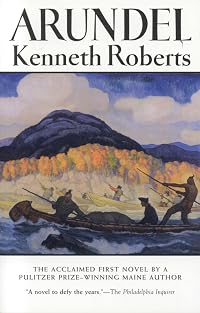
This is the classic series from Pulitzer Prize-winning historical novelist Kenneth Roberts, all featuring characters from the town of Arundel, Maine. Arundel follows Steven Nason as he joins Benedict Arnold in his march to Quebec during the American Revolution.Tags
Recommendations






















Member Recommendations

myshelves Contains the historical materials used as the basis for the novel.
20
Member Reviews
Arundel by Kenneth Roberts was originally published in 1930. It tells of the early days of the American Revolution and of Benedict Arnold’s doomed march on Quebec in 1775. It is also the story of Steven Nason, a Maine colonist whose desire to reach Quebec is greater than most as he dreams of reuniting with Mary, a young girl who was kidnapped by a Frenchman and a group of Indians a number of years ago. As children Steven and Mary had promised each other that they would marry, and although a number of years has passed and Mary now goes by the name of Marie de Sabrevois, he still vows to bring Mary home.
The author paints a vivid picture of the conditions that existed in the American colonies, the characters, both real and fictional, show more that decide to fight for their freedom from the British and the various Native Americans that helped or hindered their cause. There is plenty of action as the expedition travels through rugged forest and paddles the rivers and lakes of the American wilderness.
Arundel is an epic tale of war, revenge, romance and friendship. The prime source of research material that the author used were the journals of Benedict Arnold’s soldiers and the reader is rewarded with a stirring story as well as a plethora of historical facts, from the clothing they wore to the food they ate, to the political thinking of the day. The only drawback for modern readers could be that the language is rather dated and being true to it’s time, both women and Native Americans are not always presented in the best light. show less
The author paints a vivid picture of the conditions that existed in the American colonies, the characters, both real and fictional, show more that decide to fight for their freedom from the British and the various Native Americans that helped or hindered their cause. There is plenty of action as the expedition travels through rugged forest and paddles the rivers and lakes of the American wilderness.
Arundel is an epic tale of war, revenge, romance and friendship. The prime source of research material that the author used were the journals of Benedict Arnold’s soldiers and the reader is rewarded with a stirring story as well as a plethora of historical facts, from the clothing they wore to the food they ate, to the political thinking of the day. The only drawback for modern readers could be that the language is rather dated and being true to it’s time, both women and Native Americans are not always presented in the best light. show less
Steven Nason, a boy from Arundel, Maine, opens his story with the announcement that he wants to set the record straight. He looks back his childhood in 1759 when Steven is only twelve years old. His childhood sweetheart, Mary Mallison, has just been kidnapped and her father murdered. Steven's father suspects it is the work of Henri Guerlac de Sabrevois, a Frenchman hiding out in Quebec. Calling upon the Abenaki nation for help, Steven and his father set out to rescue the fair maiden Mary. The mission takes years and Steven's life takes many twists and turns as he and his companions get caught up in the American Revolution. As a historical fiction writer, Kenneth Roberts weaves in events so real they seem to jump off the page. I show more particularly enjoyed Steven's loyalty to his friends and the fact that he had a pet seal named Eunice. show less
I do enjoy the novels of Kenneth Roberts who has a good narrative gift, and does try to portray the American War of Independence with a reaonable level of objectivity. Arundel, follows the adventures of Steve Nason, who finds himself joining the army under Benedict Arnold in the unsucessful attack on Quebec city by the Continentals in 1775-76. Arnold is not yet a traitor, and is depicted as a very energetic and vehement patriot. But the attack on the city fails, and Nason and company have to get back to New York as best they can. Steve does get the girl, though. The Roberts' novels about this War would make quite an interesting TV series, a la "Game of thrones" as there are several interesting villains and heroes in his corpus. The show more novel was first published in 1934. show less
The first of a series of four historical novels dealing with people from Arundel, Maine (originally part of Kennebunkport; the author's Chronicles of Arundel was instrumental in prompting the state legislature to restore the name "Arundel" to it, according to the town's Wikipedia page) from just before the American Revolution to the War of 1812, Kenneth Roberts's Arundel (or, to give it its full, original title: Arundel; Being the Recollections of Steven Nason of Arundel, in the Province of Maine, Attached to the Secret Expedition Led by Benedict Arnold Against Quebec)'s main action stretches from 1759 to early in 1776. Arundel was originally published in 1930, although it was revised in 1933 and 1956; the edition that I read, a library show more copy published in 1969 (from whose pages the maps have been torn out; boo, hiss), is the 37th printing.
Steven Nason, the book's first person narrator, is the eponymous son of an innkeeper, ferryman, trader, and outdoorsman who is friendlier with the Abenaki Indians than with many of his fellow townsfolk; his story begins when he is 12 years old when the girl he is besotted with, Mary Mallinson, is abducted by a supercilious Frenchman named Henri Guerlac de Sabrevois. The rest of Arundel is essentially the account of his attempts to get her back, with interesting (to say nothing of harrowing...) events and personalities from the American Revolution thrown in for good measure.
For me, by far the most interesting parts of the book are the accounts of the Abenakis and the relations of Steven and his father with them, in the first hundred pages or so; however, Roberts has a flair for detail and local color, so I can't honestly say that the book flags in its later sections, even if I as a reader was almost as sick of reading of the deliberately misguided travails of Arnold's expeditionary force to Quebec as they must've been of living it. The "battle," as such, is a confused hodge-podge, and likely to frustrate fans of military fiction; this doubtless owes no little amount to the confused, higgledy-piggledy nature of the actual battle, the true miracle of which surely must be the fact that any American officers or troops escaped with their lives.
Aaron Burr makes a relatively brief appearance in these pages, and he is not exactly presented in a flattering light; his turn here makes me want to re-read Gore Vidal's superb novel Burr in the near future. Benedict Arnold is presented, in his youth, as absurdly acrobatic, to say nothing of grandstanding; as a colonel in the American Revolutionary Army, he is shown as a strong-willed, if not mulish, man who is not always successful in keeping a leash on his temper, qualities that will not serve him well in the years following this account. George Washington, for the short amount of time he appears here, comes off as something of a little tin god, not entirely out of keeping with how Vidal presented him in Burr. One marvels at the disdain of Washington and Arnold for the Indians; understandable, perhaps, in light of the recent French and Indian War (or Seven Years War to Europeans), but nearly fatal to the Continental Army's enterprise, and surely at least partly fatal to the invasion of Quebec.
Steven Nason is mostly an agreeable narrator: competent and tough (though not superhumanly so) and full of gumption and a temper of his own that sometimes gets him into trouble, he is also thunderously, maddeningly blinkered in matters of the heart, so much so that one begins to look for a safe to drop onto his head from the clouds before the light finally dawns. His main Maine companion is the Falstaffian Saved From Captivity (called "Cap") Huff, whose turns were usually far less comic, to me, than they were apparently intended to be. Apparently Cap Huff also makes an appearance in Roberts's novel Northwest Passage.
Roberts's account of the early stages of the Revolutionary movement -- in particular of the spread of chapters of The Sons of Liberty -- is not likely to please those looking for simple, cut-and-dried, breast-beating patriotism: he shows The Sons as "noisy brawlers and table-bangers. . . . [with] no property to speak of"; "wild and foolish fellows who had no vote and screamed the loudest for paper money." Nason observes: "In the beginning they were the poorest and scurviest knaves that our village could boast, so that instead of being called Sons of Liberty, they were more often called Sons of something entirely different, when mentioned by respectable folk. Yet they were no different, travelers told me, from the Sons of Liberty in Massachusetts and Connecticut and the rest of our colonies, and I have no doubt it could not have been otherwise, if they were to do the work they did" (pps. 128-29).
Some readers may also not welcome Roberts's accounts of factionalism among the colonists (indeed, the regional prejudices among the men of Arnold's force -- Virginians, Rhode Islanders, New Yorkers, Connecticuters, Mainelanders, etc. -- play no small part in hampering their efforts to reach Quebec), who often declare themselves more willing to fight each other than the British, as does Nason when Cap Huff first approaches him with admiring talk for Samuel Adams and The Sons of Liberty:
"'Sam Adams says!' I objected, befuddled by his talk. 'Sam Adams! Sam Adams! Sam Adams! Who in hell is this Sam Adams? And what do we want to fight England for? I don't know what you're talking about! If you talked about fighting the French, now, it would mean something. They've been fighting us for a hundred years, and my father said there never was a bunch of dirtier, underhandeder, rottener fighters than the French! I'd rather fight the damned Virginians, with their high and mighty airs, and every cheap drunkard telling about being a Cavalier! I'd rather fight the Rhode Islanders! There ain't meaner white folks anywhere than the Rhode Islanders, and everybody knows it!'" (p. 126)
However, Roberts's relatively straightforward style has just enough mustiness, regional words ("gurry" was new to me) and semi-formality to effectively convey the mindset of colonials who mostly wanted to get on with their lives, no matter who was in power; Roberts also effectively conveys his deep love of the Maine wilderness and his respect and affection for the Abenakis (pleasantly surprising in a work of this vintage). Roberts is not above the occasional, usually successful, attempt at poetic phrasing, as in the first paragraph of Chapter XXVIII, the first chapter of Book IV: "Lady of the Snows":
"Quebec, scornful and aloof in her white mantle, put me in mind of a woman: caring nothing, to outward view, for these dirty, ragged, limping, hairy men who had accomplished the impossible and burst from the trackless wilderness to stare at her with hot and hungry eyes, yet watchful of their every move; eager to know their thoughts; fearful lest she succumb to them against her will; subject, even, to moments of weakness when, had we known, she might have softened at our touch." (p. 371)
In short, any reader interested in an account of ordinary people in the American Revolution and unoffended by a presentation of same more nuanced than a storybook for very young children (or a Roland Emmerich-directed movie...), or any reader looking for an account of relations between early American settlers and Native Americans that isn't wholly and bloodily adversarial, should enjoy Arundel. show less
Steven Nason, the book's first person narrator, is the eponymous son of an innkeeper, ferryman, trader, and outdoorsman who is friendlier with the Abenaki Indians than with many of his fellow townsfolk; his story begins when he is 12 years old when the girl he is besotted with, Mary Mallinson, is abducted by a supercilious Frenchman named Henri Guerlac de Sabrevois. The rest of Arundel is essentially the account of his attempts to get her back, with interesting (to say nothing of harrowing...) events and personalities from the American Revolution thrown in for good measure.
For me, by far the most interesting parts of the book are the accounts of the Abenakis and the relations of Steven and his father with them, in the first hundred pages or so; however, Roberts has a flair for detail and local color, so I can't honestly say that the book flags in its later sections, even if I as a reader was almost as sick of reading of the deliberately misguided travails of Arnold's expeditionary force to Quebec as they must've been of living it. The "battle," as such, is a confused hodge-podge, and likely to frustrate fans of military fiction; this doubtless owes no little amount to the confused, higgledy-piggledy nature of the actual battle, the true miracle of which surely must be the fact that any American officers or troops escaped with their lives.
Aaron Burr makes a relatively brief appearance in these pages, and he is not exactly presented in a flattering light; his turn here makes me want to re-read Gore Vidal's superb novel Burr in the near future. Benedict Arnold is presented, in his youth, as absurdly acrobatic, to say nothing of grandstanding; as a colonel in the American Revolutionary Army, he is shown as a strong-willed, if not mulish, man who is not always successful in keeping a leash on his temper, qualities that will not serve him well in the years following this account. George Washington, for the short amount of time he appears here, comes off as something of a little tin god, not entirely out of keeping with how Vidal presented him in Burr. One marvels at the disdain of Washington and Arnold for the Indians; understandable, perhaps, in light of the recent French and Indian War (or Seven Years War to Europeans), but nearly fatal to the Continental Army's enterprise, and surely at least partly fatal to the invasion of Quebec.
Steven Nason is mostly an agreeable narrator: competent and tough (though not superhumanly so) and full of gumption and a temper of his own that sometimes gets him into trouble, he is also thunderously, maddeningly blinkered in matters of the heart, so much so that one begins to look for a safe to drop onto his head from the clouds before the light finally dawns. His main Maine companion is the Falstaffian Saved From Captivity (called "Cap") Huff, whose turns were usually far less comic, to me, than they were apparently intended to be. Apparently Cap Huff also makes an appearance in Roberts's novel Northwest Passage.
Roberts's account of the early stages of the Revolutionary movement -- in particular of the spread of chapters of The Sons of Liberty -- is not likely to please those looking for simple, cut-and-dried, breast-beating patriotism: he shows The Sons as "noisy brawlers and table-bangers. . . . [with] no property to speak of"; "wild and foolish fellows who had no vote and screamed the loudest for paper money." Nason observes: "In the beginning they were the poorest and scurviest knaves that our village could boast, so that instead of being called Sons of Liberty, they were more often called Sons of something entirely different, when mentioned by respectable folk. Yet they were no different, travelers told me, from the Sons of Liberty in Massachusetts and Connecticut and the rest of our colonies, and I have no doubt it could not have been otherwise, if they were to do the work they did" (pps. 128-29).
Some readers may also not welcome Roberts's accounts of factionalism among the colonists (indeed, the regional prejudices among the men of Arnold's force -- Virginians, Rhode Islanders, New Yorkers, Connecticuters, Mainelanders, etc. -- play no small part in hampering their efforts to reach Quebec), who often declare themselves more willing to fight each other than the British, as does Nason when Cap Huff first approaches him with admiring talk for Samuel Adams and The Sons of Liberty:
"'Sam Adams says!' I objected, befuddled by his talk. 'Sam Adams! Sam Adams! Sam Adams! Who in hell is this Sam Adams? And what do we want to fight England for? I don't know what you're talking about! If you talked about fighting the French, now, it would mean something. They've been fighting us for a hundred years, and my father said there never was a bunch of dirtier, underhandeder, rottener fighters than the French! I'd rather fight the damned Virginians, with their high and mighty airs, and every cheap drunkard telling about being a Cavalier! I'd rather fight the Rhode Islanders! There ain't meaner white folks anywhere than the Rhode Islanders, and everybody knows it!'" (p. 126)
However, Roberts's relatively straightforward style has just enough mustiness, regional words ("gurry" was new to me) and semi-formality to effectively convey the mindset of colonials who mostly wanted to get on with their lives, no matter who was in power; Roberts also effectively conveys his deep love of the Maine wilderness and his respect and affection for the Abenakis (pleasantly surprising in a work of this vintage). Roberts is not above the occasional, usually successful, attempt at poetic phrasing, as in the first paragraph of Chapter XXVIII, the first chapter of Book IV: "Lady of the Snows":
"Quebec, scornful and aloof in her white mantle, put me in mind of a woman: caring nothing, to outward view, for these dirty, ragged, limping, hairy men who had accomplished the impossible and burst from the trackless wilderness to stare at her with hot and hungry eyes, yet watchful of their every move; eager to know their thoughts; fearful lest she succumb to them against her will; subject, even, to moments of weakness when, had we known, she might have softened at our touch." (p. 371)
In short, any reader interested in an account of ordinary people in the American Revolution and unoffended by a presentation of same more nuanced than a storybook for very young children (or a Roland Emmerich-directed movie...), or any reader looking for an account of relations between early American settlers and Native Americans that isn't wholly and bloodily adversarial, should enjoy Arundel. show less
Well written, and for me, a well told story. The characters are diverse and believable, and the expedition to Quebec reeks of human frailty, greed and power. Military intelligence at its finest.
The first of Kenneth Roberts' three books on the American Revolution, this story tells of the Americans' abortive attempt to take the city of Quebec from the English. The narrator, Steven Nason, is a young man from Arundel who witnesses and endures the hardships of an army on the move through forbidding terrain.
The story is peppered with real figures, including Benedict Arnold, Aaron Burr and Daniel Morgan, But it centers mostly on a group of friends from Arundel who represent the hardy core of those who heeded the call to fight for freedom.
The descriptive language Roberts uses makes everything come alive. I challenge you to read Nason's toothsome description of the bounties of Maine, as provided by his sister and mother's cooking, and show more not find your mouth watering with anticipation. Or, when reading of the cold, hunger and illness faced by these soldiers on their trek through Maine, not wanting to wrap yourself up in a warm blanket. show less
The story is peppered with real figures, including Benedict Arnold, Aaron Burr and Daniel Morgan, But it centers mostly on a group of friends from Arundel who represent the hardy core of those who heeded the call to fight for freedom.
The descriptive language Roberts uses makes everything come alive. I challenge you to read Nason's toothsome description of the bounties of Maine, as provided by his sister and mother's cooking, and show more not find your mouth watering with anticipation. Or, when reading of the cold, hunger and illness faced by these soldiers on their trek through Maine, not wanting to wrap yourself up in a warm blanket. show less
Another of Roberts' well-researched and retold stories of the turbulent times of The American Revolution.This one deals with the heroic march overland to Quebec by the troops with Benedict Arnold, the notorious and much-maligned bogeyman of West Point. As seen through the eyes of Steven Nason and accompanied by his stalwart if somewhat unorthodox companion Cap Huff, the tale flows like the Saint Lawrence River does through the era of change and upheaval.
Members
- Recently Added By
Lists

Must-Read Maine
146 works; 91 members

Books Set in Maine
42 works; 6 members

Canadian Historical Fiction 🇨🇦
157 works; 8 members

Art Bourgeau's Favorites [Mystery Lovers Companion, 1986]
124 works; 2 members
Author Information

23+ Works 3,357 Members
Awards and Honors
Series

Work Relationships
Is contained in
Common Knowledge
- Canonical title
- Arundel
- Original title
- Arundel, being the Recollections of Steve Nason of Arundel, in the Province of Maine, Attached to the Secret Expedition led by Colonel Benedict Arnold Against Quebec and Later a Captain in the Continental Army serving at Valcour Island, Bemis Heights, and Yorktown
- Alternate titles
- Arundel: A Chronicle of the Province of Maine and of the Secret Expedition Against Quebec
- Original publication date
- 1929 ( [1933]) (copyright, 1930) ( [1933] | copyright, 1930)
- People/Characters
- Steven Nason; Benedict Arnold; Cap Huff; Mary Mallinson ; Phoebe Marvin; Natanis (show all 17); Aaron Burr; Henri Guerlac de Sabrevois; Hobomok; Roger Enos; Daniel Morgan; Steven Nason (senior); Henry Dearborn; Reverend Ezekiel Hook; Natawammet; Rabomis; Jacataqua
- Important places
- Arundel, Maine, USA; Québec City, Québec, Canada; Swan Island, Maine, USA
- Important events
- American Revolution (1775 | 1783)
- Dedication
- To G.T.R.
- First words
- Having no wish to pose as a man of letters, but earnestly desiring to see justice done, I, Steven Nason, of the town of Arundel, in the county of York and the province of Maine, herein set down the truth, as I saw it, of cert... (show all)ain occurrences connected in various ways with this neighborhood.
- Last words
- (Click to show. Warning: May contain spoilers.)I was home again -- in Arundel.
- Blurbers
- Deland, Margaret
Classifications
- Genres
- Fiction and Literature, General Fiction, Historical Fiction
- DDC/MDS
- 813.52 — Literature & rhetoric American literature in English American fiction in English 1900-1999 1900-1945
- LCC
- PS3535 .O176 .A8 — Language and Literature American literature American literature Individual authors 1900-1960
- BISAC
Statistics
- Members
- 692
- Popularity
- 41,403
- Reviews
- 9
- Rating
- (3.97)
- Languages
- Danish, English, Polish, Swedish
- Media
- Paper, Ebook
- ISBNs
- 14
- ASINs
- 41