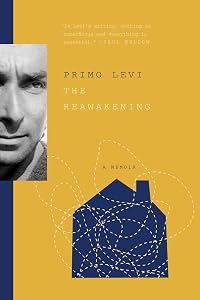
On This Page
Description
[This is the author's] sequel to his ... memoir of the Holocaust, Survival in Auschwitz. The inspiring story of [the author's] liberation from the German death camp in January 1945 by the Red Army, it tells of his strange and eventful journey home to Italy by way of the Soviet Union, Hungary, and Romania. [The author's] railway travels take him through bombed-out cities and transit camps, and with keen insight he describes the former prisoners and Russian soldiers he encounters along the show more way.-Back cover. show lessTags
Recommendations




















Member Recommendations

Member Reviews
Survival, not of the fittest, but of the ones with the most wits about them. Very harrowing, though not as grim as If this is a man... and compelling reading. Lucid style, no whining, no complaining, about the interminable hiatus between the liberation from Auschwitz and the return to Turin, via the "Old Roads" somewhere in the Russian countryside at the end of a railway track. Of the 605 who were in Levi's group when he was interned, only 3 survived. I think Levi must have been a quiet man, but he should be listened to.
This is the second book in Primo Levi’s autobiography about Auschwitz and the aftermath of the war. Also goes by the title “The Truce”, in Danish "Tøbruddet".
As the first one this is no doubt a solid five star read. Primo Levi recounts the time just after Auschwitz when jews, refugees and other war victims are trying to get home. Everything is chaos, people are starving and sick and many dies in interim camps - Primo Levi is relocated several times to different camps, trying to survive.
He’s such a good storyteller, vivid descriptions of so many people - some showing forth trumendous strength and resilience, others caring and loving, others cruel and vicious. It’s also in places very funny in all the absurd circumstances show more they happen to find themselves in - so many strange characters and events that you shake your head in disbelief. show less
As the first one this is no doubt a solid five star read. Primo Levi recounts the time just after Auschwitz when jews, refugees and other war victims are trying to get home. Everything is chaos, people are starving and sick and many dies in interim camps - Primo Levi is relocated several times to different camps, trying to survive.
He’s such a good storyteller, vivid descriptions of so many people - some showing forth trumendous strength and resilience, others caring and loving, others cruel and vicious. It’s also in places very funny in all the absurd circumstances show more they happen to find themselves in - so many strange characters and events that you shake your head in disbelief. show less
After being freed by the Russians from the unimaginable horrors of one year in Auschwitz, Primo Levi endured another several months of extreme discomfort being transported back home to Italy. This book gives an eye-witness view of the chaos of the months following WWII. It is a tale also of the incredible suffering a human being can endure and still survive. An amazing story.
One of the harder to get through books that I have read recently because Levi has a way of writing in only the exact necessary details of his experiences. This volume deals with his accounts of surviving Auschwitz and what happened to him immediately following it. This book will change your perception of what you think happened right after because most of us would consider that people in the concentration camps would just go back home, but this book tells you an entirely different story. If you want to become educated on the real world after the Holocaust you must spend the time to read this book.
This is an account of the author’s return home to Italy following his imprisonment in Auschwitz.
It is wonderfully written and extremely readable. But it does not provide any information we really feel we need to know as did Survival in Auschwitz.
We are told of the rescue from the camp by the Russians and their necessary and thorough bathing by the Russian nurses.
Primo, being ill, was delegated to an Infectious Ward. He ended up in a small ward with only twenty bunks.
There were a few desperate cases, including an unknown skeleton-like little man whose muscles were horriblly contracted and whom the nurses did what they could with.
There was a “child of death” who looked about three years old who could not speak and had no name show more – they called him Hurbinek.
He was paralyzed from the waist down, with atrophied legs as thin as sticks. His eyes “flashed terribly alive, full of demand and assertion”.
Hanek, a robust Hungarian boy of fifteen, spent half his day beside Hurbinek’s pallet, Hanek brought him food, adjusted his blankets, cleaned him skilfully and spoke to him, in Hungarian, of course.
Hurbinek died in March, 1945.
Hanek came from Transsylvania; he and his whole family had been captured and deported to Auschwitz.
There were several children. One, Peter Pavel, was five years old. He was a beautiful, blond, robust child. He spoke to nobody and needed nobody.
There was Kleine Kapura, twelve years old. Enormously long arms and legs stuck out from his squat, short body.
He had been the attendant of the “Lager-Kapo”.
After a few days he began to speak.
“He shouted imperious commands in German to a group of non-existent slaves.”
“Get up, swine --- Make your beds, quickly; clean your shoes. All in line, lice inspection, feet inspection!”
Primo describes in detail in his wonderful prose all the characters he encounters.
Eventually, he gets into a Russian transport convoy heading towards a “mysterious” transit camp. He meets a Greek, Mordo Nahun, who becomes a sort of friend,
Primo passes through several camps together with many others.
In one town, the Polish Red Cross had established a marvelous field-kitchen and served a substantial hot soup at all hours.
Primo meets people of various nationalities with whom he communicates in a mixture of languages.
He travels by various trains, though often he does not know for certain where they are heading, if at all in the right direction.
I found the book to be extremely readable but not indispensable or important. show less
It is wonderfully written and extremely readable. But it does not provide any information we really feel we need to know as did Survival in Auschwitz.
We are told of the rescue from the camp by the Russians and their necessary and thorough bathing by the Russian nurses.
Primo, being ill, was delegated to an Infectious Ward. He ended up in a small ward with only twenty bunks.
There were a few desperate cases, including an unknown skeleton-like little man whose muscles were horriblly contracted and whom the nurses did what they could with.
There was a “child of death” who looked about three years old who could not speak and had no name show more – they called him Hurbinek.
He was paralyzed from the waist down, with atrophied legs as thin as sticks. His eyes “flashed terribly alive, full of demand and assertion”.
Hanek, a robust Hungarian boy of fifteen, spent half his day beside Hurbinek’s pallet, Hanek brought him food, adjusted his blankets, cleaned him skilfully and spoke to him, in Hungarian, of course.
Hurbinek died in March, 1945.
Hanek came from Transsylvania; he and his whole family had been captured and deported to Auschwitz.
There were several children. One, Peter Pavel, was five years old. He was a beautiful, blond, robust child. He spoke to nobody and needed nobody.
There was Kleine Kapura, twelve years old. Enormously long arms and legs stuck out from his squat, short body.
He had been the attendant of the “Lager-Kapo”.
After a few days he began to speak.
“He shouted imperious commands in German to a group of non-existent slaves.”
“Get up, swine --- Make your beds, quickly; clean your shoes. All in line, lice inspection, feet inspection!”
Primo describes in detail in his wonderful prose all the characters he encounters.
Eventually, he gets into a Russian transport convoy heading towards a “mysterious” transit camp. He meets a Greek, Mordo Nahun, who becomes a sort of friend,
Primo passes through several camps together with many others.
In one town, the Polish Red Cross had established a marvelous field-kitchen and served a substantial hot soup at all hours.
Primo meets people of various nationalities with whom he communicates in a mixture of languages.
He travels by various trains, though often he does not know for certain where they are heading, if at all in the right direction.
I found the book to be extremely readable but not indispensable or important. show less
It's an important book but not nearly as compelling as the preceding [b:Survival in Auschwitz|6174|Survival in Auschwitz|Primo Levi|http://photo.goodreads.com/books/1165555421s/6174.jpg|851110]. This book becomes more of a series of snapshots of different incidents and characters that Levi encountered in the few months between his liberation from the concentration camp and his arrival back home. Levi's poignant sociological, political and philosophical observations are still present, just fewer and farther between. His most admirable trait is the non-judgmental way he has of observing even the most maddening and unjust of circumstances. All in all, however, I would have preferred to read this book without all the fluff, perhaps as a show more "Last Part" or Coda to Survival since it would then be too short to stand alone.
The Afterword interview with Levi is perhaps more valuable than the book itself, and well worth reading if you don't want to labor through the rest (for perspective, I'm generally a fast reader but it took me about 3 weeks to read these 200 pages due to lack of interest). show less
The Afterword interview with Levi is perhaps more valuable than the book itself, and well worth reading if you don't want to labor through the rest (for perspective, I'm generally a fast reader but it took me about 3 weeks to read these 200 pages due to lack of interest). show less
Unlike If This is a Man, which is sad and serious, The Truce, which relates Primo Levi's circuitous journey home after his concentration camp survival, if full of expectation and hope.
Members
- Recently Added By
Lists

Jewish Books
367 works; 24 members

Italian Literature
556 works; 41 members

1960s, Best books published therein
254 works; 22 members

1960s
281 works; 16 members

Best Literary Walks
35 works; 7 members

Blue Pyramid 1,276 Best Books of All Time
1,248 works; 32 members

Amanda's Guaranteed Books
110 works; 5 members

Bibliografia essenziale
86 works; 2 members
Lista dei 100 migliori libri italiani degli ultimi 200 anni
100 works; 1 member
Author Information

167+ Works 25,363 Members
Primo Levi was born on July 31, 1919 in Turin, Italy. He pursued a career in chemistry, and spent the early years World War II as a research chemist in Milan. Upon the German invasion of northern Italy, Levi, an Italian Jew, joined an anti-fascist group and was captured and sent to the Auschwitz concentration camp in Poland. He was able to survive show more the camp, due in part to his value to the Nazis as a chemist. After the war ended, Levi did chemistry work in a Turin paint factory while beginning his writing career. His first book, If This Is a Man (title later was changed to Survival in Auschwitz) was published in 1947 and its sequel, The Truce (later retitled The Reawakening) came out in 1958. These two books recount Levi's story of surviving concentration camp life. Levi also published poetry, short stories, and novels, some under the pen name Damianos Malabaila. His 1985, largely autobiographical work, The Periodic Table, cemented his world fame. Awards in tribute to his writing included the Kenneth B. Smilen fiction award, presented by the Jewish Museum in New York. Ironically, despite his surviving Auschwitz, Primo Levi appears to have died by suicide, in Turin on April 11, 1987. (Bowker Author Biography) show less
Some Editions
Awards and Honors
Notable Lists
Torchlight List (#133a)
Series


Belongs to Publisher Series
Work Relationships
Common Knowledge
- Canonical title*
- Het respijt
- Original title
- La tregua
- Alternate titles
- The Reawakening; The Truce; Het respijt
- Original publication date
- 1963
- People/Characters
- Primo Levi; Thylle; Hurbinek; Henek; Peter Pavel; Kleine Kiepura (show all 24); Frau Vitta; Mordo Nahum; Ivan Antonovich Egorov; Marya Fyodorovna Prima; Cesare; Giacomantonio; Vanka Vstanka; Ambrogia Trovati; Cravero; Mr Unverdorben; Cantarella; Velletrano; Semyòn Konstantinovich Timoshenko; Galina; Pista; Giuliana Tedeschi; Piero Sonnino; Leonardo De Benedetti
- Important places*
- Concentratiekamp Auschwitz, Oświęcim, Klein-Polen, Polen
- Related movies
- The Truce (La Tregua) (1996) directed by Francesco Rosi; John Turturro as Primo Levi (La Tregua | 1996)
- Epigraph*
- Somiàvem a les nits ferotges
Somnis densos i violents
Somiats amb l'ànima i el cos
Tornar; menjar; explicar.
Fins que sonava curta, continguda,
L'ordre de l'alba:
"Wstawac"
I... (show all) se'ns trencava el cor.
Ara hem tornat a casa,
Tenim el ventre ple,
Ja hem acabat d'axplicar.
És l'hora. Aviat tornarem a sentir
L'ordre estrangera:
"Wstawac".
11 de gener de 1946 - First words*
- Nei primi giorni del gennaio 1945, sotto la spinta dell'Armata Rossa ormai vicina, i tedeschi avevano evacuato in tutta fretta il bacino minerario slesiano.
- Last words*
- (Click to show. Warning: May contain spoilers.)És l'ordre de l'alba a Auschwitz, una paraula estrangera, temuda i esperada: llevar-se, "Wstawac".
- Blurbers
- Bellow, Saul; Denby, David; Gross, John; Calvino, Italo
- Original language*
- Italiaans
- Disambiguation notice
- Original title: La tregua (The Truce). Published in the US as The Reawakening.
*Some information comes from Common Knowledge in other languages. Click "Edit" for more information.
Classifications
- Genres
- Biography & Memoir, History, Nonfiction
- DDC/MDS
- 940.5318092 — History & geography History of Europe History of Europe 1918- World War II, 1939-1945 Social, political, economic history; Holocaust Holocaust Standard subdivisions History, geographic treatment, biography Biography
- LCC
- D804.3 .L48413 — History of Europe, Asia, Africa and Oceania History (General) World War II (1939-1945)
- BISAC
Statistics
- Members
- 1,478
- Popularity
- 15,741
- Reviews
- 30
- Rating
- (4.18)
- Languages
- 20 — Catalan, Czech, Danish, Dutch, English, Finnish, French, German, Greek, Hebrew, Hungarian, Italian, Japanese, Korean, Norwegian (Bokmål), Slovenian, Spanish, Swedish, Turkish, Portuguese (Portugal)
- Media
- Paper, Audiobook, Ebook
- ISBNs
- 66
- ASINs
- 19