On This Page
Description
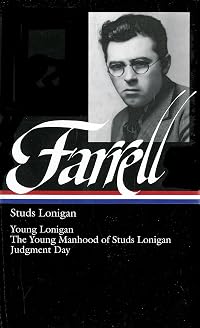
Collected here in one volume is James T. Farrell's renowned trilogy of the youth, early manhood, and death of Studs Lonigan: Young Lonigan, The Young Manhood of Studs Lonigan, and Judgment Day. In this relentlessly naturalistic portrait, Studs starts out his life full of vigor and ambition, qualities that are crushed by the Chicago youth's limited social and economic environment. Studs's swaggering and vicious comrades, his narrow family, and his educational and religious background lead him show more to a life of futile dissipation. Ann Douglas provides an illuminating introductory essay to Farrell's masterpiece, one of the greatest novels of American literature. For more than seventy years, Penguin has been the leading publisher of classic literature in the English-speaking world. With more than 1,700 titles, Penguin Classics represents a global bookshelf of the best works throughout history and across genres and disciplines. Readers trust the series to provide authoritative texts enhanced by introductions and notes by distinguished scholars and contemporary authors, as well as up-to-date translations by award-winning translators. show lessTags
Recommendations



Member Recommendations

Member Reviews
Certainly worthy of its place in the canon of "classic American fiction", Farrell's first and greatest work is a stark depiction of life and death among Chicago's South-side Irish.
The trilogy is often pegged as an example of "naturalism" or "realism" ala Dresier. It is also typically taken to advance some kind of social determinism as its main thesis (by this I mean the idea that the characters' actions and psychological development are almost wholly controlled and constrained by their social situation). Both of these things are fairly evident, but they aren't, to my mind, what make Studs Lonigan an interesting read.
The interesting part is Studs himself, for all his racism, abusiveness, aimlessness, sloth, and other failings is very show more sympathetic character. Furthermore, his principle conflicts seem to be internal struggles that take place when his more benign, good natured interests conflict with his imagined tough guy persona (the one that is "the real stuff"). It is Studs' felt need to live up to a reputation (real or imagined) earned in the 8th grade and, of course, conditioned by the local notions of "manhood" that seems to me to lead to his unfortunate end. show less
The trilogy is often pegged as an example of "naturalism" or "realism" ala Dresier. It is also typically taken to advance some kind of social determinism as its main thesis (by this I mean the idea that the characters' actions and psychological development are almost wholly controlled and constrained by their social situation). Both of these things are fairly evident, but they aren't, to my mind, what make Studs Lonigan an interesting read.
The interesting part is Studs himself, for all his racism, abusiveness, aimlessness, sloth, and other failings is very show more sympathetic character. Furthermore, his principle conflicts seem to be internal struggles that take place when his more benign, good natured interests conflict with his imagined tough guy persona (the one that is "the real stuff"). It is Studs' felt need to live up to a reputation (real or imagined) earned in the 8th grade and, of course, conditioned by the local notions of "manhood" that seems to me to lead to his unfortunate end. show less
This trio is best read as one long continuous novel. The story is a tale of life in an Irish middle class neighborhood on the south side of Chicago from the years 1916 through 1931... all centered on one young Irish punk- Studs Lonigan. If it had been a movie, James Cagney could have won an Oscar starring in the role.
"Studs Lonigan: A Trilogy" is the best and the worst of American Literature- listed as number 29 on the Modern Library’s best 100 novels.
The best: James Farrell writes of his own experiences (casting himself as one of Studs’ neighborhood buddies) so Studs Lonigan presents a very vivid, authentic view of cultural conditions during that era. Studs is a very tough bad boy- dropping out of school at the age of 15 to hang show more out on the Chicago streets. He would have liked to play football but boasts to his buddies, “I was out for freshman team, and the coach liked my stuff, but he finally canned me. Said it was discipline, because I didn’t show up every day. Hell, if I showed up every day, that meant I’d have to go to school. And they raise hell with you for not having homework and that stuff. You can’t fake Latin and algebra, and Jesus, you have to write compositions for English. None of that for me.”
In a simple matter-of-fact natural narrative, Farrell schools the reader on American life almost 100 years ago covering the turbulent years of WW I, civil disorder and race riots, Prohibition, the stock market crash of 1929, and the Great Depression. The working class population grappled with issues like their own personal battle between religion and atheism, socialism and capitalism. Read about Catholic schools with nuns as teachers, gangs that hang out on street corners and in pool halls, the prejudice against all other nationalities and religions, the rules and rituals of dating and the limited proficiency of the medical profession. It’s every bit as good as Dos Passos’ Trilogy "U.S.A." which ranks number 23 on the Modern Library list.
The worst: This series is the most politically incorrect piece of literature I’ve ever come across. It doesn’t get any worse than this! As editors felt the need to remove the dreadful N word from "Uncle Tom’s Cabin" in recent years, it amazes me that this work of literature has been left alone… possibly because it would require removing entire paragraphs from the "Studs Lonigan Trilogy".
Farrell certainly exposes the dark underbelly of middle class American society: murder, rape, petty theft, sexual transmitted diseases, intolerance and bigotry. It is difficult to read through the instances of brutal cruelty. And so much hate! Perhaps poverty breeds hate, and after the stock market crash of 1929, everyone was looking for someone to blame.
And it is disheartening to read of the unwarranted dangers:
Playing neighborhood football could be fatal because the game was played without protection, and the games often erupted into chaotic violence. It was not unusual to have a death occur during a game.
And Prohibition! All the neighborhood punks drank and the only alcohol available was moonshine. “The stuff was generally strong enough to corrode a cast iron gut. It was canned heat, rot gut, furniture varnish, rat-poison. When you drank it, you took your life in your hands, and even if it didn’t kill you, it might make you blind, or put your heart, liver, guts or kidneys on the fritz for life.” Yet they drank! By the time Studs reaches 30 years old, many of his childhood friends are already dead.
The three books of Studs Lonigan are "Young Lonigan", "The Young Manhood of Studs Lonigan", and "Judgement Day". And indeed, what a judgement day it was! Reading this trilogy was a real eye-opener. Generally speaking, I like bad boys. But Studs had too few redeeming qualities. He was just too, too bad.
Taking the worst features of the three novels into consideration I concluded that the primitive attitudes, barbaric actions, and uncivilized behavior were all based on uneducated, raw ignorance. It makes for difficult reading, but what a treat to enter a time capsule that transports you to a very real whole other world in a very different time. It’s time travel at it’s best. show less
"Studs Lonigan: A Trilogy" is the best and the worst of American Literature- listed as number 29 on the Modern Library’s best 100 novels.
The best: James Farrell writes of his own experiences (casting himself as one of Studs’ neighborhood buddies) so Studs Lonigan presents a very vivid, authentic view of cultural conditions during that era. Studs is a very tough bad boy- dropping out of school at the age of 15 to hang show more out on the Chicago streets. He would have liked to play football but boasts to his buddies, “I was out for freshman team, and the coach liked my stuff, but he finally canned me. Said it was discipline, because I didn’t show up every day. Hell, if I showed up every day, that meant I’d have to go to school. And they raise hell with you for not having homework and that stuff. You can’t fake Latin and algebra, and Jesus, you have to write compositions for English. None of that for me.”
In a simple matter-of-fact natural narrative, Farrell schools the reader on American life almost 100 years ago covering the turbulent years of WW I, civil disorder and race riots, Prohibition, the stock market crash of 1929, and the Great Depression. The working class population grappled with issues like their own personal battle between religion and atheism, socialism and capitalism. Read about Catholic schools with nuns as teachers, gangs that hang out on street corners and in pool halls, the prejudice against all other nationalities and religions, the rules and rituals of dating and the limited proficiency of the medical profession. It’s every bit as good as Dos Passos’ Trilogy "U.S.A." which ranks number 23 on the Modern Library list.
The worst: This series is the most politically incorrect piece of literature I’ve ever come across. It doesn’t get any worse than this! As editors felt the need to remove the dreadful N word from "Uncle Tom’s Cabin" in recent years, it amazes me that this work of literature has been left alone… possibly because it would require removing entire paragraphs from the "Studs Lonigan Trilogy".
Farrell certainly exposes the dark underbelly of middle class American society: murder, rape, petty theft, sexual transmitted diseases, intolerance and bigotry. It is difficult to read through the instances of brutal cruelty. And so much hate! Perhaps poverty breeds hate, and after the stock market crash of 1929, everyone was looking for someone to blame.
And it is disheartening to read of the unwarranted dangers:
Playing neighborhood football could be fatal because the game was played without protection, and the games often erupted into chaotic violence. It was not unusual to have a death occur during a game.
And Prohibition! All the neighborhood punks drank and the only alcohol available was moonshine. “The stuff was generally strong enough to corrode a cast iron gut. It was canned heat, rot gut, furniture varnish, rat-poison. When you drank it, you took your life in your hands, and even if it didn’t kill you, it might make you blind, or put your heart, liver, guts or kidneys on the fritz for life.” Yet they drank! By the time Studs reaches 30 years old, many of his childhood friends are already dead.
The three books of Studs Lonigan are "Young Lonigan", "The Young Manhood of Studs Lonigan", and "Judgement Day". And indeed, what a judgement day it was! Reading this trilogy was a real eye-opener. Generally speaking, I like bad boys. But Studs had too few redeeming qualities. He was just too, too bad.
Taking the worst features of the three novels into consideration I concluded that the primitive attitudes, barbaric actions, and uncivilized behavior were all based on uneducated, raw ignorance. It makes for difficult reading, but what a treat to enter a time capsule that transports you to a very real whole other world in a very different time. It’s time travel at it’s best. show less
The first time I read this novel I was in high school while a subsequent reading was for a book group. Farrell is one of the American naturalists. He chose to use his own personal knowledge of Irish-American life on the South Side of Chicago to create a description of an average American slowly destroyed by the "spiritual poverty" of his environment. Both Chicago and the Irish-American Roman Catholic Church of that era are described in detail, and faulted. Farrell describes Studs sympathetically as Studs slowly deteriorates, changing from a tough but fundamentally good-hearted, adventurous teenage boy to an embittered, physically weak alcoholic.
While Farrell exhibits a gritty realism in his story of Chicago his prose has too many show more "rough" edges for my taste. The book seems dated in a way that does not happen with Dreiser or Norris, both of whom I admire more than Farrell. show less
While Farrell exhibits a gritty realism in his story of Chicago his prose has too many show more "rough" edges for my taste. The book seems dated in a way that does not happen with Dreiser or Norris, both of whom I admire more than Farrell. show less
Young Lonnigan
This is the first in the triology of stories chronicling the coming of age and life of Studs Lonigan in pre-World War I Chicago. The story picks up on the day of Studs' graduation from eigth grade, facing a decision of whether to follow his mother's wishes and choose a life of service to the Catholic Church, follow his father's wishes and take over the family business, or neither and follow his own meandering wishes. Studs comes across as a bit of a wanna-be 'tough', always looking for ways to impress the older, more experienced kids. Studs eventually makes several choices, each of which is salve for a fragile ego, and ends up as part of a gang of Irish Catholic kids always on the lookout for the quick, easy fun. Studs' show more rich inner life is detailed on every page, giving us a glimpse of a young man with a seemingly deep faith and thoughts of pure love living next to visions of violence and debauchery.
The Young Manhood of Studs Lonnigan
This second part of Farrell's examination of a life describes the subtle, unnoticed passing of days in Studs' life now that he has arrived in manhood. Studs was eager to reach the age of accountability but now that he has reached it, he beings to long for his youth. Rushing towards his adult life, eager for the years, Studs passed into manhood without fanfare or acknowledgement, only to find the uncertainty of his future and the certainty of a monotonous hours and days. Realizing that the days are now flying past him, carrying him farther away from the innocent days of his youth and closer to death, Studs faces daily moral quandries. His battles to hold to the Catholic churches teachings, his families expectations of him, and his own committments to his health, well-being, and love are the meat of this story. Studs fails more than he succeeds in the battles, succombing to the easy, ego stroking crowd of his youth who seem to be engaged in missions of self-destruction.
Judgement Day
With this, the Studs Lonnigan triology is complete. In this final episode of the story, Studs, at 30, seems to compare all of his life, his failures and his successes, to his life as an adolescent. As the title suggests, Studs meets with an early death, largely the result of his own careless and hard lived youth.
Farrell, in an introduction to this edition written just about six years after the first publication of the novels, says that his story was written as an examination of 'a normal American boy of Irish-Catholic extraction' and the 'spiritual poverty' of his education and life. By 'spiritual poverty' Farrell seems to mean the emptiness of a certain set of social values common to the time and group. I didn't necessarily agree with his determination that the values were empty and useless but Farrell's story evokes the cyclical nature of life and generations. The story also gives a powerful voice to the common plight of all people in their inner struggle between their faith and temptation. The best parts of the books were the sections when the reader is given access to Studs' thoughts as he constantly commits to live differently but then gives in to his temptations or when he dreams of himself as a tough, confident young man only to choose the weakest or easiest way out of a difficult situation. In the end, I was not looking at Studs' life in judgement. Rather, I felt a deep kinship with him and his struggles.
As a caution, all of these books deal with racial prejudice and divides, often describing the racist thoughts of Studs and his family and friends. While these descriptions may be an accurate accounting of racial difficulties of the time, they are difficult to read sometimes. Farrell deals with white flight, communism, politics, and class struggles also, all as they inform the lives of Studs and those around him.
4 bones!!!! show less
This is the first in the triology of stories chronicling the coming of age and life of Studs Lonigan in pre-World War I Chicago. The story picks up on the day of Studs' graduation from eigth grade, facing a decision of whether to follow his mother's wishes and choose a life of service to the Catholic Church, follow his father's wishes and take over the family business, or neither and follow his own meandering wishes. Studs comes across as a bit of a wanna-be 'tough', always looking for ways to impress the older, more experienced kids. Studs eventually makes several choices, each of which is salve for a fragile ego, and ends up as part of a gang of Irish Catholic kids always on the lookout for the quick, easy fun. Studs' show more rich inner life is detailed on every page, giving us a glimpse of a young man with a seemingly deep faith and thoughts of pure love living next to visions of violence and debauchery.
The Young Manhood of Studs Lonnigan
This second part of Farrell's examination of a life describes the subtle, unnoticed passing of days in Studs' life now that he has arrived in manhood. Studs was eager to reach the age of accountability but now that he has reached it, he beings to long for his youth. Rushing towards his adult life, eager for the years, Studs passed into manhood without fanfare or acknowledgement, only to find the uncertainty of his future and the certainty of a monotonous hours and days. Realizing that the days are now flying past him, carrying him farther away from the innocent days of his youth and closer to death, Studs faces daily moral quandries. His battles to hold to the Catholic churches teachings, his families expectations of him, and his own committments to his health, well-being, and love are the meat of this story. Studs fails more than he succeeds in the battles, succombing to the easy, ego stroking crowd of his youth who seem to be engaged in missions of self-destruction.
Judgement Day
With this, the Studs Lonnigan triology is complete. In this final episode of the story, Studs, at 30, seems to compare all of his life, his failures and his successes, to his life as an adolescent. As the title suggests, Studs meets with an early death, largely the result of his own careless and hard lived youth.
Farrell, in an introduction to this edition written just about six years after the first publication of the novels, says that his story was written as an examination of 'a normal American boy of Irish-Catholic extraction' and the 'spiritual poverty' of his education and life. By 'spiritual poverty' Farrell seems to mean the emptiness of a certain set of social values common to the time and group. I didn't necessarily agree with his determination that the values were empty and useless but Farrell's story evokes the cyclical nature of life and generations. The story also gives a powerful voice to the common plight of all people in their inner struggle between their faith and temptation. The best parts of the books were the sections when the reader is given access to Studs' thoughts as he constantly commits to live differently but then gives in to his temptations or when he dreams of himself as a tough, confident young man only to choose the weakest or easiest way out of a difficult situation. In the end, I was not looking at Studs' life in judgement. Rather, I felt a deep kinship with him and his struggles.
As a caution, all of these books deal with racial prejudice and divides, often describing the racist thoughts of Studs and his family and friends. While these descriptions may be an accurate accounting of racial difficulties of the time, they are difficult to read sometimes. Farrell deals with white flight, communism, politics, and class struggles also, all as they inform the lives of Studs and those around him.
4 bones!!!! show less
This is a novel originally designated as a contemporary best seller that has become a classic. It's a fine novel and one of the best explorations of a not-very bright mind that exists in world literature. Modern Americans should read this book. The Modern Democrats will want to be able to help Studs, the Republicans will burn the book because it knows too much. But if you want to know something of who you are, this is the book for men. Originally written as three novels from 1929 to 1934. I read this cover to cover twice, and still dip into it.
I understand readers who complain about the book seeming dated. The slang the characters use, their clothes, even some of their concerns, are anachronisms now. But it strikes me as a spot-on description of the rough world of second generation, Irish Catholic toughs in Chicago in the 1920s. Definitely not the glittery 1920s of Fitzgerald or Dorothy Parker!
The final book of the trilogy, Judgment Day, is the longest of the three and my favorite. It has a lot more going on than just what is in Studs Lonigan’s head.
This final volume really gives a compelling view of the Great Depression, focusing as it does on the middle class characters and what they lose because of the depression. Because these people have jobs, own their own businesses, show more invest in real estate, speculate on the stock market, they seem more familiar and relevant to me than dirt farmers (Grapes of Wrath), labor agitators (USA Trilogy), or other soup line characters from books and movies about the Great Depression.
Except for compulsive “list” readers, I would recommend skipping the first two volumes and only reading Judgment Day. It stands alone and, I think, is the best of the three. show less
The final book of the trilogy, Judgment Day, is the longest of the three and my favorite. It has a lot more going on than just what is in Studs Lonigan’s head.
This final volume really gives a compelling view of the Great Depression, focusing as it does on the middle class characters and what they lose because of the depression. Because these people have jobs, own their own businesses, show more invest in real estate, speculate on the stock market, they seem more familiar and relevant to me than dirt farmers (Grapes of Wrath), labor agitators (USA Trilogy), or other soup line characters from books and movies about the Great Depression.
Except for compulsive “list” readers, I would recommend skipping the first two volumes and only reading Judgment Day. It stands alone and, I think, is the best of the three. show less
Sadly overlooked and often dismissed as simply a "Great Depression" novel, Studs is a massive epic of working class literature. This is the story of a guy who wants nothing more from life than the respect of his fellows, and how, ultimately, he is crushed under the weight of that need. - Justin
Members
- Recently Added By
Lists

Favorite Long Books
330 works; 42 members

In or About the 1930s
198 works; 27 members

The Modern Library's 100 Best Novels: The Board's List
85 works; 6 members

Books Read in 2023
5,638 works; 147 members

Lamont's Hundred Best Novels (1947)
100 works; 4 members
Trinity College Booklist (1951): Class Ten, English Literature
358 works; 5 members

The Torchlight List
95 works; 1 member

Modern Library's 100 Best Novels
100 works; 2 members

Fiction With Familiar Settings
280 works; 94 members
Author Information

80+ Works 1,952 Members
James T. Farrell was born Chicago, Illinois on February 27, 1904. He attended the University of Chicago, but left before graduating. During his lifetime, he publish more than 50 books, including 28 novels and 16 collections of short stories. He is the author of the Studs Lonigan Trilogy, the Danny O'Neill Pentalogy, The Bernard Carr Trilogy, and show more The Universe of Time series featuring Eddie Ryan. He died on August 22, 1979. (Bowker Author Biography) show less
All Editions
Some Editions
Awards and Honors
Notable Lists
Series

Belongs to Publisher Series
Work Relationships
Common Knowledge
- Canonical title
- Studs Lonigan
- Original title
- Studs Lonigan
- Original publication date
- 1935
- People/Characters
- Studs Lonigan
- Important places
- Chicago, Illinois, USA
- Related movies
- Studs Lonigan (1960 | IMDb); Studs Lonigan (1979 | IMDb)
- Epigraph
- East Side, West Side
All around the town,
The tots sing ring-a-rosie,
London Brigs is falling down.
Boys and girls together,
Me and Mamie O'Rourke,
We tripped the light fantastic
On the sidewalks of New Y... (show all)ork.
= Popular song
A literature that cannot be vulgarized is no literature at all and will perish.
- Frank Norris
Except in the case of some rarely gifted nature there never will be a good man who has not from his childhood been used to play amid things of beauty and make of them a joy and study.
- Plato, Republic, Jowett trans... (show all)lation
The polgnancy of situations that evoke reflection lies in the fact that we really do not know the meaning of the tendencies that are pressing for action.
- John Dewey Human Nature and Conduct - Dedication
- To Marjorie and James Henle
Whose encouragement was so helpful
in completing this trilogy - First words
- Studs Lonigan, on the verge of fifteen, and wearing his first suit of long trousers, stood in the bathroom with a Sweet Caproal pasted in his mug.
- Last words
- (Click to show. Warning: May contain spoilers.)The two daughters lead the hysterical mother out of the room and the nurse covered the face of Studs Lonigan with a white sheet.
Classifications
Statistics
- Members
- 1,072
- Popularity
- 24,052
- Reviews
- 13
- Rating
- (3.86)
- Languages
- Dutch, English, German, Italian
- Media
- Paper, Ebook
- ISBNs
- 20
- UPCs
- 1
- ASINs
- 33