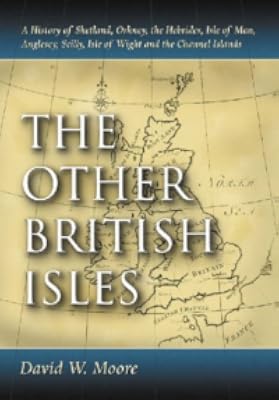
The Other British isles : A History of Shetland, Orkney, the Hebrides, Isle of Man, Anglesey, Scilly, Isle of Wight and the Channel Islands
by David W Moore
On This Page
Description
"This history tells the stories of the Shetlands, the Orkneys, the Hebrides, the Channel Islands, the Scilly Isles, and the Isles of Man and Wight. From their earliest settlement, to Roman, Norse and Norman occupation, to the struggle to maintain their unique identities in today's world, the lives of these islands are a fascinating slice of European history"--Provided by publisher.Tags
Recommendations



































Member Recommendations





Member Reviews
Short but very detailed capsule histories of Shetland, Orkney, the Hebrides, the Isle of Man, Anglesey, Scilly, the Isle of Wight, and the Channel Islands, each of which are surprisingly different, with much variation in influence and trajectory. The maps are pretty crap, but the descriptions still made me want to jump on a plane (or a ferry boat) and go see these places.
Being of Celtic stock and from one of the 6,289 offshore ‘islands of the archipelagos’, but not from one visited or even indexed by David Moore, I could readily accept his statements on the differences of attitude if not cultures of ‘islanders’ to those peoples on the mainland of Great Britain, but I argue with his claim that history readers might be forgiven for forgetting these islands form part of the nation – it is called the British Isles after all!
Firstly, the physical book itself, handsomely published by the appropriately named McFarland, a large yet handy volume, regretfully containing in this version just a handful of sketched maps. As I enjoyed the book I longed for photographs, even at one stage - the descriptions show more of Skara Brae - resorting to Google, so as to actually “see” what I had learned by my reading. I was able to rely on personal memories for several of the islands (Jersey, Guernsey, Orkney, Wright and Mann) in support of the mind-pictures of the prose, but would have liked some pictures, or indeed, more descriptions of these beautiful isles from Professor Moore.
Of Skara Brae itself the author firmly establishes its antiquity by creating a mind-picture of a path descending to the foundations past a series of ‘signposts’ recording such historical events as the moon landing, various inventions, the crusades, the Roman Empire, the building of the pyramids until – oldest of all - the founding of Skara Brae itself. Dated to 3100 BCE this ‘village’ had built in closet organizers, sleeping couches and even rudimentary plumbing and drainage – long before the Romans settled. An island occupation from over 5000 years ago that astounds us still.
This is a book for history buffs, written by a history professor, so is not for casual skimming, and it requires concentration – almost studying – but the rewards justify one’s attention. The work is a deep historical research leading to thrilling and revealing accounts. Despite my visiting many times and often reading about the Channel Isles – those geographical, incongruous anomalies near Brittany – I had little idea of the waves of anthropological storms that had washed around them. Anglesey – again oft visited and, I thought before reading this work, well know - proved to have exciting stories of Roman occupation, Vikings, Druids and Welsh Kings, It was, Moore reveals, called Mổn mam Cymru, the Mother of Wales as long ago as the time of Gruffydd in 1081.
This is a book that can be strongly recommended to any ‘history-buff’ or even more serious studiers of the history of the British Isles, or of man and Western civilization. show less
Firstly, the physical book itself, handsomely published by the appropriately named McFarland, a large yet handy volume, regretfully containing in this version just a handful of sketched maps. As I enjoyed the book I longed for photographs, even at one stage - the descriptions show more of Skara Brae - resorting to Google, so as to actually “see” what I had learned by my reading. I was able to rely on personal memories for several of the islands (Jersey, Guernsey, Orkney, Wright and Mann) in support of the mind-pictures of the prose, but would have liked some pictures, or indeed, more descriptions of these beautiful isles from Professor Moore.
Of Skara Brae itself the author firmly establishes its antiquity by creating a mind-picture of a path descending to the foundations past a series of ‘signposts’ recording such historical events as the moon landing, various inventions, the crusades, the Roman Empire, the building of the pyramids until – oldest of all - the founding of Skara Brae itself. Dated to 3100 BCE this ‘village’ had built in closet organizers, sleeping couches and even rudimentary plumbing and drainage – long before the Romans settled. An island occupation from over 5000 years ago that astounds us still.
This is a book for history buffs, written by a history professor, so is not for casual skimming, and it requires concentration – almost studying – but the rewards justify one’s attention. The work is a deep historical research leading to thrilling and revealing accounts. Despite my visiting many times and often reading about the Channel Isles – those geographical, incongruous anomalies near Brittany – I had little idea of the waves of anthropological storms that had washed around them. Anglesey – again oft visited and, I thought before reading this work, well know - proved to have exciting stories of Roman occupation, Vikings, Druids and Welsh Kings, It was, Moore reveals, called Mổn mam Cymru, the Mother of Wales as long ago as the time of Gruffydd in 1081.
This is a book that can be strongly recommended to any ‘history-buff’ or even more serious studiers of the history of the British Isles, or of man and Western civilization. show less
 This review was written for LibraryThing Early Reviewers.
For an island nation, most histories of Britain focus on one or two--or perhaps a handful--of the thousands of islands that make up the nation. Moore's book remedies that gap, and does it in far-ranging way that's sometimes fascinating, sometimes pedestrian, and sometimes so compelling that I was left with the urge to up stakes and head to the islands myself.
This review was written for LibraryThing Early Reviewers.The Other British Isles is a brisk run through of the history of some of the larger islands and island groups of Britain. Covering how they respectively came to be (usually rising seas making hill tops into islands), human habitation and how the wider world came into contact and interacted with them.
Written in the early 21st Century, at least some of the information in each chapter must be out of date and it would be interesting to see the directions each isles has taken since then. The Other British Isles has also helped increase my trivia knowledge; there are apparently more New Zealanders of Shetland ancestry than there are Shetland Islanders is but one good example of this.
Written in the early 21st Century, at least some of the information in each chapter must be out of date and it would be interesting to see the directions each isles has taken since then. The Other British Isles has also helped increase my trivia knowledge; there are apparently more New Zealanders of Shetland ancestry than there are Shetland Islanders is but one good example of this.
Countless popular and scholarly histories have been written on England, Scotland and Ireland. Yet Britain (as we learn from this book) is actually an "archipelago nation" that also includes over 6200 offshore islands, peopled over the millennia by diverse peoples speaking at least 7 different languages. These islands have largely been ignored in the traditional histories, in favor of English exclusivity.
In The Other British Isles, author David W. Moore redresses the balance by focusing on the history of eight distinct islands and island groups. These include Shetland (15 inhabited islands lying to the far northeast of Scotland); Orkney (90 or so islands off the northern coast of Scotland); the Hebrides (~500 islands off Scotland's show more Atlantic coast); the Isle of Man (which, nestled between England and Ireland, is technically part of neither Great Britain nor the United Kingdom); the Isle of Anglesey (perched off the northern shore of Wales); the Isles of Scilly (25 miles southwest of Britain); the famous Isle of Wight; and finally, the Channel Islands (lying off the northern coast of France, but nonetheless, a British dependency).
Moore's book traces the history of each of these island groups from ancient through modern times, and describes each in terms of ethnicities, culture, politics, religion, and economics. The account is comprehensive, and is geared to the serious (not the casual) reader. What the book may lack in resonant prose (the account tends to be a bit dry) it makes up for in well- documented factual detail. The text is supplemented by simple maps (showing the location of each of the island groups). Appendices summarize census data and information on geography, as well as political and economic profiles, and a list of references is offered for further reading. One notable feature lacking herein is photographs -- but the motivated reader will likely find them readily enough via the internet. In sum, this book offers a wealth of information on the "other" isles of Britain, places steeped in history but overlooked in conventional accounts. show less
In The Other British Isles, author David W. Moore redresses the balance by focusing on the history of eight distinct islands and island groups. These include Shetland (15 inhabited islands lying to the far northeast of Scotland); Orkney (90 or so islands off the northern coast of Scotland); the Hebrides (~500 islands off Scotland's show more Atlantic coast); the Isle of Man (which, nestled between England and Ireland, is technically part of neither Great Britain nor the United Kingdom); the Isle of Anglesey (perched off the northern shore of Wales); the Isles of Scilly (25 miles southwest of Britain); the famous Isle of Wight; and finally, the Channel Islands (lying off the northern coast of France, but nonetheless, a British dependency).
Moore's book traces the history of each of these island groups from ancient through modern times, and describes each in terms of ethnicities, culture, politics, religion, and economics. The account is comprehensive, and is geared to the serious (not the casual) reader. What the book may lack in resonant prose (the account tends to be a bit dry) it makes up for in well- documented factual detail. The text is supplemented by simple maps (showing the location of each of the island groups). Appendices summarize census data and information on geography, as well as political and economic profiles, and a list of references is offered for further reading. One notable feature lacking herein is photographs -- but the motivated reader will likely find them readily enough via the internet. In sum, this book offers a wealth of information on the "other" isles of Britain, places steeped in history but overlooked in conventional accounts. show less
This review was written for LibraryThing Early Reviewers.Moore has written a definitive history of the smaller islands around what we normally think of when we hear "British Isles". I knew of some of these islands, but not all of them, and I knew almost nothing about their histories. Each set of islands has a unique history, character, and feel, and this book does an excellent job of conveying this to the reader. I did get a bit lost at times since I am not a student of British history, but that is my fault as an American and not a fault with the book! I learned so much by reading this book and found new places that I hope to visit one day. If there is any complaint at all, it is that I missed having photographs. A few would have been helpful and would have kept me from running to the show more computer to see what something looks like, particularly historic places. The information is certainly packed into these pages! I recommend this to anyone who wants to increase their knowledge of the history of all the British Isles. show less
This review was written for LibraryThing Early Reviewers.No doubt the history of the islands surrounding England and Scotland is told mostly sketchely in larger histories of the British Isles. This book remedies any neglect of these small islands. The author provides detailed histories of Shetland, Orkney, the Hebrides, Isle of Man, Anglesey, Scilly, Isle of Wight and the Channel Islands. Moore covers the full gamut of the stories of these islands from mythology to megalithic times to Gaels/Celts/Norse/Saxon and other early settlers up to the modern era. He describes the cultural, economic, social, religious and political circumstances of each of the islands. Among the many interesting revelations is the political status of the islands. One might have assumed they are political subdivisions show more of Great Britian akin to counties, but several are semi-autonomus states, having a surprising degree of self-governance removed from parliament. Some little known events and occurences are interesting to learn, e.g. the Isle of Man had large POW-like camps during WWII where people of foreign heritage were interned for the course of the war. The Channel Islands were purposely abandoned to the Germans during the war and not liberated until some time after the invasion of France.
This book will resonant to people wishing to learn about, and perhaps travel to, places not in the mainstream of destination interest. The stories of these islands will be particularly interesting to people whose heritage links back to them, as our family's does to Man. show less
This book will resonant to people wishing to learn about, and perhaps travel to, places not in the mainstream of destination interest. The stories of these islands will be particularly interesting to people whose heritage links back to them, as our family's does to Man. show less
This review was written for LibraryThing Early Reviewers.Members
- Recently Added By
Author Information
1 Work 55 Members
British-born David W. Moore, a college history professor, lives in Los Angeles, California.
Common Knowledge
- Canonical title
- The Other British isles : A History of Shetland, Orkney, the Hebrides, Isle of Man, Anglesey, Scilly, Isle of Wight and the Channel Islands
- Original publication date
- 2005
- People/Characters
- Charles II, King of England, Scotland, and Ireland; Charles I, King of England, Scotland, and Ireland; Victor Hugo; Bede or The Venerable Bede; Elizabeth I, Queen of England
- Important places
- Shetland, Scotland, UK; Orkney, Scotland, UK; Outer Hebrides, Scotland, UK (as The Western Isles, Scotland); Isle of Man; Anglesey, Wales, UK; Isles of Scilly, England, UK (show all 13); Isle of Wight, England, UK; Channel Islands; Jersey, Channel Islands; Guernsey, Channel Islands; Na h-Eileanan Siar, Scotland, UK (a.k.a., Outer Hebrides); Alderney, Channel Islands; Sark, Channel Islands
- First words
- Acknowledgments
No book is an island, entire of itself, with apologies to John Donne, and so it is with this one, hewn from a trans-oceanic compilation of readings, on-site observations, and archive and museum material... (show all)s.
Preface
British history is not what it used to be. Valid questions about selection and organization of material were raised decades ago, not least of them questions about histories of England masquerading as British h... (show all)istory. England and Britain are not synonyms and the horizons of Shakespeare's "blessed plot" have rolled back to accommodate other parts. Yet there is more to it than adding Scotland and Wales to the mix. Britain is an archipelago nation, though history readers might be forgiven for not appreciating it: such is the ease with which the off-island slip through the fingers of historical reporting. Although small pieces of history individually, the outer-island aggregate is not insignifiant. Over half a million people make homes there, and their earliest habitations are among the oldest anywhere in Europe. Accessory to the main event at best and sometimes ignored altogether, the offshore assumes center stage here.
1
Shetland: "Ultima Thule"?
In later years a new age will come in which the Ocean shall relax its hold over the world and a vast land shall lie open to view ... and Thule will not be the last country on earth... (show all)" — Seneca Medea
The 14-hour ferry service from Aberdeen on the northeastern coast of Scotland to Shetland is the longest scheduled in British waters, affording enough time to reflect on cruder vessels once braving these hostile seas. A force nine gale is one thing with modern stabilizers and heated cabins but quite another in a Viking galley where the only protection was sealskins and the instant anesthetic of a North Sea wind. The overnight voyage is fleeting in summer with a late dusk dimming the sky around midnight known locallly as the simmer dim. In the winter months, ships' lights pierce a vast northern darkness. - Last words
- (Click to show. Warning: May contain spoilers.)The English language has prevailed. German occupation in World War II is blamed for exposing evacuees to English, but the tide began long before that. The number of Norman-French speakers at the outset of the 21st century was small with less than 5 percent reportedly fluent in Dgernesiais and those conversant in Jèrriais only a little higher, down from 20 years ago. It is flickering but the signs are it will survive. Efforts to keep it alive persist. An ability to talk in the vernacular may yet win appeal; it is a way of maintaining cultural distance in the face of newcomers, a durable in a hurried age.
Classifications
- Genres
- Nonfiction, History, Anthropology, General Nonfiction
- DDC/MDS
- 941.00942 — History & geography History of Europe British Isles Historical periods of British Isles Geographic treatment, biography Land and landforms
- LCC
- DA668 .M66 — History of Europe, Asia, Africa and Oceania Great Britain History of Great Britain England
- BISAC
Statistics
- Members
- 55
- Popularity
- 555,347
- Reviews
- 13
- Rating
- (3.50)
- Languages
- English
- Media
- Paper, Ebook
- ISBNs
- 3
- ASINs
- 1