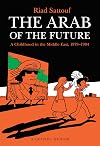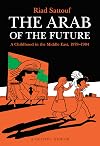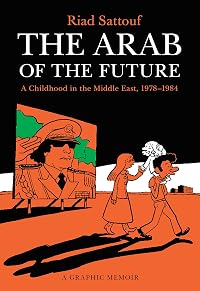
The Arab of the Future: A Childhood in the Middle East, 1978-1984: A Graphic Memoir
by Riad Sattouf
The Arab of the Future (1)
On This Page
Description
"In striking, virtuoso graphic style that captures both the immediacy of childhood and the fervor of political idealism, Riad Sattouf recounts his nomadic childhood growing up in rural France, Gaddafi's Libya, and Assad's Syria--but always under the roof of his father, a Syrian Pan-Arabist who drags his family along in his pursuit of grandiose dreams for the Arab nation. Riad, delicate and wide-eyed, follows in the trail of his mismatched parents; his mother, a bookish French student, is as show more modest as his father is flamboyant. Venturing first to the Great Socialist People's Libyan Arab State and then joining the family tribe in Homs, Syria, they hold fast to the vision of the paradise that always lies just around the corner. And hold they do, though food is scarce, children kill dogs for sport, and with locks banned, the Sattoufs come home one day to discover another family occupying their apartment. The ultimate outsider, Riad, with his flowing blond hair, is called the ultimate insult... Jewish. And in no time at all, his father has come up with yet another grand plan, moving from building a new people to building his own great palace. Brimming with life and dark humor, The Arab of the Future reveals the truth and texture of one eccentric family in an absurd Middle East, and also introduces a master cartoonist in a work destined to stand alongside Maus and Persepolis"-- show lessTags
Recommendations




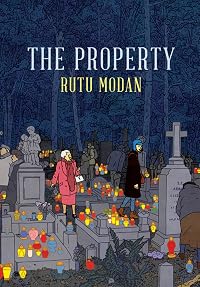
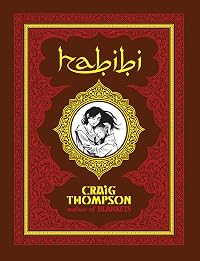


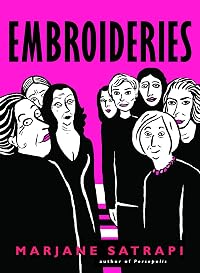



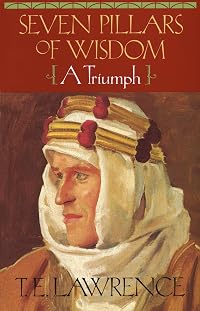

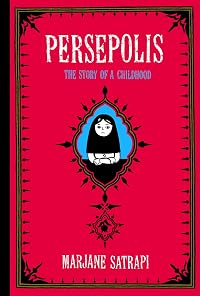
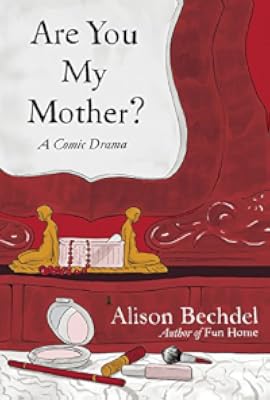
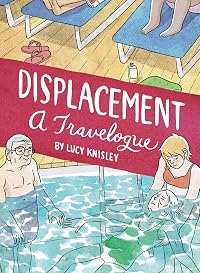
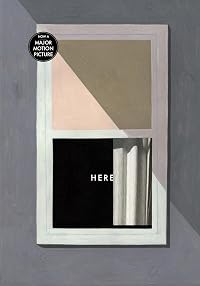







Member Recommendations
Member Reviews
Brutal honesty from a 4-year-old’s perspective. It’s so innocent and yet so devastating. Riad’s mother is French, his dad Syrian. Born in France, his family first moves to Libya then to Syria. This is a fierce look at Riad’s view of his parents and his homes. The countries are filthy, bleak, garbage strewn, misogynistic, & racist. His father, claiming to be an atheist, finds every single bit of it beautiful. Qaddafi and Assad are his heroes. Riad loves his Arab family. He wants the gun his father has promised. He wants to be part of the all-out bruising fights with cousins. But upon returning to France, finally, and staying with his French grandparents he realizes he doesn’t want to go back. And there it ends. I’ve been show more looking for volume 2 and 3 (I have the last volume 4). Like Riad, I don’t want to see where his life goes from here. But it seems he’s grown up well, so I’m ready to travel this journey with him. And now I’m forewarned of how bad it could be. Serious trigger warnings, especially given Muslims’ extreme dislike of dogs (I didn’t know this) and so there is a horrific episode near the end. Your heart will be crushed. So beware. show less
While blurbs can't generally be relied on, I was hoping that comparisons of this graphic memoir to Maus and Persepolis were more than mere marketing technique. I really enjoy graphic non-fiction, and memoir is often an intriguing use of the form. Unfortunately, this particular one feels more like an extended political cartoon than personal experience, no doubt in part because it all takes place before the author's school years and I rather doubt it's based on more than fragmentary memories.
The central figure of this installment of what promises to be a multivolume work is Riad Sattouf's father, a displaced, French-educated Pan-Arabist who understandably strives to see the best in the flawed societies he's championed. But as portrayed in show more this volume, he feels flatter and more stereotypical than such a complicated figure perhaps ought to be. Like just about every other character in the book (with the possible exception of the author's French mother), his father is overall an unpleasant person and made harder to sympathize by cartoonish exaggeration of facial expression. I'd say the book was tremendously unflattering towards Arabs, except that it seems just as biased against every non-Arab represented. Even though the mother is an exception to this general rule, she's portrayed as a cipher and little space is devoted to depicting her reaction to the strange scenarios she found herself in.
Basically, while I appreciated Sattouf's exploring places and times I was unfamiliar with, I did not particularly enjoy or appreciate this book and don't anticipate looking more than casually into the sequels. As the focus likely shifts towards the author's own views and experiences, the narrative may become more nuanced and interesting, but if not, it doesn't seem likely to merit the comparisons to other, better examples of the genre. show less
The central figure of this installment of what promises to be a multivolume work is Riad Sattouf's father, a displaced, French-educated Pan-Arabist who understandably strives to see the best in the flawed societies he's championed. But as portrayed in show more this volume, he feels flatter and more stereotypical than such a complicated figure perhaps ought to be. Like just about every other character in the book (with the possible exception of the author's French mother), his father is overall an unpleasant person and made harder to sympathize by cartoonish exaggeration of facial expression. I'd say the book was tremendously unflattering towards Arabs, except that it seems just as biased against every non-Arab represented. Even though the mother is an exception to this general rule, she's portrayed as a cipher and little space is devoted to depicting her reaction to the strange scenarios she found herself in.
Basically, while I appreciated Sattouf's exploring places and times I was unfamiliar with, I did not particularly enjoy or appreciate this book and don't anticipate looking more than casually into the sequels. As the focus likely shifts towards the author's own views and experiences, the narrative may become more nuanced and interesting, but if not, it doesn't seem likely to merit the comparisons to other, better examples of the genre. show less
 This review was written for LibraryThing Early Reviewers.
"The Arab of the Future" succeeds on several levels at once. In one sense, it's an unmistakably personal story told through the eyes of a bright, empathetic child who's forced to shuffle between two cultures, neither of which he understands completely. It's also a deeply political work: a recollection of a childhood spent in the shadow of the grand, now mostly disappeared, project of secular Arab nationalism. Sattouf's take on the Libya and Syria he saw as a child is clear-eyed and pitiless: he describes a desolate, poor, filthy landscape dotted by propaganda posters and half-finished construction projects and filled with hostile, uneducated people. His description of the bizarre government policies that came to be part of everyday life show more in Ghaddafi's Libya is also not to be missed. While Sattouf's descriptions of France aren't exactly glowing, either, in this sense, "The Arab of the Future" reminded me a bit of V.S. Naipaul's unsentimental take on the Caribbean, which mostly dispenses with any perceived romanticism to focus on the place's general air of sadness and underdevelopment. Sattouf's got a great eye for detail: from the cracks in the walls of his family's house to the way that animals were routinely mistreated in the Syria of his youth, the author effectively communicates the shock and sadness he felt after moving there. "The Arab of the Future" is a pretty good description of what severe poverty and long-term mismanagement can do to the collective personality of a country. The book is also a startlingly clear-eyed portrait of Sattouf's father, who is portrayed as a man caught between his provincial upbringing and the education he acquired later in life. While he was, understandably, the author's hero when he was a child, he also comes off, by turns, as a dreamer, a hopeless idealist, a bigot, and, to put it frankly, a bit of a fool. Sattouf's drawing style is also a pleasure: it's simultaneously precise and flowing, and the childlike script in which most of the book is narrated effectively underscores the main character's psychological vulnerability and rapidly diminishing childhood innocence. Recommended, and not just because the author's experience seems to speak directly to the historical and cultural moment we're experiencing right now. I hope to get my hands on volume two soon. show less
I loved this book. Sattouf has an uncanny ability to evoke the way a child sees the world - through sound, smell, texture - small, vivid memories. It would have been easy to write this story with a sense of self-consciousness - to make the whole thing a commentary about the Arab world vs. the Western world for example, or to play up the similarities and differences between them in a deliberate way. But that's not the feeling I got from this story. The young Riad just observes the two worlds he lives in - what he likes about them, what he doesn't like - with the microscopic focus of a child, not the value judgments of an adult. Like any child, Riad just accepts the rather bizarre details of his cross-cultural life as normal - it's all show more he's known.
The family drama is the real heart of the story. Because we see everything through the child Riad's eyes, we don't get much of a sense of the relationship between his parents, but we get a strong sense of how they each impact the child. His mother seems kindly but rather blank, sometimes mildly rebellious but generally making a point of remaining in the background, while his father dominates every scene he is in. Despite his many flaws - his boorishness, prejudice and backwardness - he is still rather likable and sympathetic. His unstoppable enthusiasm is infectious, even when it is dramatically misguided, and it's easy to see why the young Riad thinks of him as a superhero. His story - the only member of a peasant family to learn to read, let alone go to college - is astounding, and it's hardly surprising that the cognitive dissonance between his old and new lives (brought into sharp relief when he moves the family to live in his childhood village in Syria) causes him to behave erratically sometimes. He is sincere in his belief in Arab nationalism and the need to modernise, but emotionally he cannot let go of the religiosity, superstition and supremacist assumptions of his upbringing. In a way, the figure of Abdel-Razek Sattouf is a tragic hero, brought down by his own hamartia.
Sattouf is continuing the story in follow-up volumes - I believe there will be 3 in total. The second edition has been published but has not yet been translated into English. I look forward to seeing how the story develops, and especially to getting a fuller picture of his mother Clementine's personality.
Some may not like the very simple cartoon style of the art, but I think it's very appropriate to the story. Highly recommended to any reader - those with an interest in the Middle East will be drawn to it, but that background is not necessary to enjoy 'The Arab of the Future'. show less
The family drama is the real heart of the story. Because we see everything through the child Riad's eyes, we don't get much of a sense of the relationship between his parents, but we get a strong sense of how they each impact the child. His mother seems kindly but rather blank, sometimes mildly rebellious but generally making a point of remaining in the background, while his father dominates every scene he is in. Despite his many flaws - his boorishness, prejudice and backwardness - he is still rather likable and sympathetic. His unstoppable enthusiasm is infectious, even when it is dramatically misguided, and it's easy to see why the young Riad thinks of him as a superhero. His story - the only member of a peasant family to learn to read, let alone go to college - is astounding, and it's hardly surprising that the cognitive dissonance between his old and new lives (brought into sharp relief when he moves the family to live in his childhood village in Syria) causes him to behave erratically sometimes. He is sincere in his belief in Arab nationalism and the need to modernise, but emotionally he cannot let go of the religiosity, superstition and supremacist assumptions of his upbringing. In a way, the figure of Abdel-Razek Sattouf is a tragic hero, brought down by his own hamartia.
Sattouf is continuing the story in follow-up volumes - I believe there will be 3 in total. The second edition has been published but has not yet been translated into English. I look forward to seeing how the story develops, and especially to getting a fuller picture of his mother Clementine's personality.
Some may not like the very simple cartoon style of the art, but I think it's very appropriate to the story. Highly recommended to any reader - those with an interest in the Middle East will be drawn to it, but that background is not necessary to enjoy 'The Arab of the Future'. show less
A terrific graphic memoir which vividly illustrates the peculiar mind set of a Syrian pan-Arabist and his French wife, and the consequences of adopting this mind set to life of their young child. While revealing the absurdities and horrors of Gaddafi’s Libya and Assad’s Syria, Sattouf also manages to show the contradictions his well-educated father was willing to ignore in order to fulfill his dreams. The graphic format adds a great deal of texture to the story. Enlightening and entertaining.
This review was written for LibraryThing Early Reviewers.A charming graphic novel about the life of a child growing up in France, Libya, and Syria in the late 1970s and early 1980s. His mother is French and his father Syrian, and they all follow the naive and narcissistic father from country to country as he pursues his dream. Libya under Gadaffi and Syria under Hafez Al-Assad are portrayed as horribly dystopic, especially Syria, with low levels of education, environmental destruction, food shortages, fear of the regimes and each other, and a lack of understanding about the world abroad. The artwork combined with Sattouf's wit and keen observation of the world from the point of view of a child are delightful. When the story ends, Riad is about five of six, and there will clearly be a sequel show more (we hope!). Highly recommended, especially for those interested in the Middle East during this time period and in graphic novels. show less
This review was written for LibraryThing Early Reviewers.This was a detailed look at growing up French-Syrian, bouncing between France, Libya and Syria as a child. Riad's father grew more racist, sexist and militant as the book went on, or maybe Riad was just noting it more; it was a stark view at how little control children have over their environments. Riad struggled to fit in as a French speaking secular blonde kid in Arabic speaking Muslim communities. The family dynamics were interesting, he spends some time with each side of the family, but more focus was on his father's side as I assume that's what he was trying to illuminate. The art is a bit cartoony but evocative. The book ends with a "to be continued" note, it just covers Riad up until he starts school.
This review was written for LibraryThing Early Reviewers.Members
- Recently Added By
Published Reviews
ThingScore 75
The Arab of the Future is an authentic, emotionally honest memoir, and much more useful background reading for present events than a romanticised account of cosmopolitan, bourgeois Damascus would be.
added by Nevov
Lists

Recommended Comics / Graphic Novels
595 works; 122 members

Middle East and Maghreb Graphic Novels
46 works; 3 members

Books Read in 2016
4,666 works; 199 members

Books Read in 2017
4,249 works; 130 members

Childhood: Books for or about children in different cultures around the wor
345 works; 18 members

Pleasant Surprises: Books That Exceeded Our Expectations
418 works; 143 members

Evan's Reading List 2022
18 works; 1 member
Best Graphic Novel Nonfiction
199 works; 101 members

Arab and Arab Diaspora Literature We Recommend
112 works; 53 members
Author Information

Some Editions
Awards and Honors
Awards
Distinctions
Notable Lists
Series

Work Relationships
Is contained in
Common Knowledge
- Canonical title*
- De Arabier van de toekomst
- Original title
- L'Arabe du futur
- Alternate titles
- De Arabier van de toekomst
- Original publication date
- 2014 (French) (French); 2015 (English translation) (English translation)
- Important places
- Libya; Syria
- First words
- Ik heet Riad. In 1980 was ik twee jaar oud en een ideale man.
Je m'appelle Riad. En 1980, j'avais 2 ans et j'étais un homme parfait. - Last words
- (Click to show. Warning: May contain spoilers.)De Arabier van de toekomst gaat naar school!
(Click to show. Warning: May contain spoilers.)L'arabe du futur, il va à l'école ! - Blurbers
- Bechdel, Alison; Yang, Gene Luen; Hazanavicius, Michel
- Original language
- French
*Some information comes from Common Knowledge in other languages. Click "Edit" for more information.
Classifications
- Genre
- Graphic Novels & Comics
- DDC/MDS
- 741.5 — Arts & recreation Drawing & decorative arts Drawing Comic books, graphic novels, fotonovelas, cartoons, caricatures, comic strips
- LCC
- NC1499 .S337 .A2 — Fine Arts Drawing. Design. Illustration Drawing. Design. Illustration Pictorial humor, caricature, etc.
- BISAC
Statistics
- Members
- 894
- Popularity
- 30,178
- Reviews
- 33
- Rating
- (3.87)
- Languages
- 13 — Catalan, Danish, Dutch, English, Estonian, Finnish, French, German, Italian, Norwegian (Bokmål), Portuguese (Brazil), Spanish, Swedish
- Media
- Paper, Ebook
- ISBNs
- 28
- ASINs
- 6