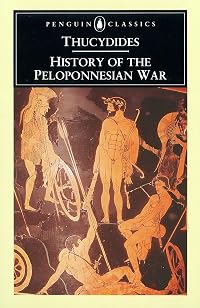
The History of the Peloponnesian War
by Thucydides
There is 1 current discussion about this work.
On This Page
Description
Written by Thucydides around 400 AD, The History of the Peloponnesian War is a meticulous account by the Athenian general of the extended struggle that raged between Athens and Sparta for the better part of twenty years. Thucydides eschews the romance of heroics and dramatics and his precise and thorough account of the ill-fated conflict is one of the first surviving scholarly works of history..
Tags
Recommendations















Member Recommendations
Member Reviews
I really liked Thucydides as a historian. He seems to make a good effort to be accurate and he's open about where he takes artistic liberty ("reconstructing" the speeches of various leaders). It seems like quite a sophisticated approach for someone writing 2000+ years ago. "Sophisticated" seems to be a word I keep using when it comes to ancient Greek writings, so maybe that says more about my preconceptions than it does about the works themselves.
The most difficult aspect of this book is the sheer complexity of the war. It's not just a simple matter of Athens vs Sparta, it's Athens vs Sparta vs Corinth vs Macedonia vs Persia vs Siracuse vs Lesbos etc etc etc. It's tough to keep everything straight, and it reminds me of an article I saw show more on the Syrian war once, stating that there were at least 300 factions. It really exemplifies how much chaos war can bring.
One thing I can appreciate, whether it's a cultural difference or a device of Thucydides, is the "honesty" of the conquering factions. It's refreshing to hear "hey, we're hear to conquer you because we have more ships than you, and it's natural for the powerful to subjugate the weak. You'd do the same in our shoes", instead of our modern conceit of framing aggression as a service to some greater ideal.
In fact, one of the larger themes of the work seems to be the conflict between righteousness and practicality. Is it better to fight nobly and lose, or act with discretion and perhaps survive? I was really invested in the fate of the Plataeans, who defended their city in so many brave and ingenious ways, and the injustice of their eventual fate was heartbreaking.
Another great theme is the capriciousness of fortune, and the danger of mistaking good fortune for superiority. Many times the narrative emphasizes that victory should never be taken for granted, and sudden reversals can occur at any time.
Thucydides also has an art for human feeling. In his description of the retreat of the defeated Athenians from Syracuse, he paints a poignant picture of misery - of those who have to leave their wounded companions behind, of the suffering of the fleeing soldiers.
Sadly, the book ends abruptly. Mid-sentence even. How I wish the rest had been preserved! show less
The most difficult aspect of this book is the sheer complexity of the war. It's not just a simple matter of Athens vs Sparta, it's Athens vs Sparta vs Corinth vs Macedonia vs Persia vs Siracuse vs Lesbos etc etc etc. It's tough to keep everything straight, and it reminds me of an article I saw show more on the Syrian war once, stating that there were at least 300 factions. It really exemplifies how much chaos war can bring.
One thing I can appreciate, whether it's a cultural difference or a device of Thucydides, is the "honesty" of the conquering factions. It's refreshing to hear "hey, we're hear to conquer you because we have more ships than you, and it's natural for the powerful to subjugate the weak. You'd do the same in our shoes", instead of our modern conceit of framing aggression as a service to some greater ideal.
In fact, one of the larger themes of the work seems to be the conflict between righteousness and practicality. Is it better to fight nobly and lose, or act with discretion and perhaps survive? I was really invested in the fate of the Plataeans, who defended their city in so many brave and ingenious ways, and the injustice of their eventual fate was heartbreaking.
Another great theme is the capriciousness of fortune, and the danger of mistaking good fortune for superiority. Many times the narrative emphasizes that victory should never be taken for granted, and sudden reversals can occur at any time.
Thucydides also has an art for human feeling. In his description of the retreat of the defeated Athenians from Syracuse, he paints a poignant picture of misery - of those who have to leave their wounded companions behind, of the suffering of the fleeing soldiers.
Sadly, the book ends abruptly. Mid-sentence even. How I wish the rest had been preserved! show less
Two political-economic systems compete for influence and dominance after the greatest war that has ever happened, but peace could not last. The History of the Peloponnesian War by Thucydides covers the first twenty years of the war between Athens and Sparta before it’s abrupt ending, but throughout his text the motives of the participants and the analysis of unintended consequences shows give the war it’s full context.
The first book—created by later editors not Thucydides—of the work focuses on early Greek history, political commentary, and seeks to explain how the war was caused and why it happened when it did. Over the course of Books 2 through 8, Thucydides covered not only the military action of the war but also the numerous show more political machinations that both sides encouraged in each other’s allied cities or in neutrals to bring them to their side. The war is presented in a chronological manner for nearly the entire work with only two or three diversions in either historical context or to record what happened elsewhere during the Sicilian Expedition that took up Books 6 & 7. The sudden ending of the text reveals that Thucydides was working hard on the work right up until he died, years after the conflict had ended.
The military narrative is top notch throughout the book which is not a surprise given Thucydides’ time as an Athenian general before his exile. Even though he was an Athenian, Thucydides was positively and negatively critical of both Athens and Sparta especially when it came to demagogues in Athenian democracy and severe conservatism that permeated Spartan society in all its facets. Though Thucydides’ created the prebattle and political speeches he relates, is straightforwardness about why he did it does not take away from the work. If there is one negative for the work is that Thucydides is somewhat dry which can make you not feel the urge to pick up the book if you’ve been forced to set it down even though you’ve been enjoying the flow of history it describes.
The History of the Peloponnesian War though unfinished due to Thucydides death was both a continuation of the historic genre that Herodotus began but also a pioneering work as it recorded history as it happened while also using sources that Thucydides was able to interview. If you enjoy reading history and haven’t read this classic in military history, then you need to. show less
The first book—created by later editors not Thucydides—of the work focuses on early Greek history, political commentary, and seeks to explain how the war was caused and why it happened when it did. Over the course of Books 2 through 8, Thucydides covered not only the military action of the war but also the numerous show more political machinations that both sides encouraged in each other’s allied cities or in neutrals to bring them to their side. The war is presented in a chronological manner for nearly the entire work with only two or three diversions in either historical context or to record what happened elsewhere during the Sicilian Expedition that took up Books 6 & 7. The sudden ending of the text reveals that Thucydides was working hard on the work right up until he died, years after the conflict had ended.
The military narrative is top notch throughout the book which is not a surprise given Thucydides’ time as an Athenian general before his exile. Even though he was an Athenian, Thucydides was positively and negatively critical of both Athens and Sparta especially when it came to demagogues in Athenian democracy and severe conservatism that permeated Spartan society in all its facets. Though Thucydides’ created the prebattle and political speeches he relates, is straightforwardness about why he did it does not take away from the work. If there is one negative for the work is that Thucydides is somewhat dry which can make you not feel the urge to pick up the book if you’ve been forced to set it down even though you’ve been enjoying the flow of history it describes.
The History of the Peloponnesian War though unfinished due to Thucydides death was both a continuation of the historic genre that Herodotus began but also a pioneering work as it recorded history as it happened while also using sources that Thucydides was able to interview. If you enjoy reading history and haven’t read this classic in military history, then you need to. show less
Cobbled together from musty scraps of parchment, scribbled marginalia and fragments of wax tablets, Thucydides’ account of a war among ancient Greek city-states is historical fiction of profound political insight and psychological acumen. In order to tell his story, he invents characters and scenes for which we have no corroborating sources, and fabricates dialogue and ceremonial oration that encapsulate his own biased perceptions. He provides no bibliography or notes to support his “history,” but Thucydides gets credit for formulating a conceptual scheme that has been deployed by the chroniclers of war ever since.
Reread the complete version of this for the first time since reading the excerpted "On Justice, Power, and Human Nature" as an undergrad. Really shines in the imagined monologues negotiating terms, truces, and pleas. The military logistics fade in interest because this unwinnable war amounted to the Athenian Vietnam.
Thucydides predicted that the lessons in his History of the Peloponnesian War would be valid “for ever” (I, 22, p. 48), and sure enough, scholars still apply his concepts. Graham Allison, for example, in Destined for War (2017), examines several wars between established powers and rising ones, and whether the United States and China “can escape Thucydides’s trap.”
Now that the world is in the midst of a pandemic, Thucydides’s account of the Plague of Athens (II, 47-55. Pp. 151-6) takes on additional interest. Thucydides contracted the disease but survived. Pericles, Athens’s greatest leader, died of it. A medical symposium in 1999 judged that the Plague of Athens was typhus, but in light of the significance of show more coronaviruses, that judgment may need reexamination. Thucydides concluded that “Nothing did the Athenians so much harm . . . or so reduced their strength for war” (III, 87: p. 246).
Thucydides was an Athenian strategos (a general and also an admiral) until relieved of his command and exiled. Exile enabled him to write about the war with relative impartiality, because he had access to information from Sparta and other city states. He appears to have been inured to the suffering and death in ordinary battles, and he takes for granted that his readers are familiar with the weapons and tactics of the combatants. He mentions repeatedly that advancing armies (especially the Spartans) "laid waste to the countryside," implying that destruction of the civilian economy, especially agriculture, was the Greeks' version of strategic warfare--their forerunner of Sherman's March and strategic bombing. He skips over whether rape and plunder were implicit forms of soldiers' pay. He does not address why the Greek city states so often chose war over peace, but he was appalled by the bitterness of civil conflict, when political and personal enmities intermingled, moderation was denounced as cowardice and “words, too, had to change their usual meanings” (III, 82, p. 242).
Some readers will find the History an uncongenial work of a hard-bitten and humorless author who grinds through obscure battles, amphibious expeditions and local revolts. To make more sense of the narrative, readers can skip the inadequate maps in the Penguin Classic in favor of The Ohio State University’s computerized geographic information: https://ehistory.osu.edu/exhibitions/peloponnesian. show less
Now that the world is in the midst of a pandemic, Thucydides’s account of the Plague of Athens (II, 47-55. Pp. 151-6) takes on additional interest. Thucydides contracted the disease but survived. Pericles, Athens’s greatest leader, died of it. A medical symposium in 1999 judged that the Plague of Athens was typhus, but in light of the significance of show more coronaviruses, that judgment may need reexamination. Thucydides concluded that “Nothing did the Athenians so much harm . . . or so reduced their strength for war” (III, 87: p. 246).
Thucydides was an Athenian strategos (a general and also an admiral) until relieved of his command and exiled. Exile enabled him to write about the war with relative impartiality, because he had access to information from Sparta and other city states. He appears to have been inured to the suffering and death in ordinary battles, and he takes for granted that his readers are familiar with the weapons and tactics of the combatants. He mentions repeatedly that advancing armies (especially the Spartans) "laid waste to the countryside," implying that destruction of the civilian economy, especially agriculture, was the Greeks' version of strategic warfare--their forerunner of Sherman's March and strategic bombing. He skips over whether rape and plunder were implicit forms of soldiers' pay. He does not address why the Greek city states so often chose war over peace, but he was appalled by the bitterness of civil conflict, when political and personal enmities intermingled, moderation was denounced as cowardice and “words, too, had to change their usual meanings” (III, 82, p. 242).
Some readers will find the History an uncongenial work of a hard-bitten and humorless author who grinds through obscure battles, amphibious expeditions and local revolts. To make more sense of the narrative, readers can skip the inadequate maps in the Penguin Classic in favor of The Ohio State University’s computerized geographic information: https://ehistory.osu.edu/exhibitions/peloponnesian. show less
First things first: the whole Herodotus/Thucydides grudge match binary thing is such bunk. There's no comparison. Thucydides is the father of history. Herodotus is the father of telling cute lil stories. (Although I am well aware that said stories have had a salutary influence on the profession, influenced the Annales school and the move away from Thucydidean political history to social history and the politics that come along with it, and in short, that Herodotus is probably our favourite dude).
And yet, even at that, this is history, but not as we moderns know it. Thucydides's vaunted objectivity consists mostly in talking to people on both sides (not consulting records, because by 'n' large there werent any), and keeping Athenian show more prejudice out of it--so it's a start. And he does a good job on the prejudice thing--although some apparently disagree, and certainly he feels no such compunctions when dealing not with Greeks v. Greeks, but Greeks v. Barbarians--his treatment of the Illyrian horde in, oh, one of those battles fairly drips with scorn. On the other hand, the Illyrians seem like they deserved it. "Don't hurt women or children", as a rule of warfare, makes the Greeks not only more civilized than the barbs, but than, well, us. One of the fascinations of this book, incidentally, is seeing that ritualistic, circumscribed approach to warfare break down. When the atrocities start, at Plataea, at Melos, you're like damn it. Maybe the logic of realpolitik does irresistibly lead to total war.
And while I can't love this and clutch it to my heart completely without reservation--the actual troop movement and war-tech stuff is dry, pedantic, most likely geared to the industry insiders that Thucy and 99% of his readership would have been, with a few exceptions like the final stand of the Athenians in Sicily, and even there you're like "Lamachus died in a ditch! Did a Syracusan arrow pierce his eye? Did a Spartan hoplite claim his shield as a trophy? Inquiring minds!"; also, the maps are pretty bad, Penguin Classics--the Melian Dialogue before the Athenians kill everybody's ass for no real reason, besides being the book's centrepiece,is the prime example of the prime awesome afoot in The Peloponnesian War: the speeches. Maybe I should say "speeches", since the introduction gives me to understand that many of them are reconstructed, but hey, Thucydides can get a little Herodotean on me anytime. It's an amazing way of doing business--talk, talk, talk the issues of the day right into the ground and then some before you make your move. Talk civilized, and then when you do make that move it can be brutal and people will still talk about the Greek Golden Age. It leads to a world of demagogues instead of accountants; public engagement instead of apathy; the extreme concern for points of rhetoric that gave us alliteration and anaphora and anadiplosis and anacothulon (and anastrophe to zeugma!). It explains how we can agree with Nicias, and Thucy can praise him, and yet somehow Alcibiades foxes him and us and Athens and Sparta and the Persian satrap again and again and again.(And how cool that it's the same Alcibiades who ran with Socrates!)
There are some phenomenal speeches--the initial petitions from Corinth and Corcyra to Athens, before the world catches fire; Pericles's Funeral Oration. Most of all, though, you come back to that Melian Debate, where the Melians throw everything they can at the Athenians, dead men walking and tonguing desperate word magic. I would love to have a rhetoric-annotated edition, or speak Ancient Greek. And . . . nothing. The Athenians don't even blink. "It is true that it is more in keeping with the dignity of a great nation to show mercy, but we're still gonna kill everybody's ass. And yes, it is true that to extend the hand of peace to a defeated rival makes a foe an ally and adds to one's own strength, but sorry, you're still fucked. Can't you die with dignity?"
This is Warsaw Ghetto shit. And that's probably the biggest adjustment to be made as a result of the book to one's (my) classic picture of Ancient Greece: Athens is fucking awful. It's like, okay, their democracy is vigorous or whatever, and the Spartans are a racial slave theocracy--but then you see the way Athenians treat their colonies, their ostensible allies, the places whose power and wealth they usurped and even those, like Melos, they didn't--and of course they were all slave states, and Athens just exports the contradictions of their class structure with the superficial democracy they market. Classic imperialist neocons.
And okay, Sparta uses not entirely dissimilar rhetoric, but . . . they really seem to mean it. We keep getting told how artless they are, and if Thucydides does have a bias, it's certainly not in their direction, so I see no reason to believe that Brasidas, say, is not exactly what he seems--and what he seems is like Optimus Prime or some shit, liberating all the townz, and if there is a little bit of "we're gonna liberate you whether you like it or not!", well, look at the way Sparta's allies--your Corinth, your Thebes, your Syracuse--get treated versus what happens to the Athenian subaltern.
After Brasidas, consider "The state of feeling among the people of Camarina was as follows. They were well disposed to the Athenians, except insofar as they thought they might enslave Sicily . . . ." Athens as charismatic asshole/Sparta as misunderstood weirdo?
But then, what did I just say? Racial slave state. So Sparta rules unless you're a helot or a weakling child, and Athens rules unless you're from the colonies, and who's to say whether power games trumps eugenics in the worst historical powers stakes, and none of them had refrigeration, and Thucydides rules. This deserves five stars for being the first and one of the best of its kind, dry patches and all. show less
And yet, even at that, this is history, but not as we moderns know it. Thucydides's vaunted objectivity consists mostly in talking to people on both sides (not consulting records, because by 'n' large there werent any), and keeping Athenian show more prejudice out of it--so it's a start. And he does a good job on the prejudice thing--although some apparently disagree, and certainly he feels no such compunctions when dealing not with Greeks v. Greeks, but Greeks v. Barbarians--his treatment of the Illyrian horde in, oh, one of those battles fairly drips with scorn. On the other hand, the Illyrians seem like they deserved it. "Don't hurt women or children", as a rule of warfare, makes the Greeks not only more civilized than the barbs, but than, well, us. One of the fascinations of this book, incidentally, is seeing that ritualistic, circumscribed approach to warfare break down. When the atrocities start, at Plataea, at Melos, you're like damn it. Maybe the logic of realpolitik does irresistibly lead to total war.
And while I can't love this and clutch it to my heart completely without reservation--the actual troop movement and war-tech stuff is dry, pedantic, most likely geared to the industry insiders that Thucy and 99% of his readership would have been, with a few exceptions like the final stand of the Athenians in Sicily, and even there you're like "Lamachus died in a ditch! Did a Syracusan arrow pierce his eye? Did a Spartan hoplite claim his shield as a trophy? Inquiring minds!"; also, the maps are pretty bad, Penguin Classics--the Melian Dialogue before the Athenians kill everybody's ass for no real reason, besides being the book's centrepiece,is the prime example of the prime awesome afoot in The Peloponnesian War: the speeches. Maybe I should say "speeches", since the introduction gives me to understand that many of them are reconstructed, but hey, Thucydides can get a little Herodotean on me anytime. It's an amazing way of doing business--talk, talk, talk the issues of the day right into the ground and then some before you make your move. Talk civilized, and then when you do make that move it can be brutal and people will still talk about the Greek Golden Age. It leads to a world of demagogues instead of accountants; public engagement instead of apathy; the extreme concern for points of rhetoric that gave us alliteration and anaphora and anadiplosis and anacothulon (and anastrophe to zeugma!). It explains how we can agree with Nicias, and Thucy can praise him, and yet somehow Alcibiades foxes him and us and Athens and Sparta and the Persian satrap again and again and again.(And how cool that it's the same Alcibiades who ran with Socrates!)
There are some phenomenal speeches--the initial petitions from Corinth and Corcyra to Athens, before the world catches fire; Pericles's Funeral Oration. Most of all, though, you come back to that Melian Debate, where the Melians throw everything they can at the Athenians, dead men walking and tonguing desperate word magic. I would love to have a rhetoric-annotated edition, or speak Ancient Greek. And . . . nothing. The Athenians don't even blink. "It is true that it is more in keeping with the dignity of a great nation to show mercy, but we're still gonna kill everybody's ass. And yes, it is true that to extend the hand of peace to a defeated rival makes a foe an ally and adds to one's own strength, but sorry, you're still fucked. Can't you die with dignity?"
This is Warsaw Ghetto shit. And that's probably the biggest adjustment to be made as a result of the book to one's (my) classic picture of Ancient Greece: Athens is fucking awful. It's like, okay, their democracy is vigorous or whatever, and the Spartans are a racial slave theocracy--but then you see the way Athenians treat their colonies, their ostensible allies, the places whose power and wealth they usurped and even those, like Melos, they didn't--and of course they were all slave states, and Athens just exports the contradictions of their class structure with the superficial democracy they market. Classic imperialist neocons.
And okay, Sparta uses not entirely dissimilar rhetoric, but . . . they really seem to mean it. We keep getting told how artless they are, and if Thucydides does have a bias, it's certainly not in their direction, so I see no reason to believe that Brasidas, say, is not exactly what he seems--and what he seems is like Optimus Prime or some shit, liberating all the townz, and if there is a little bit of "we're gonna liberate you whether you like it or not!", well, look at the way Sparta's allies--your Corinth, your Thebes, your Syracuse--get treated versus what happens to the Athenian subaltern.
After Brasidas, consider "The state of feeling among the people of Camarina was as follows. They were well disposed to the Athenians, except insofar as they thought they might enslave Sicily . . . ." Athens as charismatic asshole/Sparta as misunderstood weirdo?
But then, what did I just say? Racial slave state. So Sparta rules unless you're a helot or a weakling child, and Athens rules unless you're from the colonies, and who's to say whether power games trumps eugenics in the worst historical powers stakes, and none of them had refrigeration, and Thucydides rules. This deserves five stars for being the first and one of the best of its kind, dry patches and all. show less
http://nwhyte.livejournal.com/1674785.html
This is a classic work of history, about the war between Athens and Sparta in the 430s and 420s BC. I'm not terribly interested in the war itself, or the geographical details (though I would have liked it if my Penguin edition had put useful maps in the text closer to the descriptions of events taking place on obscure islands); I hoped to find out from reading it the extent to which Thucydides' reputation as the first proper historian is justifiable.
What I found was rather different to what I expected. This is not an academic history as we know such things, but a commentary on contemporary international relations, propagandistically crafted for a particular domestic interpretation in Athens, show more rather like most of the books you can find in shops on the War on Terror or the Cold War. Thucydides' use of rhetoric, his visibly partial citation of evidence and his dramatic reconstruction of conversations at which he was not present are all familiar tactics from today's literature. He would have been very much in his intellectual element as a crafter of drama-documentaries. I rate it as fascinating artistically - particularly the complex character of Alcibiades - but barely history.
I blame Thucydides directly for the useless mess that is most academic research into international relations. In Thucydides' account (the Melian dialogue is the most obviously fictional passage, but there are many others) decisions about war and peace (and, later in the text, internal revolution) are made on the basis of perfect or near-perfect knowledge of the international and local situation, after mature reflection and rational debate of the alternatives. It's a lovely fairy-tale and it's not surprising that many people choose to believe it; I had not appreciated, however, that it went back so far. Irrational decisions are only made by the deranged, who are normally anonymous (eg the people of Corcyra in 3.84, or the Syracusans who mistreat the Athenian captives in 7.86-87).
I know I'm not being fair; Thucydides is at the very beginning of recorded history, and it is amazing that a book written 2430 years ago is still lucidly intelligible (and interrogable) on its own terms. Pericles' funeral oration (2.34-46), in particular, whether by Pericles or Thucydides, is a brilliantly eloquent appeal to the emotions of those who have lost their loved ones in the service of their country, and is far ahead of anything else I have read on that subject in terms of literary quality. But I think his inability, for whatever reason, to examine the cultural context of his time, and to be honest about his own political situation, weakens the truth of the book.
Apart from the general issue of the book's ideological purpose, there are a lot of interesting points of detail here. As a lapsed astronomer, my eye was caught by the three eclipses mentioned, especially the first, where we are told that "the sun took on the appearance of a crescent and some of the stars became visible before it returned to its normal shape" (1.28). I was a bit surprised about the stars becoming visible even though this was not a total eclipse. A little research, however, got me to Mercury being close to maximum elongation 25 degrees from the Sun, and Venus approaching superior conjunction and 15 degrees from the sun, and I suppose both would have been visible if the Sun was sufficiently dimmed.
In 5.16 we read of accusations that "Pleistoanax... and his brother Aristocles had bribed the priestess at Delphi to give oracles to the Spartan delegations, commanding them to bring home from abroad the seed of the demigod son of Zeus". The what??? of who??? I checked the original: Διὸς υἱοῦ ἡμιθέου τὸ σπέρμα - what on earth can it be?
Snerk in 4.84 about Brasidas, who "was not at all a bad speaker, for a Spartan."
Anyway, very glad to have finally ploughed through this. show less
This is a classic work of history, about the war between Athens and Sparta in the 430s and 420s BC. I'm not terribly interested in the war itself, or the geographical details (though I would have liked it if my Penguin edition had put useful maps in the text closer to the descriptions of events taking place on obscure islands); I hoped to find out from reading it the extent to which Thucydides' reputation as the first proper historian is justifiable.
What I found was rather different to what I expected. This is not an academic history as we know such things, but a commentary on contemporary international relations, propagandistically crafted for a particular domestic interpretation in Athens, show more rather like most of the books you can find in shops on the War on Terror or the Cold War. Thucydides' use of rhetoric, his visibly partial citation of evidence and his dramatic reconstruction of conversations at which he was not present are all familiar tactics from today's literature. He would have been very much in his intellectual element as a crafter of drama-documentaries. I rate it as fascinating artistically - particularly the complex character of Alcibiades - but barely history.
I blame Thucydides directly for the useless mess that is most academic research into international relations. In Thucydides' account (the Melian dialogue is the most obviously fictional passage, but there are many others) decisions about war and peace (and, later in the text, internal revolution) are made on the basis of perfect or near-perfect knowledge of the international and local situation, after mature reflection and rational debate of the alternatives. It's a lovely fairy-tale and it's not surprising that many people choose to believe it; I had not appreciated, however, that it went back so far. Irrational decisions are only made by the deranged, who are normally anonymous (eg the people of Corcyra in 3.84, or the Syracusans who mistreat the Athenian captives in 7.86-87).
I know I'm not being fair; Thucydides is at the very beginning of recorded history, and it is amazing that a book written 2430 years ago is still lucidly intelligible (and interrogable) on its own terms. Pericles' funeral oration (2.34-46), in particular, whether by Pericles or Thucydides, is a brilliantly eloquent appeal to the emotions of those who have lost their loved ones in the service of their country, and is far ahead of anything else I have read on that subject in terms of literary quality. But I think his inability, for whatever reason, to examine the cultural context of his time, and to be honest about his own political situation, weakens the truth of the book.
Apart from the general issue of the book's ideological purpose, there are a lot of interesting points of detail here. As a lapsed astronomer, my eye was caught by the three eclipses mentioned, especially the first, where we are told that "the sun took on the appearance of a crescent and some of the stars became visible before it returned to its normal shape" (1.28). I was a bit surprised about the stars becoming visible even though this was not a total eclipse. A little research, however, got me to Mercury being close to maximum elongation 25 degrees from the Sun, and Venus approaching superior conjunction and 15 degrees from the sun, and I suppose both would have been visible if the Sun was sufficiently dimmed.
In 5.16 we read of accusations that "Pleistoanax... and his brother Aristocles had bribed the priestess at Delphi to give oracles to the Spartan delegations, commanding them to bring home from abroad the seed of the demigod son of Zeus". The what??? of who??? I checked the original: Διὸς υἱοῦ ἡμιθέου τὸ σπέρμα - what on earth can it be?
Snerk in 4.84 about Brasidas, who "was not at all a bad speaker, for a Spartan."
Anyway, very glad to have finally ploughed through this. show less
Members
- Recently Added By
Lists

100 Books to Read in a Lifetime (That Are Older Than 200 Years)
415 works; 175 members

Books that changed the world
67 works; 64 members

Unread books
1,063 works; 83 members

The Telegraph's 110 Best Books: The Perfect Library
101 works; 18 members

Newsweek's Top 100 Books: The Meta-List
100 works; 18 members

r/History Recommended Reading List
603 works; 12 members

The Road to Freedom (Will Durant's 100 Best Books for an Education)
100 works; 8 members
Philip Ward's Lifetime Reading Plan
592 works; 22 members

Harold Bloom - The Western Canon: A. The Theocratic Age
97 works; 13 members
Truly old classics
63 works; 6 members

Neustadt & May's List
21 works; 1 member

The Well-Educated Mind Reading Challenge
75 works; 7 members

Política - Clásicos
164 works; 2 members

Europe
205 works; 6 members

Well-Educated Mind
150 works; 3 members

Antigua Grecia
43 works; 2 members

CCE 100 Great Books List
145 works; 8 members

Ryan Holiday's Books To Base Your Life On
97 works; 2 members

Ancient/Classical World
34 works; 1 member

sotiris' favourites circa january 2023
43 works; 2 members

Foundational Books in International Relations
13 works; 1 member

The Well-Educated Mind, Susan Wise Bauer, 2016
179 works; 3 members

The Complete Rory Gilmore Reading List
506 works; 5 members
New Lifetime Reading Plan by Fadiman and Major
225 works; 5 members

2024-2025 Ezra Klein Guest Recommendations
213 works; 6 members

Works Cited in The Life and Death of Democracy by John Keane
278 works; 1 member

In Our Time books
4,934 works; 2 members

Books in the Bibliography of The Cold War by John Lewis Gaddis
192 works; 1 member

THE WAR ROOM
813 works; 24 members

Shaykh Hamza's Book Recommendations
439 works; 3 members
My List
302 works; 1 member

Mustich's 1000 Books to Read Before You Die: A Life Changing List
1,001 works; 19 members

Greatest Books, allegedly
484 works; 9 members
How to Read a Book's Recommended Reading List
309 works; 10 members
Most Popular Penguins
70 works; 5 members
1001 Books You Must Read Before You Die
1,448 works; 1,134 members

A Reading List
100 works; 3 members

Books Read in 2021
5,361 works; 114 members

Kilobook
19 works; 1 member

Books You Couldn't Finish
202 works; 32 members

Trinity College Booklist (1951): Class Eight, Classic Civilization
39 works; 3 members

Art of Reading
188 works; 5 members

I Can't Finish This Book
189 works; 22 members

Lectuurlijst
63 works; 1 member
Talk Discussions
Current Discussions
Ashendene Thucydides design binding by Michael Wilcox in Fine Press Forum (December 2025)
Past Discussions
OT for GMacAree in Fine Press Forum (November 2023)
Thucydides in Ancient History (December 2021)
Group read - Thucydides' The Peloponnesian War in The 11 in 11 Category Challenge (December 2010)
Herodotus vs. Thucydides in Ancient History (March 2007)
Author Information

293+ Works 15,062 Members
Born into a family of Athens's old nobility claiming descent from the Homeric hero Ajax of Salamis, Thucydides pursued a political career under Pericles and served as a general in the Great Peloponnesian War of 431--404 b.c. His subsequent exile for failure to prevent a Spartan takeover of an Athenian colony in Thrace enabled him to observe the show more war from both sides. In his history of the war, he examines the policies and motives of the people involved with a calculated rationality that nevertheless conveys great passion. Although his narrative style is lucid and astringent, the language of the speeches that he gives his protagonists is some of the most difficult, yet rhetorically powerful, Greek from any period of antiquity. The work is deeply serious in tone. As Thucydides tells his readers at the beginning of the work, it contains nothing of entertainment value. He meant it, as he says, to be not simply a set-piece written for the delectation of an audience, but a "possession for ever." As Herodotus was the inventor of universal history, Thucydides was the inventor of the analytical historical monograph. He wrote in conscious contrast to Herodotus, whose work is full of entertaining fable and romance. While Herodotus wrote about the past by using all manner of traditions gleaned in his travels, Thucydides considered only contemporary history to be reliable and writes as an interrogator and witness of contemporary men and events. The gods, too, are absent from Thucydides's work, which scrutinizes human motivations as the exclusive business of history. The most powerful intellectual influences visible are the fully rational method of description and prognosis developed by the Hippocratic physicians and the tools of logical analysis and verbal argument then being forged by the Sophists. Behind these, however, lay a sense of tragedy. The history of Thucydides possesses the rhythm of a Sophoclean drama of reversal of fortune in which Athens falls from the pinnacle of imperial success and brilliance into political corruption, ruthless and amoral imperial aggression, and finally utter defeat and disaster. Athens's imperial hubris leads to its nemesis at the hands of Sparta, a conservative and landlocked state that had been powerless at the beginning of the war to inflict significant harm on the Athenians. Thucydides's work is unfinished. It ends abruptly in midsentence during a discussion of the events of the year 411 b.c. It was continued to the end of the war by Xenophon. Although very much the intellectual inferior of Thucydides, Xenophon managed by imitation to infuse this part of his Hellenica (his continuation to 362 b.c. of the history of Thucydides) with an elevation absent in the rest of his work. Until relatively recently, scholars took Thucydides at his word as an objective writer. More recently it has been recognized that his work skillfully promotes a patriotic and political argument, written in the climate of postwar recriminations. He presents Athens's empire as a natural consequence of the position of that city-state in the Greek world and the Athenian leader Pericles as Athens's greatest statesman, a leader who had governed Athens and preserved the empire with a firm and intelligent hand. Thucydides wanted to persuade his readers that Pericles was not the villain who destroyed Athens, that the blame fell to the politicians who came after him and pandered to the most extreme ambitious of the common citizens, the politicians who were the ultimate arbiters of policy in Athens's democracy. Some modern historians remain persuaded by Thucydides's portrait of Pericles and the Athenian democracy, but others argue from Thucydides's own testimony that Pericles led Athens into an unnecessary war in the belief that the opportunity had arrived to advance Athenian domination over the whole of the Greek world. (Bowker Author Biography) show less
Some Editions
Awards and Honors
Awards
Notable Lists
Series
Belongs to Publisher Series
Akal Clásica (12)
Bernat Metge (113)
Letras Universales (97)
Work Relationships
Is contained in
Contains
Has the (non-series) sequel
Is abridged in
Has as a reference guide/companion
Has as a study
Has as a student's study guide
Common Knowledge
- Canonical title
- The History of the Peloponnesian War
- Original title
- Ιστορία του Πελοποννησιακού Πολέμου
- Alternate titles*
- De Peloponnesische oorlog
- Original publication date
- c. 396 BCE; ca. 400 BCE (Greek) (Greek); 1629 (Translation) (Translation)
- People/Characters
- Alcibiades; Apollo; Archidamus II, King of Sparta; Astyochus; Brasidas; Demosthenes (show all 10); Eurymedon; Hermocrates; Nicias; Pericles
- Important places
- Athens, Greece; Greece; Sparta, Greece; Abdera, Thrace; Delphi, Greece; Euboia (show all 12); Megara, Megaris, Greece; Miletus; Piraeus, Greece; Pylos; Sicily; Thebes, Greece
- Important events
- Peloponnesian War (431 BCE | 404 BCE)
- Related movies
- The War That Never Ends (1991 | IMDb)
- First words
- Thucydides the Athenian wrote the history of the war fought between Athens and Sparta, beginning the account at the very outbreak of the war, in the belief that it was going to be a great war and more worth writing about than... (show all) any of those which had taken place in the past.
- Quotations
- The Corcyraeans...went to the sanctuary of Hera and persuaded about fifty men to take their trial, and condemned them all to death. The mass of the suppliants who had refused to do so, on seeing what was taking place, slew ea... (show all)ch other there on the consecrated ground; some hanged themselves upon the trees, and others destroyed themselves as they were severally able. During seven days...the Corcyraeans were engaged in butchering those of their fellow-citizens whom they regarded as their enemies: and although the crime imputed was that of attempting to put down the democracy, some were slain also for private hatred, others by their debtors because of the moneys owed to them. Death thus raged in every shape; and as usually happens at such times, there was no length to which violence did not go; sons were killed by their fathers, and suppliants dragged from the altar or killed upon it, while some were even walled up in the temple of Dionysus and died there.
- Last words
- (Click to show. Warning: May contain spoilers.)He went first to Ephesus where he made a sacrifice to Artemis...
- Original language
- Greek
*Some information comes from Common Knowledge in other languages. Click "Edit" for more information.
Classifications
- Genres
- History, General Nonfiction, Nonfiction
- DDC/MDS
- 938.05 — History & geography History of ancient world (to ca. 499) Greece to 323 Greece to 323 Peloponnesian War (431-404 BC)
- LCC
- DF229 .T5 .J6 — History of Europe, Asia, Africa and Oceania Greece History of Greece History By period Peloponnesian War, 431-404 B.C.
- BISAC
Statistics
- Members
- 8,954
- Popularity
- 1,203
- Reviews
- 69
- Rating
- (4.02)
- Languages
- 20 — Catalan, Chinese, Dutch, English, Finnish, French, German, Greek (Ancient), Greek, Hungarian, Italian, Japanese, Latin, Norwegian (Bokmål), Polish, Portuguese, Russian, Spanish, Swedish, Turkish
- Media
- Paper, Audiobook, Ebook
- ISBNs
- 223
- UPCs
- 1
- ASINs
- 163