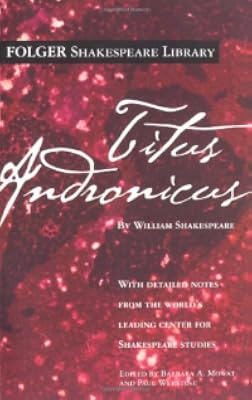
Titus Andronicus
by William Shakespeare, George Peele (Author)
On This Page
Description
The noble Titus returns victorious to Rome bringing Tamora, Queen of the Goths as his captive. When one of Tamora's sons is condemned to die, she vows revenge, and, aided by the villainous Aaron, she exacts a terrible retribution, inaugurating a grim cycle of rape, murder, and cannibalism. This macabre, often brilliant tragedy comes from the earliest stage of Shakespeare's dramatic career.Tags
Recommendations












Member Recommendations


SnootyBaronet Vengeance through cannibalism
Member Reviews
The pornography of violence is writ large in this early play by Shakespeare. It was considered too shocking for a Victorian Audience, but was a success in 1592 when it hit the Elizabethan stage. Recent modern revivals have also succeeded which may say more about the 21st century than Shakespeare and the Elizabethans. The amount of violence in the play is listed in the wikipedia article. I lost count of the incidents way before the end:
The play is saturated with violence from its opening scene, and violence touches virtually every character; Alarbus is burned alive and has his arms chopped off; Titus stabs his own son to death; Bassianus is murdered and thrown into a pit; Lavinia is brutally raped and has her hands cut off and her show more tongue cut out; Martius and Quintus are decapitated; a nurse and a midwife are stabbed to death by Aaron; an innocent clown is executed for no apparent reason; Titus kills Chiron and Demetrius and cooks them in a pie, which he then feeds to their mother. Then, in the final scene, in the space of a few lines, Titus kills in succession Lavinia and Tamora, and is then immediately killed by Saturninus, who is in turn immediately killed by Lucius. Aaron is then buried up to his neck and left to starve to death in the open air and Tamora's body is thrown to the wild beasts outside the city. As S. Clark Hulse points out, "it has 14 killings, 9 of them on stage, 6 severed members, 1 rape (or 2 or 3 depending on how you count), 1 live burial, 1 case of insanity, and 1 of cannibalism – an average of 5.2 atrocities per act, or one for every 97 lines
This run down does not reveal the whole picture however, because it is Shakespeare's depiction of his characters seeming to revel in the violence that is most shocking for audiences and readers of the play. This is Marcus coming across his sister Lavinia in a forest who has just been raped by two Goths and has had her hands cut off and her tongue cut out:
Why dost not speak to me?
Alas, a crimson river of warm blood,
Like to a bubbling fountain stirr'd with wind,
Doth rise and fall between thy rosed lips,
Coming and going with thy honey breath.
But sure some Tereus hath deflowered thee,
And, lest thou shouldst detect him, cut thy tongue.
Ah, now thou turn'st away thy face for shame!
And notwithstanding all this loss of blood-
As from a conduit with three issuing spouts-
Yet do thy cheeks look red as Titan's face
Blushing to be encount'red with a cloud.
This is what happens to Aaron at the end of the play:
Set him breast-deep in earth, and famish him;
There let him stand and rave and cry for food.
If any one relieves or pities him,
For the offence he dies. This is our doom.
Some stay to see him fast'ned in the earth.
We only have to wait until line 130 for the first violent act: Lucius has demanded that one of the prisoners be sacrificed to appease the Roman dead and selects the eldest son of the conquered queen Tamora. She pleads with Titus Andronicus for mercy; the first of the characters kneeling in supplication. Her plea is dismissed out of hand and Lucius gives the order:
Away with him, and make a fire straight;
And with our swords, upon a pile of wood,
Let's hew his limbs till they be clean consum'd.
This is the murder that starts the chain of the murder and revenge cycle.
The play is set in Roman times where it could be argued that there was violence and spectacle enough to warrant this graphic rendition. With the amount of action that takes place it is a wonder that Shakespeare can tell a coherent story, but he does and significantly his character have no time to develop, the only soliloquy's are by the arch villain Aaron. It is a story of power and vengeance. Titus Andronicus has returned to Rome from a ten year campaign against the barbarian goths. His return coincides with the election of a new Roman emperor. Saturninus claims the throne as the eldest son of the dead emperor, but his brother Bassianus also lays claim: the people favour Titus, but he declines saying he is too old and too weary and supports Saturninus. Lavinia is chosen by Saturninus as empress to unite the two families, but Bassianus seizes her claiming they are already married. Saturninus therefore turns to Tamora who has already sworn vengeance against Titus and his family. Aaron the Moor and lover of Tamora plots to destabilise the regime and instigates two of Tamora's sons to rape and disfigure Lavinia and kill Bassianus. War breaks out between the families as each murder leads to more bloodshed. It can only end when most of the principal characters are dead, but their is no moral to this story, the violence continues to the end of the play and the audience is left with the impression that violence is endemic.
Shakespeare was following a tradition of earlier successes in the theatre: Thomas Kyd's The Spanish Tragedy and Christopher Marlowe's the Jew of Malta were both revenge tragedy's, but Shakespeare took this theme and ran with it further into the darkness and darkness is the overall impression that I got from this play. The BBC production starring Trevor Peacock as Titus stays true to the text and there is no light at all in the 2 and a half hours playing time. It does show how well the play can be made to work. An evening in the theatre with this play cannot fail to depress the viewer. No thoughts of better times ahead, no optimism, just blackness piled on blackness. Perhaps it was a play of its time with the theatres on the verge of being closed due to the plague. It does not make for cheerful viewing during the covid 19 epidemic. It is a powerful unrelenting play and I can understand why it might be well thought of by some, but for me at this moment in time I could quite cheerfully pass it by 4 stars, but 5 stars for the BBC film. show less
The play is saturated with violence from its opening scene, and violence touches virtually every character; Alarbus is burned alive and has his arms chopped off; Titus stabs his own son to death; Bassianus is murdered and thrown into a pit; Lavinia is brutally raped and has her hands cut off and her show more tongue cut out; Martius and Quintus are decapitated; a nurse and a midwife are stabbed to death by Aaron; an innocent clown is executed for no apparent reason; Titus kills Chiron and Demetrius and cooks them in a pie, which he then feeds to their mother. Then, in the final scene, in the space of a few lines, Titus kills in succession Lavinia and Tamora, and is then immediately killed by Saturninus, who is in turn immediately killed by Lucius. Aaron is then buried up to his neck and left to starve to death in the open air and Tamora's body is thrown to the wild beasts outside the city. As S. Clark Hulse points out, "it has 14 killings, 9 of them on stage, 6 severed members, 1 rape (or 2 or 3 depending on how you count), 1 live burial, 1 case of insanity, and 1 of cannibalism – an average of 5.2 atrocities per act, or one for every 97 lines
This run down does not reveal the whole picture however, because it is Shakespeare's depiction of his characters seeming to revel in the violence that is most shocking for audiences and readers of the play. This is Marcus coming across his sister Lavinia in a forest who has just been raped by two Goths and has had her hands cut off and her tongue cut out:
Why dost not speak to me?
Alas, a crimson river of warm blood,
Like to a bubbling fountain stirr'd with wind,
Doth rise and fall between thy rosed lips,
Coming and going with thy honey breath.
But sure some Tereus hath deflowered thee,
And, lest thou shouldst detect him, cut thy tongue.
Ah, now thou turn'st away thy face for shame!
And notwithstanding all this loss of blood-
As from a conduit with three issuing spouts-
Yet do thy cheeks look red as Titan's face
Blushing to be encount'red with a cloud.
This is what happens to Aaron at the end of the play:
Set him breast-deep in earth, and famish him;
There let him stand and rave and cry for food.
If any one relieves or pities him,
For the offence he dies. This is our doom.
Some stay to see him fast'ned in the earth.
We only have to wait until line 130 for the first violent act: Lucius has demanded that one of the prisoners be sacrificed to appease the Roman dead and selects the eldest son of the conquered queen Tamora. She pleads with Titus Andronicus for mercy; the first of the characters kneeling in supplication. Her plea is dismissed out of hand and Lucius gives the order:
Away with him, and make a fire straight;
And with our swords, upon a pile of wood,
Let's hew his limbs till they be clean consum'd.
This is the murder that starts the chain of the murder and revenge cycle.
The play is set in Roman times where it could be argued that there was violence and spectacle enough to warrant this graphic rendition. With the amount of action that takes place it is a wonder that Shakespeare can tell a coherent story, but he does and significantly his character have no time to develop, the only soliloquy's are by the arch villain Aaron. It is a story of power and vengeance. Titus Andronicus has returned to Rome from a ten year campaign against the barbarian goths. His return coincides with the election of a new Roman emperor. Saturninus claims the throne as the eldest son of the dead emperor, but his brother Bassianus also lays claim: the people favour Titus, but he declines saying he is too old and too weary and supports Saturninus. Lavinia is chosen by Saturninus as empress to unite the two families, but Bassianus seizes her claiming they are already married. Saturninus therefore turns to Tamora who has already sworn vengeance against Titus and his family. Aaron the Moor and lover of Tamora plots to destabilise the regime and instigates two of Tamora's sons to rape and disfigure Lavinia and kill Bassianus. War breaks out between the families as each murder leads to more bloodshed. It can only end when most of the principal characters are dead, but their is no moral to this story, the violence continues to the end of the play and the audience is left with the impression that violence is endemic.
Shakespeare was following a tradition of earlier successes in the theatre: Thomas Kyd's The Spanish Tragedy and Christopher Marlowe's the Jew of Malta were both revenge tragedy's, but Shakespeare took this theme and ran with it further into the darkness and darkness is the overall impression that I got from this play. The BBC production starring Trevor Peacock as Titus stays true to the text and there is no light at all in the 2 and a half hours playing time. It does show how well the play can be made to work. An evening in the theatre with this play cannot fail to depress the viewer. No thoughts of better times ahead, no optimism, just blackness piled on blackness. Perhaps it was a play of its time with the theatres on the verge of being closed due to the plague. It does not make for cheerful viewing during the covid 19 epidemic. It is a powerful unrelenting play and I can understand why it might be well thought of by some, but for me at this moment in time I could quite cheerfully pass it by 4 stars, but 5 stars for the BBC film. show less
I’m fond of this one, but I’d better go four stars to distinguish between my Shakespeares. It is the Quentin Tarantino of Shakespeare plays, with The Cook, The Thief, His Wife and Her Lover thrown in (remember that?) Put another way, it is the Marlowe – Tamburlaine, Jew of Malta – and The Spanish Tragedy – deck strewn with dead – of Shakespeares. And fun was had. But you can take this as an exploration of the exploitation of violence. Will loved those plays, presumably, and I feel here he questions himself about why he loves this stuff.
Avoid the Oxford edition. Its introduction told me cruelty can only have been staged for the ‘unlettered groundling’ – nobody educated has such low appetites in entertainment – and show more never addressed the one thing that bothers me in the play, Aaron the Moor being black and a stereotype villain. However, I see he’s direct from a popular story, and when I place him with Marlowe’s Jew (whose lines he steals), I start to understand. So that’s saved you from marks off, Shakespeare.
As for Lavinia, she is best read against young Will's poem The Rape of Lucrece, published in the same year: fantastic poem, which gives a woman voice on sexual violence, unlike Lavinia who has her tongue cut out. show less
Avoid the Oxford edition. Its introduction told me cruelty can only have been staged for the ‘unlettered groundling’ – nobody educated has such low appetites in entertainment – and show more never addressed the one thing that bothers me in the play, Aaron the Moor being black and a stereotype villain. However, I see he’s direct from a popular story, and when I place him with Marlowe’s Jew (whose lines he steals), I start to understand. So that’s saved you from marks off, Shakespeare.
As for Lavinia, she is best read against young Will's poem The Rape of Lucrece, published in the same year: fantastic poem, which gives a woman voice on sexual violence, unlike Lavinia who has her tongue cut out. show less
The once was a Roman named Titus
Who thought that his cause was righteous,
But he brought in the Goths,
Then the deaths came in swaths;
I guess that’s one way to end this bloody crisis
(Of a play, that is)
Did we write a bullshit limerick in response to Shakespeare’s alleged first tragedy? Yes, yes we did. The tale of Titus Andronicus is so full of seemingly pointless violence and brutality that it’s almost impossible to treat it as a play with any sort or moral compass or seriousness, and instead we must accept that we’re here to see a bunch of people wreak vengeance on eachother from start to finish in a never ending cycle of (military) might doesn’t make right. Unlike Shakespeare’s other Roman plays, Titus isn’t based on any show more historical account, and the character depth that comes to define the Bard’s more mature work hasn’t yet been developed, so what we’re left with is a play that relies on a pastiche of myths, moments of violence, and a barely developed political schema to drive the narration. I’m sure Elizabethan audiences were as entranced by this shellac as modern day viewers of staged wrestling are (same vapid entertainment for the masses), but damn, William, this is some ridiculous tripe! show less
Who thought that his cause was righteous,
But he brought in the Goths,
Then the deaths came in swaths;
I guess that’s one way to end this bloody crisis
(Of a play, that is)
Did we write a bullshit limerick in response to Shakespeare’s alleged first tragedy? Yes, yes we did. The tale of Titus Andronicus is so full of seemingly pointless violence and brutality that it’s almost impossible to treat it as a play with any sort or moral compass or seriousness, and instead we must accept that we’re here to see a bunch of people wreak vengeance on eachother from start to finish in a never ending cycle of (military) might doesn’t make right. Unlike Shakespeare’s other Roman plays, Titus isn’t based on any show more historical account, and the character depth that comes to define the Bard’s more mature work hasn’t yet been developed, so what we’re left with is a play that relies on a pastiche of myths, moments of violence, and a barely developed political schema to drive the narration. I’m sure Elizabethan audiences were as entranced by this shellac as modern day viewers of staged wrestling are (same vapid entertainment for the masses), but damn, William, this is some ridiculous tripe! show less
Not Shakespeare's finest hour, Titus Andronicus is a stodgy and tasteless piece of drama so variable in quality that scholars struggle to place it chronologically in Shakespeare's artistic development, and many come to believe it was a collaborative effort with other playwrights, or perhaps not even written by Shakespeare at all. So over-the-top and ham-fisted is the play that the critic Harold Bloom was able to make a reasonably sound argument that Shakespeare intended it as a Mel Brooks-style spoof.
On the face of it, it's a crowd-pleaser: an orgiastic revenge story with scheming and torture and blood-lusting soliloquies. However, unlike, say, the later Macbeth, there's no real art, finesse or plot to give the violence some structure, show more and the result is a grimy stew of gore and bile. Its revenge arc is simplistic and unreflective, and yet simultaneously hard to understand. Much of the drama is resolved in abrupt stage actions [x stabs y, y falls] than in the ingenious confluence of plot, theme and lyricism for which the Bard was to win eternal renown. Titus Andronicus is Shakespeare's video nasty; a footnote in the finest career. show less
On the face of it, it's a crowd-pleaser: an orgiastic revenge story with scheming and torture and blood-lusting soliloquies. However, unlike, say, the later Macbeth, there's no real art, finesse or plot to give the violence some structure, show more and the result is a grimy stew of gore and bile. Its revenge arc is simplistic and unreflective, and yet simultaneously hard to understand. Much of the drama is resolved in abrupt stage actions [x stabs y, y falls] than in the ingenious confluence of plot, theme and lyricism for which the Bard was to win eternal renown. Titus Andronicus is Shakespeare's video nasty; a footnote in the finest career. show less
Hamlet is better-written; but Titus is more fun.
Okay, but really. The characters are cruel and sarcastic. After his daughter is raped and tortured, his son dead by his hands, his son-in-law murdered, and his own hand removed in a wicked, failed plot to save the life of (yet more) sons - after all this, and I skipped over a good bit - Titus mocks the hell out of his brother, the good Marcus, who kills a fly at the dinner table.
A deed of death done on the innocent
Becomes not Titus' brother: get thee gone ...
But how, if that fly had a father and mother?
How would he hang his slender gilded wings,
And buzz lamenting doings in the air!
Poor harmless fly,
That, with his pretty buzzing melody,
Came here to make us merry! and thou hast kill'd show more him.
And then in the next scene, Titus kills two young men, their mother, and his own daughter - he probably would have gone on murdering but he's killed himself before he gets the chance - so is this "alas the poor murdered fly" bit sarcasm? insanity, real or feigned? neither? both? DOES IT MATTER?
The Tamor film is my favorite (aside from the play itself); the actors are marvelously unaware of their IMPENDING DOOOOM (with the exception of Anthony Hopkins who always looks like he's near death, in a spiritual sense) - and the lush texture of scenery and costuming and decadence heightens heightens heightens.
The best bit, cinematic-ally speaking, is the little petty cruelty of Lavinia and Bassianus, who - lest you should think they are good people! - mock Tamora in her adulterous ways. Since Tamora's marriage was forced and Lavinia herself was almost forcibly married to the same man, one would expect her to have some sympathy for the poor exiled Queen. HOWEVER. NO.
Under your patience, gentle empress,
'Tis thought you have a goodly gift in horning ...
Jove shield your husband from his hounds to-day!
'Tis pity they should take him for a stag.
-- and are roundly punished for it. Bassianus is murdered and Lavinia left to scream and beg and plea -- not for life, "for poor I was slain when Bassianus died" - but that Tamora kill her at once. THIS IS NOT TO BE. As Demetrius puts it (so chillingly)
"First thrash the corn, then after burn the straw."
No one in this play is getting out alive. show less
Okay, but really. The characters are cruel and sarcastic. After his daughter is raped and tortured, his son dead by his hands, his son-in-law murdered, and his own hand removed in a wicked, failed plot to save the life of (yet more) sons - after all this, and I skipped over a good bit - Titus mocks the hell out of his brother, the good Marcus, who kills a fly at the dinner table.
A deed of death done on the innocent
Becomes not Titus' brother: get thee gone ...
But how, if that fly had a father and mother?
How would he hang his slender gilded wings,
And buzz lamenting doings in the air!
Poor harmless fly,
That, with his pretty buzzing melody,
Came here to make us merry! and thou hast kill'd show more him.
And then in the next scene, Titus kills two young men, their mother, and his own daughter - he probably would have gone on murdering but he's killed himself before he gets the chance - so is this "alas the poor murdered fly" bit sarcasm? insanity, real or feigned? neither? both? DOES IT MATTER?
The Tamor film is my favorite (aside from the play itself); the actors are marvelously unaware of their IMPENDING DOOOOM (with the exception of Anthony Hopkins who always looks like he's near death, in a spiritual sense) - and the lush texture of scenery and costuming and decadence heightens heightens heightens.
The best bit, cinematic-ally speaking, is the little petty cruelty of Lavinia and Bassianus, who - lest you should think they are good people! - mock Tamora in her adulterous ways. Since Tamora's marriage was forced and Lavinia herself was almost forcibly married to the same man, one would expect her to have some sympathy for the poor exiled Queen. HOWEVER. NO.
Under your patience, gentle empress,
'Tis thought you have a goodly gift in horning ...
Jove shield your husband from his hounds to-day!
'Tis pity they should take him for a stag.
-- and are roundly punished for it. Bassianus is murdered and Lavinia left to scream and beg and plea -- not for life, "for poor I was slain when Bassianus died" - but that Tamora kill her at once. THIS IS NOT TO BE. As Demetrius puts it (so chillingly)
"First thrash the corn, then after burn the straw."
No one in this play is getting out alive. show less
My godfathers, this is bloody! The cast count at the end is barely a fraction of the beginning. I can imagine actors eyeing up how far they survive rather than a measure of how many lines they get.
Titus Andronicus returns to Rome with the Queen of the Goths and her sons as prisoners. He has lost 21 sons in the 10 years at the wars, and his first act is the sacrifice the Queen's eldest son to the gods and honour his own dead. It doesn't really get a lot better from there on in.
I listened to this and it was actually really easy to follow because the characters have a habit of announcing themselves by name, so that it's usually pretty clear who our of this predominantly male cast was speaking. The subject matter is so very grim that I show more can't imagine that this is easy to watch (I barely coped with seeing the King Lear eye scene, this would have been worse). Difficult to rate, it's so terribly violent that it almost becomes cartoonish. I suggest some of the others as better plays and more enjoyable subject matter. show less
Titus Andronicus returns to Rome with the Queen of the Goths and her sons as prisoners. He has lost 21 sons in the 10 years at the wars, and his first act is the sacrifice the Queen's eldest son to the gods and honour his own dead. It doesn't really get a lot better from there on in.
I listened to this and it was actually really easy to follow because the characters have a habit of announcing themselves by name, so that it's usually pretty clear who our of this predominantly male cast was speaking. The subject matter is so very grim that I show more can't imagine that this is easy to watch (I barely coped with seeing the King Lear eye scene, this would have been worse). Difficult to rate, it's so terribly violent that it almost becomes cartoonish. I suggest some of the others as better plays and more enjoyable subject matter. show less
Shakespeare's earliest, starkest, bloodiest tragedy, Titus Andronicus is among a handful of nearly everyone's least favorite Shakespeare plays - mainly for the unmitigated violence, racism, and misogyny that fills it. The body count is staggering - perhaps 14 corpses in all - along with multiple dismemberings, decapitations, and gang rape. The theatrical spectacle is amazing and virtually unmatched in all of the First Folio.
Julie Taymor, noted interpreter of Shakespeare for the stage and screen, says Titus is about what makes great, noble people turn violent. In that respect it has more in common with the most famous classical Greek tragedies than with most of Shakespeare’s plays. It is in the verbal style of Seneca – oratorical show more declamation – or of Shakespeare’s early contemporaries Kyd and Marlowe, using what Ben Jonson referred to as their “mighty line” – not naturalistic but heightened speech.
The play is set at the time of the late Roman Empire. Unlike in Yeats’ “Second Coming,” in Shakespeare’s play of apocalyptic horrors both the best and “the worst are full of passionate intensity.” At breakneck pace we are subjected to a series of catastrophic errors by the most powerful and respected man in Rome, the conquering general Titus. 1) Ignoring a mother’s pleas for mercy, he has the son of his conquered opponent Tamora killed, dismembered and sacrificed; 2) declining to rule Rome himself, he selects the wrong candidate, Saturninus, to be emperor; 3) disregarding a prior claim by the emperor’s brother Bassianus, he agrees to wed his daughter Lavinia to the emperor; 4) accusing his own son of treason for supporting Lavinia, he kills son Mutius; 5) believing her deceitful peacemaking, he expects friendship and gratitude from Tamora even as she plots the demise of his entire family. And that’s all in the first scene. By the play’s end, only three Andronici (two men and a boy, and virtually no other named characters) are left alive – all the result of unchecked villainy combined with blind adherence to principles of honor.
Early in his career Shakespeare discovered the powerful attraction of articulate, scheming villains. In Tamora and Aaron he created two of the best, and ironically they are also two of the best parents in the play, in their unflagging loyalty to their children. The play’s final irony is that Rome is saved only by an invasion of barbarians. show less
Julie Taymor, noted interpreter of Shakespeare for the stage and screen, says Titus is about what makes great, noble people turn violent. In that respect it has more in common with the most famous classical Greek tragedies than with most of Shakespeare’s plays. It is in the verbal style of Seneca – oratorical show more declamation – or of Shakespeare’s early contemporaries Kyd and Marlowe, using what Ben Jonson referred to as their “mighty line” – not naturalistic but heightened speech.
The play is set at the time of the late Roman Empire. Unlike in Yeats’ “Second Coming,” in Shakespeare’s play of apocalyptic horrors both the best and “the worst are full of passionate intensity.” At breakneck pace we are subjected to a series of catastrophic errors by the most powerful and respected man in Rome, the conquering general Titus. 1) Ignoring a mother’s pleas for mercy, he has the son of his conquered opponent Tamora killed, dismembered and sacrificed; 2) declining to rule Rome himself, he selects the wrong candidate, Saturninus, to be emperor; 3) disregarding a prior claim by the emperor’s brother Bassianus, he agrees to wed his daughter Lavinia to the emperor; 4) accusing his own son of treason for supporting Lavinia, he kills son Mutius; 5) believing her deceitful peacemaking, he expects friendship and gratitude from Tamora even as she plots the demise of his entire family. And that’s all in the first scene. By the play’s end, only three Andronici (two men and a boy, and virtually no other named characters) are left alive – all the result of unchecked villainy combined with blind adherence to principles of honor.
Early in his career Shakespeare discovered the powerful attraction of articulate, scheming villains. In Tamora and Aaron he created two of the best, and ironically they are also two of the best parents in the play, in their unflagging loyalty to their children. The play’s final irony is that Rome is saved only by an invasion of barbarians. show less
Members
- Recently Added By
Lists

Favorite Shakespeare plays?
37 works; 45 members

Bibliography for How to be a Heroine
148 works; 12 members

Read
293 works; 4 members

Blue Pyramid 1,276 Best Books of All Time
1,248 works; 32 members

Books Read in 2020
4,379 works; 124 members

Books Set in Rome
98 works; 2 members
Stage Plays/Screenplays/Dialogues/Anything Dialogue-Storytelling Related
81 works; 2 members
1:28 p.m.'s 350 Stage Plays Challenge
94 works; 3 members

Greatest Books, allegedly
484 works; 9 members

'Books You Can't Live Without: The Top 100', The Guardian, 2007
156 works; 7 members
My Play Collection
769 works; 3 members
Author Information

6,137+ Works 442,993 Members
William Shakespeare, 1564 - 1616 Although there are many myths and mysteries surrounding William Shakespeare, a great deal is actually known about his life. He was born in Stratford-Upon-Avon, son of John Shakespeare, a prosperous merchant and local politician and Mary Arden, who had the wealth to send their oldest son to Stratford Grammar School. show more At 18, Shakespeare married Anne Hathaway, the 27-year-old daughter of a local farmer, and they had their first daughter six months later. He probably developed an interest in theatre by watching plays performed by traveling players in Stratford while still in his youth. Some time before 1592, he left his family to take up residence in London, where he began acting and writing plays and poetry. By 1594 Shakespeare had become a member and part owner of an acting company called The Lord Chamberlain's Men, where he soon became the company's principal playwright. His plays enjoyed great popularity and high critical acclaim in the newly built Globe Theatre. It was through his popularity that the troupe gained the attention of the new king, James I, who appointed them the King's Players in 1603. Before retiring to Stratford in 1613, after the Globe burned down, he wrote more than three dozen plays (that we are sure of) and more than 150 sonnets. He was celebrated by Ben Jonson, one of the leading playwrights of the day, as a writer who would be "not for an age, but for all time," a prediction that has proved to be true. Today, Shakespeare towers over all other English writers and has few rivals in any language. His genius and creativity continue to astound scholars, and his plays continue to delight audiences. Many have served as the basis for operas, ballets, musical compositions, and films. While Jonson and other writers labored over their plays, Shakespeare seems to have had the ability to turn out work of exceptionally high caliber at an amazing speed. At the height of his career, he wrote an average of two plays a year as well as dozens of poems, songs, and possibly even verses for tombstones and heraldic shields, all while he continued to act in the plays performed by the Lord Chamberlain's Men. This staggering output is even more impressive when one considers its variety. Except for the English history plays, he never wrote the same kind of play twice. He seems to have had a good deal of fun in trying his hand at every kind of play. Shakespeare wrote 154 sonnets, all published on 1609, most of which were dedicated to his patron Henry Wriothsley, The Earl of Southhampton. He also wrote 13 comedies, 13 histories, 6 tragedies, and 4 tragecomedies. He died at Stratford-upon-Avon April 23, 1616, and was buried two days later on the grounds of Holy Trinity Church in Stratford. His cause of death was unknown, but it is surmised that he knew he was dying. (Bowker Author Biography) show less
Peele wrote a variety of plays: Edward I, an English Chronicle history; The Battle of Alcazar, a foreign history; The Old Wives' Tale (1595), a folkloric narration; The Arraignment of Paris (1584), a mythological pastoral; and David and Bethsabe (1599), a biblical tragedy. Peele is predominantly a courtly dramatist best known for his fluent show more lyrical gifts. (Bowker Author Biography) show less
Some Editions
Series
Belongs to Publisher Series
Penguin Shakespeare (B33)
University Paperbacks (UP254)
Klassieke Galerij (147)
Edition Holzinger (Shakespeare)
Work Relationships
Is contained in
De werken van William Shakespeare. 1e dl.: Titus Andronicus ; De klucht der vergissingen ; Twee edellieden van Verona ; Veel gemin, geen gewin by William Shakespeare
The complete works of William Shakespeare : reprinted from the First Folio (volume 9 of 13) by William Shakespeare
Has the adaptation
Has as a study
Has as a supplement
Common Knowledge
- Canonical title
- Titus Andronicus
- Original title
- The Lamentable Tragedy of Titus Andronicus
- Original publication date
- 1594 (Quarto) (Quarto); 1600 (Quarto) (Quarto); 1611 (Quarto) (Quarto); 1623 (Folio) (Folio)
- People/Characters
- Titus Andronicus; Lucius; Quintus; Martius; Mutius; Young Lucius (show all 20); Lavinia; Marcus Andronicus; Publius; Saturninus; Bassianus; Sempronius; Caius; Valentine; Æmilius; Tamora; Demetrius; Chiron; Alarbus; Aaron
- Important places
- Ancient Rome; Rome, Italy; Italy
- Related movies
- Titus Andronicus (1985 | IMDb); Titus Andronicus (1999 | IMDb); Titus Andronicus (2000 | IMDb); Titus Andronicus (1970 | IMDb); Titus Andronicus: The Movie (1997 | IMDb); Titus (1999 | IMDb)
- First words
- Noble patricians, patrons of my right,
Defend the justice of my cause with arms,
And, countrymen, my loving followers,
Plead my successive title with your swords:
I am his first-born son, that was the last
That... (show all) wore the imperial diadem of Rome;
Then let my father's honours live in me,
Nor wrong mine age with this indignity. - Quotations
- Sweet mercy is nobility's true badge.
- Last words
- (Click to show. Warning: May contain spoilers.)See justice done on Aaron, that damn'd Moor,
By whom our heavy haps had their beginning:
Then, afterwards, to order well the state,
That like events may ne'er it ruinate. - Publisher's editor
- Berthoud, Jacques (Penguin Shakespeare)
- Original language
- English
- Disambiguation notice
- This work is for the complete Titus Andronicus only. Do not combine this work with abridgements, adaptations or simplifications (such as "Shakespeare Made Easy"), Cliffs Notes or similar study guides, or anything else ... (show all)that does not contain the full text. Do not include any video recordings. Additionally, do not combine this with other plays.
George Peele has been demonstrated to have been Shakespeare's collaborator in this play. Peele wrote Act 1 and probably a bit of Act 4.
Classifications
Statistics
- Members
- 3,164
- Popularity
- 5,495
- Reviews
- 58
- Rating
- (3.66)
- Languages
- 20 — Catalan, Chinese, Czech, Dutch, English, Finnish, French, German, Greek, Hungarian, Italian, Japanese, Korean, Norwegian (Bokmål), Norwegian, Polish, Portuguese, Croatian, Spanish, Turkish
- Media
- Paper, Audiobook, Ebook
- ISBNs
- 182
- UPCs
- 3
- ASINs
- 55
