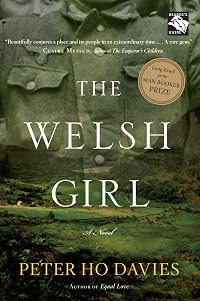
The Welsh Girl
by Peter Ho Davies
On This Page
Description
Set in the stunning landscape of North Wales just after D-Day, this critically acclaimed debut novel traces the intersection of disparate lives in wartime. When a prisoner-of-war camp is established near her village, seventeen-year-old barmaid Esther Evans finds herself strangely drawn to the camp and its forlorn captives. She is exploring the camp boundary when an astonishing thing occurs: A young German corporal calls out to her from behind the fence. From that moment on, the two begin an show more unlikely-and perilous-romance. show lessTags
Recommendations














Member Recommendations

by anonymous user
Member Reviews
Historical fiction set in northern Wales near the end of WWII involving three primary characters. Esther is a seventeen-year-old whose mother died when she was young. She helps her father run her family’s sheep farm and also works in a local pub. Karsten is a German soldier who speaks English. He is being held in a nearby POW camp and is haunted by his decision to surrender. Rotheram is a half-Jewish German who has fled to England and works as an interrogator of German prisoners, specifically assigned to interview Rudolf Hess. At first, his story seems unrelated, but as the book progresses, we begin to see the impact of his story on the other two.
This is a subtle, slowly developing, character-driven book. The characters are ordinary show more people brought together during extraordinary times. Each character is faced with moral quandaries and the author keeps the reader’s interest in wondering how these issues will be resolved. The three main characters are very different, yet they are similar in that each is an outcast and each character struggles with doubt, guilt, and fear. They evolve over time, learning through their experiences.
Though this story eventually involves a relationship, it does not sink into sentimentality, and it is not the primary focus of the book. Instead, it is oriented around symbols, such as the Welsh concept of cynefin, a Welsh term connoting the intimate connection between the sheep and the land they occupy. It is not difficult to extrapolate this idea to the people in the story. Themes include nationalism, identity, belonging, freedom, secrecy, honor, courage, and loyalty.
I have always been interested in reading about different parts of the world during the second World War to get a feel for what life was like and how people coped. It is like putting together an enormous jigsaw puzzle, filling in portions at a time to eventually reveal the bigger picture. This book fills in the pieces related to life in the rural Welsh countryside, which is an integral part of the story. I learned a great deal about the history and culture of Wales. I found it extremely well-written, meaningful, and thought-provoking. show less
This is a subtle, slowly developing, character-driven book. The characters are ordinary show more people brought together during extraordinary times. Each character is faced with moral quandaries and the author keeps the reader’s interest in wondering how these issues will be resolved. The three main characters are very different, yet they are similar in that each is an outcast and each character struggles with doubt, guilt, and fear. They evolve over time, learning through their experiences.
Though this story eventually involves a relationship, it does not sink into sentimentality, and it is not the primary focus of the book. Instead, it is oriented around symbols, such as the Welsh concept of cynefin, a Welsh term connoting the intimate connection between the sheep and the land they occupy. It is not difficult to extrapolate this idea to the people in the story. Themes include nationalism, identity, belonging, freedom, secrecy, honor, courage, and loyalty.
I have always been interested in reading about different parts of the world during the second World War to get a feel for what life was like and how people coped. It is like putting together an enormous jigsaw puzzle, filling in portions at a time to eventually reveal the bigger picture. This book fills in the pieces related to life in the rural Welsh countryside, which is an integral part of the story. I learned a great deal about the history and culture of Wales. I found it extremely well-written, meaningful, and thought-provoking. show less
For Esther Evans, seventeen, June 1944 in Cilgwyn, her village in North Wales, brings sights and sounds of the wider world she dreams of: BBC broadcasts, radio performers from London, English soldiers building an encampment. Living with her sheep-farmer father, who’s a Welsh nationalist, and an ill-tempered young evacuee, Esther has little to excite her except her job at the pub, where she rubs elbows with “foreigners,” including the English corporal with whom she’s stepping out. Don’t tell Dad.
Meanwhile, Karsten Simmering is taken prisoner defending a Normandy beachhead on D-Day. He doesn’t know what to think of himself for surrendering; his fellow prisoners, neck-deep in admiration for the Führer and certain of final show more victory, shame him for it, conveniently forgetting that they too put their hands up.
You know that Esther and Karsten are destined to cross paths, so you can guess that the encampment being built is for prisoners of war. Their relationship is an intriguing premise, and Davies shapes it well, conveying alliances and resentments with subtlety and aplomb, whether in Cilgwyn or the prison camp. He also colors his narrative with wistfulness, desire for escape, and search for a comfortable, fitting definition for the word “nation,” which several of his characters seem to lack.
I do question how Karsten speaks such fluent English. I also dislike the unmentionable trope that changes Esther’s path, both for itself and its predictability and borrowed from a humorless Victorian novelist (the offending work even rates a mention). But at least Davies makes it his own, and his prose renders the village and POW camp in unforgettable detail.
Unfortunately, he buries the Esther-Karsten narrative under a subplot connected to it only vaguely through the nation-belonging theme, an infelicitous addition at best. The novel begins with Joseph Rotheram, a British intelligence officer of German birth, assigned to observe and question the infamous Rudolf Hess. Hess, Hitler’s righthand man until 1940, when he flew an airplane to England, has spent four years under heavy guard. The Allies contemplate war-crimes trials, at which Hess would be a star defendant. Yet he claims amnesia, and no questioner can penetrate that mask.
Rotheram hates his assignment, especially for the reason he’s there: he’s considered Jewish, an identity he hotly (and accurately) denies, since his mother is Christian. But his superiors insist on saying he is, and they suppose that Hess will detect his “race” and react, whereupon they’ll have their prisoner in a bind. What an anti-Semitic trope, heightened when Rotheram’s officer comrades speak as if he has no country, only a tribe.
Davies knows how to set a scene, and he’s imagined a couple notable confrontations between Rotheram and Hess, especially during a screening of Triumph of the Will, Leni Riefenstahl’s infamous propaganda film. It’s like Hamlet’s play within a play, hoping to catch the conscience of the king.
But to wade into anti-Semitic tropes requires insight, and Davies’s narrative suggests he knows little or nothing about Jews or Judaism. Rotheram’s Jewish only to the extent that others think he is and scorn him for it; he has no thoughts about that identity or his family’s past, other than rejecting it. You might as well say the Welsh characters are Welsh only because the English make bigoted jokes about them.
Toward the novel’s end, Rotheram starts thinking like his anti-Semitic superiors: “The Jews, he knew, had no homeland, yearned for one, and yet as much as he understood it to be a source of their victimization, it seemed at once such pure freedom to be without a country.” I suspect Davies has no idea his character appears to find liberation in thousands of years of expulsion, enforced statelessness, expropriation, and murder, justified by the slander that Jews owe allegiance to no country.
A critic quoted on the jacket flap praises Davies’s “all-encompassing empathy.” Not quite.
To my fellow historical novelists, please: If you must write about the Holocaust, make sure you treat your Jewish characters as full people. Please don’t deploy them like paperweights to keep themes or plot points from blowing away. Tropes and stereotypes hurt. show less
Meanwhile, Karsten Simmering is taken prisoner defending a Normandy beachhead on D-Day. He doesn’t know what to think of himself for surrendering; his fellow prisoners, neck-deep in admiration for the Führer and certain of final show more victory, shame him for it, conveniently forgetting that they too put their hands up.
You know that Esther and Karsten are destined to cross paths, so you can guess that the encampment being built is for prisoners of war. Their relationship is an intriguing premise, and Davies shapes it well, conveying alliances and resentments with subtlety and aplomb, whether in Cilgwyn or the prison camp. He also colors his narrative with wistfulness, desire for escape, and search for a comfortable, fitting definition for the word “nation,” which several of his characters seem to lack.
I do question how Karsten speaks such fluent English. I also dislike the unmentionable trope that changes Esther’s path, both for itself and its predictability and borrowed from a humorless Victorian novelist (the offending work even rates a mention). But at least Davies makes it his own, and his prose renders the village and POW camp in unforgettable detail.
Unfortunately, he buries the Esther-Karsten narrative under a subplot connected to it only vaguely through the nation-belonging theme, an infelicitous addition at best. The novel begins with Joseph Rotheram, a British intelligence officer of German birth, assigned to observe and question the infamous Rudolf Hess. Hess, Hitler’s righthand man until 1940, when he flew an airplane to England, has spent four years under heavy guard. The Allies contemplate war-crimes trials, at which Hess would be a star defendant. Yet he claims amnesia, and no questioner can penetrate that mask.
Rotheram hates his assignment, especially for the reason he’s there: he’s considered Jewish, an identity he hotly (and accurately) denies, since his mother is Christian. But his superiors insist on saying he is, and they suppose that Hess will detect his “race” and react, whereupon they’ll have their prisoner in a bind. What an anti-Semitic trope, heightened when Rotheram’s officer comrades speak as if he has no country, only a tribe.
Davies knows how to set a scene, and he’s imagined a couple notable confrontations between Rotheram and Hess, especially during a screening of Triumph of the Will, Leni Riefenstahl’s infamous propaganda film. It’s like Hamlet’s play within a play, hoping to catch the conscience of the king.
But to wade into anti-Semitic tropes requires insight, and Davies’s narrative suggests he knows little or nothing about Jews or Judaism. Rotheram’s Jewish only to the extent that others think he is and scorn him for it; he has no thoughts about that identity or his family’s past, other than rejecting it. You might as well say the Welsh characters are Welsh only because the English make bigoted jokes about them.
Toward the novel’s end, Rotheram starts thinking like his anti-Semitic superiors: “The Jews, he knew, had no homeland, yearned for one, and yet as much as he understood it to be a source of their victimization, it seemed at once such pure freedom to be without a country.” I suspect Davies has no idea his character appears to find liberation in thousands of years of expulsion, enforced statelessness, expropriation, and murder, justified by the slander that Jews owe allegiance to no country.
A critic quoted on the jacket flap praises Davies’s “all-encompassing empathy.” Not quite.
To my fellow historical novelists, please: If you must write about the Holocaust, make sure you treat your Jewish characters as full people. Please don’t deploy them like paperweights to keep themes or plot points from blowing away. Tropes and stereotypes hurt. show less
"Maybe it's a kind of freedom too. To stay home."
Set in a Welsh village during World War II, this novel is centred around a trio of very differing characters. A half-Jewish British military interrogator, who left Germany as a child, a young village girl, raped and impregnated by an English soldier stationed near her village in her first sexual encounter and lastly a German soldier taken prisoner by the Allies during the D-Day landings in Normandy. Each character start off in far-removed worlds but their worlds come together like leaves drifting in the wind, seemingly randomly, the victims of the vagaries of chance.
Rotheram, the interrogator, is ordered to Wales to try and debrief Rudolf Hess, Hitler’s deputy, who had mysteriously show more flown to Britain at the start of the war in an attempt to discern whether the latter is sane enough to stand trial should the Allies’ prove victorious. Hess is generally uncooperative and instead tries to needle Rotheram over his ancestry. Only very briefly does Rotheram cross paths with Esther Evans.
Esther Evans is shepherd’s daughter, working as barmaid in the local pub where she acts as a peacemaker between the pub’s Welsh-speaking regulars and the detested English soldiers stationed nearby. Esther craves escape to something or somewhere larger but feels confined by her tight knit community ties. For a while she envisages an English soldier who courts her as her means of escape but when he rapes and leaves her pregnant, her confinement has doubled.
It is Karsten, the German prisoner who ultimately gives Esther some sense of freedom. We meet Karsten initially manning a Normandy coastal defence bunker. Initially he and his three comrades put up a manful defence against the Allies landing on their stretch of beach but when one of their guns jams and one of their number is killed the Allies are able to bring up flame-throwers leaving them with little choice but to surrender or die. Karsten, the only English-speaker, is the one sent out to lay down their arms. In doing so Karsten finds himself hated by his captors and treated with bitter suspicion by his fellow captives, partly because he can speak English but also because to them he symbolizes defeat. Finding himself sent to a POW camp set in Wales Karsten briefly escapes from the camp finding some succour on Esther's father's farm but when he realises that freedom wasn't what he had imagined he lets himself be recaptured, only in turn to be severely beaten by his fellow in-mates.
Karsten's escape attempt was not an act of military defiance but rather based on the need for freedom. Thus he and his fellow prisoners are used to represent the dehumanization of war. The villagers all gather to look through the fences at the captives as much as the prisoners look out of them at the hills. Karsten comes to see beyond the confines of his cage and in doing so allows the reader to look beyond the boundaries of our own fences. In giving himself up, Karsten realizes that freedom can come with surrender as well as escape.
Thankfully the author didn't try and have some neat romantic ending as that would have IMHO completely ruined this book. This isn't a conventional war story with winners and losers, instead its message is anti-war, so don't let the time frame put you off. Rather this is a book about identity, belonging and alienation set in war-time. This apparently is the author's first novel making it an all the more remarkable and very enjoyable read. show less
Set in a Welsh village during World War II, this novel is centred around a trio of very differing characters. A half-Jewish British military interrogator, who left Germany as a child, a young village girl, raped and impregnated by an English soldier stationed near her village in her first sexual encounter and lastly a German soldier taken prisoner by the Allies during the D-Day landings in Normandy. Each character start off in far-removed worlds but their worlds come together like leaves drifting in the wind, seemingly randomly, the victims of the vagaries of chance.
Rotheram, the interrogator, is ordered to Wales to try and debrief Rudolf Hess, Hitler’s deputy, who had mysteriously show more flown to Britain at the start of the war in an attempt to discern whether the latter is sane enough to stand trial should the Allies’ prove victorious. Hess is generally uncooperative and instead tries to needle Rotheram over his ancestry. Only very briefly does Rotheram cross paths with Esther Evans.
Esther Evans is shepherd’s daughter, working as barmaid in the local pub where she acts as a peacemaker between the pub’s Welsh-speaking regulars and the detested English soldiers stationed nearby. Esther craves escape to something or somewhere larger but feels confined by her tight knit community ties. For a while she envisages an English soldier who courts her as her means of escape but when he rapes and leaves her pregnant, her confinement has doubled.
It is Karsten, the German prisoner who ultimately gives Esther some sense of freedom. We meet Karsten initially manning a Normandy coastal defence bunker. Initially he and his three comrades put up a manful defence against the Allies landing on their stretch of beach but when one of their guns jams and one of their number is killed the Allies are able to bring up flame-throwers leaving them with little choice but to surrender or die. Karsten, the only English-speaker, is the one sent out to lay down their arms. In doing so Karsten finds himself hated by his captors and treated with bitter suspicion by his fellow captives, partly because he can speak English but also because to them he symbolizes defeat. Finding himself sent to a POW camp set in Wales Karsten briefly escapes from the camp finding some succour on Esther's father's farm but when he realises that freedom wasn't what he had imagined he lets himself be recaptured, only in turn to be severely beaten by his fellow in-mates.
Karsten's escape attempt was not an act of military defiance but rather based on the need for freedom. Thus he and his fellow prisoners are used to represent the dehumanization of war. The villagers all gather to look through the fences at the captives as much as the prisoners look out of them at the hills. Karsten comes to see beyond the confines of his cage and in doing so allows the reader to look beyond the boundaries of our own fences. In giving himself up, Karsten realizes that freedom can come with surrender as well as escape.
Thankfully the author didn't try and have some neat romantic ending as that would have IMHO completely ruined this book. This isn't a conventional war story with winners and losers, instead its message is anti-war, so don't let the time frame put you off. Rather this is a book about identity, belonging and alienation set in war-time. This apparently is the author's first novel making it an all the more remarkable and very enjoyable read. show less
Historical fiction set in northern Wales near the end of WWII involving three primary characters. Esther is a seventeen-year-old whose mother died when she was young. She helps her father run her family’s sheep farm and also works in a local pub. Karsten is a German soldier who speaks English. He is being held in a nearby POW camp and is haunted by his decision to surrender. Rotheram is a half-Jewish German who has fled to England and works as an interrogator of German prisoners, specifically assigned to interview Rudolf Hess. At first, his story seems unrelated, but as the book progresses, we begin to see the impact of his story on the other two.
This is a subtle, slowly developing, character-driven book. The characters are ordinary show more people brought together during extraordinary times. Each character is faced with moral quandaries and the author keeps the reader’s interest in wondering how these issues will be resolved. The three main characters are very different, yet they are similar in that each is an outcast and each character struggles with doubt, guilt, and fear. They evolve over time, learning through their experiences.
Though this story eventually involves a relationship, it does not sink into sentimentality, and it is not the primary focus of the book. Instead, it is oriented around symbols, such as the Welsh concept of cynefin, a Welsh term connoting the intimate connection between the sheep and the land they occupy. It is not difficult to extrapolate this idea to the people in the story. Themes include nationalism, identity, belonging, freedom, secrecy, honor, courage, and loyalty.
I have always been interested in reading about different parts of the world during the second World War to get a feel for what life was like and how people coped. It is like putting together an enormous jigsaw puzzle, filling in portions at a time to eventually reveal the bigger picture. This book fills in the pieces related to life in the rural Welsh countryside, which is an integral part of the story. I learned a great deal about the history and culture of Wales. I found it extremely well-written, meaningful, and thought-provoking. show less
This is a subtle, slowly developing, character-driven book. The characters are ordinary show more people brought together during extraordinary times. Each character is faced with moral quandaries and the author keeps the reader’s interest in wondering how these issues will be resolved. The three main characters are very different, yet they are similar in that each is an outcast and each character struggles with doubt, guilt, and fear. They evolve over time, learning through their experiences.
Though this story eventually involves a relationship, it does not sink into sentimentality, and it is not the primary focus of the book. Instead, it is oriented around symbols, such as the Welsh concept of cynefin, a Welsh term connoting the intimate connection between the sheep and the land they occupy. It is not difficult to extrapolate this idea to the people in the story. Themes include nationalism, identity, belonging, freedom, secrecy, honor, courage, and loyalty.
I have always been interested in reading about different parts of the world during the second World War to get a feel for what life was like and how people coped. It is like putting together an enormous jigsaw puzzle, filling in portions at a time to eventually reveal the bigger picture. This book fills in the pieces related to life in the rural Welsh countryside, which is an integral part of the story. I learned a great deal about the history and culture of Wales. I found it extremely well-written, meaningful, and thought-provoking. show less
The Welsh Girl - Peter Ho Davies
4 stars
World War 2 brings changes to a small Welsh village. Some of the young men leave to fight and do not return. Undisciplined, evacuated London children are billeted to area sheep farms. And towards the end of the war, the hated British invade to build a ‘secret’ base. Following the D-day invasion the secret is out. It’s to be a prisoner of war camp. There is a second invasion of German prisoners. The day to day troubles of the Welsh girl, Esther; Karsten, the German POW; and Jim, the London evacuee are weighed against the fate of another more infamous prisoner, in a different part of Wales, Rudolf Hess.
All of the characters in this story are struggling to come to terms with issues of honor, show more loyalty, guilt, and national identity. The pack behavior of village schoolboys who taunt the prisoners from outside the fence is contrasted with more lethal pack behavior inside the fence. Esther’s desire for a wider world than her small village forces her to some difficult decisions and a contemplation of honor from a woman’s perspective. Karstan is forced to reexamine everything he thought he was fighting for.
This story was slow, wandering, and inconclusive in many ways. I liked it because it did not provide easy answers or a tidy ending. It made me think.
Some quotes:
“The Jews, he knew, had no homeland, yearned for one, and yet as he understood it to be the source of their victimization, it seemed at once to be such pure freedom to be without a country”.
”This is what men will never understand , she realizes, …...Their dishonor, men’s dishonor, can always be redeemed, defeat followed by victory, capture by escape, escape by capture. …
But women are dishonored once and for all. Their only hope is to hide it. To keep it to themselves”.
“Sometimes it feels like they’re all linked somehow, the losses, like a chain, one death coupled to the next, and the next, whichever side they’re on.” show less
4 stars
World War 2 brings changes to a small Welsh village. Some of the young men leave to fight and do not return. Undisciplined, evacuated London children are billeted to area sheep farms. And towards the end of the war, the hated British invade to build a ‘secret’ base. Following the D-day invasion the secret is out. It’s to be a prisoner of war camp. There is a second invasion of German prisoners. The day to day troubles of the Welsh girl, Esther; Karsten, the German POW; and Jim, the London evacuee are weighed against the fate of another more infamous prisoner, in a different part of Wales, Rudolf Hess.
All of the characters in this story are struggling to come to terms with issues of honor, show more loyalty, guilt, and national identity. The pack behavior of village schoolboys who taunt the prisoners from outside the fence is contrasted with more lethal pack behavior inside the fence. Esther’s desire for a wider world than her small village forces her to some difficult decisions and a contemplation of honor from a woman’s perspective. Karstan is forced to reexamine everything he thought he was fighting for.
This story was slow, wandering, and inconclusive in many ways. I liked it because it did not provide easy answers or a tidy ending. It made me think.
Some quotes:
“The Jews, he knew, had no homeland, yearned for one, and yet as he understood it to be the source of their victimization, it seemed at once to be such pure freedom to be without a country”.
”This is what men will never understand , she realizes, …...Their dishonor, men’s dishonor, can always be redeemed, defeat followed by victory, capture by escape, escape by capture. …
But women are dishonored once and for all. Their only hope is to hide it. To keep it to themselves”.
“Sometimes it feels like they’re all linked somehow, the losses, like a chain, one death coupled to the next, and the next, whichever side they’re on.” show less
Its funny, I was originally interested in this because I read some extracts in Granta. But those extracts - featuring Rotheram and Hess - are pretty unrepresentative of the book as a whole, and interesting as they are, feel as though they belong in a different novel and have been included here because the author didn't know what else to do with them. But the rest of the book, although the plot line is predictable, is nicely crafted, and perfectly evokes Welsh village life in the war years (according to what my mother, who grew up in a similar village, told me), the unchanging cycle of seasons and years, dislike of the English - and therefore sympathy with their enemies - the excitement of prisoners of war and evacuees in the valleys and show more the dangerous allure of the unknown.
I agree that with some other readers that the end is a little confusing, and that other than The Welsh Girl herself some of the other characters are sketchily drawn, but I enjoyed it none the less and really wanted to know what happened next. And I want to thank the author for introducing me to Cynefin - an untranslatable Welsh word to mean a sense of place as expressed by sheep. This book is really all about Cynefin and the need for people to find their own sense of place show less
I agree that with some other readers that the end is a little confusing, and that other than The Welsh Girl herself some of the other characters are sketchily drawn, but I enjoyed it none the less and really wanted to know what happened next. And I want to thank the author for introducing me to Cynefin - an untranslatable Welsh word to mean a sense of place as expressed by sheep. This book is really all about Cynefin and the need for people to find their own sense of place show less
One of those gems, heard about it through the Richard and Judy bookclub, something I tried to steer clear of initially! The book deals with a Welsh village "invaded" by English soldiers and then prisoners of war. Themes include trying to keep a national identity and the sense of a village when English culture and the war are coming in by stealth. Confusion about who is the enemy, the English or the Germans. Another theme is about identity, how you see yourself and how others see you. There are 2 storylines going through the book, the first is about a girl living in the village and the second about a Jewish interpreter.
Members
- Recently Added By
Lists

Booker Prize
491 works; 62 members

Books about World War II
241 works; 22 members

Man Booker Prize Longlist 2007
13 works; 2 members

Books Read in 2008
335 works; 8 members
Author Information

9+ Works 1,855 Members
Awards and Honors
Common Knowledge
- Canonical title
- The Welsh Girl
- Original publication date
- 2007
- People/Characters
- Esther Evans; Karsten Simmering; Joseph Rotheram; Rudolf Hess
- Important places
- Wales, UK
- Important events
- D-Day; World War II
- Epigraph
- welsh, v. Also welch [Of obscure origin]
1. trans. To swindle (a person) out of money laid as a bet.
2. intr. Const. on. To fail to carry out one's promise to (... (show all)a person); to fail to keep (an obligation).
- Oxford English Dictionary, 1928 - Dedication
- For Owen
- First words
- Prologue
Outside, the technicolor sunset is giving way to the silvery sweep of searchlights over distant Cardiff as a hand tugs the blackout curtain across the sky.
Chapter One
It's a close June night in the Welsh hills, taut with the threat of thunder, and the radios of the village cough with static. - Last words
- (Click to show. Warning: May contain spoilers.)He set his glass down in the wet circle it had made on the bar, and made sure to wish the young couple luck on his way out.
- Blurbers
- Mann, Jessica; O'Farrell, Maggie; Shriver, Lionel
- Canonical DDC/MDS
- 823.92
Classifications
Statistics
- Members
- 1,136
- Popularity
- 22,213
- Reviews
- 59
- Rating
- (3.49)
- Languages
- English
- Media
- Paper, Audiobook, Ebook
- ISBNs
- 17
- UPCs
- 1
- ASINs
- 6