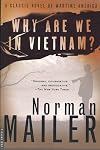
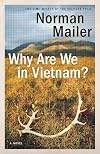
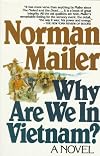
Why Are We in Vietnam?
by Norman Mailer 
On This Page
Description
When "Why Are We in Vietnam"? was published in 1967, almost twenty years after "The Naked and the Dead," the critical response was ecstatic. The novel fully confirmed Mailer's stature as one of the most important figures in contemporary American literature. Now, a new edition of this exceptional work serves as further affirmation of its timeless quality. Narrated by Ranald ("D.J.") Jethroe, Texas's most precocious teenager, on the eve of his departure to fight in Vietnam, this story of a show more hunting trip in Alaska is both brilliantly entertaining and profoundly thoughtful. show lessTags
Recommendations






























Member Recommendations

by anonymous user
Member Reviews
When you think about it, the only way to really answer the question of why the U.S. was in Vietnam is to NOT talk about Vietnam. The word only appears three times: once in the title, and twice in the last paragraph. The rest of the book is a modern Moby-Dick in the Alaskan wilderness, with a Texas CEO dragging his son, D.J., and subordinates on a fanatical hunt for a bear. Both an allegory for the Vietnam War, complete with helicopter raids on herds of ram, and a startling portrait of the generational divide developing in the late '60s that resulted in so many dead young men at the whim of older men, Why Are We in Vietnam? is at the same time beautiful and obscene and horrifically violent. Narrated by young D.J., Disc Jockey to America, show more a vulgar Holden Caulfield channeling Humbert Humbert, Why Are We In Vietnam? forces us to consider the war without thinking about the war itself. The fact of the matter is, this novel could just as well have been set in 2001, for all the similarities with the most recent Gulf War. Even though Vietnam is over, Mailer's novel will never cease to be relevant, not to mention incredibly entertaining. show less
Mailer uses the metaphor of a hunting trip to explore some of the ways in which young men are exploited by older men. We get a healthy dose of Melville echoes as well, and more references to the writings of other men than we normally get from Mailer. It is a raw book, because the process can be very violent in real life. well worth reading, but one should remember the Title is reflective, not directly related to the matter of the book. There are virtually no direct references to the war of 1959-75 in the novel.
Pas question du Vietnam dans ce roman, mais d'une expédition de chasse, allégorique et obscène en Alaska. Deux personnages principaux, un adolescent de dix-huit ans névrosé et son père, fleur vénéneuse poussée sur le fumier de la haute société de Dallas. En les suivant à la poursuite des ours et des loups, peut-être comprendra-t-on pourquoi les Américains furent au Vietnam...
Too long ago. Was there where the children are fighting about standing up their father and it is symbolic about our ignorance and folly in fighting overseas?
מיילר משיב על השאלה המטרידה הזאת ברומן שמלבד הכותרת המילה ויאטנאם לא מוזכרת בו. מסע צייד שמתאר את האלימות שנמצאת בבסיס הפסיך האמריקני
Feb 5, 2012Hebrew
Ratings
Members
- Recently Added By
Published Reviews
ThingScore 100
Mailer seems to me by far the best of the novelists who have constructed “language-systems,” because he does so without the coyness, the small-boy innocence and cunning we flinch at in other, less disturbed novelists who are largely American sons of Nabokov, Borges, and Beckett; his maniac broadcast by way of D.J. (or D.J.’s alter ego somewhere in Harlem) is meant to be a real broadcast, show more a real communication to the public, and its hysterical scatology and obscenity are probably its most important message...
Mailer, in dramatizing this predicament, is speaking for a multitude of voices — or perhaps the voices are speaking through him? A casual reading of Why Are We in Vietnam? reveals the presence of T. S. Eliot, James Joyce, Robert Lowell, William Burroughs, Hemingway, Faulkner, Melville, Twain, Sterne, Swift, Beckett, Céline, Kafka, Pynchon, Hawkes, Gass, Barth, Proust, Burgess, Freud, Roth, Selby, Genet, Bellow, Lenny Bruce, Borges, and Lawrence, and of course Mailer of the self-interviews and Advertisements, Mailer-as-Juvenile voicing his disgust at Mailer-as-Adult. None of these voices are disguised, the novel is an intentional literary event of magical telepathies (what Mailer is picking out of the air waves that swirl so violently around him), and it is a healthy acknowledgment on his part that he is not and has never been an original writer, but only deluded by the contemporary prejudice for Originality. show less
Mailer, in dramatizing this predicament, is speaking for a multitude of voices — or perhaps the voices are speaking through him? A casual reading of Why Are We in Vietnam? reveals the presence of T. S. Eliot, James Joyce, Robert Lowell, William Burroughs, Hemingway, Faulkner, Melville, Twain, Sterne, Swift, Beckett, Céline, Kafka, Pynchon, Hawkes, Gass, Barth, Proust, Burgess, Freud, Roth, Selby, Genet, Bellow, Lenny Bruce, Borges, and Lawrence, and of course Mailer of the self-interviews and Advertisements, Mailer-as-Juvenile voicing his disgust at Mailer-as-Adult. None of these voices are disguised, the novel is an intentional literary event of magical telepathies (what Mailer is picking out of the air waves that swirl so violently around him), and it is a healthy acknowledgment on his part that he is not and has never been an original writer, but only deluded by the contemporary prejudice for Originality. show less
added by SnootyBaronet
Lists

National Book Award Finalists - Fiction
377 works; 12 members
Author Information

160+ Works 24,796 Members
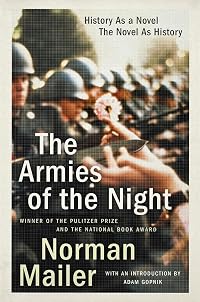
Norman Kingsley Mailer was born on January 31, 1923 in Long Branch, N. J. and then moved with his family to Brooklyn, N. Y. Mailer later attended Harvard University and graduated with a degree in aeronautical engineering. Mailer served in the Army during World War II, and later wrote, directed, and acted in motion pictures. He was also a show more co-founder of the Village Voice and edited Disssent for nine years. Mailer has written several books including: The Armies of the Night, which won the National Book Award, the Pulitzer Prize, and a Polk Award; and The Executioner's Song, which won the Pulitzer Prize. In 2005, he won the Medal for Distinguished Contribution to American Letters from the National Book Foundation. He published his last novel, The Castle in the Forest, in 2007. He died of acute renal failure on November 10, 2007. (Bowker Author Biography) show less
Norman Mailer has a Legacy Library. Legacy libraries are the personal libraries of famous readers, entered by LibraryThing members from the Legacy Libraries group.
Awards and Honors
Awards
Series
Belongs to Publisher Series
Grote Beren (52)
Common Knowledge
- Canonical title
- Why Are We in Vietnam?
- Original publication date
- 1967
- Important places
- USA; Alaska, USA
- Important events
- Vietnam War
- Dedication
- TO MY FRIENDS
Roger Donoghue
Buzz Farbar
Mickey Knox
Norman Podhoretz
Cy Rembar
and
Jose Torres - First words
- PREFACE
This is the only novel I ever finished under the mistaken belief I was writing not this kind of novel but another.
Hip hole and hupmobile, Braunschweiger, you didn’t invite Geiger and his counter for nothing, here is D.J. the friendLee voice at your service—hold tight young America—introductions come. - Quotations
- Whang! Whang! this plastic filter—trade name Pure Pores—is the most absorptive substance devised ever in a vat—traps all the nicotine, sucks up every bit of your spit. Pure Pores also causes cancer of the lip but the su... (show all)rveys are inconclusive, and besides, fuck you!
A ring of vengeance like a pitch of the Saracen’s sword on the quiver (what a movie was that, madame!) rings out of the air as if all the woe and shit and parsimony and genuine greed of all those fucking English, Irish, Sco... (show all)tch and European weeds, transplanted to North America, that sad deep sweet beauteous mystery land of purple forests, and pink rock, and blue water, Indian haunts from Maine to the shore of Californ, all gutted, shit on, used and blasted, man, cause a weed thrives on a cesspool, piss is its nectar, shit all ambrosia, and those messages at night—oh, God, let me hump the boss’ daughter, let me make it, God, all going up through the M.E.F. cutting the night air, giving a singe to the dream field, all the United Greedies of America humping up that old rhythm, turning the dynamo around.. - Last words
- (Click to show. Warning: May contain spoilers.)Vietnam, hot damn.
Classifications
Statistics
- Members
- 355
- Popularity
- 89,070
- Reviews
- 5
- Rating
- (3.60)
- Languages
- 10 — Czech, Danish, Dutch, English, French, German, Italian, Japanese, Spanish, Swedish
- Media
- Paper, Audiobook, Ebook
- ISBNs
- 19
- ASINs
- 13