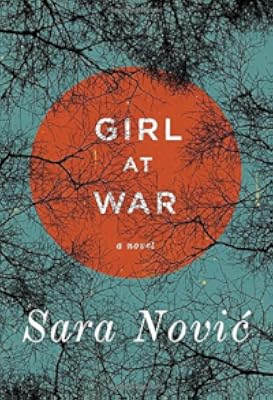
Girl at War
by Sara Novic
On This Page
Description
For readers of The Tiger’s Wife and All the Light We Cannot See comes a powerful debut novel about a girl’s coming of age—and how her sense of family, friendship, love, and belonging is profoundly shaped by war.NAMED ONE OF THE BEST BOOKS OF THE YEAR BY BOOKPAGE, BOOKLIST, AND ELECTRIC LITERATURE • ALEX AWARD WINNER • LOS ANGELES TIMES BOOK PRIZE FINALIST • LONGLISTED FOR THE BAILEYS WOMEN’S PRIZE FOR FICTION
Zagreb, 1991. Ana Juri? is a carefree ten-year-old, living show more with her family in a small apartment in Croatia’s capital. But that year, civil war breaks out across Yugoslavia, splintering Ana’s idyllic childhood. Daily life is altered by food rations and air raid drills, and soccer matches are replaced by sniper fire. Neighbors grow suspicious of one another, and Ana’s sense of safety starts to fray. When the war arrives at her doorstep, Ana must find her way in a dangerous world.
New York, 2001. Ana is now a college student in Manhattan. Though she’s tried to move on from her past, she can’t escape her memories of war—secrets she keeps even from those closest to her. Haunted by the events that forever changed her family, Ana returns to Croatia after a decade away, hoping to make peace with the place she once called home. As she faces her ghosts, she must come to terms with her country’s difficult history and the events that interrupted her childhood years before.
Moving back and forth through time, Girl at War is an honest, generous, brilliantly written novel that illuminates how history shapes the individual. Sara Novi? fearlessly shows the impact of war on one young girl—and its legacy on all of us. It’s a debut by a writer who has stared into recent history to find a story that continues to resonate today.
Praise for Girl at War
“Outstanding . . . Girl at War performs the miracle of making the stories of broken lives in a distant country feel as large and universal as myth.”—The New York Times Book Review (Editor’s Choice)
“[An] old-fashioned page-turner that will demand all of the reader’s attention, happily given. A debut novel that astonishes.”—Vanity Fair
“Shattering . . . The book begins with what deserves to become one of contemporary literature’s more memorable opening lines. The sentences that follow are equally as lyrical as a folk lament and as taut as metal wire wrapped through an electrified fence.”—USA Today. show less
Tags
Recommendations





Member Recommendations
Member Reviews
I put my elbows on the counter to get the clerk’s attention. Mr. Petrović knew me and knew what I wanted, but today his smile looked more like a smirk. “Do you want Serbian cigarettes or Croatian ones?” The way he stressed the two nationalities sounded unnatural. I had heard people on the news talking about Serbs and Croats this way because of the fighting in the villages, but no one had ever said anything to me directly. And I didn’t want to buy the wrong kind of cigarettes. “Can I have the ones I always get, please?” “Serbian or Croatian?” “You know. The gold wrapper?” I tried to see around his bulk, pointing to the shelf behind him. But he just laughed and waved to another customer, who sneered at me. “Hey!”show more
I tried to get the clerk’s attention back. He ignored me and made change for the next man in line. I’d already lost the game, but I ran home as fast as I could anyway. “Mr. Petrović wanted me to pick Serbian or Croatian cigarettes,” I told Petar. “I didn’t know the answer and he wouldn’t give me any. I’m sorry.”
This book excels at telling of how Yugoslavia was killed in the 1990s, in a lot of subtle ways. As my father is from Yugoslavia, and the high school that I attended in the mid-1990s went on, I learned how Serbs "were" different from Croats, Bosnians, et cetera, and "why". A lot of bullshit went on, and a lot of friendships were uprooted and destroyed.
Nović is very good at noting the little things, as well as the big picture. I knew nothing of her life before reading this book, and appx. 30% in, I was really shocked. It opened my eyes to what some people may feel where PTSD and war is concerned - but there's naturally no way I would ever really know this.
In school we’d been taught to ignore distinguishing ethnic factors, though it was easy enough to discern someone’s ancestry by their last name. Instead we were trained to regurgitate pan-Slavic slogans: “Bratstvo i Jedinstvo!” Brotherhood and Unity. But now it seemed the differences between us might be important after all. Luka’s family was originally from Bosnia, a mixed state, a confusing third category. Serbs wrote in Cyrillic and Croats in the Latin alphabet, but in Bosnia they used both, the spoken differences even more minute. I wondered if there was a special brand of Bosnian cigarettes, too, and whether Luka’s father smoked those.
It's not hard to draw parallels between WW2, the USA and the Yugoslav war:
Our class got two boys who looked close enough to our age to blend in. They were from Vukovar and spoke with funny accents. Vukovar was a small city a few hours away and had never meant much to me during peacetime, but now it was always in the news. In Vukovar people were disappearing. People were being forced at gunpoint to march east; people were becoming hemic vapor amid the nighttime explosions. The boys had walked all the way to Zagreb and they didn’t like to talk about it. Even after they settled in they were always a little dirtier, the circles beneath their eyes a little darker than ours, and we treated them with a distant curiosity.
There's a lot of pitch-black humor in here, which is inherently Yugo:
As a side effect of modern warfare, we had the peculiar privilege of watching the destruction of our country on television.
...and the constant threat crept closer:
After the bombing of the palace, Croatia had officially declared independence, inciting a flurry of modifications that called even the most mundane detail of our former lives into question. Pop singers famous across Yugoslavia recorded dual versions of their hits in both dialects; seemingly innocuous words like coffee had to be replaced with kava and kafa for Croatian and Serbian audiences. Even one’s greeting habits could be analyzed—a kiss on each cheek for hello was acceptable, three kisses too many, a custom in the Orthodox Church and therefore traitorous.
“They’re killing them,” the man said. “Who?” said my father, studying the paper for clues. “Everyone.” “Would you like some soup?” said my mother.
As Nović lives in the USA, she writes about the international connotations:
In America I’d learned quickly what it was okay to talk about and what I should keep to myself. “It’s terrible what happened there,” people would say when I let slip my home country and explained that it was the one next to Bosnia. They’d heard about Bosnia; the Olympics had been there in ’84.
I shan't say more about the book, as there would be spoilers, so to speak. This book has much depth and breadth, and ties in with Nović's current and "former" life. Don't miss this. show less
I admit this novel came across my radar as to-read because I learned that author Sara Novic is Deaf, as I am (but of course we have different life experiences). That fact about her is really just an aside. I knew before reading that none of the characters in this book were D/deaf, by the way.
This is an excellent novel that is informed by the fact that the author is Croatian-American.
I was absorbed by the story of Ana, whose life as she knows it ends after the civil war in Yugoslavia begins, and how the young-adult Ana deals with the present, and especially her past, after being adopted by a family in America.
As would be expected with a novel that deals with war, there are heart-wrenching moments and struggles, but it's kept in show more balance with hope and Ana's strong will. show less
This is an excellent novel that is informed by the fact that the author is Croatian-American.
I was absorbed by the story of Ana, whose life as she knows it ends after the civil war in Yugoslavia begins, and how the young-adult Ana deals with the present, and especially her past, after being adopted by a family in America.
As would be expected with a novel that deals with war, there are heart-wrenching moments and struggles, but it's kept in show more balance with hope and Ana's strong will. show less
The basics: In 1991, Ana is living a typical ten-year-old's life in Zagreb, the capital of Croatia, when the Yugoslavian war breaks out.
My thoughts: I'm about the same age as Ana, so I was immediately drawn into her story. As a ten-year-old, she doesn't understand what's happening, and as a reader, neither did I. I've heard of the war, but my knowledge of it was slim at best. While coming of age stories set against a war backdrop are hardly new, Novic takes Ana's story in unexpected directions.
We enter the story in 1991, but the story is told in several nonlinear parts. The action next jumps to New York City in 2001, where Ana is in college. Novic skillfully moves locations and times in a way that enhance the story, both emotionally show more and in structurally. Again, I could have been one of Ana's peers in college at that time. I wouldn't have known what country Zagreb was in or the significance of what it meant to be Zagreb. Watching Ana negotiate these social and educational situations was fascinating. She's such a complicated, smart, and flawed character, and I loved spending time in her worlds.
Audiobook thoughts: Julia Whelan's narration was extraordinary. She featured different accents for different characters, which helped bring the Croatian sections to life even more vividly for me. The performance was so well done I had to remind myself it wasn't done with multiple narrators. After listening to it, I came across this essay Novic wrote about what it's like to be a deaf novelist and not be able to experience the audiobook version of your book. It's fascinating!
The verdict: Every so often I read a novel so good that has me gushing with cliched superlatives like haunting and lyrical. Girl at War is indeed a haunting, lyrical novel. It's also smart and beautiful. It's a window into a place and a time I was embarrassingly ignorant about, but it's also a deft depiction of a fascinating character who is both heroine and anti-heroine, extraordinary and ordinary. This novel is one of the best I've read this year, and I hope it becomes a modern classic. It's a novel that reminds me why I so love fiction--it can educate, connect, and remind me of the vastness of our shared humanity. show less
My thoughts: I'm about the same age as Ana, so I was immediately drawn into her story. As a ten-year-old, she doesn't understand what's happening, and as a reader, neither did I. I've heard of the war, but my knowledge of it was slim at best. While coming of age stories set against a war backdrop are hardly new, Novic takes Ana's story in unexpected directions.
We enter the story in 1991, but the story is told in several nonlinear parts. The action next jumps to New York City in 2001, where Ana is in college. Novic skillfully moves locations and times in a way that enhance the story, both emotionally show more and in structurally. Again, I could have been one of Ana's peers in college at that time. I wouldn't have known what country Zagreb was in or the significance of what it meant to be Zagreb. Watching Ana negotiate these social and educational situations was fascinating. She's such a complicated, smart, and flawed character, and I loved spending time in her worlds.
Audiobook thoughts: Julia Whelan's narration was extraordinary. She featured different accents for different characters, which helped bring the Croatian sections to life even more vividly for me. The performance was so well done I had to remind myself it wasn't done with multiple narrators. After listening to it, I came across this essay Novic wrote about what it's like to be a deaf novelist and not be able to experience the audiobook version of your book. It's fascinating!
The verdict: Every so often I read a novel so good that has me gushing with cliched superlatives like haunting and lyrical. Girl at War is indeed a haunting, lyrical novel. It's also smart and beautiful. It's a window into a place and a time I was embarrassingly ignorant about, but it's also a deft depiction of a fascinating character who is both heroine and anti-heroine, extraordinary and ordinary. This novel is one of the best I've read this year, and I hope it becomes a modern classic. It's a novel that reminds me why I so love fiction--it can educate, connect, and remind me of the vastness of our shared humanity. show less
‘’Of course we want to go back. Of course we’re going home.’’
Home...Where is this ‘’home’’ when the land where you’ve spent all your life is about to witness violence, desolation, and death? Where is this ‘’home’’ when the people you’ve known as neighbours and friends are now considered enemies? Where is this ‘’home’’ when your loved ones are lost? When the guilt of surviving the nightmare still haunts your dreams? Home can only be found once you’ve made your peace with a terrifying past and Ana begins her journey through an ordeal that no living human being should ever experience again...The ordeal of war and exile.
“As a side effect of modern warfare, we had the peculiar privilege of watching show more the destruction of our country on television.”
Ana, a young girl from Zagreb, finds her life torn as the war in the Balkan region starts in 1990. Croatia is heavily wounded and Ana experiences the cruelest face of fate. Ten years later, following the tragic results of a ferocious war, Ana returns to beautiful Croatia to lay the ghosts to rest, to find beloved faces from the past, to discover some form of peace, however fragile. Through her story, her personal journey, we come to know a deeply sympathetic and brave character in a realistic, understated, poignant and powerful book by a brilliant young writer,
The setting of the novel and the implications of dealing with a war that is very much alive in the minds of most of us could have resulted in a work that would have been melodramatic in the hands of an incompetent writer or one who has to serve a personal agenda. Nović is neither. She has the confidence to project an extremely sensitive subject, a moment in recent History that was witnessed by most of us and creates a novel that is balanced, honest and extremely memorable. She weaves her story through the eyes of a young girl (going back and forth in time) and later, as a young woman that fights to understand a world that has changed forever. Nović doesn’t have to resort to gore and violence in order to attract attention. Her writing, quiet and poetic, creates moments of dread that grip your soul page after page. The hearsay stories of terror against children during the first days of the war. The necessity to turn the lights off because not doing so may prove deadly. The story of the Wall of Pain, the Zid boli in Zagreb. The child armies. The self-exile.
“...I knew in the end the guilt of one side did not prove the innocence of the other.”
People who were neighbours, friends are separated. Many have to abandon their homes, their relations because they’re suddenly considered enemies overnight. Others become refugees. And many fall, victims of men who do not fight for a country but to satisfy their endless lust for blood and rape. When you cannot distinguish truth from lies, a different kind of terror begins. When you cannot know whether the horror stories are reality or counter-propaganda. When people who have not experienced the nightmare of war use the word ‘’starving’’. This always gets me. I mean, we cannot even begin to fathom the vicious force of this expression and yet we use it thoughtlessly because this is how ignorant we all are...And after a while, the sequence of crimes and blind violence begins. The line between defense and revenge blurs and the innocents, the women and the children, are the first to pay the most horrible price. And it doesn’t matter who fights against whom. In the end, everyone is guilty of something. This is the outcome of every war...
Through Ana, a unique, bookish girl, we see beautiful Croatia. From Zagreb to Plitvice Lakes, to Split, one of the most beautiful cities. Through her memories of a happier time, we see her strong, beautiful relationship with her father. Her love for football which is a religion in itself in every Balkan country. We Balkans adore football and basketball, being pretty good at both. In fact, Croatia’s national football team is one of the best in the world.
Nović creates a journey that is heartbreaking and hopeful, sad, powerful, haunting. The ending is full of confidence, possibilities, and hope. She doesn’t struggle to force our feelings as we so often see in Contemporary Literature. She writes and we experience.
Since my university years, I’ve had many friends from the countries involved in that terrible war that devastated our beautiful corner of Europe. Some live in Greece, in Slovenia, in Croatia, in Serbia, in Germany, in Bosnia. We are all in our thirties now. We are all friends, we get together, we laugh and sing and argue. We share the same fears and hopes. Thank God for today’s peace. Thank God for us, the younger generation that lives with the values of friendship, cooperation, and understanding lighting the way. It is not easy to escape the past but I firmly believe we have succeeded in creating a new future for a region that has suffered so much for so many years.
‘’Around the room the moon filled the shell marks in the walls with a pallid blue light, and they looked full again, like a home.’’
My reviews can also be found on https://theopinionatedreaderblog.wordpress.com show less
Home...Where is this ‘’home’’ when the land where you’ve spent all your life is about to witness violence, desolation, and death? Where is this ‘’home’’ when the people you’ve known as neighbours and friends are now considered enemies? Where is this ‘’home’’ when your loved ones are lost? When the guilt of surviving the nightmare still haunts your dreams? Home can only be found once you’ve made your peace with a terrifying past and Ana begins her journey through an ordeal that no living human being should ever experience again...The ordeal of war and exile.
“As a side effect of modern warfare, we had the peculiar privilege of watching show more the destruction of our country on television.”
Ana, a young girl from Zagreb, finds her life torn as the war in the Balkan region starts in 1990. Croatia is heavily wounded and Ana experiences the cruelest face of fate. Ten years later, following the tragic results of a ferocious war, Ana returns to beautiful Croatia to lay the ghosts to rest, to find beloved faces from the past, to discover some form of peace, however fragile. Through her story, her personal journey, we come to know a deeply sympathetic and brave character in a realistic, understated, poignant and powerful book by a brilliant young writer,
The setting of the novel and the implications of dealing with a war that is very much alive in the minds of most of us could have resulted in a work that would have been melodramatic in the hands of an incompetent writer or one who has to serve a personal agenda. Nović is neither. She has the confidence to project an extremely sensitive subject, a moment in recent History that was witnessed by most of us and creates a novel that is balanced, honest and extremely memorable. She weaves her story through the eyes of a young girl (going back and forth in time) and later, as a young woman that fights to understand a world that has changed forever. Nović doesn’t have to resort to gore and violence in order to attract attention. Her writing, quiet and poetic, creates moments of dread that grip your soul page after page. The hearsay stories of terror against children during the first days of the war. The necessity to turn the lights off because not doing so may prove deadly. The story of the Wall of Pain, the Zid boli in Zagreb. The child armies. The self-exile.
“...I knew in the end the guilt of one side did not prove the innocence of the other.”
People who were neighbours, friends are separated. Many have to abandon their homes, their relations because they’re suddenly considered enemies overnight. Others become refugees. And many fall, victims of men who do not fight for a country but to satisfy their endless lust for blood and rape. When you cannot distinguish truth from lies, a different kind of terror begins. When you cannot know whether the horror stories are reality or counter-propaganda. When people who have not experienced the nightmare of war use the word ‘’starving’’. This always gets me. I mean, we cannot even begin to fathom the vicious force of this expression and yet we use it thoughtlessly because this is how ignorant we all are...And after a while, the sequence of crimes and blind violence begins. The line between defense and revenge blurs and the innocents, the women and the children, are the first to pay the most horrible price. And it doesn’t matter who fights against whom. In the end, everyone is guilty of something. This is the outcome of every war...
Through Ana, a unique, bookish girl, we see beautiful Croatia. From Zagreb to Plitvice Lakes, to Split, one of the most beautiful cities. Through her memories of a happier time, we see her strong, beautiful relationship with her father. Her love for football which is a religion in itself in every Balkan country. We Balkans adore football and basketball, being pretty good at both. In fact, Croatia’s national football team is one of the best in the world.
Nović creates a journey that is heartbreaking and hopeful, sad, powerful, haunting. The ending is full of confidence, possibilities, and hope. She doesn’t struggle to force our feelings as we so often see in Contemporary Literature. She writes and we experience.
Since my university years, I’ve had many friends from the countries involved in that terrible war that devastated our beautiful corner of Europe. Some live in Greece, in Slovenia, in Croatia, in Serbia, in Germany, in Bosnia. We are all in our thirties now. We are all friends, we get together, we laugh and sing and argue. We share the same fears and hopes. Thank God for today’s peace. Thank God for us, the younger generation that lives with the values of friendship, cooperation, and understanding lighting the way. It is not easy to escape the past but I firmly believe we have succeeded in creating a new future for a region that has suffered so much for so many years.
‘’Around the room the moon filled the shell marks in the walls with a pallid blue light, and they looked full again, like a home.’’
My reviews can also be found on https://theopinionatedreaderblog.wordpress.com show less
Many reviews mention the detached voice, the lack of depth of characterisation, and the telling of a story with an absence of emotion. It's an okay read. But it would have been so much better if the reader had been involved with the story. This is an appalling period of history that everyone on the planet should be ashamed of. The failure of this book to involve the reader is the saddest part of its telling.
On a personal note, I found the text deeply American in tone. As a European reading a European story this felt weird. From the outset, the central character was an American and not Croatian. That the character soon ended up in the USA came as no surprise and weakened further the book's opening.
I'm fairly sure the author has a story show more to tell here, and I think she was let down by her publishing team. Given a voice, this book could have been so much more. show less
On a personal note, I found the text deeply American in tone. As a European reading a European story this felt weird. From the outset, the central character was an American and not Croatian. That the character soon ended up in the USA came as no surprise and weakened further the book's opening.
I'm fairly sure the author has a story show more to tell here, and I think she was let down by her publishing team. Given a voice, this book could have been so much more. show less
I compulsively listened to this engrossing book during my daily quarantine walks. A ten year old girl living in Croatia with her loving family suddenly loses most of what is dear to her when civil war breaks out. The book follows her life as she escapes to America as well as, years later as a college student, when she returns to Croatia to make sense of all that she had experienced there. She struggles with the meaning of home and family and is in many ways a lost soul until she can confront her past. The story is beautifully told and, though no details are spared, Ana was such an engaging child/young woman that I couldn't wait to continue reading. This is a truly memorable book.
The thing about books like this is that the stories need to be told. It is so very important for readers to be introduced to tragic situations that are unfamiliar to them and this book, being about life in Zagreb during war in Croatia, is one of those important ones. It is also so very well written that I couldn't put it down.
There is a bit of a coming of age feel to this, though it is a novel about war and the physical and emotional toll that it causes on the lives of everyone it touches. I took special notice when the main character grew up and lived her "adult" life in the states, where she tries to fit in as if nothing has happened to her. She doesn't talk about the events in her life and all of the emotion that goes with that show more really made her character seem tangible and three dimensional to me. It wasn't just a girl with a sad past wandering around saying poor me, it was someone concerned for how she would be treated once people knew the truth.
The book is beautifully written, just skimming through other reviews takes me easily back to a moment in the book that I can vividly picture in my mind, as if I had been standing beside the characters, experiencing it myself. Stories that make your mind believe you lived them are rare indeed. This one was longlisted for the Baileys Prize for Women's Fiction, which is how I found it, but it has other awards to brag of, though there aren't enough of them, in my opinion. show less
There is a bit of a coming of age feel to this, though it is a novel about war and the physical and emotional toll that it causes on the lives of everyone it touches. I took special notice when the main character grew up and lived her "adult" life in the states, where she tries to fit in as if nothing has happened to her. She doesn't talk about the events in her life and all of the emotion that goes with that show more really made her character seem tangible and three dimensional to me. It wasn't just a girl with a sad past wandering around saying poor me, it was someone concerned for how she would be treated once people knew the truth.
The book is beautifully written, just skimming through other reviews takes me easily back to a moment in the book that I can vividly picture in my mind, as if I had been standing beside the characters, experiencing it myself. Stories that make your mind believe you lived them are rare indeed. This one was longlisted for the Baileys Prize for Women's Fiction, which is how I found it, but it has other awards to brag of, though there aren't enough of them, in my opinion. show less
Members
- Recently Added By
Published Reviews
ThingScore 75
Throughout, “Girl at War” performs the miracle of making the stories of broken lives in a distant country feel as large and universal as myth. It is a brutal novel, but a beautiful one.
added by vancouverdeb
Nović excels at distilling visual poetry from action scenes, and there is one section in the middle that steals the show, when the shellshocked young Ana drifts into a twilight community and becomes an accidental combatant. “Suspended between living and dead”, Ana has become mute, except for the mantra: “Forward grip, gas chamber, cleaning rod, bolt, frame, magazine, function check.” show more Nović has breathed fire and ice into these pages. Immersing herself in the darkest materials, she has given us the real stuff dystopian fantasies are made of. show less
added by vancouverdeb
Lists

2016 Baileys Women's Prize for Fiction
18 works; 10 members

Favourite Women's Prize for Fiction, Orange & Bailey's Prize contenders
132 works; 52 members

Women in War
148 works; 30 members

War Literature
101 works; 19 members

Books Read in 2015
3,299 works; 126 members

My TBR Challenge Leftovers
22 works; 1 member
Books Read in 2016
4,666 works; 199 members

Overdue Podcast
806 works; 9 members
International Dublin Literary Award Longlist 2017
147 works; 3 members

Dublin Literary Award Longlist 2017
147 works; 2 members

To Read
617 works; 7 members

Books With Girls in Titles
27 works; 2 members

Wishlist
48 works; 1 member

Books recommended by Calgary Public Library staff
1,588 works; 4 members

Reading Glasses Podcast
410 works; 3 members
Author Information

6 Works 2,409 Members
Some Editions
Awards and Honors
Awards
Distinctions
Notable Lists
Common Knowledge
- Canonical title
- Girl at War
- Original title
- Girl at War
- Original publication date
- 2015-05-12
- People/Characters
- Ana Jurić; Luka; Petar Tomić; Ivan Jurić; Dijana Jurić; Sharon Stanfield (show all 13); Rahela "Rachel" Jurić; Damir; Marina Tomić; Brian; Jack; Laura; Denka
- Important places
- Zagreb, Croatia; Yugoslavia; Manhattan, New York, New York, USA
- Important events
- Yugoslav Wars; September 11 Attacks
- Epigraph
- I had come to Yugoslavia to see what history meant in flesh and blood. I learned now that it might follow, because an empire passed, that a world full of strong men and women and rich food and heady wine might nevertheless se... (show all)em like a shadow-show: that a man of every excellence might sit by a fire warming his hands in the vain hope of casting out a chill that lived not in the flesh.
—Rebecca West,
Black Lamb and Grey Falcon
I see pictures merging before my mind's eye—paths through the fields, river meadows, and mountain pastures mingling with images of destruction—and oddly enough, it is the latter, not the now entirely unreal idylls of my e... (show all)arly childhood, that make me feel rather as if I were coming home.
—W. G. Sebald,
On the Natural History of Destruction - Dedication
- For my family, and for A
- First words
- The war in Zagreb began over a pack of cigarettes.
- Last words
- (Click to show. Warning: May contain spoilers.)Around the room the moon filled the shell marks in the walls with a pallid blue light, and they looked full again, like a home.
- Blurbers
- Taylor, Justin; Shteyngart, Gary; Kaplan, Robert D.; Dubois, Jennifer; Dee, Jonathan; LaValle, Victor
- Original language
- English
Classifications
Statistics
- Members
- 1,088
- Popularity
- 23,436
- Reviews
- 58
- Rating
- (4.06)
- Languages
- 9 — Czech, Dutch, English, French, German, Korean, Portuguese, Spanish, Turkish
- Media
- Paper, Audiobook, Ebook
- ISBNs
- 24
- ASINs
- 6