On This Page
Description
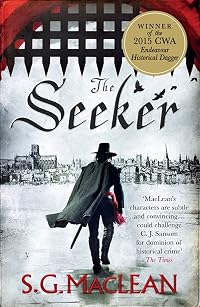
London, 1654. Oliver Cromwell is at the height of his power and has declared himself Lord Protector. Yet he has many enemies, at home and abroad.Tags
Recommendations

















Member Reviews
A politician once said of Germany that it took half the country to control the other half (and he was speaking around 1900, well before either world war). I get the same chilling impression of midseventeenth-century London from The Seeker, a mystery that involves murder, royalist conspiracies, and the terror of speaking one’s mind.
It’s 1654, and after a fractious, savage civil war, Oliver Cromwell has seized power, employing a vast, pervasive spy network to root out anything he considers subversive. His most ubiquitous, feared agent is Damian Seeker, who seems to know whatever you shouldn’t have done, when, and with whom. So if you’ve spoken against the Lord Protector Cromwell’s joyless, repressive regime; longed for the show more Stuart monarchy to return; written a poem extolling liberty; or merely sat in the same room as someone who’s done any of these, when The Seeker comes for you–and he will–don’t bother to deny a thing. It’s better not to.
However, what makes Seeker more than an extraordinarily energetic, gifted goon is a passion for truth, no matter where it leads. Consequently, when an assassin fells John Winter, a soldier who enjoyed the Lord Protector’s favor and sat in his inner council, it’s more than a security breach. It’s also a murder case, and finding the killer matters, not only because he could strike again, but–well, because. And from the first, Seeker doubts that Elias Ellingworth is the killer, even if he was discovered near Winter’s body, holding the bloody knife, and even if he’s penned seditious pamphlets.
To find the real murderer, Seeker must follow a sinuous trail that quickly branches in several directions, all of which appear to threaten the regime. Coffee houses, the latest fad in London, are the perfect breeding ground for conspiracy, though they’re also places for free conversation on any topic under the sun.
I like how MacLean plays this theme. Cromwell’s followers pretend that they have swept away a tyranny based on birth and replaced it with a temperate government that values merit. But, as Ellingworth insists, the Lord Protector has betrayed the democracy he once professed and instituted a tyranny of his own. That Seeker, a commoner of humble origins, hunts down dissidents to uphold an unjust, autocratic ruler lends the conflict a fitting irony.
Little is known about Seeker’s origins, though, for the man never talks about himself or his feelings, if he even has any. He’s all work. However, Maria Ellingworth, the imprisoned suspect’s sister, interests him, and I doubt I’m giving anything away by saying that the young woman’s naive honesty and directness slowly seep through his defenses. It’s obvious from the get-go, though anything but obvious how it will end.
That’s The Seeker’s greatest strength, I think. Except for a scene or two recounted out of order to withhold a secret, the novel is exceptionally well plotted, no mean trick, given the sheer number of characters. Further, MacLean excels at hiding whether certain key characters are friends or foes, sometimes up until the end.
I could have done without a cliché action or two, as when Seeker holds off his men to battle a traitor in single combat, but that’s a minor quibble. I love the period details, which flow seamlessly through the narrative and lend atmosphere. The language does slip occasionally, though; I’m certain no seventeenth-century Englishman would have ever used the phrase “liaise with.”
Seeker’s also pretty thin as a character, yet he’s the deepest of the lot. Late in the novel–too late, I think–we’re told (not shown) why he’s so loyal to Cromwell, and why he loves order above all. But I’m not entirely persuaded, and I think it would have taken little to establish this in small ways throughout the narrative. Seeker has potential–why is he so fierce, and why does truth matter to him?–but this book doesn’t exploit his inner conflicts. Maybe in future installments, MacLean will show more of him and her other characters. show less
It’s 1654, and after a fractious, savage civil war, Oliver Cromwell has seized power, employing a vast, pervasive spy network to root out anything he considers subversive. His most ubiquitous, feared agent is Damian Seeker, who seems to know whatever you shouldn’t have done, when, and with whom. So if you’ve spoken against the Lord Protector Cromwell’s joyless, repressive regime; longed for the show more Stuart monarchy to return; written a poem extolling liberty; or merely sat in the same room as someone who’s done any of these, when The Seeker comes for you–and he will–don’t bother to deny a thing. It’s better not to.
However, what makes Seeker more than an extraordinarily energetic, gifted goon is a passion for truth, no matter where it leads. Consequently, when an assassin fells John Winter, a soldier who enjoyed the Lord Protector’s favor and sat in his inner council, it’s more than a security breach. It’s also a murder case, and finding the killer matters, not only because he could strike again, but–well, because. And from the first, Seeker doubts that Elias Ellingworth is the killer, even if he was discovered near Winter’s body, holding the bloody knife, and even if he’s penned seditious pamphlets.
To find the real murderer, Seeker must follow a sinuous trail that quickly branches in several directions, all of which appear to threaten the regime. Coffee houses, the latest fad in London, are the perfect breeding ground for conspiracy, though they’re also places for free conversation on any topic under the sun.
I like how MacLean plays this theme. Cromwell’s followers pretend that they have swept away a tyranny based on birth and replaced it with a temperate government that values merit. But, as Ellingworth insists, the Lord Protector has betrayed the democracy he once professed and instituted a tyranny of his own. That Seeker, a commoner of humble origins, hunts down dissidents to uphold an unjust, autocratic ruler lends the conflict a fitting irony.
Little is known about Seeker’s origins, though, for the man never talks about himself or his feelings, if he even has any. He’s all work. However, Maria Ellingworth, the imprisoned suspect’s sister, interests him, and I doubt I’m giving anything away by saying that the young woman’s naive honesty and directness slowly seep through his defenses. It’s obvious from the get-go, though anything but obvious how it will end.
That’s The Seeker’s greatest strength, I think. Except for a scene or two recounted out of order to withhold a secret, the novel is exceptionally well plotted, no mean trick, given the sheer number of characters. Further, MacLean excels at hiding whether certain key characters are friends or foes, sometimes up until the end.
I could have done without a cliché action or two, as when Seeker holds off his men to battle a traitor in single combat, but that’s a minor quibble. I love the period details, which flow seamlessly through the narrative and lend atmosphere. The language does slip occasionally, though; I’m certain no seventeenth-century Englishman would have ever used the phrase “liaise with.”
Seeker’s also pretty thin as a character, yet he’s the deepest of the lot. Late in the novel–too late, I think–we’re told (not shown) why he’s so loyal to Cromwell, and why he loves order above all. But I’m not entirely persuaded, and I think it would have taken little to establish this in small ways throughout the narrative. Seeker has potential–why is he so fierce, and why does truth matter to him?–but this book doesn’t exploit his inner conflicts. Maybe in future installments, MacLean will show more of him and her other characters. show less
I've had this in my library for a while but someone else's review of it (and the rest of the series) prompted me to read it now. Novels set during the English Commonwealth are fairly uncommon so the subject matter was interesting. The plot was very complicated but also easy to follow and, again, introduced some unusual (to me) concepts and ideas. I wish I had the next one in the series to hand!
I found this a hard novel to assess. In most aspects The Seeker is a hugely accomplished and absorbing novel. S.G. MacLean evokes the darkness and paranoia of Cromwell's England with economy and precision, and delivers a neatly plotted murder mystery which dovetails nicely with the political backdrop. However...
...the character of Damian Seeker, the protagonist, seems to come from a different and inferior novel. Seeker is a stereotypically dark and damaged anti-hero we have all come across in fiction many times before. He is attractive to women without realising it, nurses a battered integrity and is never, ever wrong. He can tell infallibly if someone is lying and is, of course, a peerless swordsman. And underneath his forbidding show more exterior, we find he does have a heart which simply awaits the appropriate prompt...
I have not read any of S.G. MacLean's work before, and there was so much I liked in the book that I will certainly read more, but it may be a while before I sit down with Damian Seeker again. show less
...the character of Damian Seeker, the protagonist, seems to come from a different and inferior novel. Seeker is a stereotypically dark and damaged anti-hero we have all come across in fiction many times before. He is attractive to women without realising it, nurses a battered integrity and is never, ever wrong. He can tell infallibly if someone is lying and is, of course, a peerless swordsman. And underneath his forbidding show more exterior, we find he does have a heart which simply awaits the appropriate prompt...
I have not read any of S.G. MacLean's work before, and there was so much I liked in the book that I will certainly read more, but it may be a while before I sit down with Damian Seeker again. show less
London in time of The Protectorate is a complex place. Whilst the Commonwealth under the leadership of Oliver Cromwell has banned theatre etc, the people are still living life as normal regardless of whether there is a king on the throne or a Protector in charge. Meanwhile the Royalists are plotting and spying from their base in The Netherlands. High-ranking Parliamentarian John Winter is brutally murdered in Whitehall, his wife appears innocent even though she is a staunch Royalist, but a plot is feared and intelligencer and enforcer Damian Seeker is tasked with solving the crime. This leads to a web of intrigue involving the Barbados slave trade, coffee houses and an old score to settle from the West Country.
Having read one of show more MacLean's books before I had high hopes for this series, the setting is relatively unexplored, particularly from the perspective of the Parliamentarians. Usually books focus on the Civil War itself and have a romanticised view of the Royalists, this book explores issues affecting both sides and takes the viewpoint from the common people which is also refreshing. Whilst Damian Seeker is the central character he is quite lightly drawn, probably to be further explored in later instalments, and this is the the benefit of the pace of the novel. Plotting is interesting with multiple strands drawn together and I was particularly interested in the white slave trade aspect as it was something I was relatively unaware of in this period. show less
Having read one of show more MacLean's books before I had high hopes for this series, the setting is relatively unexplored, particularly from the perspective of the Parliamentarians. Usually books focus on the Civil War itself and have a romanticised view of the Royalists, this book explores issues affecting both sides and takes the viewpoint from the common people which is also refreshing. Whilst Damian Seeker is the central character he is quite lightly drawn, probably to be further explored in later instalments, and this is the the benefit of the pace of the novel. Plotting is interesting with multiple strands drawn together and I was particularly interested in the white slave trade aspect as it was something I was relatively unaware of in this period. show less
Ratings
Members
- Recently Added By
Lists

Huxley's Reading Log 2019
24 works; 1 member
Author Information

14 Works 1,624 Members
Awards and Honors
Series

Common Knowledge
- Canonical title
- The Seeker
- Original publication date
- 2015
Classifications
Statistics
- Members
- 219
- Popularity
- 149,578
- Reviews
- 5
- Rating
- (3.86)
- Languages
- English
- Media
- Paper, Audiobook, Ebook
- ISBNs
- 8
- ASINs
- 5