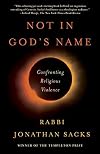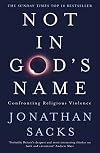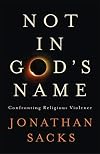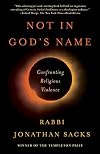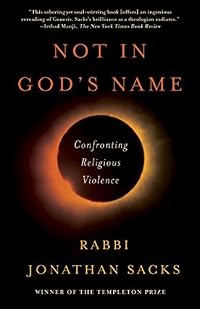
Not in God's Name: Confronting Religious Violence
by Jonathan Sacks
On This Page
Description
"In this powerful and timely book, one of the most admired and authoritative religious leaders of our time tackles the phenomenon of religious extremism and violence committed in the name of God,"--Amazon.com.Tags
Recommendations















Member Reviews
Many thanks to Edelweiss, Net Galley and Schocken for providing me an advance copy of this book for an honest review. I have already placed a pre-order for it.
This book addresses the issue of those who perform violent acts in the name of God. Rabbi Sacks defines “altruistic evil” as those acts so heinous that they cannot be defended or justified as the means to a great, noble or holy end. Much of the book looks at the connection between religion and violence. The role social media plays in the perpetuation of violent ideology is discussed.
Rabbi Sacks explains the concept of dualism and how it establishes the feeling of Us versus Them. It is suggested that “dualism becomes lethal when a group of people, a nation or a faith, feel show more endangered by internal conflict”. This Us versus Them can easily lead to the dehumanization which destroys empathy and sympathy. He proposes that through role reversal – always placing ourselves in the shoes of Them – can help us prevent dehumanizing others. He makes a good argument, in my opinion, of how this led to the Crusades, the Holocaust, Kosovo, Hutus vs Tutsis, and now al-Qaeda and ISIS. Since he believes that the Holocaust illustrates the psychological and social dynamics of hatred, the Holocaust is addresses extensively.
Anyone familiar with the Hebrew Bible (the Old Testament) knows that much of the violence centered around sibling rivalry. Several chapters explore the stories of Isaac and Ishmael, Esau and Jacob, Rachel and Leah. I found this section especially enlightening as Rabbi Sacks digs deeper into the stories and presents a totally different reason for these stories than we have all been taught. I spent quite some time thinking about his interpretations. And I know I will continue to think about them.
Jews are continually reminded that we are to be kind to the stranger because we were once a stranger in another land. This teaching has a much more profound meaning than I thought before I read this book.
Anyone interested in exploring the role of religion in violence and who is willing to broaden their thinking on stories they have been taught their entire life should definitely read this book. I will be keeping it with me and re-reading portions frequently as I continue to mull over what is written. show less
This book addresses the issue of those who perform violent acts in the name of God. Rabbi Sacks defines “altruistic evil” as those acts so heinous that they cannot be defended or justified as the means to a great, noble or holy end. Much of the book looks at the connection between religion and violence. The role social media plays in the perpetuation of violent ideology is discussed.
Rabbi Sacks explains the concept of dualism and how it establishes the feeling of Us versus Them. It is suggested that “dualism becomes lethal when a group of people, a nation or a faith, feel show more endangered by internal conflict”. This Us versus Them can easily lead to the dehumanization which destroys empathy and sympathy. He proposes that through role reversal – always placing ourselves in the shoes of Them – can help us prevent dehumanizing others. He makes a good argument, in my opinion, of how this led to the Crusades, the Holocaust, Kosovo, Hutus vs Tutsis, and now al-Qaeda and ISIS. Since he believes that the Holocaust illustrates the psychological and social dynamics of hatred, the Holocaust is addresses extensively.
Anyone familiar with the Hebrew Bible (the Old Testament) knows that much of the violence centered around sibling rivalry. Several chapters explore the stories of Isaac and Ishmael, Esau and Jacob, Rachel and Leah. I found this section especially enlightening as Rabbi Sacks digs deeper into the stories and presents a totally different reason for these stories than we have all been taught. I spent quite some time thinking about his interpretations. And I know I will continue to think about them.
Jews are continually reminded that we are to be kind to the stranger because we were once a stranger in another land. This teaching has a much more profound meaning than I thought before I read this book.
Anyone interested in exploring the role of religion in violence and who is willing to broaden their thinking on stories they have been taught their entire life should definitely read this book. I will be keeping it with me and re-reading portions frequently as I continue to mull over what is written. show less
People have been killing each other for centuries in the name of religion. In this National Jewish Book Award-winning text, Rabbi Sacks has attempted to grapple with the current rise in violent killings based on religious beliefs. Rabbi Sacks is a philosopher. As such, he goes on at great length to analyze the roots of religious violence. He states that religion leads to violence when it consecrates hatred. Although no practical solutions to the issues are offered here, he observes that this violence “must be fought religiously as well as militarily”. His standard ideals of love your enemy, let go of the hatred in your heart, and acknowledge that only God can mete out vengeance can only go so far. His theory is that wars may be won show more with weapons but only ideas can win a peace. show less
A superb book, confronting justification of religious violence in all its forms. Being a Rabbi, he does focus on antisemitism as a larger example but is quick to point out other instances in other religions and world events. Thoughtful and probing in many, sometimes uncomfortable, ways.
2nd Read:
"God hears the cry of the unheard, and so, if we follow him, do we."
2nd Read:
"God hears the cry of the unheard, and so, if we follow him, do we."
Jonathan Sacks’ Not in God’s Name is rather interesting discourse on sibling rivalry as the cause of religious violence. His discussion is based largely on the Hebrew Bible, Midrash, Mishnah, and Talmud. He analyzes the story of Cain and Abel, Isaac and Ishmael, Esau and Jacob, and the sisters Laban, Rachel, and Leah. Sacks points out that what is important about these stories in Genesis was the fact that they led to blessings and redemption of all concerned.
Deuteronomy contains the word ‘love’ more than any other Mosaic books. To Sacks ‘memory’ has also become a moral force that is found both in Exodus and Deuteronomy. But the virtue of ‘love’ has to be tempered with ‘justice’ for laws and rights of the poor, and show more destitute to be upheld. He addresses the Islamic prediction and divisions that resulted with the fall of the Ottoman Empire in 1922. And Sacks envisions that the monotheistic faiths of Judaism, Christianity, and Islam should be able to live in peace.
It was interesting to learn of the ‘commonalities’ of the three Abrahamic traditions. Yet Sacks shows that the reading of scripture calls for study and reflection. For the ‘Word of God’ is subject to different interpretations, and much depends on time and place. He states how the Hebrew language differs that that of Greek, and how believers in Judaism, Christianity, and Islam have differed in their beliefs. Yet he argues that there should be no place for fundamentalist beliefs in society. People should do unto others like what they would like to be done to themselves. And they ought to love God, their neighbor, and the stranger. For divine living is all about ‘forgiveness’ and ‘reconciliation.’ So why nations can’t heed these principles and live in peace? show less
Deuteronomy contains the word ‘love’ more than any other Mosaic books. To Sacks ‘memory’ has also become a moral force that is found both in Exodus and Deuteronomy. But the virtue of ‘love’ has to be tempered with ‘justice’ for laws and rights of the poor, and show more destitute to be upheld. He addresses the Islamic prediction and divisions that resulted with the fall of the Ottoman Empire in 1922. And Sacks envisions that the monotheistic faiths of Judaism, Christianity, and Islam should be able to live in peace.
It was interesting to learn of the ‘commonalities’ of the three Abrahamic traditions. Yet Sacks shows that the reading of scripture calls for study and reflection. For the ‘Word of God’ is subject to different interpretations, and much depends on time and place. He states how the Hebrew language differs that that of Greek, and how believers in Judaism, Christianity, and Islam have differed in their beliefs. Yet he argues that there should be no place for fundamentalist beliefs in society. People should do unto others like what they would like to be done to themselves. And they ought to love God, their neighbor, and the stranger. For divine living is all about ‘forgiveness’ and ‘reconciliation.’ So why nations can’t heed these principles and live in peace? show less
Not in God’s Name – An Interesting Opening to a debate
Former Chief Rabbi Jonathan Sacks has just published one of the most pertinent books about religious extremism that should be the beginning of a debate on religious violence. This is a well researched well written start to a debate that needs to be taken about how we can understand radical politicised religious violence. While not coming up with a complete answer what Jonathan Sacks is doing is inviting us to think about how we can end radical politicised religious violence.
At present there is a whole slew of books that have been published on religious violence mainly from a Christian standpoint looking at Islamic violence this is a wonderful complimentary book to that canon and show more vital at the same time.
Sacks open the book looking at a definition of evil and reminding us that Judaism, Islam and Christianity are the three Abrahamic faiths, religious cousins. There is an interesting debate about the sociology of the Abrahamic faiths, the history, philosophy, and psychological insight into relationships which includes a sort of sibling rivalry, rejection, where all three see themselves as victims, scapegoats, and the need to search for reconciliation.
In the final chapter Sacks addresses his specific remedies to religious violence which are aimed specifically towards the Abrahamic faiths. At least unlike politicians and so called media experts and commentators, who will disagree with Sacks ideas, there is no flailing around looking for an answer. Sacks also points out that have a vested interest in the problem of violence are actually part of the problem.
In God’s Name does not offer a cure but it certainly offers a diagnosis and that the current pace of religious violence offers those opposed to religions to state their case even more at the moment. What Sacks does say that one of the things religions can do is learn to honour God’s name and be more like his likeness may help to solve the problems that arise from religions.
Those who are not active in any faith will point out the many points that they will not agree with but this book is not designed for a non-believer it is written for those who have a faith and want to understand religious violence.
Those with a faith will receive this book and its teaching and wisdom with an open mind while those commentators who do not, will continue flail around and come up with nothing. show less
Former Chief Rabbi Jonathan Sacks has just published one of the most pertinent books about religious extremism that should be the beginning of a debate on religious violence. This is a well researched well written start to a debate that needs to be taken about how we can understand radical politicised religious violence. While not coming up with a complete answer what Jonathan Sacks is doing is inviting us to think about how we can end radical politicised religious violence.
At present there is a whole slew of books that have been published on religious violence mainly from a Christian standpoint looking at Islamic violence this is a wonderful complimentary book to that canon and show more vital at the same time.
Sacks open the book looking at a definition of evil and reminding us that Judaism, Islam and Christianity are the three Abrahamic faiths, religious cousins. There is an interesting debate about the sociology of the Abrahamic faiths, the history, philosophy, and psychological insight into relationships which includes a sort of sibling rivalry, rejection, where all three see themselves as victims, scapegoats, and the need to search for reconciliation.
In the final chapter Sacks addresses his specific remedies to religious violence which are aimed specifically towards the Abrahamic faiths. At least unlike politicians and so called media experts and commentators, who will disagree with Sacks ideas, there is no flailing around looking for an answer. Sacks also points out that have a vested interest in the problem of violence are actually part of the problem.
In God’s Name does not offer a cure but it certainly offers a diagnosis and that the current pace of religious violence offers those opposed to religions to state their case even more at the moment. What Sacks does say that one of the things religions can do is learn to honour God’s name and be more like his likeness may help to solve the problems that arise from religions.
Those who are not active in any faith will point out the many points that they will not agree with but this book is not designed for a non-believer it is written for those who have a faith and want to understand religious violence.
Those with a faith will receive this book and its teaching and wisdom with an open mind while those commentators who do not, will continue flail around and come up with nothing. show less
This is a well researched well written start to a debate that needs to be taken about how we can understand radical politicised religious violence. While not coming up with a complete answer what Jonathan Sacks is doing is inviting us to think about how we can end radical politicised religious violence.
Ratings
Members
- Recently Added By
Lists

Wish to read
6 works; 1 member

Nonfiction
41 works; 1 member
Author Information

143+ Works 4,057 Members
Jonathan Sacks is currently visiting Professor at the Hebrew University, Jerusalem, and is an Honorary Fellow of Gonville and Caius College, Cambridge.
Awards and Honors
Common Knowledge
- Dedication
- To my brother Eliot,
With love - First words
- When religion turns men into murderers, God weeps.
- Last words
- (Click to show. Warning: May contain spoilers.)Today God is calling us, Jew, Christian and Muslim, to let go of hate and the preaching of hate,
and live at last as brothers and sisters, true to our faith and a blessing to others regardless of their faith, honouring God's name by honouring his image, humankind. - Publisher's editor
- Karper, Altie
Classifications
- Genres
- Religion & Spirituality, Nonfiction, General Nonfiction, Philosophy, History
- DDC/MDS
- 201.76332 — Religion The Bible & Christianity Religious mythology, general classes of religion, interreligious relations and attitudes, social theology Attitudes of religions toward social issues Social problems and services
- LCC
- BL65 .V55 .S24 — Philosophy, Psychology and Religion Religions. Mythology. Rationalism Religions. Mythology. Rationalism Philosophy of religion. Psychology of religion. Religion
- BISAC
Statistics
- Members
- 446
- Popularity
- 68,100
- Reviews
- 6
- Rating
- (4.38)
- Languages
- 6 — Czech, Dutch, English, French, Italian, Swedish
- Media
- Paper, Audiobook, Ebook
- ISBNs
- 12
- ASINs
- 4