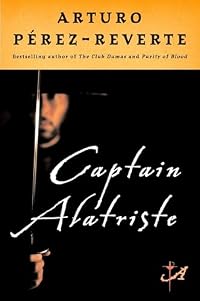
On This Page
Description
The first action-packed historical adventure in the internationally acclaimed Captain Alatriste series, featuring a Spanish soldier who lives as a swordsman-for-hire in 17th century Madrid. Needing gold to pay off his debts, Captain Alatriste and another hired blade are paid to ambush two travelers, stage a robbery, and give the travelers a fright. "No blood," they are told. Then a mysterious stranger enters to clarify the job: he increases the pay, and tells Alatriste that, instead, he show more must murder the two travelers. When the attack unfolds, Alatriste realizes that these aren't ordinary travelers, and what happens next is only the first in a riveting series of twists and turns, with implications that will reverberate throughout the courts of Europe... show lessTags
Recommendations




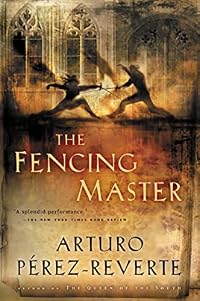

































Member Recommendations



Member Reviews
"There are women who are interesting for their charms, priests for their absolutions, old men for their money… As for men like you and me, it is only our swords." (pg. 21)
Some promising, good-calibre escapism from Arturo Pérez-Reverte. This first Captain Alatriste novel is standard Dumas-like adventure fare pepped up by good dialogue and the odd literary flourish. It is in essence a character study of its titular 17th-century captain, an honourable soldier of fortune who, after being hired to Jussie Smollett some mysterious Englishmen in a dark alley, instead saves them after they conduct themselves honourably in the swordfight. Alatriste is quite an interesting character throughout, as we watch him negotiate the pitfalls and show more intrigues of Spain's 'Golden Age'.
Pérez-Reverte is keen to educate the reader on the realities of this Golden Age, showing how "Spain had begun to doze, trusting in the gold and silver that the galleons brought from the Indies", leading to corruption and "an inexorable decadence" (pg. 60). If the author's educational enthusiasm does sometimes become a bit overt, there are more than enough swordfights, pistol shots and plumed hats to compensate. It's good adventure.
I'm a sucker for this sort of thing and its faults are irrelevant to me, but here they are anyway: For one thing, the author's occasional literary flourishes can disguise that what he has here is essentially the Spanish equivalent of a Sharpe novel, and those readers who crave originality will be disappointed. The book is short and easy – great for a lazy weekend – but it lacks the extra qualities of theme, character, pathos and allusion that elevate, for example, the Flashman novels by George MacDonald Fraser, which recurred in my mind as I read it. The book is also, as other reviewers have mentioned, a bit slow at times. The plot takes a while to warm and it ends rather sharply, with the author clearly setting the stage for future novels. But there is enough promise here in Captain Alatriste that I'll be reading them in due course. show less
Some promising, good-calibre escapism from Arturo Pérez-Reverte. This first Captain Alatriste novel is standard Dumas-like adventure fare pepped up by good dialogue and the odd literary flourish. It is in essence a character study of its titular 17th-century captain, an honourable soldier of fortune who, after being hired to Jussie Smollett some mysterious Englishmen in a dark alley, instead saves them after they conduct themselves honourably in the swordfight. Alatriste is quite an interesting character throughout, as we watch him negotiate the pitfalls and show more intrigues of Spain's 'Golden Age'.
Pérez-Reverte is keen to educate the reader on the realities of this Golden Age, showing how "Spain had begun to doze, trusting in the gold and silver that the galleons brought from the Indies", leading to corruption and "an inexorable decadence" (pg. 60). If the author's educational enthusiasm does sometimes become a bit overt, there are more than enough swordfights, pistol shots and plumed hats to compensate. It's good adventure.
I'm a sucker for this sort of thing and its faults are irrelevant to me, but here they are anyway: For one thing, the author's occasional literary flourishes can disguise that what he has here is essentially the Spanish equivalent of a Sharpe novel, and those readers who crave originality will be disappointed. The book is short and easy – great for a lazy weekend – but it lacks the extra qualities of theme, character, pathos and allusion that elevate, for example, the Flashman novels by George MacDonald Fraser, which recurred in my mind as I read it. The book is also, as other reviewers have mentioned, a bit slow at times. The plot takes a while to warm and it ends rather sharply, with the author clearly setting the stage for future novels. But there is enough promise here in Captain Alatriste that I'll be reading them in due course. show less
I have always been a sucker for the 17th Century; Cavaliers and Roundheads, Cyrano and Roxane, Peter Blood and his honorable pirates, Constance and Milady and D’Artagnan. Rapiers at dawn and satin gowns in candlelight. And this despite the knowledge that with a sword I would be considerably more dangerous to myself than to an opponent - I once cut myself on the sharp edge of a basketball - and that no amount of satin and candlelight could make up for the fact that the personal hygiene standards of the time meant Milady’s boudoir probably smelled like a sewage lift station. Perhaps Milady used enough scent that it smelled like a sewage lift station with a room deoderizer in it, but you could still pick up the undertones.
I therefore show more greeted the news that one of my favorite mystery authors - Arturo Perez-Reverte - was starting a series based on the picaresque adventures of a mercenary but honorable swordsman in the Madrid of Philip IV with favor. There’s some temerity in treading the same ground as Alexandre Dumas, but Perez-Reverte isn’t shy about it; the young Duke of Buckingham is an important figure in the novel, and his eventual demise at the hands of an agent of Milady de Winter is mentioned.
We get swordplay and knife work, plots and counterplots, mysterious masked men, beautiful blond noblewomen, equally beautiful harlots, Italian assassins, loyal friends, deadly enemies, and (I confess I wasn’t expecting it) the Spanish Inquisition. The narrator is the orphan ward of Captain Alatriste, Inigo Balboa (it’s tempting, but I doubt we’ll later find him wandering around looking for the man who killed his father, because apparently the deed was done by an anonymous harquebusier in Flanders and not a six-fingered Count). The historical background necessary to understand what Spain was like back then is woven in seamlessly; this is frequently a stumbling block in historical novels.
I wonder if there isn’t something to Jungian archetypes after all. Is there a set of 17th century swordsman somehow built into our memories, along with naval officers of the Napoleonic Wars, a undead Transylvania count, Victorian detectives and their loyal companions, and the ancient Greek wanderer who also turns up in medieval Arabia and 1906 Dublin? Why do certain fictional or semifictional characters become mythic figures and others who are seemingly equally interesting fade away? It doesn’t seem to be the quality of the writing; Dracula, with its unfortunate epistolary style, is almost as painful to read as getting bitten in the neck; however, the Count supposedly shares with Sherlock Holmes the distinction of appearing in more movies than any other fictional character. (Triva question; what American has appeared in the most movies? Hint: Nonfictional). Similarly, the Three Musketeers are much more familiar from their movie and candy bar appearances than from the novels, which have 100 pages of French court politics for every sword fight.
I wonder if Perez-Reverte is thinking movie rights here? Although his more cerebral novels have been critically acclaimed, the only one I know of to make it to the screen is (ironically) The Club Dumas, which was filmed as The Ninth Gate after a rewrite that left nothing of the original but the character’s names. Perhaps Captain Alatriste is a roundabout way of giving Hollywood what it wants; even if so it’s still a good read. show less
I therefore show more greeted the news that one of my favorite mystery authors - Arturo Perez-Reverte - was starting a series based on the picaresque adventures of a mercenary but honorable swordsman in the Madrid of Philip IV with favor. There’s some temerity in treading the same ground as Alexandre Dumas, but Perez-Reverte isn’t shy about it; the young Duke of Buckingham is an important figure in the novel, and his eventual demise at the hands of an agent of Milady de Winter is mentioned.
We get swordplay and knife work, plots and counterplots, mysterious masked men, beautiful blond noblewomen, equally beautiful harlots, Italian assassins, loyal friends, deadly enemies, and (I confess I wasn’t expecting it) the Spanish Inquisition. The narrator is the orphan ward of Captain Alatriste, Inigo Balboa (it’s tempting, but I doubt we’ll later find him wandering around looking for the man who killed his father, because apparently the deed was done by an anonymous harquebusier in Flanders and not a six-fingered Count). The historical background necessary to understand what Spain was like back then is woven in seamlessly; this is frequently a stumbling block in historical novels.
I wonder if there isn’t something to Jungian archetypes after all. Is there a set of 17th century swordsman somehow built into our memories, along with naval officers of the Napoleonic Wars, a undead Transylvania count, Victorian detectives and their loyal companions, and the ancient Greek wanderer who also turns up in medieval Arabia and 1906 Dublin? Why do certain fictional or semifictional characters become mythic figures and others who are seemingly equally interesting fade away? It doesn’t seem to be the quality of the writing; Dracula, with its unfortunate epistolary style, is almost as painful to read as getting bitten in the neck; however, the Count supposedly shares with Sherlock Holmes the distinction of appearing in more movies than any other fictional character. (Triva question; what American has appeared in the most movies? Hint: Nonfictional). Similarly, the Three Musketeers are much more familiar from their movie and candy bar appearances than from the novels, which have 100 pages of French court politics for every sword fight.
I wonder if Perez-Reverte is thinking movie rights here? Although his more cerebral novels have been critically acclaimed, the only one I know of to make it to the screen is (ironically) The Club Dumas, which was filmed as The Ninth Gate after a rewrite that left nothing of the original but the character’s names. Perhaps Captain Alatriste is a roundabout way of giving Hollywood what it wants; even if so it’s still a good read. show less
Acción, historia y aventura se dan cita como un torbellino en las inolvidables páginas de esta primera novela de la serie «Las aventuras del capitán Alatriste», que comienza cuando el valeroso protagonista acepta un peligroso encargo...
«No era el hombre más honesto ni el más piadoso, pero era un hombre valiente.»
Con estas palabras empieza El capitán Alatriste, la historia de un soldado veterano de los tercios de Flandes que malvive como espadachín a sueldo en el Madrid del siglo XVII. Sus aventuras peligrosas y apasionantes nos sumergen sin aliento en las intrigas de una España corrupta y en decadencia, las emboscadas en callejones oscuros entre el brillo de dos aceros, las tabernas donde Francisco de Quevedo compone sonetos show more entre pendencias y botellas de vino, o los corrales de comedias donde las representaciones de Lope de Vega terminan a cuchilladas. Todo ello de la mano de personajes entrañables y fascinantes: el joven Íñigo Balboa, el implacable inquisidor fray Emilio Bocanegra, el peligroso asesino Gualterio Malatesta, o el diabólico secretario del rey, Luis de Alquézar. show less
«No era el hombre más honesto ni el más piadoso, pero era un hombre valiente.»
Con estas palabras empieza El capitán Alatriste, la historia de un soldado veterano de los tercios de Flandes que malvive como espadachín a sueldo en el Madrid del siglo XVII. Sus aventuras peligrosas y apasionantes nos sumergen sin aliento en las intrigas de una España corrupta y en decadencia, las emboscadas en callejones oscuros entre el brillo de dos aceros, las tabernas donde Francisco de Quevedo compone sonetos show more entre pendencias y botellas de vino, o los corrales de comedias donde las representaciones de Lope de Vega terminan a cuchilladas. Todo ello de la mano de personajes entrañables y fascinantes: el joven Íñigo Balboa, el implacable inquisidor fray Emilio Bocanegra, el peligroso asesino Gualterio Malatesta, o el diabólico secretario del rey, Luis de Alquézar. show less
Pleasant enough swashbuckler tale. Perez-Reverte creates a great character in Captain Alatriste, the poor but proud former soldier who now earns a living as a sword for hire in Spain's 17th century Golden Age. Alatriste is truly the incarnation of Golden Age Spain's virtues and flaws.
Reverte writes about his swashbuckling hero with conviction and genuine affection for the genre. However, he pulls no punches when it comes to emphasizing the corruption and decadence of 17th century Spain. The narration has a bittersweet tone, because of that.
The author does a good job in recreating the time period, and showing how literature and poetry paid a big part in the ethos of the time. This is the century of the great Lope de Vega, called "The show more Phoenix of Wits", and countless other great playwrights, poets and artists. One of them, Francisco de Quevedo, a historical figure who is by his own right one of the greats of classic Spanish literature, plays a big part in the story, as Alatriste's friend. Reverte freely intersperses lines of poems, which I appreciated as helping to create the book's atmosphere. I read this in Spanish, and it no doubt loses something in translation, at least when it comes to poems.
The book is short and very fast to read, but it has a big problem that keeps it from realizing its potential. The story is told in first person by Iñigo Balboa, then a 13-year-old boy who is under Captain Alatriste's protection after the death of his father, an old friend of Alatriste's in his soldiering days. Iñigo tells the story many years later, as an old man, and the author uses this artifice to digress and educate the reader about the decadent glory of Golden Age Spain. This is not badly done, but it is done so often that it becomes repetitive and the plot becomes secondary. The novel would have benefited from taking away many of these digressions and adding more story, because the plot is quite interesting but also flimsy. It could almost have been done in a short story, if one takes away the narrator's ramblings.
I would give it 3.5 stars. Since goodreads does not allow that, I will be generous and round it up to 4, since this was really a pleasant read. If only it had had a stern editor who would have forced the author to concentrate on the story he is telling and only educate the reader when necessary... show less
Reverte writes about his swashbuckling hero with conviction and genuine affection for the genre. However, he pulls no punches when it comes to emphasizing the corruption and decadence of 17th century Spain. The narration has a bittersweet tone, because of that.
The author does a good job in recreating the time period, and showing how literature and poetry paid a big part in the ethos of the time. This is the century of the great Lope de Vega, called "The show more Phoenix of Wits", and countless other great playwrights, poets and artists. One of them, Francisco de Quevedo, a historical figure who is by his own right one of the greats of classic Spanish literature, plays a big part in the story, as Alatriste's friend. Reverte freely intersperses lines of poems, which I appreciated as helping to create the book's atmosphere. I read this in Spanish, and it no doubt loses something in translation, at least when it comes to poems.
The book is short and very fast to read, but it has a big problem that keeps it from realizing its potential. The story is told in first person by Iñigo Balboa, then a 13-year-old boy who is under Captain Alatriste's protection after the death of his father, an old friend of Alatriste's in his soldiering days. Iñigo tells the story many years later, as an old man, and the author uses this artifice to digress and educate the reader about the decadent glory of Golden Age Spain. This is not badly done, but it is done so often that it becomes repetitive and the plot becomes secondary. The novel would have benefited from taking away many of these digressions and adding more story, because the plot is quite interesting but also flimsy. It could almost have been done in a short story, if one takes away the narrator's ramblings.
I would give it 3.5 stars. Since goodreads does not allow that, I will be generous and round it up to 4, since this was really a pleasant read. If only it had had a stern editor who would have forced the author to concentrate on the story he is telling and only educate the reader when necessary... show less
I adore Pérez-Reverte's narration and his complete command of the Spanish language. Reading his books will improve your vocabulary and your appreciation of Spanish.
The characters are interesting and engaging. It's a short little book, kind of a novella with some extra meat on the bones. The plot twist happens at the end of the first third, so you are rooting for the right people for most of the book. The environment lives and breathes Siglo de Oro Madrid, warts and all.
Would recommend it to everyone. Would read it again.
The characters are interesting and engaging. It's a short little book, kind of a novella with some extra meat on the bones. The plot twist happens at the end of the first third, so you are rooting for the right people for most of the book. The environment lives and breathes Siglo de Oro Madrid, warts and all.
Would recommend it to everyone. Would read it again.
This modern story follows the lead of Dumas and Cervantes, making an ancient stage seem real and vital once more. Fantastic adventure, dark humor, and beautiful scenes.
Highly recommended.
Highly recommended.
Captain Alatriste by Arturo Perez-Reverte is an entertaining escapist story set in 17th century Spain. This historical adventure has plenty of swordplay, a nice amount of history and, since it is the first book in a series, plenty of characters to be introduced to.
The main character is an ex-soldier who now earns his living by selling his dexterity with his sword to the highest bidder. Alatriste with his many scars and melancholy manner has a warrior’s code of honor which gets him in trouble when he accepts a job to assassinate two English strangers and then during the heat of the battle, fails to follow through when one of the victims asks for mercy, not for himself but for his younger companion. The two intended victims turn out to show more be the English Prince Charles and the Duke of Buckingham come to Spain to hurry along the intended betrothal of the prince with the Spanish Infanta. The mysterious powers that hired him are powerful men that do not want their Catholic princess to go to the English heretics. Although Alatriste is able to escape their planned punishment in this book, he has made a couple of powerful enemies who I am sure will carry their plotting over to the next book in the series.
The author, Arturo Perez-Reverte, is well known for his admiration of Alexandre Dumas and with Captain Alatriste one finds a fun, swash-buckling story with touches of political intrigue that would sit well alongside The Three Musketeers. show less
The main character is an ex-soldier who now earns his living by selling his dexterity with his sword to the highest bidder. Alatriste with his many scars and melancholy manner has a warrior’s code of honor which gets him in trouble when he accepts a job to assassinate two English strangers and then during the heat of the battle, fails to follow through when one of the victims asks for mercy, not for himself but for his younger companion. The two intended victims turn out to show more be the English Prince Charles and the Duke of Buckingham come to Spain to hurry along the intended betrothal of the prince with the Spanish Infanta. The mysterious powers that hired him are powerful men that do not want their Catholic princess to go to the English heretics. Although Alatriste is able to escape their planned punishment in this book, he has made a couple of powerful enemies who I am sure will carry their plotting over to the next book in the series.
The author, Arturo Perez-Reverte, is well known for his admiration of Alexandre Dumas and with Captain Alatriste one finds a fun, swash-buckling story with touches of political intrigue that would sit well alongside The Three Musketeers. show less
Members
- Recently Added By
Lists

Best Historical Fiction
620 works; 257 members

Historical Fiction
889 works; 91 members

Best Novels For Learning Spanish
7 works; 5 members

Five star books
1,755 works; 107 members

España, work in progress
21 works; 1 member
Author Information

75+ Works 37,761 Members
Novelist and former journalist Arturo Pérez-Reverte Gutiérrez was born in Cartagena, Spain on November 25, 1951. He started his journalistic career writing for the Spanish newspaper Pueblo and later for Television Espanola - the Spanish state owned television, in the role of war correspondant. He worked as a war correspondent from 1973 to1994 show more before becoming a full-time writer. His first novel, El húsar, which was set in the Napoleonic Wars, was published in 1986, and he is well-known internationally for his popular Captain Alatriste fiction series, which takes place in 17th-century Europe. Pérez-Reverte has been elected to the Spanish Royal Academy. (Bowker Author Biography) show less
Some Editions
Series

Work Relationships
Is contained in
Common Knowledge
- Canonical title
- Captain Alatriste
- Original title
- El Capitán Alatriste
- Original publication date
- 1996 (original Spanish) (original Spanish); 2005 (English: Sayers Peden) (English: Sayers Peden)
- People/Characters
- Diego Alatriste y Tenorio; Iñigo Balboa; Francisco de Quevedo; Conde de Olivares; Angélica de Alquézar; Gualterio Malatesta (show all 12); Caridad la Lebrijana; Luis de Alquézar; George Villiers, 1st Duke of Buckingham; Charles I, King of England, Scotland, and Ireland (as Prince of Wales); Emilio Bocanegra; Philip IV, King of Spain
- Important places
- Madrid, Spain; Spain
- Important events
- The Spanish Golden Age
- Related movies
- Alatriste (2006 | IMDb)
- Epigraph
- Was once a captain,
the story goes,
who led men in battle,
though in death's throes.
Oh, señores! What an apt man
was that brave captain!
E. Marquina
The Sun Has Set in Flanders - Dedication
- For our grandparents Sebastián, Amelia, Pepe and Cala: for life, books and memories.
- First words
- He was not the most honest or pious of men, but he was courageous.
- Last words
- (Click to show. Warning: May contain spoilers.)And through the rain, I heard his laughter growing faint in the distance.
- Original language
- Spanish
Classifications
- Genres
- Fiction and Literature, General Fiction, Historical Fiction, Mystery
- DDC/MDS
- 863.64 — Literature & rhetoric Spanish, Portuguese, Galician literatures Spanish fiction 20th Century 1945-2000
- LCC
- PQ6666 .E765 .C3713 — Language and Literature French, Italian, Spanish and Portuguese literatures Spanish literature Individual authors, 1961-2000
- BISAC
Statistics
- Members
- 2,988
- Popularity
- 5,931
- Reviews
- 91
- Rating
- (3.57)
- Languages
- 16 — Bulgarian, Catalan, Danish, Dutch, English, Finnish, French, German, Greek, Hungarian, Italian, Polish, Portuguese, Romanian, Russian, Spanish
- Media
- Paper, Audiobook, Ebook
- ISBNs
- 81
- UPCs
- 1
- ASINs
- 22