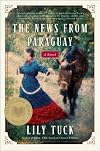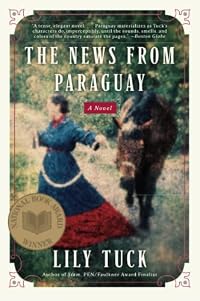
The News from Paraguay
by Lily Tuck
On This Page
Description
The year is l854. In Paris, Francisco Solano -- the future dictator of Paraguay -- begins his courtship of the young, beautiful Irish courtesan Ella Lynch with a poncho, a Paraguayan band, and ahorse named Mathilde. Ella follows Franco to Asunción and reigns there as his mistress. Isolated and estranged in this new world, she embraces her lover's ill-fated imperial dream -- one fueled by a heedless arrogance that will devastate all of Paraguay.With the urgency of the narrative, rich and show more intimate detail, and a wealth of skillfully layered characters, The News from Paraguay recalls the epic novels of Gabriel García Márquez and Mario Vargas Llosa show less
Tags
Recommendations












Member Reviews
This historical novel is set in Paraguay in the 1850's and is a wonderful picture of a colonial country that has many advantages and in the end is devastated by a dictatorship. The novel is filled with characters, but the major flaw is that we never learn what motivates the two central characters - Franco and Ella. Is it greed or love that brings about their downfall? I think it is neither. It is simple stubbornness and ego. Franco simply can't conceive of a world without him at the center and of course he is the kind of man who thinks his limited understanding is all the knowledge needed by all people who surround him. He thinks his country is lucky to have him and the reality is far different. Ella is the trophy wife who simply floats show more through life on his arm. On one level she knows what is going on but does nothing to stop it or to influence Franco. As long as she has champagne and her horse, life is good.
I am not sure why this book was rated so highly and won a National Book Award. It is about an exotic place and about a history that is unfamiliar to most, but I did not think it was an outstanding work of literature. show less
I am not sure why this book was rated so highly and won a National Book Award. It is about an exotic place and about a history that is unfamiliar to most, but I did not think it was an outstanding work of literature. show less
Reviewers have compared this to novels by garcia marquez and vargas llosa, but i don't think the writers have much in common besides their subject matter - central and south america. depicting imperial ambition and human tragedy, the prose is sparse yet powerful when addressing the numerous atrocities committed by the paraguayan dictator in his misguided and disastrous war against his neighbors. kind of dragged on while i was reading it, but now that it's finnished, it's definitely something that stays with you. very realistic in the way it moves in and out of the lives of so many people, providing vivid vignettes that coalesce into paraguay itself, which in turn is connected to a broader, global picture through epistolary and show more ideological links to distant paris. show less
Just finished this book a few minutes ago, so these are the off-the-top-of-my-head thoughts. This book won the National Book Award for Fiction in 2004, and I can see why. It's very well written with short but vivid chapters; very action-packed, and evocative of a time and place most people know nothing about. It was fascinating. But, heavens, it was horrifying. As JMT mentioned, it's about a Paraguayan dictator who declared war on Brazil and other neighboring countries. War is never pretty, and Tuck certainly doesn't try to glorify it in any way. She shows just how awful it was, and in the Paraguayans' case, it was horrendous; before the war, the country had over a million citizens. After the war, less than 200,000. But it wasn't the show more large scale annihilation that got to me, it was the small acts of cruelty. The unnecessary evil. The baseness to which humans descend. I like to think that people, on the whole, are good and kind by nature. Stories like this one make me question that basic philosophy.
All said, I think this was a very good book and one I'm glad I read. Even if I did find it troubling. show less
All said, I think this was a very good book and one I'm glad I read. Even if I did find it troubling. show less
Protagonist Eliza (Ella) Lynch is an Irishwoman living in Paris in 1854 when she meets and becomes the mistress of Francisco (Franco) Solano López. She and Franco travel by sea to his homeland in Paraguay, where he eventually becomes dictator, and leads the country into war with neighboring Brazil and Argentina. The book follows her privileged existence, motherhood, and how her life is impacted by Franco’s warmongering.
I have mixed feelings about this book. On the positive side, I feel I learned a great deal about Paraguay of the 1850s-1870s. The two main characters are believable. The descriptions of the local flora and fauna are vividly portrayed. On the negative side, there are just too many people in this book, and it is almost show more impossible to keep track of them all. It flits from one scene to another rather abruptly, so it does not have a pleasing flow. It recounts history in the form of “this happened and then that happened” rather than weaving the events together into a more entertaining story.
Ella and Franco were real people, but the author emphasizes that this is a work of historical fiction. It is based upon facts, but a substantial amount is imagined. I can say I liked it and I am glad to have read it, but I am also rather glad to be finished. I will seek out more reading material about Paraguay, as it has a rich history of which I was previously unaware. show less
I have mixed feelings about this book. On the positive side, I feel I learned a great deal about Paraguay of the 1850s-1870s. The two main characters are believable. The descriptions of the local flora and fauna are vividly portrayed. On the negative side, there are just too many people in this book, and it is almost show more impossible to keep track of them all. It flits from one scene to another rather abruptly, so it does not have a pleasing flow. It recounts history in the form of “this happened and then that happened” rather than weaving the events together into a more entertaining story.
Ella and Franco were real people, but the author emphasizes that this is a work of historical fiction. It is based upon facts, but a substantial amount is imagined. I can say I liked it and I am glad to have read it, but I am also rather glad to be finished. I will seek out more reading material about Paraguay, as it has a rich history of which I was previously unaware. show less
Okay, first I will confess: I usually don't go for historical fiction, so this had a less than great chance with me. But I was not familiar with this period of South American history, so that worked build my interest. I was never going to be attracted in any way to Franco Lopez, however, I had hopes for Ella Lynch as I found some aspects of her character admirable and her overall life story intriguing. I enjoyed Lily Tuck's prose; she brought a new part of the world to life for me (I would like to visit and see for myself). This story of an Irish girl who brought culture to Paraguay had potential, but for me the story moved too slowly and the flaws in Ella's character, while making her more real, left me with little to really pull me in.
A curious story of love, risk and consequences reveals an era of Paraguayan history, with the country's landscape and people vividly evoked. The main characters are both native and European, the journey from the civilization of Paris in the mid-19th century to the churning mud and violence of a country in the hands of madmen.
I must have picked up this book at a Friends of the Library book sale long ago (probably on the final sale day, "fill a box for five dollars"), solely because of the "National Book Award Winner" sticker on the cover. It won that prize for fiction in 2004. Frankly, I don't really see why. It's historical fiction, partly about Francisco Solano Lopez, the president/dictator of Paraguay 1862-1870 (called Franco in the book), but more about his mistress Eliza Lynch (called Ella in the book).
While there were a number of interesting anecdotes about minor characters in the book, I finished it feeling like I really didn't learn much about Ella, Franco, or Paraguay. Very disappointing.
While there were a number of interesting anecdotes about minor characters in the book, I finished it feeling like I really didn't learn much about Ella, Franco, or Paraguay. Very disappointing.
Members
- Recently Added By
Published Reviews
ThingScore 100
What matters in this book is the consistent mining of narrative voices in the service of fractured and frantic lives.
added by Shortride
Lists

National Book Award - Fiction
78 works; 10 members

Biggest Disappointments
606 works; 168 members
Author Information

14+ Works 1,661 Members
Lily Tuck is the author of four novels, including the National Book Award winner The News from Paraguay, and Siam, a PEN/Faulkner Award finalist, and a collection of stories. She divides her time between New York City and Maine.
Awards and Honors
Common Knowledge
- Canonical title
- The News from Paraguay
- Original title
- The News from Paraguay
- Original publication date
- 2004
- People/Characters
- Ella Lynch; Francisco Solano
- Important places*
- Paraguay
- Important events
- Paraguayan War (1864–1870)
- Epigraph
- Paraguay is the most interesting, loveliest, pleasantest country in the world, I believe.
-- from a letter written by
C. B. Mansfield, Esq., M. A., in 1852 - Dedication
- To my family
- First words
- For him it began with a feather.
- Last words
- (Click to show. Warning: May contain spoilers.)Always, every day, as well, in Paris, she looked out of her window for Franco, only Ella never saw him again.
- Original language
- English US
*Some information comes from Common Knowledge in other languages. Click "Edit" for more information.
Classifications
Statistics
- Members
- 756
- Popularity
- 36,986
- Reviews
- 14
- Rating
- (3.17)
- Languages
- 5 — English, French, German, Italian, Spanish
- Media
- Paper, Audiobook, Ebook
- ISBNs
- 18
- ASINs
- 6