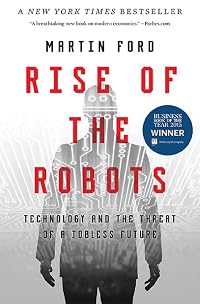
Rise of the Robots: Technology and the Threat of a Jobless Future
by Martin Ford
On This Page
Description
"In Silicon Valley the phrase "disruptive technology" is tossed around on a casual basis. No one doubts that technology has the power to devastate entire industries and upend various sectors of the job market. But Rise of the Robots asks a bigger question: Can accelerating technology disrupt our entire economic system to the point where a fundamental restructuring is required? Companies like Facebook and YouTube may only need a handful of employees to achieve enormous valuations, but what show more will be the fate of those of us not lucky or smart enough to have gotten into the great shift from human labor to computation?"-- show lessTags
Recommendations





























Member Reviews
I read Orwell's 1984 a few months back and, at the time, it was the most horrific thing I'd read all year. And then I read this book, Rise of the Robots. Author Martin Ford paints one heck of a scary picture for the near future. And by scary, I also mean realistically plausible AND already happening. Maybe I'm sensitive to this issue because I currently live and work in an industry that's ripe for technology disruption, but there's no way this isn't felt globally. Seriously, Terminator feels like a bedtime story by comparison.
That said... I can't think of a better alternative than to forge ahead. Technology improves lives on the whole—an honest person would have a hard time disputing this. What we can't know is if this trend will show more continue to hold true indefinitely. To artificially limit technological advancement for moral reasons is foolishly shortsighted. Best to prepare ourselves.
Towards the end, Ford provides a reasonable defense of what's being called a "guaranteed basic income" which is one of many ideas being tossed about which would absorb some of the coming change, and it's the best argument I've seen so far. I still don't agree with it, but more insight like this is what the conversation needs. show less
That said... I can't think of a better alternative than to forge ahead. Technology improves lives on the whole—an honest person would have a hard time disputing this. What we can't know is if this trend will show more continue to hold true indefinitely. To artificially limit technological advancement for moral reasons is foolishly shortsighted. Best to prepare ourselves.
Towards the end, Ford provides a reasonable defense of what's being called a "guaranteed basic income" which is one of many ideas being tossed about which would absorb some of the coming change, and it's the best argument I've seen so far. I still don't agree with it, but more insight like this is what the conversation needs. show less
Well - this was a depressing read. Ford's hypothesis is that unless you are one of the mega rich, the future is very bleak indeed as soon algorithms i.e artificial intelligence will pretty much be able to do most routine jobs - and most jobs are routine. Only jobs which require physical contact and manipulation e.g health will likely survive and they will probably be mostly minimum wage. Even professionals such as doctors are threatened by AI such as IBM's Watson. As he succinctly states - no business wants to hire a worker - they are expensive and unreliable and need managing. An AI doesn't get sick or have childcare problems or complain about overtime or its coworkers. He is scathing of those who say new types of jobs will be created show more as has happened in the past. He thinks this time is different.
He makes a suggestion of a basic income for all as a way to maintain a society. Can't see current politics even contemplating that unless there was a complete societal breakdown happening. And even then...
Far from a cheery read. show less
He makes a suggestion of a basic income for all as a way to maintain a society. Can't see current politics even contemplating that unless there was a complete societal breakdown happening. And even then...
Far from a cheery read. show less
from Michael:
I'll begin by saying Martin Ford's Rise of the Robots suffers from a poor title. The book isn't about an apocalyptic Terminator-type future as the title might imply. The issue at the heart of this book is the rise of the machine as a replacement for human labor. As Ford explains, throughout history new technology has generally created enough new jobs as it simultaneously replaces old ones, but we've reached a critical point where machines/software/technology are advancing so quickly that they're replacing human workers much faster than new jobs are being created. The results, according to Ford: higher unemployment and a greater concentration of wealth. Robots have arrived to crash our economy.
As I read this book, it became show more clearer and clearer that, yes, technology will continue to replace much of the workforce and will eventually render human labor worthless. As we continue to build smarter and smarter technology, and eventually create a fully automated, thinking robot that can act on its own (which will happen, because really, what's going to stop us?), Ford wonders what effect this will have on humanity. Business owners have every financial incentive to replace human employees with machines that don't demand a salary, benefits, sick leave, etc. Think the self-checkout at the grocery store as a small example, among countless others. And this eventually leads to a small wealthy elite, destruction of the middle class, and high unemployment.
In between, Ford touches on the implications for military robots (scary), software algorithms that control Wall Street's financial transactions (already the norm), and even climate change works its way into the discussion (in case you didn't already feel overwhelmed).
Ford's answer to the problem seems simple and makes total sense, but we shouldn't expect legislators to do anything in the near future. Though the book is relatively dry and slightly repetitive at times, it discusses an important and growing issue that probably isn't on the average person's radar. Before we can go about rectifying the situation, we first have to see it as a problem (as if our collective political plate wasn't already full of other important issues). If nothing else, Rise of the Robots might at least plant some seeds and make people realize that, contrary to popular belief, technological advancement isn't always and necessarily a good thing.
Related reading: Kurt Vonnegut's Player Piano and Nicholas Carr's The Shallows. show less
I'll begin by saying Martin Ford's Rise of the Robots suffers from a poor title. The book isn't about an apocalyptic Terminator-type future as the title might imply. The issue at the heart of this book is the rise of the machine as a replacement for human labor. As Ford explains, throughout history new technology has generally created enough new jobs as it simultaneously replaces old ones, but we've reached a critical point where machines/software/technology are advancing so quickly that they're replacing human workers much faster than new jobs are being created. The results, according to Ford: higher unemployment and a greater concentration of wealth. Robots have arrived to crash our economy.
As I read this book, it became show more clearer and clearer that, yes, technology will continue to replace much of the workforce and will eventually render human labor worthless. As we continue to build smarter and smarter technology, and eventually create a fully automated, thinking robot that can act on its own (which will happen, because really, what's going to stop us?), Ford wonders what effect this will have on humanity. Business owners have every financial incentive to replace human employees with machines that don't demand a salary, benefits, sick leave, etc. Think the self-checkout at the grocery store as a small example, among countless others. And this eventually leads to a small wealthy elite, destruction of the middle class, and high unemployment.
In between, Ford touches on the implications for military robots (scary), software algorithms that control Wall Street's financial transactions (already the norm), and even climate change works its way into the discussion (in case you didn't already feel overwhelmed).
Ford's answer to the problem seems simple and makes total sense, but we shouldn't expect legislators to do anything in the near future. Though the book is relatively dry and slightly repetitive at times, it discusses an important and growing issue that probably isn't on the average person's radar. Before we can go about rectifying the situation, we first have to see it as a problem (as if our collective political plate wasn't already full of other important issues). If nothing else, Rise of the Robots might at least plant some seeds and make people realize that, contrary to popular belief, technological advancement isn't always and necessarily a good thing.
Related reading: Kurt Vonnegut's Player Piano and Nicholas Carr's The Shallows. show less
The Star Trek replicator has long been a dream of humanity - completely automated provision of the means of subsistence, with the potential to eliminate unprecedented amounts of drudgery. Far from everyone being freed to pursue their dreams of becoming starship captains, though, it's entirely possible that the current dramatic increase in automation will simply put humans out of work, whether those humans are low-wage burger-flippers, manufacturing workers at home or offshore, or white-shoe corporate lawyers. Ford looks at how the immense transformation of the global economy is both helping and hurting workers, detouring into some of the more outlandish science fiction possibilities of automation, before settling on what increasingly show more appears like the only viable solution to a sufficiently mechanized economy: a guaranteed income that ensures everyone shares in the coming bounty. show less
Robots are almost certainly coming for your job, if any part of it involves tasks that can be repeated again and again. This includes fast food work, many kinds of health care, many kinds of legal work, and arguably (though I am unconvinced) some teaching. Ford convincingly makes the case that automation will continue to improve and replace previous human workers, then spends a bit of time on total speculation about artificial intelligence (Skynet!), and finally asks what we ought to do about it. Ford argues that automation has already contributed substantially to longterm disemployment in the US, and that education and retraining will not solve the problem. But if very few people have jobs, who will buy all the stuff robots make? His show more proposal, which he recognizes is unviable in the US because we are all terrified and atomized, is for a basic income for everyone. show less
Rise of the Robots focuses on the economic impact of increased productivity due to automation. When I was just a lad, sometime in the last century, I recall this being talked about and how it would lead to greater wealth, shorter working hours, higher pay, and general abundance. That hasn't happened, at least not for most workers who have seen no substantial increases in pay or benefits even though the value of the goods they are producing has risen substantially. Where did all that wealth go? I'll bet you can guess. Automation isn't the only cause for income disparity, of course. Narrowly focused short-term profit-seeking and manipulation of governmental policies and public opinion by well-funded special interests play a large role, show more but this book only touches on those. The automation aspect, especially the rapid advancement in robotics is the main topic.
When I started my first 'real' office job (1981), we had one admin assistant for about every dozen desk jockeys. Her job (all were women) was primarily to type our hand-written correspondence so it could be snail-mailed. When we got our first desktop computers a couple of years later, we typed the letters ourselves on our computers and sent them to a shared printer. A year later, we did away with the need for printing and emailed most of them. One of the consequences was elimination of the admin support jobs followed closely by staff reductions in the mail room.
We all know about robots replacing assembly line workers to build cars and a host of other things. This technology is getting more sophisticated and is being used in more ways. The trend will certainly continue. Some people may tell you that businesses are 'job creators', but they leave out an important word. Businesses are reluctant job creators. They don't hire people they don't need, and they do their best to need as few as possible. Robots that are reliable and cost-effective will, undoubtedly, continue to reduce the need for human labor. In the past, displaced workers might hope to retrain for different, possibly better jobs, but computer technology is advancing so quickly, there may soon be few jobs robots aren't better suited for...from a purely profit-motivated business perspective.
Martin Ford suggests that what is needed is a new paradigm, one that retains the essential contribution of people as consumers, even if they do not have paying jobs bringing in income. This is necessary to keep the economy moving. Broad-based consumer spending drives the economy, but businesses can't sell what people can't afford to buy. He offers several options. I don't know which, if any, of these might work, but they are all worth considering. I am quite sure, however, that the days of the labor-based income economy are numbered.
This is an important subject for our times and Rise of the Robots does a good job addressing it. I recommend it. show less
When I started my first 'real' office job (1981), we had one admin assistant for about every dozen desk jockeys. Her job (all were women) was primarily to type our hand-written correspondence so it could be snail-mailed. When we got our first desktop computers a couple of years later, we typed the letters ourselves on our computers and sent them to a shared printer. A year later, we did away with the need for printing and emailed most of them. One of the consequences was elimination of the admin support jobs followed closely by staff reductions in the mail room.
We all know about robots replacing assembly line workers to build cars and a host of other things. This technology is getting more sophisticated and is being used in more ways. The trend will certainly continue. Some people may tell you that businesses are 'job creators', but they leave out an important word. Businesses are reluctant job creators. They don't hire people they don't need, and they do their best to need as few as possible. Robots that are reliable and cost-effective will, undoubtedly, continue to reduce the need for human labor. In the past, displaced workers might hope to retrain for different, possibly better jobs, but computer technology is advancing so quickly, there may soon be few jobs robots aren't better suited for...from a purely profit-motivated business perspective.
Martin Ford suggests that what is needed is a new paradigm, one that retains the essential contribution of people as consumers, even if they do not have paying jobs bringing in income. This is necessary to keep the economy moving. Broad-based consumer spending drives the economy, but businesses can't sell what people can't afford to buy. He offers several options. I don't know which, if any, of these might work, but they are all worth considering. I am quite sure, however, that the days of the labor-based income economy are numbered.
This is an important subject for our times and Rise of the Robots does a good job addressing it. I recommend it. show less
The Ultimate Disruptive Technology
Various voices are beginning to sound the alarm concerning the advent of the most disruptive technology yet to come. The technologies that comprise AI-enhanced automation pose a severe risk to the ages-old paradigm of distributing purchasing power on a basis of the value of labor provided. Martin Ford’s “Rise of the Robots,” is certainly one of the more cogent and compelling of these alarms. He explains many of the ways automation is poised to intrude into or possibly obviate traditional areas of labor and even professions. It is time to heed these voices and begin a national or even global discussion on how we will manage the economic, sociological, and societal impacts arriving with the show more deployment of these technologies.
General artificial intelligence may or may not be realized in the near term. However, narrow-field AI has made impressive advances in recent years. The event horizon that will bring these profound changes may be decidedly more immanent then previously forecast, making the need for discussion and planning necessary public policy changes more immediate. Mr. Ford gives compelling examples of AI computers or AI-assisted robots that are already demonstrating the ability to takes on task, occupations, and professional domains once thought safe by virtue of their complexity or lengthy training requirements.
The author further expands on some of the expected disruptions inherent in the projected idling of the labor force. Foremost among these are the consequences of wide-spread unemployment on our consumer-driven economy. Ford describes some of possible adaptive adjustments that have been discussed. Not all of his suggestions are practicable or even desirable. Clearly the warning bell is now sounded. show less
Various voices are beginning to sound the alarm concerning the advent of the most disruptive technology yet to come. The technologies that comprise AI-enhanced automation pose a severe risk to the ages-old paradigm of distributing purchasing power on a basis of the value of labor provided. Martin Ford’s “Rise of the Robots,” is certainly one of the more cogent and compelling of these alarms. He explains many of the ways automation is poised to intrude into or possibly obviate traditional areas of labor and even professions. It is time to heed these voices and begin a national or even global discussion on how we will manage the economic, sociological, and societal impacts arriving with the show more deployment of these technologies.
General artificial intelligence may or may not be realized in the near term. However, narrow-field AI has made impressive advances in recent years. The event horizon that will bring these profound changes may be decidedly more immanent then previously forecast, making the need for discussion and planning necessary public policy changes more immediate. Mr. Ford gives compelling examples of AI computers or AI-assisted robots that are already demonstrating the ability to takes on task, occupations, and professional domains once thought safe by virtue of their complexity or lengthy training requirements.
The author further expands on some of the expected disruptions inherent in the projected idling of the labor force. Foremost among these are the consequences of wide-spread unemployment on our consumer-driven economy. Ford describes some of possible adaptive adjustments that have been discussed. Not all of his suggestions are practicable or even desirable. Clearly the warning bell is now sounded. show less
Members
- Recently Added By
Lists

Top Five Books of 2016
795 works; 229 members

Books Read in 2016
4,666 works; 199 members
Talk Discussions
Past Discussions
Rise of the Robots by Martin Ford in Non-Fiction Readers (September 2016)
Author Information

4 Works 918 Members
Martin Ford is the author of The Rise of the Robots: Technology and the Threat of Mass Unemployment which won the Business Book of the Year 2015 award in the UK. The award is worth AUD$64,300. (Bowker Author Biography)
Awards and Honors
Common Knowledge
- Original publication date
- 2014
- Dedication
- To Tristan, Colin, Elaine, and Xiaoxiao
- Blurbers
- Lanier, Jaron; Skidelsky, Robert; Sachs, Jeffrey D.; Cukier, Kenneth; Davidson, Cathy N.
Classifications
- Genres
- Economics, Technology, Nonfiction, General Nonfiction, Business, Science & Nature
- DDC/MDS
- 331.13 — Society, government, & culture Economics Labor economics Labor force and market Discrimination on the labor market, unemployment
- LCC
- HD6331 .F58 — Social sciences Industries. Land use. Labor Industries. Land use. Labor Labor. Work. Working class
- BISAC
Statistics
- Members
- 675
- Popularity
- 42,349
- Reviews
- 18
- Rating
- (3.91)
- Languages
- 8 — Dutch, English, Finnish, French, German, Portuguese, Spanish, Turkish
- Media
- Paper, Audiobook, Ebook
- ISBNs
- 29
- UPCs
- 2
- ASINs
- 8