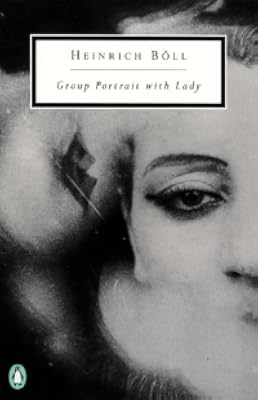
Group Portrait With Lady
by Heinrich Böll
On This Page
Description
In a sweeping portrayal of German life from World War I to the early 1970's, Böll, tells the story of the widow Leni Pfeiffer and her son Lev who have become the nexus of Cologne's counterculture, spurning the pursuit of affluence in present-day Germany.Tags
Recommendations


































Member Reviews
Leni è un'affascinante e sensuale donna bionda, ormai di mezza età ma ancora bellissima, della quale Böll ci racconta la storia, attraverso quella delle persone che la conoscono, genitori, amici, amanti, colleghi di lavoro, educatori. Leni è donna dai molti talenti, che si ama o si odia senza mezzi termini: molti dei testimoni ne parlano come di un'intelligenza sublime, altri come di una povera demente. Leni ha un figlio, un figlio della colpa in quanto concepito con un prigioniero di guerra russo, ragione per cui, nella Germania denazificata, c'è ancora chi la condannerebbe alla camera a gas, ha avuto come mentore una suora cattolica di origini ebree in odore di santità e la sua migliore amica è una specie di prostituta. show more Attraverso le testimonianze l'autore narra la storia di questa donna senza che lei compaia quasi mai in primo piano, e solo verso la fine la sua presenza diventa reale, tangibile, e solo quasi per informarci che Leni è di nuovo incinta, e questa volta il futuro padre è un immigrato, turco e musulmano.
Ma chi è Leni se non la Germania stessa, coi suoi errori, le sue tragedie, la sua fondamentale schizofrenia?
Bellissimo romanzo, molto complesso, reso forse un po' difficoltoso da alcune scelte stilistiche dell'autore, soprattutto quella di usare sigle per indicare i protagonisti.
Traduzione di discreta qualità, anche se si sente una maggiore fedeltà alla lingua tedesca che a quella italiana (immer noch tradotto costantemente in maniera letterale con ancora sempre, invece che con gli avverbi che indicano la continuazione di un evento o avvenimento che si usano in italiano).
Prima lettura 2007 show less
Ma chi è Leni se non la Germania stessa, coi suoi errori, le sue tragedie, la sua fondamentale schizofrenia?
Bellissimo romanzo, molto complesso, reso forse un po' difficoltoso da alcune scelte stilistiche dell'autore, soprattutto quella di usare sigle per indicare i protagonisti.
Traduzione di discreta qualità, anche se si sente una maggiore fedeltà alla lingua tedesca che a quella italiana (immer noch tradotto costantemente in maniera letterale con ancora sempre, invece che con gli avverbi che indicano la continuazione di un evento o avvenimento che si usano in italiano).
Prima lettura 2007 show less
This is a novel for advanced users only. It reminded me at several points of Kubrick's Barry Lyndon in that I was aware I was engaged upon a great piece of art so serious its creator was prepared to make absolutely no allowances for pacing and had complete confidence in his audience to submit to this. I consider myself an advanced user and for much of the novel I struggled with the pace. Frankly, I could have done with a little more Blitzkrieg and a little less Cold War.
Still, there is much to enjoy here. There's something unusual going on. It took me a while to figure it out. My theory is as follows:
The novel is about construction and deconstruction. The chapter divisions make no sense. They are arbitrary divisions as blocks of text show more are moved into or out of place. The scaffolding is still up, so to speak, and it is not clear if the novel is in the process of construction or deconstruction. Böll writes at one point about the computer as big as Bavaria, a sort of astro-philosophical verberator that produces life stories. Is the novel under construction? Has Böll not finished novelising the information from his transcripts or has the verberator delivered the novel perfectly, only for Böll to deconstruct it into transcripts?
This motif is reflected again and again in other ways, perhaps most obviously in Leni and her father (who runs a construction company of course) but also more subtly in other characters. And also in the setting of Germany itself, where Nazism constructs the country from the ruins of the Treaty of Versailles but in the process destroys it.
This is a complex novel and having read it only once this must remain a theory but I see some confirmation in the opening passage where Böll describes Leni. At the same time as he constructs her in the reader's mind by giving information he is also deconstructing her from a person into a few pieces of information. show less
Still, there is much to enjoy here. There's something unusual going on. It took me a while to figure it out. My theory is as follows:
The novel is about construction and deconstruction. The chapter divisions make no sense. They are arbitrary divisions as blocks of text show more are moved into or out of place. The scaffolding is still up, so to speak, and it is not clear if the novel is in the process of construction or deconstruction. Böll writes at one point about the computer as big as Bavaria, a sort of astro-philosophical verberator that produces life stories. Is the novel under construction? Has Böll not finished novelising the information from his transcripts or has the verberator delivered the novel perfectly, only for Böll to deconstruct it into transcripts?
This motif is reflected again and again in other ways, perhaps most obviously in Leni and her father (who runs a construction company of course) but also more subtly in other characters. And also in the setting of Germany itself, where Nazism constructs the country from the ruins of the Treaty of Versailles but in the process destroys it.
This is a complex novel and having read it only once this must remain a theory but I see some confirmation in the opening passage where Böll describes Leni. At the same time as he constructs her in the reader's mind by giving information he is also deconstructing her from a person into a few pieces of information. show less
I read an article that the novels of this Nobel Prize winning author were due to be re-issued by Melville House because his depictions of life under fascism were still too relevant to be out of print, so I read the first title I could find of his ahead of the availability of the new editions. This had the added benefit of furthering my ambition to read something from most, if not all, of the winners of the Nobel Prize for Literature. I didn’t really know anything about Böll before I read the article and this book.
I’ve read my share of literature on World War II. As a kid, I read about the battles and the heroes and villains and the (cool?) weapons. As an adult, I realized that war was far from cool and that it came at an enormous show more cost of human suffering, not just to the people directly participating in the war but even more so to the innocent civilians, the men, women, and children that are caught in the conflict. The “war” stories I read usually glossed over these collateral victims or gave them the short shrift of a statistic like a casualty number in the bombing of a city.
Böll’s writing is not like that in Group Portrait with a Lady. His novel brings to life how some of the citizens of Germany had to live under fascism and war. The profiteering, the concentration and forced labour camps, the conscription, the scarcity of basic needs, the fear of being denounced by others as a traitor or spy or un-German, and the gradually increasing bombing by the allies. One of the most striking discoveries in his writing for me was the ambiguous reality of the “end” of a war for those who were in it’s direct path. There seemed to be no V-E Day where they went from war to peace. During the weeks/months that transpired between knowing the war was lost (but not officially) and the cessation of hostilities and some semblance of safety nobody was quite sure what to do. You could be picked up by the retreating German patrols and shot as a deserter; you could be picked up by the Soviets and shot or sent east to a POW camp you probably would not survive; you could be picked up by the Americans, British, or French and be shot or sent to a POW camp with not much better assurance of your safety, you could be harmed by other desperate people trying to survive. Many people just disappeared, especially if their “papers” were not in order; even with your papers it might take a while for them to be “sorted out” while you waited in a camp. Years later, the characters in the novel are still dealing with the consequences of their experiences and wondering where their friends and relatives might have disappeared too. Böll captures this effect of war very well in this novel. I will definitely be checking out some of his other novels in the future. show less
I’ve read my share of literature on World War II. As a kid, I read about the battles and the heroes and villains and the (cool?) weapons. As an adult, I realized that war was far from cool and that it came at an enormous show more cost of human suffering, not just to the people directly participating in the war but even more so to the innocent civilians, the men, women, and children that are caught in the conflict. The “war” stories I read usually glossed over these collateral victims or gave them the short shrift of a statistic like a casualty number in the bombing of a city.
Böll’s writing is not like that in Group Portrait with a Lady. His novel brings to life how some of the citizens of Germany had to live under fascism and war. The profiteering, the concentration and forced labour camps, the conscription, the scarcity of basic needs, the fear of being denounced by others as a traitor or spy or un-German, and the gradually increasing bombing by the allies. One of the most striking discoveries in his writing for me was the ambiguous reality of the “end” of a war for those who were in it’s direct path. There seemed to be no V-E Day where they went from war to peace. During the weeks/months that transpired between knowing the war was lost (but not officially) and the cessation of hostilities and some semblance of safety nobody was quite sure what to do. You could be picked up by the retreating German patrols and shot as a deserter; you could be picked up by the Soviets and shot or sent east to a POW camp you probably would not survive; you could be picked up by the Americans, British, or French and be shot or sent to a POW camp with not much better assurance of your safety, you could be harmed by other desperate people trying to survive. Many people just disappeared, especially if their “papers” were not in order; even with your papers it might take a while for them to be “sorted out” while you waited in a camp. Years later, the characters in the novel are still dealing with the consequences of their experiences and wondering where their friends and relatives might have disappeared too. Böll captures this effect of war very well in this novel. I will definitely be checking out some of his other novels in the future. show less
This book looks at life in perhaps the most terrible periods of human history -- Germany in the 1930's and 1940's -- and finds that, pretty much, life went on. Life under increasingly restricted, surreal, and irrational circumstances, life in the midst of death (our central characters actually end up living beneath a cemetery) and life that seemed to go on only because of an animal will to live, but still -- life. Boll's 1971 novel centers on an unnamed author's effort to find out about one Leni Pfieffer, a war widow at the center of an oddly assorted (and often very odd) group of people -- parents, employers, lovers, friends, and so on. . The author may be nameless, but he is definitely identified (as Au) and his personality and show more interest interweave with the rest of the story. He traces Leni's story from her bourgeoise childhood and youth, through her adventures and misadventures at school (including a close relationship with a Jewish nun who is concealed -- and starved -- in her convent), through her early doomed love for a young man who is shot, up to her apotheosis as the lover of a Russian prisoner of war. He dies, but she survives, as does her son, very much reduced in circumstances by the machinations of those who should have treated her better. There is, however -- oh, I won't spoil it by discussing the ending.
What I found so fascinating about this book was the way the characters simply try to go about their lives, Nazis or no nazis, bombs or no bombs. It gets more and more difficult, until the last days of the war when chaos reigns -- they don't know whether or not the war is over nor do they much care, they just don't want to get shot. Boll's style is not linear, which can be irksome in the earlier parts of the book, but which is entirely appropriate as the novel unfolds. This is a terrific book. show less
What I found so fascinating about this book was the way the characters simply try to go about their lives, Nazis or no nazis, bombs or no bombs. It gets more and more difficult, until the last days of the war when chaos reigns -- they don't know whether or not the war is over nor do they much care, they just don't want to get shot. Boll's style is not linear, which can be irksome in the earlier parts of the book, but which is entirely appropriate as the novel unfolds. This is a terrific book. show less
Another review here gives a good outline of Group Portrait. All I can add to it is that the story is pieced together a bit as a documentary film would be rather than being a straightforward narrative, and that virtually all the book is what an unnamed author has learned in interviews with people who have known Leni.
If I said that Group Portrait is an author's account of his attempt to learn all he could about a woman, telling us of the course of that quest and of what he learned along the way, giving vivid accounts of the various characters he encountered whilst doing so, it could well sound like a book club selection. It's far from it: this is unmistakably a literary novel with ambiguities and authorial games, and not only do we not show more get a strong sense of Leni but she seems (as I read it) nearly a cipher. Where the writer of a lesser book would have made her into saint or goddess, as could easily have been done, Boll shows us little more of her personality than suggestions that she's a free spirit and--again, by my reading--a bit simple. (And in the same way, episodes that a less subtle author would have striven to make heart-wrenching, e.g., are handled not coldly but nonetheless without any attempt to manipulate the reader's emotions.) This treatment of the main character is refreshing and one not many authors would dare, I think.
I'd read a couple of other novels by Boll and hadn't gathered from them that he has a good sense of humour, but he does. Indeed, his 'happy endings' take on the flavour of those in farces, though the one truly touching moment occurs amidst those endings. I don't know whether this is something I'd ever re-read but in the short term I'll be intently thinking over the novel and in the long term I doubt I'll ever forget it.
And by the way, a reading of Group Portrait would no doubt be enriched by some knowledge of political and everyday life in Germany in the first three quarters of the last century but my having none at all didn't detract from my enjoyment of it. show less
If I said that Group Portrait is an author's account of his attempt to learn all he could about a woman, telling us of the course of that quest and of what he learned along the way, giving vivid accounts of the various characters he encountered whilst doing so, it could well sound like a book club selection. It's far from it: this is unmistakably a literary novel with ambiguities and authorial games, and not only do we not show more get a strong sense of Leni but she seems (as I read it) nearly a cipher. Where the writer of a lesser book would have made her into saint or goddess, as could easily have been done, Boll shows us little more of her personality than suggestions that she's a free spirit and--again, by my reading--a bit simple. (And in the same way, episodes that a less subtle author would have striven to make heart-wrenching, e.g., are handled not coldly but nonetheless without any attempt to manipulate the reader's emotions.) This treatment of the main character is refreshing and one not many authors would dare, I think.
I'd read a couple of other novels by Boll and hadn't gathered from them that he has a good sense of humour, but he does. Indeed, his 'happy endings' take on the flavour of those in farces, though the one truly touching moment occurs amidst those endings. I don't know whether this is something I'd ever re-read but in the short term I'll be intently thinking over the novel and in the long term I doubt I'll ever forget it.
And by the way, a reading of Group Portrait would no doubt be enriched by some knowledge of political and everyday life in Germany in the first three quarters of the last century but my having none at all didn't detract from my enjoyment of it. show less
Story told as an investigation of the person of Leni. The narrator (Au) interviews and researches the life of Leni for unknown reasons. It is an interesting way to tell the story of what the German people went through during and after the war. While I really liked it and think it is Nobel prize worthy, I found it hard to engage and it was quite easy to fall asleep. Still it is a 4 star read.
This is a fascinating book on many levels. It's a book about 20th century German history, human nature amidst chaos, an intriguing cast of characters, and political commentary presented with sarcastic humor within a complex but effective format.
Members
- Recently Added By
Lists

1001 Books You Must Read Before You Die
1,448 works; 1,132 members

German Literature
518 works; 55 members

Books About World War II
102 works; 29 members

20th Century Literature
1,161 works; 55 members
Best War Stories
87 works; 16 members

Nobel Price Winners
222 works; 20 members

Books Set in Germany
74 works; 11 members

Blue Pyramid 1,276 Best Books of All Time
1,248 works; 32 members

Books about World War II
241 works; 22 members

War Literature
101 works; 19 members

1,001 BYMRBYD Concensus
723 works; 27 members

My list of 100 books to read next
100 works; 4 members

Undiscovered Classics to Read
70 works; 15 members

My TBR
371 works; 3 members
Author Information

Heinrich Böll was born in Cologne, Germany on December 21, 1917. He studied German at the University of Cologne. He was drafted into military service in 1938 shortly after he finished his schooling and served several years in the infantry before his demobilization in 1945. His first novel, Der Zug war pünktlich (The Train Was on Time), was show more published in 1949. His other works include Billiards at Half-Past Nine, The Clown, Absent without Leave, Enter and Exit, and The Lost Honor of Katharina Blum. He received numerous awards including the Georg Büchner Prize in 1967 and the Nobel Prize for Literature in 1972. He died on July 16, 1985 at the age of 67. (Bowker Author Biography) show less
Some Editions
Awards and Honors
Series
Belongs to Publisher Series
Work Relationships
Is contained in
Has as a student's study guide
Common Knowledge
- Canonical title
- Group Portrait With Lady
- Original title
- Gruppenbild mit Dame
- Alternate titles
- Group Picture With Lady
- Original publication date
- 1971; 1973 (English translation) (English translation)
- People/Characters*
- Leni Gruyten; Alois Pfeiffer; Margret Schlömer; Lotte Hoyser; Otto Hoyser; Heinrich Gruyten (show all 24); Hubert Gruyten; Lev Borisovich Gruyten; Boris Lvović Koltowski; Erhart Schweigert; Walter Pelzer; Rahel; Marja Van Doorn; Herweg Schirtenstein; Dr. Scholsdorff; Dr. Henges; Heinrich Pfeiffer; Werner Hoyser; Kurt Hoyser; Erich Köppler; Käte Perscht; Hans; Grete; Klementina
- Important places
- Cologne, North Rhine-Westphalia, Germany
- Related movies
- Group Portrait with a Lady (1977 | IMDb)
- Dedication
- For Leni, Lev and Boris
- First words*
- Weibliche Trägerin der Handlung in der ersten Abteilung ist eine Frau von achtundvierzig Jahren, Deutsche; sie ist 1,71 groß, wiegt 68,8 kg (in Hauskleidung), liegt also nur etwa 300-400 Gramm unter dem Idealgewicht; sie ha... (show all)t zwischen Dunkelblau und Schwarz changierende Augen, leicht ergrautes, sehr dichtes blondes Haar, das lose herabhängt; glatt, helmartig umgibt es ihren Kopf.
- Last words*
- (Click to show. Warning: May contain spoilers.)Immerhin bleiben da die "noch zu klärenden Reflektionen", und es bleiben düstere, wenig Gutes versprechende Gewitterwolken am Hintergrund: Mehmets Eifersucht und seine inzwischen bekundete Abneigung gegen Gesellschaftstanz.
- Original language
- German
*Some information comes from Common Knowledge in other languages. Click "Edit" for more information.
Classifications
- Genres
- General Fiction, Fiction and Literature
- DDC/MDS
- 833.914 — Literature & rhetoric German & related literatures German fiction 1900- 1900-1990 1945-1990
- LCC
- PT2603 .O394 .G713 — Language and Literature German, Dutch and Scandinavian literatures German literature Individual authors or works 1860/70-1960
- BISAC
Statistics
- Members
- 1,441
- Popularity
- 16,249
- Reviews
- 19
- Rating
- (3.90)
- Languages
- 18 — Danish, Dutch, English, Estonian, Finnish, French, German, Greek, Hungarian, Italian, Latin, Norwegian (Bokmål), Polish, Portuguese, Romanian, Russian, Spanish, Swedish
- Media
- Paper, Ebook
- ISBNs
- 72
- ASINs
- 30