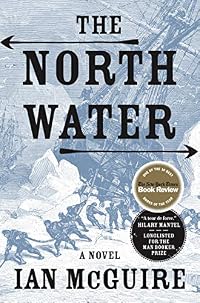
The North Water
by Ian McGuire
On This Page
Description
The Volunteer, a nineteenth-century Yorkshire whaling ship, becomes the stage for a confrontation between brutal harpooner Henry Drax and ex-army surgeon Patrick Sumner, the ship's medic, during a violent, ill-fated voyage to the Arctic.Tags
Recommendations




























Member Recommendations

Member Reviews
”There is no sin left now, there is only the blood and the water and the ice; there is only life and death and the grey-green spaces in between. “
A whaling ship on the North Sea, circa 1850. Wimps need not apply. This is a rugged bunch. Think Jack London on steroids and to make it more unsettling- there is a killer/rapist on board. There are whale hunts, seal hunts and manhunts, all expressed in brawny, unflinching prose. If gore, violence, crippling injuries and exploding bodily functions, are not your idea of a good time, you might want to sit this voyage out. I found it an excellent adventure story. One of my favorites of the year.
A whaling ship on the North Sea, circa 1850. Wimps need not apply. This is a rugged bunch. Think Jack London on steroids and to make it more unsettling- there is a killer/rapist on board. There are whale hunts, seal hunts and manhunts, all expressed in brawny, unflinching prose. If gore, violence, crippling injuries and exploding bodily functions, are not your idea of a good time, you might want to sit this voyage out. I found it an excellent adventure story. One of my favorites of the year.
This may be the most masculine book I've ever read. There are virtually no women in it, not even in the minds of the men on the whaling ship. No thoughts of wives or sweethearts back home. The only women we see are prostitutes, or members of an "Esquimaux" settlement. The book is unrelentingly violent and very graphic in its portrayals of injuries and atrocities done to various characters.
That said, it's worth reading for several reasons. First, the writing is very good. The author engaged all my senses and drew me into the world of the whaling ship. The plot moves along well...a lot happens in this short book, but the pacing never feels off.
Second, the book explores evil in a way I've not often been exposed to. This isn't a story of show more good vs. evil, but of the nature of evil itself. It is a world where both the physical environment and the life circumstances of the main characters are harsh and the men cope by being harsh themselves. There is no sense of community or working together; it's every man for himself. Success is measured only in terms of personal gain; morality doesn't enter into consideration.
I found myself rooting for Sumner, hoping he'd get away in the end even though he certainly couldn't be seen as a good guy. Does that mean I'd developed some empathy for the lives of these characters? Lives best described by Thomas Hobbes: "Solitary, poor, nasty, brutish and short". It certainly made me think about human nature and how much circumstances can shape our thoughts and behaviour. show less
That said, it's worth reading for several reasons. First, the writing is very good. The author engaged all my senses and drew me into the world of the whaling ship. The plot moves along well...a lot happens in this short book, but the pacing never feels off.
Second, the book explores evil in a way I've not often been exposed to. This isn't a story of show more good vs. evil, but of the nature of evil itself. It is a world where both the physical environment and the life circumstances of the main characters are harsh and the men cope by being harsh themselves. There is no sense of community or working together; it's every man for himself. Success is measured only in terms of personal gain; morality doesn't enter into consideration.
I found myself rooting for Sumner, hoping he'd get away in the end even though he certainly couldn't be seen as a good guy. Does that mean I'd developed some empathy for the lives of these characters? Lives best described by Thomas Hobbes: "Solitary, poor, nasty, brutish and short". It certainly made me think about human nature and how much circumstances can shape our thoughts and behaviour. show less
My kind of book, after reading some real warm-fuzzies feel-good stuff lately, this book socks you right between the eyes. Brutal, unrelenting story of two men - Drax, the semi-human brutish harpooner on the Volunteer, and Sumner, a broken-down Irish surgeon, on a voyage into hell in the Arctic. Make no mistake, this book, is shocking, visceral, nausea-inducing, but god, it is one hell of a piece of writing. Superb.
If you ever wondered what it was like being on an Arctic whaling expedition in the late 19th century, this will shed some light. It's not factual, but reads authentically. The main characters represent the worst of man, and the better (not best or perfect) of man. No one is without sin in McGuire's world, no one is above the baser urges.
Life is harsh, dirty, foul, unforgiving in The North Water. Depictions of brutal violence abound. This is not a story for those with a weak stomach. Vivid descriptions of various afflictions suffered by the crew of the whaler are poetically and fully given.
The North Water is not an easy book to enjoy, for little in it is pleasant. It is though a powerful tale, masterfully told and quite unforgettable.
Life is harsh, dirty, foul, unforgiving in The North Water. Depictions of brutal violence abound. This is not a story for those with a weak stomach. Vivid descriptions of various afflictions suffered by the crew of the whaler are poetically and fully given.
The North Water is not an easy book to enjoy, for little in it is pleasant. It is though a powerful tale, masterfully told and quite unforgettable.
The story told in The North Water is nasty and vicious. Characters regularly embrace violence, and no-one around them is spared: not the animals, not the women or the children, certainly not their fellow men. There is a great deal of gore and hatred, in relatively few pages. So why write such a story? Why read it?
While the story is often brutal, the storytelling is anything but. Several blurbs from my paperback edition invite comparison to Cormack McCarthy; one, to Homer's pairing of beautiful writing and bloody violence. TNW works as a bloody thrill ride, if that's what is meant by these comparisons. It doesn't seem to be primarily what McGuire is after, however. One clue is the setting: 1859 London, briefly, and an extended time show more aboard a whaler going into hunting grounds, with characters periodically observing how the trade is changing with commercial mechanization and whales hunted to extinction. Much is made of the changing times, and the social forces behind that change.
Another clue is found in comparing the characters. McGuire carefully provides a group of interacting characters and just as carefully describes the myriad ways they differ from one another. Drax is characterised as an unreflective person, happily driven along his vicious trail by bodily urges and chance encounter. Cavendish is slightly more deliberate if no less brutal, future gain (monetary and a sense of importance) sufficient to shape his present actions and plans. Sumner is a combination of the two, a mix of pensive reflection (almost to the point of inaction) and deliberate activity. Sumner, though, is minded always by a past mistake also involving bloody violence, the hovering question being whether that mistake is enough to change his future self. There are many other characters but these three appear to be the chief protagonists, and each is self-centred, narrowly focused on personal gain or avoiding personal pain, and not at all averse to hurting others.
Thinking on these things, and noting both circumstance and environment are harsh, a possible reading is that these characters merely reflect their situation. But that's not quite right. The environment is harsh but not cruel, and the worst that comes from nature seems to be a result of the men putting themselves into harm's way. For example, two Yak hunters are encountered, and in the brief time we read about them, they face no less harsh an environment than the whalers, but behave altogether differently. First, they are sensible in their efforts to live in their environment, and second, they are motivated not only by personal gain but mutual endeavour. It's significant that McGuire pointedly mentions that the whalers notice yet do not make use of the better adaptation to Arctic life exampled by the Yak.
Perhaps the answer to the question of why write, and why read this story, is simple. It's a ready reminder not to suffer more than necessary, and one of the best ways to accomplish this --perhaps the best-- is not to make others suffer, indeed to lessen as much suffering as you can. Fit into one's environment, band together with those of like minds, and then acknowledge that success isn't merely the improved conditions one enjoys, but the social connections made along the way, the community which is built alongside. The characters in TNW seem entirely ignorant of all of this, if not rejecting it outright, and their willful defiance lies at the root of their brutality.
The North Water is worth reading because McGuire has the sense to avoid telling the reader any of this, and simply show it. His showing of it is beautifully wrought, even if the scenes are often unpleasant.
//
A subtle book design: the cover's left-pointing ("backward") arrow is repeated throughout the text as a section break.
There are no maps, and none are needed. Accustomed to the Folio Society's Aubrey-Maturin texts, though, I admit to missing one despite never taking time to look up the relevant whaling waters for orientation. show less
While the story is often brutal, the storytelling is anything but. Several blurbs from my paperback edition invite comparison to Cormack McCarthy; one, to Homer's pairing of beautiful writing and bloody violence. TNW works as a bloody thrill ride, if that's what is meant by these comparisons. It doesn't seem to be primarily what McGuire is after, however. One clue is the setting: 1859 London, briefly, and an extended time show more aboard a whaler going into hunting grounds, with characters periodically observing how the trade is changing with commercial mechanization and whales hunted to extinction. Much is made of the changing times, and the social forces behind that change.
Another clue is found in comparing the characters. McGuire carefully provides a group of interacting characters and just as carefully describes the myriad ways they differ from one another. Drax is characterised as an unreflective person, happily driven along his vicious trail by bodily urges and chance encounter. Cavendish is slightly more deliberate if no less brutal, future gain (monetary and a sense of importance) sufficient to shape his present actions and plans. Sumner is a combination of the two, a mix of pensive reflection (almost to the point of inaction) and deliberate activity. Sumner, though, is minded always by a past mistake also involving bloody violence, the hovering question being whether that mistake is enough to change his future self. There are many other characters but these three appear to be the chief protagonists, and each is self-centred, narrowly focused on personal gain or avoiding personal pain, and not at all averse to hurting others.
Thinking on these things, and noting both circumstance and environment are harsh, a possible reading is that these characters merely reflect their situation. But that's not quite right. The environment is harsh but not cruel, and the worst that comes from nature seems to be a result of the men putting themselves into harm's way. For example, two Yak hunters are encountered, and in the brief time we read about them, they face no less harsh an environment than the whalers, but behave altogether differently. First, they are sensible in their efforts to live in their environment, and second, they are motivated not only by personal gain but mutual endeavour. It's significant that McGuire pointedly mentions that the whalers notice yet do not make use of the better adaptation to Arctic life exampled by the Yak.
Perhaps the answer to the question of why write, and why read this story, is simple. It's a ready reminder not to suffer more than necessary, and one of the best ways to accomplish this --perhaps the best-- is not to make others suffer, indeed to lessen as much suffering as you can. Fit into one's environment, band together with those of like minds, and then acknowledge that success isn't merely the improved conditions one enjoys, but the social connections made along the way, the community which is built alongside. The characters in TNW seem entirely ignorant of all of this, if not rejecting it outright, and their willful defiance lies at the root of their brutality.
The North Water is worth reading because McGuire has the sense to avoid telling the reader any of this, and simply show it. His showing of it is beautifully wrought, even if the scenes are often unpleasant.
//
A subtle book design: the cover's left-pointing ("backward") arrow is repeated throughout the text as a section break.
There are no maps, and none are needed. Accustomed to the Folio Society's Aubrey-Maturin texts, though, I admit to missing one despite never taking time to look up the relevant whaling waters for orientation. show less
Brutal but engaging. This is like the movie "The Reverent" set in the Arctic. Patrick Sumner is a young surgeon with a bad reputation due to a terrible event not of his doing in India. He has no better option than take the job of surgeon on a whaling ship led by a captain whose reputation for bad luck is well known. Also on the ship is a heartless and cruel man named Henry Drax along with his co-conspirator, Cavendish.
After a cabin boy is brutally molested and killed on the ship, things begin to really fall apart. Eventually the captain is killed and Cavendish takes charge. Whales are becoming scarce and the ship heads further into the north waters. When the reader thinks it can get no worse, it becomes even more complicated.
The writing show more in this novel, although filled with brutal description, is so clear and the story pulls the reader in due to the realistically drawn characters, not only Sumners and Drax but Otto, a harpooner with a philosophy totally at odds with the cruel world. After the ship is destroyed, the men find themselves abandoned on an ice floe. Other characters appear: Eskimos, a priest, and bears (just like the Reverent - a recently killed bear becomes a warm refuge).
A well-written story with interesting plot and believable although totally unlikeable characters. Would read more by this author. show less
After a cabin boy is brutally molested and killed on the ship, things begin to really fall apart. Eventually the captain is killed and Cavendish takes charge. Whales are becoming scarce and the ship heads further into the north waters. When the reader thinks it can get no worse, it becomes even more complicated.
The writing show more in this novel, although filled with brutal description, is so clear and the story pulls the reader in due to the realistically drawn characters, not only Sumners and Drax but Otto, a harpooner with a philosophy totally at odds with the cruel world. After the ship is destroyed, the men find themselves abandoned on an ice floe. Other characters appear: Eskimos, a priest, and bears (just like the Reverent - a recently killed bear becomes a warm refuge).
A well-written story with interesting plot and believable although totally unlikeable characters. Would read more by this author. show less
Set on the whaling ship Volunteer, heading out to arctic waters, this is a classic story of good and evil that sets the kind doctor Patrick Sumner against murderous villain Henry Drax. While Sumner is a hero, of sorts, he is far from perfect. He is addicted to laudanum and has a checkered past that resulted in his release from the Army. We gradually learn his backstory.
I found this book darkly riveting, and the writing is excellent, but I hesitate to recommend it to anyone, unless you have a very high tolerance for violence, brutality, animal slaughter, and gruesome content. There are places in it that are so gory I had to skim a few paragraphs. I just could not bear to read the details. The author creates a claustrophobic atmosphere, show more which I was able to vividly envision in my mind’s eye.
I have an entire shelf in my list of books for adventures in the extreme cold, and it was available in from my local library, so I figured I would give it a try. I cannot say I “enjoyed” it, but I admire the author’s craftsmanship.
3.5 show less
I found this book darkly riveting, and the writing is excellent, but I hesitate to recommend it to anyone, unless you have a very high tolerance for violence, brutality, animal slaughter, and gruesome content. There are places in it that are so gory I had to skim a few paragraphs. I just could not bear to read the details. The author creates a claustrophobic atmosphere, show more which I was able to vividly envision in my mind’s eye.
I have an entire shelf in my list of books for adventures in the extreme cold, and it was available in from my local library, so I figured I would give it a try. I cannot say I “enjoyed” it, but I admire the author’s craftsmanship.
3.5 show less
Members
- Recently Added By
Lists

water on the brain: maritime fiction
74 works; 18 members

Booker Prize
491 works; 62 members

Man Booker Prize Longlist 2016
13 works; 2 members

Ocean Setting
33 works; 5 members

Historical Fiction
8 works; 1 member

Arctic novels
35 works; 5 members

Best Survival Stories
97 works; 15 members

Ten Books About Disasters at Sea
10 works; 2 members
Books With Water Words in the Title
186 works; 12 members
Author Information

8 Works 1,967 Members
Ian McGuire is the co-director of the Centre for New Writing at the University of Manchester. He has published a novel, Incredible Bodies, essays, and short stories in journals and magazines including The Chicago Review, The Mississippi Quarterly, The Paris Review, and The Journal of American Studies. He lives in Manchester, England.
Awards and Honors
Awards
Distinctions
Notable Lists
Common Knowledge
- Canonical title
- The North Water
- Original title
- The North Water
- Original publication date
- 2016
- People/Characters
- Henry Drax; Patrick Sumner
- Important places
- Kingston upon Hull, East Riding of Yorkshire, England, UK; Arctic Circle
- Related movies
- The North Water (2021 | IMDb)
- Dedication
- To Abigail, Grace and Eve
- First words
- Behold the man.
- Last words
- (Click to show. Warning: May contain spoilers.)Even is hij bang maar dan, als de angst wegtrekt en aan kracht verliest, welt er een onverwacht gevoel van eenzaamheid en gemis in hem op.
(Click to show. Warning: May contain spoilers.)He feels a moment of fear and then, in its wake, as the fear fades and loses its force, an unexpected stab of loneliness and need. - Blurbers
- Mantel, Hilary; Amis, Martin; Toibin, Colm
- Original language*
- Engels
- Canonical DDC/MDS
- 813.54
- Canonical LCC
- PR6113.C4832
*Some information comes from Common Knowledge in other languages. Click "Edit" for more information.
Classifications
Statistics
- Members
- 1,644
- Popularity
- 13,563
- Reviews
- 104
- Rating
- (3.96)
- Languages
- 10 — Danish, Dutch, English, French, German, Italian, Romanian, Russian, Spanish, Turkish
- Media
- Paper, Audiobook, Ebook
- ISBNs
- 35
- ASINs
- 12
